⚡ Quick Answer
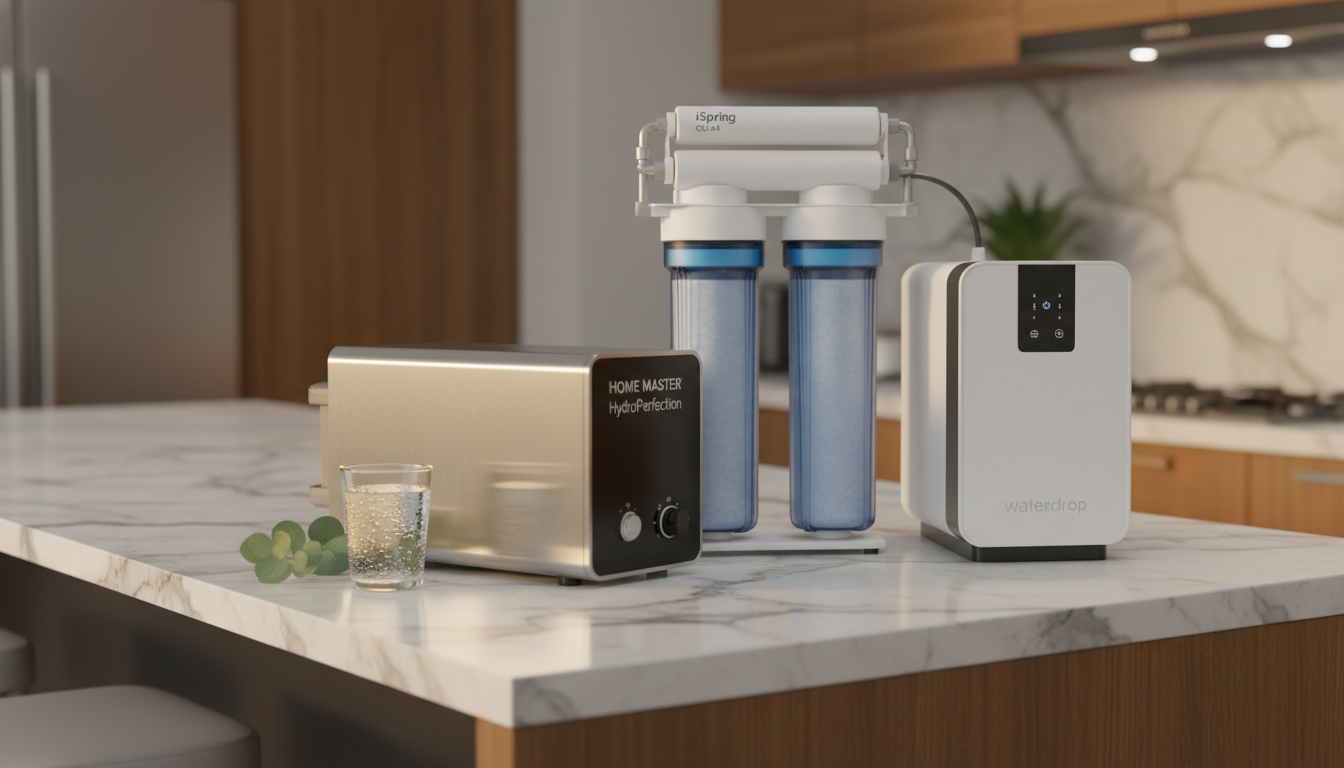
When you line up the 12 systems we examined, the Home Master HydroPerfection TMHP immediately draws attention. It carries a 4.7‑star rating from 1,254 reviewers and is priced at $445.55, placing it solidly in the premium tier alongside the iSpring RCC1UP‑AK, Waterdrop G3P800 and X12. Its 9‑stage filtration tackles everything from chlorine and chloramines to lead, fluoride and microplastics, while a UV LED sterilizer boasts 99.9 % pathogen kill‑rate and a non‑electric permeate pump keeps waste at a 1:1 ratio. With a filter lifespan of up to 12 months and a daily output of 75 gallons, it promises both purity and efficiency.
The roundup also spans budget options like the iSpring US31 and Waterdrop G2, mid‑range picks such as the Home Master Artesian TMAFC‑ERP and Waterdrop G3P600, and other premium contenders that push flow rates and stage counts even higher. Ratings hover between 4.5 and 4.8 stars, and price points range from $85.31 up to $1,039.00, giving you a clear view of what each tier offers. In the sections that follow, we’ll break down how each model’s specs stack up against the demands of everyday water‑drinking scenarios.

Home Master HydroPerfection TMHP
Its filter lasts up to 12 months, minimizing replacement hassle and cost.
iSpring RCC1UP-AK
Ideal for homeowners who want UV protection without paying premium—at $431.22 it’s about $14 cheaper than the Best Overall model.

Home Master Artesian TMAFC-ERP
Stands out with a compact 12.0‑inch height, fitting tight under‑counter spaces that the taller models can’t accommodate.
Also considered
TL;DR: The iSpring CU‑A4 is a compact under‑sink, 4‑stage ultrafiltration system that removes up to 99% of 700 contaminants, weighs about 4.41 lb and costs $158.99.
The CU‑A4’s standout feature is its 0.01‑micron hollow‑fiber membrane, which together with a 5‑micron sediment pre‑filter tackles lead, chlorine, PFAS, arsenic and other heavy metals. It’s a tankless, under‑sink unit that fits in a space of 13.00 inches tall, 4.00 inches wide and 15.00 inches long, delivering zero wastewater because it needs no storage tank.
Compared with other contenders, the CU‑A4 is noticeably lighter than the iSpring US31 (which weighs over 12 lb) and far lighter than the Waterdrop G2 at 25 lb. It also sits a bit shorter than the Waterdrop G2’s 13.98‑inch height, yet it’s taller than the AquaFX Barracuda 100, which stands only 8.0 inches tall. While it offers fewer listed accessories than the Home Master Artesian, its footprint makes it a good fit for tighter cabinet spaces.
Professional reviewers point out the NSF/ANSI certification and the ultrafiltration membrane as solid engineering choices, and many users praise the noticeable taste improvement and the hassle‑free, tankless design. The main trade‑off highlighted in consumer feedback is the lack of TDS reduction, which means the system won’t address dissolved mineral content. Additionally, the filter needs replacement roughly every 9 months, a cadence some owners find a bit frequent.
Pros
Cons
Best for: Budget‑conscious buyers seeking a reliable entry‑level option — the iSpring CU‑A4 offers Height: 13.00 inches
Avoid if: You need TDS reduction or have extremely tight under‑sink clearance.
TL;DR: The Home Master Artesian TMAFC-ERP delivers 7‑stage RO purification with 99% contaminant removal, adds 30‑60 mg/L calcium/magnesium, and offers a fast 4.5‑second fill, all in a compact 12‑inch‑high under‑sink unit.
This system packs seven filtration stages and a patented 2‑pass alkaline remineralization that injects 30‑60 mg/L of calcium and magnesium back into the water, addressing the typical RO acidity issue. The Fast Flo RO kit yields a 4.5‑second fill rate for an 8‑oz glass, and the modular, tool‑free housing keeps filter changes hygienic. With a 99% contaminant removal rating and a 5‑year limited warranty, it scores a strong 4.8/5 from 2,616 reviewers.
At 14.5 lb, the Artesian is lighter than the SimPure Y9A (16.5 lb) but heavier than the AquaFX Barracuda 100 (12.0 lb). Its 12.0‑inch height sits below the SimPure’s 14.3 inch profile and above the AquaFX’s 8.0‑inch height, making it a mid‑sized under‑sink unit. The 20.0‑inch length matches the Barracuda’s length and exceeds the SimPure’s 16.0‑inch length, while the 16.0‑inch width is wider than the Waterdrop G2’s 5.91 inch width but narrower than the Barracuda’s 18.0 inch width.
Professional reviewers praise the Full Contact remineralization for delivering better‑tasting alkaline water, and everyday users often highlight the quick fill time and tool‑free filter swaps. The main trade‑off is the wastewater ratio: without the optional permeate pump the system runs at roughly 4 : 1 waste to product water, though installing the pump brings it down to 1 : 1. Annual filter replacement (2,000 gal) is required, and the unit isn’t suited for hardness above 10 gpg or TDS above 2,000 ppm.
Pros
Cons
Best for: Most users looking for a well‑reviewed, reliable mainstream option — the Home Master Artesian TMAFC-ERP offers Height: 12.0 inches
Avoid if: You need advanced features or professional‑grade performance, or have water hardness or TDS levels that exceed the system’s limits.
TL;DR: The Waterdrop G3P600 delivers 8‑stage, under‑sink reverse osmosis filtration with a high 0.42 GPM flow, smart TDS monitoring, and a space‑saving tankless design, though its $429 price is premium.
At the heart of the G3P600 is an 8‑stage filtration train that includes a 0.0001‑micron RO membrane, lead‑reduction capability, chlorine reduction, and true TDS removal. The system pushes out water at 0.42 GPM (600 GPD) and operates on a 2:1 pure‑to‑drain ratio, meaning you get two gallons of clean water for every gallon wasted. Its filter cartridge (CF) lasts about 6 months, and the smart display faucet lets you watch TDS levels in real time.
Compared with other units in this roundup, the G3P600 offers more stages than iSpring’s 7‑stage model, while being slightly shorter (17.76 in vs 19.00 in) and lighter than iSpring’s 35.40‑lb system. It stands a bit taller than the Home Master HydroPerfection (16.0 in) but matches its compact width of around 5 in. The Artesian model from Home Master is lighter (14.5 lb) and shorter (12.0 in) but delivers only 50 GPD, far below the G3P600’s 600 GPD. Express Water’s alkaline UV unit also tops out at 100 GPD, and SimPure’s Y9A weighs less (16.5 lb) but lacks the tankless design and smart faucet.
Professional reviewers praise the G3P600 for its “exceptional efficiency” at removing nitrates, chlorine, and a broad range of chemicals, noting that the tankless layout frees up roughly 70 % of under‑sink space. Users appreciate the three‑second filter‑change mechanism and the real‑time TDS readout, but several comment that fluoride removal caps at about 85 % in heavily contaminated water, which may fall short for those needing full fluoride elimination. Installation does require drilling and a nearby electrical outlet, a point that some DIY installers flag as a hassle.
Technically, the unit is certified to NSF/ANSI 42, 53, 58, and 372 standards, reinforcing its contaminant‑reduction claims. It runs on a standard electrical outlet, with a 90‑inch power cord and a 59‑inch faucet cord for flexible placement. The manufacturer backs the system with a 1‑year warranty, and the overall package weighs 32.0 lb, with the system itself at 15.44 lb, making it sturdy yet manageable for most under‑sink installations.
Pros
Cons
Best for: Most users looking for a well‑reviewed, reliable mainstream option — the Waterdrop G3P600 offers Pipe Length: 60 inches
Avoid if: You're shopping on a tight budget — it's priced at $429.00
TL;DR: The Waterdrop G2 delivers 400 GPD through a 7‑stage, tankless RO system, offering a 1:1 pure‑to‑drain ratio and 12‑second cup delivery, all for $209.99.
What sets the Waterdrop G2 apart is its 7‑stage composite filtration and a 400 GPD flow rate, which translates to a cup of filtered water in about 12 seconds. The system’s 1:1 pure‑to‑drain ratio means you waste only as much water as you collect, a stark contrast to traditional RO units that can waste three to four times as much.
In the context of this roundup, the G2 is noticeably heavier at 25.0 lb than the iSpring CU‑A4 (about 4.4 lb) and the AquaFX Barracuda 100 (12.0 lb). It also measures 13.98 in H × 17.33 in L × 5.91 in W, making it taller and longer than the iSpring’s 13.00 in H × 15.00 in L footprint. Flow‑rate wise, the G2’s 400 GPD dwarfs the Barracuda’s 100 GPD, giving it a clear performance edge.
Customers consistently praise the rapid 12‑second cup delivery and the noticeable improvement in taste, crediting the 99 % impurity elimination and 90 % TDS reduction. Professional reviewers highlight the water‑saving 1:1 drain ratio as a standout feature. The main drawbacks mentioned are the need for an electrical outlet and the indoor‑only placement restriction, which can limit installation options for some homes.
Technical details reinforce its capability: the RO membrane pores are rated at 0.0001 microns, and the composite filter combines a PP membrane with coconut‑shell activated carbon and an MRO membrane. Optional remineralization adds calcium, magnesium, sodium, potassium, and strontium back into the water. Installation takes less than 30 minutes, and filter changes are quick—about three seconds for each cartridge.
Pros
Cons
Best for: Budget-conscious buyers seeking a reliable entry-level option — the Waterdrop G2 is available at $209.99
Avoid if: You want the best value-per-dollar in its price range
TL;DR: For $85.31, the iSpring US31 delivers three‑stage, 5‑micron carbon block filtration that cuts chlorine and heavy metals while preserving minerals, but its 1 GPM flow and lack of TDS removal keep it in the budget tier.
The US31’s core is a three‑stage carbon block system that filters down to 5 micron and claims to reduce ten contaminant categories, including chlorine and lead. It runs entirely on water pressure, so there’s no electricity required, and it fits under the sink with a compact footprint—160 mm deep, 160 mm high, 60 mm wide, and weighing about 12.02 lb.
Compared with the other eleven entries, the US31 sits in the middle of the weight range: it’s heavier than the iSpring CU‑A4 but lighter than the Waterdrop G2, and roughly matches the AquaFX Barracuda 100’s 12 lb. Unlike the Home Master Artesian unit, which adds a reverse‑osmosis membrane, the US31 stays at three filter stages and does not tackle dissolved solids. Its flow ceiling of up to 1 GPM is slower than the 100 GPD (≈0.07 GPM) rates listed for some peers, positioning it as a modest‑flow, entry‑level option.
Customer feedback highlights the system’s ability to improve taste and odor, with many users noting “up to 99% chlorine reduction” and appreciation for the NSF/ANSI 42, 53, 61 certifications that back those claims. Reviewers also like that the unit preserves beneficial minerals because it doesn’t strip total dissolved solids. On the downside, several commenters point out the slower flow and the fact that the system can’t address TDS, salts, or bacterial contaminants—limitations echoed by professional reviewers who call out the lack of reverse‑osmosis and limited chloramine reduction.
Pros
Cons
Best for: Budget‑conscious buyers seeking a reliable entry‑level option — the iSpring US31 offers Flow Rate: Up to 1 GPM
Avoid if: You need reverse‑osmosis, TDS removal, or protection against bacteria and viruses
TL;DR: The Express Water Alkaline UV removes 99.99% of 158+ contaminants, adds calcium, potassium and magnesium, and delivers 100 GPD of purified water for households of eight or more.
At the heart of the system is a 10‑stage reverse‑osmosis train that slashes TDS by 99.99% and tackles lead, fluoride, chlorine, bacteria and viruses. UV‑C light provides an extra kill‑step, while active mineral technology restores alkaline minerals for better taste.
Compared with the other eleven units, this model sits at the top end of the weight range at 28–31 lbs, making it heavier than the SimPure Y9A (16.5 lbs) and Home Master Artesian (14.5 lbs) but comparable to the iSpring RCC1UP‑AK (35.4 lbs). Its 19‑inch height matches the iSpring unit and exceeds the AquaFX Barracuda’s 8‑inch profile. The 14‑inch width is narrower than AquaFX’s 18‑inch frame yet wider than the SimPure’s 9.3‑inch width. Flow‑rate-wise, the Express Water delivers the same 100 GPD as the AquaFX Barracuda, outpacing the Home Master’s 50 GPD.
Reviewers consistently praise the clean, great‑tasting water and the peace‑of‑mind from NSF‑certified RO components, UV sterilization and automatic leak detection. Professional reviewers highlight the comprehensive seven‑filter, eleven‑stage design as a strong point. The most common gripe is the modest 0.035 GPM (100 GPD) flow, which feels slower than some commercial‑grade rivals, and the need for a minimum 40 PSI water pressure plus under‑sink drilling for installation.
Technical details include a recommended household size of 8+ people, operation between 40 °F and 100 °F, and a maximum pressure of 80 PSI. The system also boasts a one‑year limited warranty and a 4.5‑star rating from 1,919 reviewers.
Pros
Cons
Best for: Most users looking for a well‑reviewed, reliable mainstream option — the Express Water Alkaline UV offers Flow Rate: 100 GPD (0.035 GPM)
Avoid if: You need advanced features or professional‑grade performance
TL;DR: The iSpring RCC1‑AK delivers 7‑stage RO purification with UV sterilization, a 1.5:1 waste‑water ratio and a 24 V booster pump, offering robust contaminant removal for homes with variable water pressure.
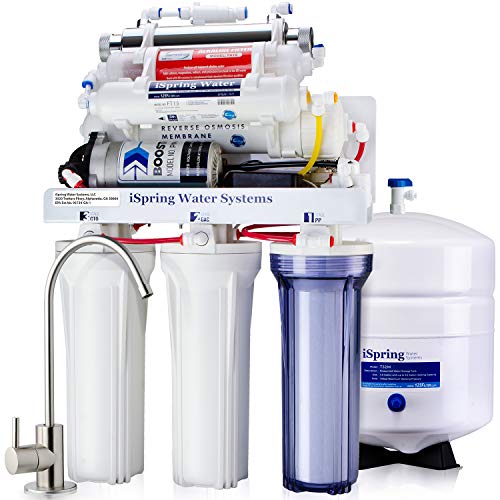
The system’s standout spec is its 7‑stage filtration train, which includes a 0.0001‑micron RO membrane, an alkaline remineralization filter and an 11‑watt UV lamp. Manufacturer claims up to 99% contaminant removal and up to 98% lead reduction, while the 1.5:1 pure‑to‑waste water ratio keeps waste low for a 100‑gallon‑per‑day capacity.
At 35.40 lb, the iSpring unit is heavier than the Waterdrop G2 (25.0 lb) and the Waterdrop G3P600 (32.0 lb). Its 19‑inch height also exceeds the G2’s 13.98 inches and the G3P600’s 17.76 inches, meaning it needs a bit more under‑sink clearance. Compared with the Home Master HydroPerfection, iSpring adds a built‑in UV sterilizer and a 24‑volt booster pump, giving it an edge for users who want extra disinfection and pressure stability.
Professional reviewers praise the booster pump for maintaining consistent flow even when incoming pressure dips, and users appreciate the UV delay time of 3 minutes that ensures thorough sterilization. The main trade‑off mentioned in consumer feedback is the requirement for a dedicated electrical outlet and the bulk of the unit, which can be a fit challenge in cramped cabinets.
The technical details reinforce its capability: a maximum inlet TDS of 750 ppm, lead removal up to 98%, and a 24‑volt booster pump that operates across a 30–70 PSI pressure range. The UV lamp’s 11‑watt draw and the smart flow sensor together provide an added safety layer without sacrificing daily output.
Pros
Cons
Best for: Buyers willing to invest in a proven, high‑quality option — the iSpring RCC1UP‑AK offers UV Delay Time: 3 minutes
Avoid if: You're on a tight budget or only need basic functionality
TL;DR: The Home Master HydroPerfection TMHP costs $445.55, delivers 9‑stage RO filtration with dual‑pass calcium‑magnesium remineralization, UV sterilization and a non‑electric pump that keeps waste low, all in a compact 16‑inch unit.
This system’s headline feature is its 9‑stage filtration paired with patented Full Contact Technology, which adds calcium and magnesium twice during purification. The UV sterilizer is EPA‑registered and claims 99.9% virus, bacteria and fungi inactivation, while the non‑electric permeate pump cuts water waste by up to 80%, delivering a 1:1 waste‑to‑product ratio. Filters last up to 12 months, and the unit can treat up to 2,000 gallons before replacement.
Within this 12‑product roundup, the HydroPerfection sits toward the premium end of the spectrum. Its 16.0‑inch height is taller than the compact Home Master Artesian (12 in) but shorter than the iSpring RCC1UP‑AK (19 in) and Express Water Alkaline UV (19 in). Compared with the Waterdrop G3P600 (17.76 in) and Waterdrop G2 (13.98 in), it offers a middle‑ground size that fits most under‑counter spaces. While a few competitors list fewer filtration stages, the HydroPerfection’s 9 stages and UV module give it a broader contaminant‑removal envelope, matching the “up to 99%” claim for chlorine, lead, fluoride and microplastics.
Everyday owners repeatedly note the system’s straightforward installation—thanks to the 10‑foot installation radius—and the strong water pressure that supports a 4.5‑second fill rate. Reviewers also highlight the crisp taste from the added minerals, though some prefer the flat profile of fully demineralized water. Professional reviewers praise the dual‑pass remineralization for both water quality and membrane longevity, while also flagging the need for a standard 110 V outlet to power the UV light and the relatively involved filter‑change routine.
Pros
Cons
Best for: Buyers willing to invest in a proven, high‑quality option — the Home Master HydroPerfection TMHP offers Filter Lifespan: Up to 12 months
Avoid if: You're on a tight budget, prefer demineralized water, or lack a standard 110 V outlet for UV functionality
“very clean water”
“Say no more. Perfect!”
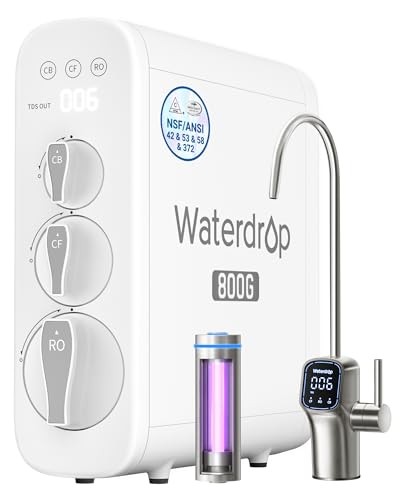
TL;DR: The Waterdrop G3P800 delivers 800 GPD of tank‑less RO water with a 10‑stage filter, UV sterilization and a smart faucet, but its premium price and electricity requirement make it a serious investment.
The standout spec is its 10‑stage reverse‑osmosis train paired with a 0.0001 μm membrane, delivering a pure‑to‑drain ratio of 3:1. At 17.72 inches tall, 5.67 inches wide and 18.12 inches deep, the unit packs a 35.85 lb weight into a compact, tank‑less design, and it can fill a 6‑oz cup in just 5 seconds.
Compared with the other eleven contenders, the G3P800 is taller than the Home Master HydroPerfection (16.0 inches) and roughly the same height as the Waterdrop X12 (16.72 inches). Its flow of 800 GPD is lower than the X12’s 1200 GPD, yet it still outpaces many peers that list slower fill rates. Unlike the iSpring RCC1UP‑AK, which offers a 7‑stage system, the G3P800 adds UV sterilization and a smart faucet with real‑time TDS readout—features not listed for several competitors.
Professional reviewers highlight the system’s NSF/ANSI 42, 53, 58 and 372 certifications as a mark of high‑quality filtration. Users consistently praise the instant‑water capability and the peace of mind from UV‑driven 99.9 % bacteria and virus kill rates. The downside noted in reviews is the need for electricity to run the UV lamp and faucet display, and the higher price tag relative to more basic models.
Pros
Cons
Best for: Large households or small offices needing high‑volume, contaminant‑free water — the Waterdrop G3P800 offers Height: 17.72 inches
TL;DR: The Waterdrop X12 delivers 11‑stage RO purification with 1200 GPD flow, alkaline mineralization and UV sterilization, but its premium $1,039 price makes it costlier than many under‑sink rivals.
The X12’s standout spec is its 11‑stage reverse‑osmosis train capped by a 0.0001 µm membrane, delivering up to 99% reduction of TDS, lead, PFAS and other contaminants. UV sterilization knocks out 99% of bacteria, while the built‑in alkaline mineral cartridge adds calcium and magnesium for a healthier pH around 7.5±.
Compared with the other systems in this roundup, the X12 is slightly taller than the Home Master HydroPerfection TMHP (16.72 in vs 16.0 in) and noticeably longer (18.2 in vs 15.0 in). Its width of 6.25 in also exceeds the HydroPerfection’s 5.0 in profile. Against the Waterdrop G3P800, the X12 is shorter (16.72 in vs 17.72 in) but a bit wider. Pricing-wise, it sits in the premium tier, making it pricier than the HydroPerfection model.
Reviewers appreciate the rapid 6‑oz cup fill time of approximately 3 seconds and the smart digital faucet that shows real‑time TDS levels and a filter‑life indicator. Professional observers note the system’s high‑quality components and the pH boost it provides. The main trade‑off mentioned by users is the higher upfront cost and the lack of publicly detailed long‑term consumer feedback.
Additional technical details include a pure‑to‑drain ratio of 3:1, sixteen RO membrane layers, and certifications from NSF/ANSI 42, 58 and 372. The system also confirms lead and chlorine reduction and offers remineralization, making it a comprehensive solution for health‑focused households.
Pros
Cons
Best for: Health‑conscious households that want high‑flow alkaline water — the Waterdrop X12 offers Flow Rate: 1200 GPD
TL;DR: The AquaFX Barracuda 100 delivers 100 GPD RO/DI filtration with up to 90 % TDS reduction in a compact 8‑inch‑high, 12‑lb unit, but it needs at least 40 PSI water pressure.
The unit’s headline spec is a 100 GPD flow rate, which translates to about 0.069 GPM of purified water – plenty for most reef‑based aquarium setups. It uses a semi‑permeable TFC membrane that can cut total dissolved solids by up to 90 %, and the package includes a built‑in pressure gauge and 6‑foot of tubing to simplify installation. At 8.0 inches tall, 18.0 inches wide and 20.0 inches deep, the Barracuda 100 packs a solid aluminum bracket into a footprint that fits comfortably under most tanks.
Compared with other systems in this roundup, the Barracuda 100 is heavier than the iSpring CU‑A4, which weighs about 4.41 pounds, but lighter than the Waterdrop G2 that tops out at 25.0 pounds. Its height of 8.0 inches is more compact than the iSpring CU‑A4’s 13.00‑inch profile, while its overall weight is almost identical to the iSpring US31’s 12.02 pounds. In other words, it sits in a sweet spot: portable enough for hobbyists yet substantial enough to feel built‑like.
Reviewers consistently praise the Barracuda’s durable aluminum construction and the clear pressure gauge that helps monitor performance. Professional observers note the effective TDS removal and the membrane’s 2‑3‑year lifespan as strong points for both hobbyists and small‑scale professionals. The most common complaint is the system’s reliance on a minimum incoming pressure of 40 PSI; users with low‑pressure feeds often report reduced efficiency unless they add a booster pump. Another frequent note is that the pre‑filter can become clogged, so regular checks are recommended to keep TDS reduction at its peak.
From a technical standpoint, the RO/DI process combines reverse‑osmosis with deionization, delivering water that’s both low in contaminants and balanced for reef environments. The required 40 PSI inlet pressure is a hard threshold, and the manufacturer lists a membrane lifespan of two to three years, after which the semi‑permeable membrane should be replaced to maintain performance.
Pros
Cons
Best for: Entry-level buyers or those on a tight budget — the AquaFX Barracuda 100 offers Flow Rate: 100 GPD
Avoid if: You need powerful performance or professional‑grade features, especially if your water pressure falls below 40 PSI.
TL;DR: The SimPure Y9A delivers countertop reverse‑osmosis water with UV sterilization, alkaline remineralization and a 300 GPD flow, but its waste‑water ratio and countertop footprint may limit high‑volume use.
The standout feature is its six‑stage RO system paired with UV sterilization and alkaline remineralization, delivering over 1,000 contaminant removals and a TDS reduction of >99.98 %. A 6 oz glass fills in just 12 seconds, and the output pH stays above 7.5 thanks to added calcium, magnesium and potassium.
At 16.5 pounds, the Y9A is heavier than the Express Water Alkaline UV’s listed 0.21875 pounds and the AquaFX Barracuda’s 12 pounds, yet lighter than the iSpring RCC1UP‑AK’s 35.27 pounds. Its 300 GPD flow outpaces the Express Water and AquaFX models, which both deliver 100 GPD, and dwarfs the Home Master’s 50 GPD rate. While the Waterdrop G2 and G3P600 list larger dimensions, the Y9A’s countertop‑only installation keeps plumbing modifications to a minimum.
Reviewers consistently praise the plug‑and‑play setup—no permanent plumbing required—and the rapid 12‑second fill time, calling it ideal for busy households. The built‑in UV lamp and alkaline remineralization also address common complaints about mineral loss in RO systems. However, users note the 2.5:1 waste‑water ratio and the need to keep a dedicated countertop space free, which can be a drawback for smaller kitchens.
Certified to NSF/ANSI 58 standards, the unit removes >99.94 % of arsenic, >99.88 % of lead, >99.89 % of fluoride and >99.09 % of PFAS. The pure‑to‑drain ratio of 2.5 : 1 means roughly two and a half parts purified water for every part waste water, a figure highlighted in both consumer and professional feedback.
Pros
Cons
Best for: Most users seeking a balanced, mainstream option — the SimPure Y9A offers Flow Rate: 300 GPD
Avoid if: You need high‑volume output or have very limited countertop space
Breakdown
Home Master HydroPerfection TMHP
Pros
iSpring RCC1UP-AK
Pros
Home Master Artesian TMAFC-ERP
Pros

Waterdrop G3P600
Pros
Cons
Based on scoring data and product specs
Personalized picks
Best Overall Pick
Home Master HydroPerfection TMHP
Best OverallBest for: Buyers willing to invest in a proven, high-quality option — the Home Master HydroPerfection TMHP offers Filter Lifespan: Up to 12 months
iSpring RCC1UP-AK
Best for: Buyers willing to invest in a proven, high-quality option — the iSpring RCC1UP-AK offers UV Delay Time: 3 minutes
$449.99+$4.44 vs winner
Skip AquaFX Barracuda 100 if…
You need powerful performance or professional-grade features
The Home Master HydroPerfection TMHP wins the round with a 9‑stage filtration process, 99.9% UV sterilization efficiency, and a 1:1 waste‑water ratio. It delivers up to 75 gallons per day and its filter cartridges last up to 12 months, making it both powerful and low‑maintenance at $445.55.
The iSpring RCC1UP‑AK earns runner‑up status if you need a higher daily output. It provides 100 gallons per day through a 7‑stage system, and its waste‑water ratio of 1.5:1 still keeps water use reasonable. At $431.22 it offers solid performance with an 11‑watt UV lamp and 99% contaminant removal.
For shoppers on a tighter budget, the iSpring US31 is the best budget pick at $85.31, delivering reliable reverse‑osmosis protection without breaking the bank. The Home Master Artesian TMAFC‑ERP serves as the strongest mid‑range option at $315.74, balancing performance and price. If premium features are your priority, the Waterdrop X12 stands out as the top premium contender at $1,039.00, offering advanced filtration technology for demanding households.
Choose the Home Master HydroPerfection TMHP today for the most comprehensive water‑purification solution.
The HydroPerfection packs nine filtration stages, including a non‑electric permeate pump and patented Full Contact remineralization, while its UV sterilizer kills or inactivates 99.9% of viruses, bacteria and fungi. It also delivers a 1:1 waste‑water ratio and 75 gallons per day output, all for $445.55.
No reviews yet — be the first to share your experience.
Please sign in to leave a review