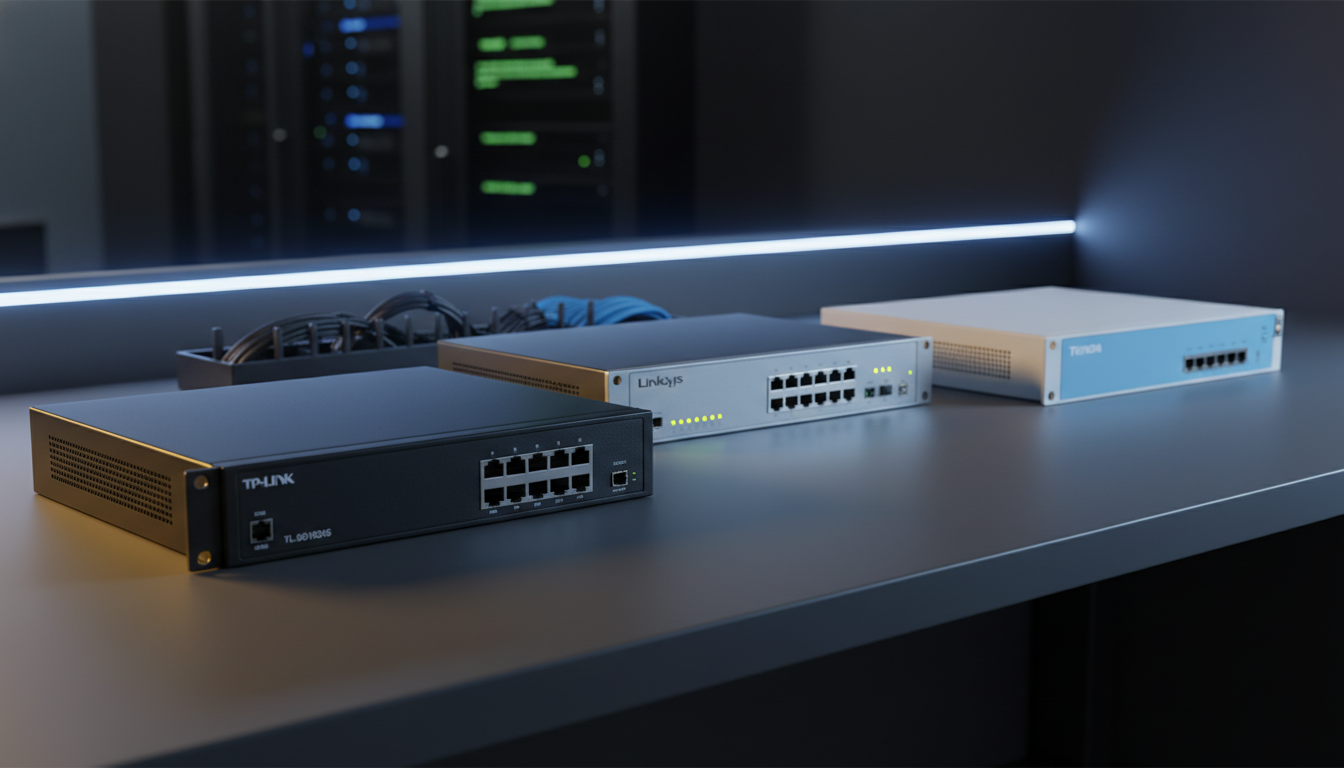
If you need to hook up a dozen PCs, a cluster of NAS drives, or a wall of security cameras, a high‑port‑count hub is the easiest way to expand your network. We compared 10 unmanaged and managed switches, spanning a price range from $54.99 for the Tenda TEG1016D up to $199.00 for the Ubiquiti USW‑Lite‑16‑PoE. The lineup is split into budget, mid‑range and premium tiers so you can match performance to your wallet.
All of the budget options—Tenda, TP‑Link, TRENDnet and Netgear—offer 16‑ or 24‑port Gigabit connectivity with fanless metal housings and non‑blocking switching capacities of 32 Gbps or 48 Gbps. The mid‑range picks, Linksys LGS116 and Zyxel GS1900‑16, keep the same 1 Gbps per‑port speed but add a slightly higher forwarding rate and a more polished chassis. Premium models such as Cisco’s CBS110‑24T and the Ubiquiti PoE‑enabled switch push 48 Gbps or 32 Gbps capacity while adding features like PoE, managed interfaces and higher memory buffers.
Each device also carries strong user sentiment—TP‑Link’s TL‑SG1024S holds a 4.7‑star rating from 176,226 reviews, while the Ubiquiti unit matches that score with 258 reviews. Below we break down how these specs translate to real‑world use cases.
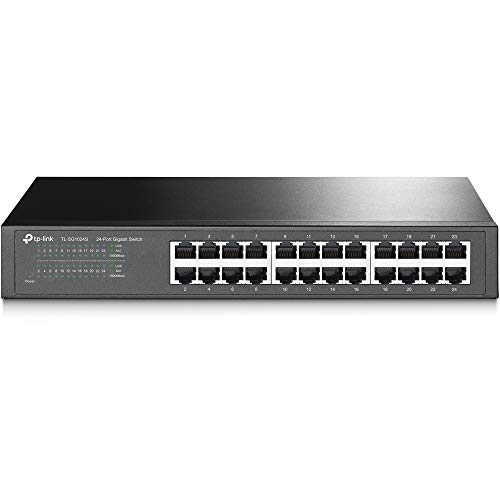
TP-Link TL-SG1024S
Its compact 44 mm height lets it fit under desks while delivering reliable performance that 176,226 reviewers praised.

Linksys LGS116
Ideal for mainstream users who want a sleek 25 mm profile, it costs $8.75 more than the Best Overall, offering a balanced blend of value and brand confidence.

Tenda TEG1016D
Stands out with a tall 254 mm height that eases cable management, and at $54.99 it’s the cheapest option, delivering solid features without the bulk of the other picks.
Also considered
Score Analysis
Key score advantages vs. runner-up (Linksys LGS116)
Price Range
TP-Link TL-SG1024S
$64.99
Linksys LGS116
$73.74
Tenda TEG1016D
$54.99

Cisco CBS110-24T
$185.99
Netgear GS324
$68.88

Ubiquiti USW-Lite-16-PoE
$199.00

D-Link DGS-1100-16V2
$95.39

Linksys SE3024
$87.99

TRENDnet 16-Port Switch Black
$64.99

Zyxel GS1900-16
$75.99
Spec Comparison
TL;DR: The TL‑SG1024S delivers 24 Gigabit ports, 48 Gbps non‑blocking switching and 35.7 Mpps forwarding in a fanless metal case for $64.99, making it a solid, budget‑friendly choice for small networks.
The standout spec is its 48 Gbps non‑blocking switching capacity paired with a 35.7 Mpps packet‑forwarding rate, ensuring each of the 24 10/100/1000 Mbps RJ45 ports runs at full wire speed simultaneously. The metal, fanless enclosure houses the unit, which weighs 3.44 pounds and measures 294 mm deep, 44 mm high and 180 mm wide, offering a sturdy yet silent footprint for desktop or 1U rackmount deployment.
Compared with the other nine switches in this roundup, the TL‑SG1024S offers more ports than the 16‑port models and a higher forwarding rate than the Netgear GS324’s 1.48 Mpps. It’s heavier than the ultra‑light TRENDnet 16‑port switch but considerably lighter than the Linksys SE3024’s 5.72‑pound chassis, striking a middle ground that fits both desktop and rack scenarios without excessive bulk.
User feedback repeatedly praises the plug‑and‑play setup, silent operation thanks to the fanless design, and consistent Gigabit speeds across all ports. Professional reviewers highlight the 8 K MAC address table as a strong point for larger device counts, while many criticize the lack of VLAN or QoS features. Power draw can climb to 20.2 W under full load, and the rackmount kit omits a physical lock, which some users find limiting.
Pros
Cons
Best for: Budget-conscious buyers seeking a reliable entry-level option
Avoid if: You have limited desk space or need portability
“ultra fast data transfer speeds”
TL;DR: The Linksys LGS116 delivers 16 gigabit ports in a compact, fanless metal case, drawing just 9.32 W, and earns a 4.7‑star rating from 364 reviewers.
This 16‑port unmanaged switch packs a full‑speed 1000 Mbps port on each RJ‑45 jack, while staying under 2 lb at 1.72 pounds (774 g). Its metal enclosure is only 25 mm tall, 280 mm deep and 120 mm wide, and it runs silently thanks to a fanless design and a modest 9.32 W power draw at 12 VDC.
When you line it up with the other nine switches in the roundup, the LGS116 sits in the middle of the weight range – heavier than the Zyxel (1.0 lb) and Trendnet (0.91 lb) models, but lighter than the Netgear (2.87 lb), TP‑Link (3.44 lb), D‑Link (2.6 lb) and Cisco (6.1 lb) units. Its depth of 280 mm is shorter than Zyxel’s 327.66 mm, and its 25 mm height is far slimmer than Zyxel’s 71.12 mm, making it one of the more space‑efficient choices.
Users consistently praise the plug‑and‑play experience – “zero‑configuration” setup is a common refrain – and the quiet operation that comes from the fanless chassis. Professional reviewers echo this, noting the low 9.32 W draw and solid gigabit performance for a basic network expansion. The downside that appears in both expert and consumer feedback is the lack of Power over Ethernet and any managed features; you won’t find VLAN tagging, traffic monitoring or jumbo‑frame support.
Beyond the physical specs, the switch supports Energy Efficient Ethernet (802.3az) and basic QoS, storing up to 8 000 MAC addresses. A 5½‑year manufacturer warranty rounds out the offering, giving peace of mind for home or small‑office deployments.
Pros
Cons
Best for: Home users, small offices, gamers, and anyone needing a simple, silent 16‑port gigabit switch.
Avoid if: You have limited desk space or need portability, or if you require PoE, VLAN segmentation, or enterprise‑grade management features.
TL;DR: The Tenda TEG1016D delivers 16 GbE ports, 32 Gbps switching capacity and fanless steel construction for under $55, making it a quiet, budget‑friendly choice for small offices or surveillance setups.
The standout spec is its 32 Gbps non‑blocking switching capacity paired with a forwarding rate of about 1.5 Mpps at 1 Gbps per port, ensuring wire‑speed traffic even when multiple cameras stream simultaneously. Its chassis measures 345 mm deep, 254 mm high and 93 mm wide, and the full‑steel housing with ventilation holes keeps the unit silent thanks to its fanless design.
Compared with the other nine switches in this roundup, the TEG1016D sits on the slimmer side of depth – deeper than the TP‑Link TL‑SG1024S’s 294 mm but shallower than the Zyxel GS1900‑16’s 327.66 mm. Its 32 Gbps switching capacity matches the Zyxel and TRENDnet models, yet it trails the 48 Gbps capacity that TP‑Link and Netgear switches provide. While the Tenda’s power draw is modest at 12 W (max at 220 V), the Linksys LGS116 draws 9.32 W and the Cisco CBS110‑24T lists a higher 35.7 Mpps forwarding rate, highlighting the TEG1016D’s focus on entry‑level performance rather than high‑end throughput.
Users consistently praise the plug‑and‑play setup and the 6 kV lightning protection on all ports and the power supply, noting that it gives peace of mind in surge‑prone surveillance environments. Reviewers also like the silent operation, which is especially valuable in office spaces where a fan would be distracting. On the flip side, the unmanaged nature means there’s no VLAN, QoS or LACP support, and the switch lacks Power over Ethernet, so it may not suit deployments that need those advanced features.
Pros
Cons
Best for: Small‑to‑medium businesses, offices, workgroups, and video‑surveillance installations that need a reliable, quiet, and affordable unmanaged switch.
Avoid if: You need advanced managed features such as VLAN, QoS, PoE, or higher‑end performance for large‑scale enterprise networks.
TL;DR: The Cisco CBS110-24T delivers 48 Gbps switching capacity and 35.7 Mpps forwarding in a fanless 24‑port Gigabit switch, but its premium $186.99 price and lack of PoE make it best for quality‑focused small‑business networks.
This Cisco model packs a 48 Gbps switching capacity and a 35.7 Mpps forwarding rate, backed by a 400 MHz ARM processor and 64 MB of memory. It offers 24 RJ‑45 Gigabit ports plus two combo SFP slots, auto‑MDI/MDI‑X, cable diagnostics, loop detection, and IEEE 802.3az power‑efficiency, all within a 170 mm depth, 44 mm height, and fanless chassis.
At 6.1 pounds, the CBS110-24T is heavier than every other switch in this ten‑item roundup—the D‑Link DGS‑1100‑16V2 weighs about 2.6 pounds and the Zyxel GS1900‑16 under 1 pound. Its 35.7 Mpps forwarding rate outpaces the Ubiquiti USW‑Lite‑16‑PoE (24 Mpps) and the TRENDnet 16‑Port Switch (23.8 Mpps). While its 48 Gbps capacity matches the Netgear GS324 and TP‑Link TL‑SG1024S, it draws 16.34 W, higher than the sub‑10 W consumption of several peers.
Users consistently award the switch a 4.7‑star rating from 93 reviewers, praising the reliable performance, plug‑and‑play setup, and Cisco’s 802.1p QoS for video and VoIP traffic. Professional reviewers also note the helpful loop detection and cable‑diagnostic tools. The main complaints focus on the unmanaged design—no VLANs, ACLs, or SNMP—and the absence of PoE, which limits direct power to devices.
The unit carries CE, CSA, FCC, and UL certifications, a Kensington lock slot for physical security, and operates from 0 °C to 40 °C with a fanless design that reduces noise and maintenance.
Pros
Cons
Best for: Those prioritizing quality and willing to pay for premium performance
Avoid if: You're shopping on a tight budget — it's priced at $186.99
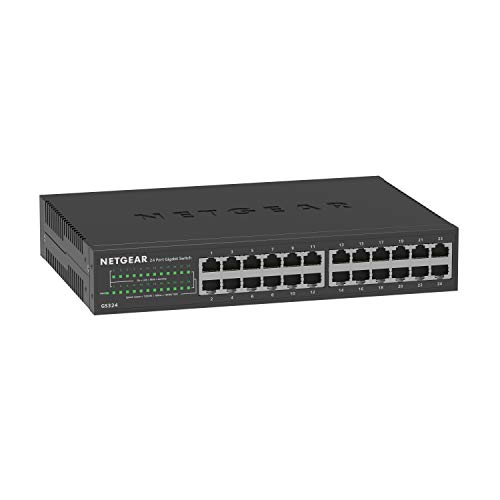
TL;DR: The Netgear GS324 delivers 24 gigabit ports, a non‑blocking 48 Gbps switching capacity and silent fanless operation at a budget‑friendly $68.88, though it lacks PoE and advanced management.
The GS324’s most striking spec features 24 RJ45 gigabit Ethernet ports, a 48 Gbps non‑blocking switching capacity, and a 1.5 Mpps forwarding rate. Housed in a metal chassis, it weighs 2.87 pounds and measures 13.5 in × 11.12 in × 3.12 in, making it sturdy enough for desktop, wall or rack mounting while staying compact enough for a home office.
Compared with the other nine switches in this roundup, the GS324 offers more ports than the 16‑port models such as TRENDnet, Zyxel, Tenda, and D‑Link. Its 48 Gbps capacity matches the TP‑Link TL‑SG1024S and Cisco CBS110‑24T, but its 1.5 Mpps forwarding rate is lower than the 23.8 Mpps seen in several peers. At 2.87 pounds it’s lighter than the TP‑Link (3.44 lb) and Cisco (6.1 lb) units, yet heavier than the TRENDnet (0.91 lb), Linksys LGS116 (1.72 lb) and D‑Link (2.6 lb) switches.
User feedback repeatedly praises the plug‑and‑play setup and the silent operation the fanless metal design provides. Reviewers also note the bright LED indicators can be distracting in dim rooms, and the lack of Power over Ethernet means devices like IP cameras need separate injectors. Professional reviewers highlight the auto‑learning MAC and auto power‑down features as energy‑saving touches, while the unmanaged nature means no VLANs or LACP for advanced networking.
Pros
Cons
Best for: Budget‑conscious buyers seeking a reliable entry‑level option
Avoid if: you’ve got limited desk space or need portability
“Just works, expands modem ports seamlessly”
“Quiet fanless operation makes it perfect for my home office”
TL;DR: The Ubiquiti USW‑Lite‑16‑PoE packs 16 Gigabit ports, eight PoE+ outputs and a fanless, silent design into a compact 200 mm‑deep chassis for $199, ideal for quiet UniFi setups.
The standout feature is its eight 802.3at PoE+ ports delivering up to 30 W per port, while the whole unit draws a max of 60 W and offers a total PoE budget of 45 W. With a non‑blocking throughput of 16 Gbps, a switching capacity of 32 Gbps and a forwarding rate of 24 Mpps, it handles full‑duplex traffic across all 16 Gigabit Ethernet ports without bottlenecking.
At 2.65 pounds, it's heavier than the D‑Link DGS‑1100‑16V2 (2.6 pounds) and the TRENDnet 16‑Port Switch (0.91 pounds), but considerably lighter than the Cisco CBS110‑24T (6.1 pounds). Its 200 mm depth exceeds the Cisco’s 170 mm depth while staying shallower than the Linksys LGS116’s 280 mm depth. Priced at $199, it sits in the premium tier compared with many sub‑$100 alternatives in this roundup.
Reviewers consistently praise the fanless enclosure for silent operation, noting that the polycarbonate case keeps noise down in office closets. Users also highlight the straightforward UniFi integration and the full Layer 2 feature set, including VLANs up to 1000, LACP aggregation and DHCP snooping. Professional reviewers call the switch a solid entry‑level managed option for UniFi deployments, but they flag the 45 W total PoE budget and the modest 0.5 MB packet buffer as constraints for power‑hungry devices or bursty traffic.
Pros
Cons
Best for: Those prioritizing quality and willing to pay for premium performance
Avoid if: You need advanced features or professional‑grade performance
TL;DR: The D-Link DGS-1100-16V2 gives you 16 gigabit ports, 32 Gbps switching capacity and silent fanless operation for $95.39, backed by a lifetime warranty.
With a 16‑port RJ‑45 layout and a switching capacity of 32 Gbps, the DGS-1100-16V2 packs a solid Layer 2 feature set—VLAN, QoS, LAG, STP, port mirroring and auto MDI/MDIX—into a compact 44.5 mm height, 279 mm length and 178 mm width chassis. Its passive cooling means no fans, and it draws just 9 W typical, making it a quiet, power‑efficient choice for a home office or small‑business network.
At 2.6 pounds, the D‑Link sits in the middle of the pack: it’s lighter than the rack‑heavy Linksys SE3024 and Cisco CBS110-24T, but heavier than the ultra‑light TRENDnet 16‑Port Switch (0.9125 pounds) and Zyxel GS1900-16 (1.0 pound). It offers both desktop and rack‑mountable options, a flexibility the wall‑mount‑only Linksys LGS116 lacks and that matches the rack‑mount kits of TRENDnet and Tenda.
Users repeatedly praise the plug‑and‑play setup and the silent operation the fanless design delivers. Professional reviewers note the easy web‑based Easy Smart management interface for basic L2 tasks, while everyday users appreciate the reliable gigabit performance across all ports. The most common gripe is the front‑facing port layout, which can lead to messy cabling, and the lack of a dedicated on/off power switch.
Beyond the basics, the switch supports full‑duplex operation on every port and includes D‑Link’s Green energy‑saving technology. The lifetime warranty adds confidence for long‑term deployments, even though detailed hardware specs beyond the listed dimensions are scarce.
Pros
Cons
Best for: Home offices, small businesses and test labs that need up to 16 gigabit ports with basic VLAN and QoS.
Avoid if: You need advanced enterprise features, high‑availability guarantees or detailed hardware specifications for mission‑critical deployments.
“Plug-and-play dummy‑proof for VOIP phones (12 Cat‑6 lines, zero issues).”
“Fantastic for non‑specialists vs. pricier managed alternatives.”
TL;DR: The Linksys SE3024 delivers 24 Gigabit Ethernet ports, a 1.2 GHz dual‑core ARM processor, and a rugged metallic chassis, but its 5.72 lb weight and modest 4.1‑star rating may give budget‑focused buyers pause.
The standout spec is the 24 Gigabit ports, each supporting up to 1 Gbps speeds, and a 1.2 GHz dual‑core ARM processor handles traffic without head‑of‑line blocking. A metallic chassis gives the unit a solid feel, and Power Save Mode automatically powers down idle ports to reduce energy use. IEEE 802.1p QoS and full‑duplex flow control keep traffic smooth.
Compared with the nine other switches in this roundup, the SE3024 stands as the only 24‑port model besides the Cisco CBS110‑24T, giving it a clear edge in port density. At 5.72 lb it is heavier than the D‑Link (2.6 lb), Zyxel (1.0 lb), Netgear (2.87 lb), and most others, but still lighter than the Cisco (6.1 lb). Its width of 441 mm makes it noticeably wider than the D‑Link’s 178 mm or Zyxel’s 231.14 mm, while its 131 mm depth is shallower than Zyxel’s 327.66 mm, fitting tighter rack spaces.
Professional reviewers note the convenience of the included rack‑mount brackets and the status LEDs that simplify troubleshooting. User feedback, shown by a 4.1‑star rating from 60 reviews, shows solid performance but also hints at some dissatisfaction compared with higher‑rated peers. The one‑year warranty offers basic protection, though it’s shorter than the longer guarantees some competitors provide.
Pros
Cons
Best for: Those prioritizing quality and willing to pay for premium performance
Avoid if: Reliability and user satisfaction are your top concerns
TL;DR: The TRENDnet TEG‑S17D offers 16 gigabit ports, 32 Gbps switching capacity, and a fanless metal case in a compact 216 × 132 × 43 mm chassis for quiet, plug‑and‑play networking.
This unmanaged switch packs 16 Gigabit RJ‑45 ports and a 32 Gbps switching capacity into a metal, fanless enclosure that weighs just 0.91 lb. Its dimensions—43 mm high, 216 mm long, and 132 mm wide—make it easy to slot onto a desk or into a rack with the included brackets. The device delivers a full‑duplex 2000 Mbps data transfer rate and a forwarding rate of 23.8 Mpps, and it's backed by a 512 KB RAM buffer.
Compared with other 16‑port options in the roundup, the TRENDnet is lighter than the TP‑Link TL‑SG1024S (3.44 lb) and the Netgear GS324 (2.87 lb), and only a touch heavier than the Zyxel GS1900‑16 (1.0 lb). Its 32 Gbps switching capacity matches Zyxel’s but falls short of the 48 Gbps found in the TP‑Link and Netgear models. While the Tenda TEG1016D also lists a 32 Gbps capacity, the TRENDnet adds a longer 9 KB jumbo‑frame size versus Tenda’s unspecified limit.
Professional reviewers highlight the fanless metal chassis as a quiet, low‑power solution—something users repeatedly praise in the 4.6‑star reviews. The plug‑and‑play setup, complete with a quick‑install guide and rackmount kit, earns points for simplicity. However, customers note the lack of managed features such as VLANs, QoS, or remote monitoring, which can be a deal‑breaker for more complex networks.
Beyond the basics, the switch features an 8,000‑entry MAC address table, an MTBF of 1,112,172 hours, and a lifetime warranty, underscoring its durability for small‑office environments. The included 1.5 m power cord and universal 100–240 VAC supply keep installation straightforward, and the LED indicators give clear visual feedback on link status.
Pros
Cons
Best for: Entry‑level buyers or those on a tight budget
Avoid if: You need powerful performance or professional‑grade features
TL;DR: The Zyxel GS1900‑16 delivers silent, fan‑less 16‑port Gigabit switching with a full 32 Gbps non‑blocking capacity and 23.8 Mpps forwarding, but its $75.99 price sits above several budget rivals.
The standout spec is the 32 Gbps switching capacity paired with a 23.8 Mpps forwarding rate, ensuring each of the 16 × 1 Gbps ports can run at full speed without bottlenecks. The unit weighs just 1.0 pound (453.6 g) and measures 327.66 mm × 71.12 mm × 231.14 mm, fitting comfortably on a desk or in a rack while staying completely silent thanks to its fanless design.
Compared with the other nine switches in this roundup, the Zyxel is slightly pricier than the Linksys LGS116 and notably cheaper than the D‑Link DGS‑1100‑16V2 or the Cisco CBS110‑24T, yet it is heavier than the ultra‑light TRENDnet 16‑Port Switch Black and lighter than most metal‑cased peers such as the Netgear GS324 and TP‑Link TL‑SG1024S. Its depth is greater than the compact Linksys SE3024 and the Cisco model, placing it toward the larger end of the physical envelope. Like many competitors, it lacks PoE and SFP ports, but it does include energy‑efficient Ethernet, loop protection, storm control, DoS prevention and SSL‑based error prevention—features not always listed on the rival sheets.
User sentiment consistently praises the silent operation and the straightforward web‑based management interface, noting that setup feels “plug‑and‑play” for small‑to‑medium business environments. Professional reviewers highlight the reliable connectivity and the full non‑blocking performance as strong points for SMB networks. The main criticisms focus on the absence of PoE and SFP uplinks, which limits direct powering of IP cameras or fiber backhaul, and a rating of 4.1 / 5 from 47 reviewers, which sits below the 4.5 + scores of several competitors.
Pros
Cons
Best for: Small‑to‑medium business offices, classrooms, or home offices that need a quiet, web‑managed Gigabit switch without PoE.
Avoid if: You require PoE, fiber uplinks via SFP, or advanced Layer 3 routing for larger networks.
“fanless 16-port GbE L2 web-managed switch... ideal for quiet environments like offices or classrooms”
Breakdown
TP-Link TL-SG1024S
Pros
Linksys LGS116
Pros
Tenda TEG1016D
Pros
Cisco CBS110-24T
Pros
Cons
Based on scoring data and product specs
Personalized picks
Best Overall Pick
TP-Link TL-SG1024S
Best OverallBest for: Budget-conscious buyers seeking a reliable entry-level option
Linksys LGS116
Best for: Most users seeking a balanced, mainstream option
$73.74+$8.75 vs winner
Skip Zyxel GS1900-16 if…
Reliability and user satisfaction are your top concerns
The TP‑Link TL‑SG1024S stands out as the clear winner. It delivers a hefty 24 Gigabit ports, a 48 Gbps switching capacity, and a 4.7‑star rating from over 176 k reviews—all for $64.99, well below its $89.99 list price. Its fanless metal design and limited‑lifetime warranty add confidence for any growing network.
The Linksys LGS116 takes the runner‑up spot, ideal if you need a compact 16‑port gigabit switch that can sit on a desk or mount on a wall. It packs 1000 Mbps ports in a slim 25 mm metal case, earns a 4.7‑star rating from 364 reviewers, and costs $73.74.
For tighter budgets, the Tenda TEG1016D shines at $54.99, offering solid basic connectivity without breaking the bank. If you prefer a mid‑range balance of features and price, the Linksys LGS116 (already highlighted) remains a strong choice. For a premium setup, the Ubiquiti USW‑Lite‑16‑PoE provides built‑in PoE support at $199.00.
Choose the TP‑Link TL‑SG1024S today and give your network the reliable, high‑port foundation it deserves.
The TP‑Link TL‑SG1024S provides 24 ports at $64.99, which is lower than the runner‑up Linksys LGS116’s $73.74 for only 16 ports, making it the most cost‑effective choice for a larger port count.
No reviews yet — be the first to share your experience.
Please sign in to leave a review
