⚡ Quick Answer
We’ve lined up 9 rip saws that span everything from a $69.00 starter model to a $5,199.00 shop‑class beast. The selection covers three clear price tiers: budget options like the SKIL 5280‑01, SKIL TS6307 and Makita HS0600; mid‑range choices such as the Evolution R10TS, Metabo HPT C10RJS and SawStop CTS‑120A60; and premium powerhouses including the SawStop Contractor Saw, JET XACTA and Grizzly G0623X3. This spread lets you see how features and performance shift as the price climbs.
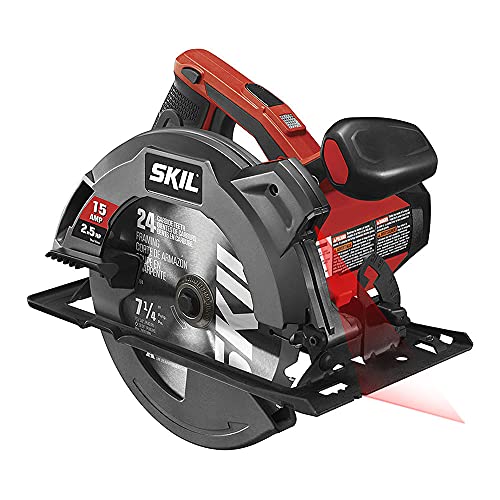
The SKIL 5280‑01 catches the eye with a 4.7‑star rating from 14,314 reviewers, a featherlight 8.7 lb body, and a 7‑1/4 inch blade that can bevel up to 51°. At just $69.00 it packs a 15‑amp motor and a single‑beam laser guide, delivering fast, accurate cuts on plywood, OSB and framing lumber while staying easy to handle on a ladder or in a cramped workshop.
Below we’ll break down each tier’s strengths, compare key specs like blade size, cutting depth and weight, and help you decide which saw aligns with your projects and budget.
SKIL 5280-01
A 51° bevel capacity lets you cut a wide range of angles, giving entry‑level flexibility that underpins its top rating.

Makita HS0600
Ideal for pros who need a sturdy saw; at $414 it’s considerably pricier than the $69 SKIL 5280‑01, reflecting its larger 12.6‑in height and 18.7‑in length.

Metabo HPT C10RJS
The 36‑inch table height lets you tackle larger sheets, a capability the more compact SKIL and Makita models lack, making it a solid mid‑range choice.
Also considered
TL;DR: The SKIL 5280-01 delivers 5,300 RPM, a 51° bevel capacity and a lightweight 8.7 lb design for under $70, making it the top‑value rip saw for DIY projects.
What really sets this saw apart is its 5,300 RPM no‑load speed paired with a 51° bevel capacity and a 7‑1/4 inch carbide‑tipped blade with 24 teeth. Those numbers give you fast cutting and plenty of angle flexibility for framing or sheet‑goods work, while the included 24‑tooth blade means you can start cutting right out of the box.
Compared with the eight other saws in this roundup, the SKIL 5280‑01 is dramatically lighter—at 8.7 lb it’s under half the weight of the Makita HS0600 (15.2 lb) and a fraction of the 51.15 lb SKIL TS6307. Its blade is also more compact; most competitors sport 10‑inch blades, so the 7‑1/4 inch size makes the SKIL easier to maneuver in tight spaces and to store in a small workshop.
Reviewers consistently praise the single‑beam laser guide for keeping cuts straight, and the low weight helps reduce fatigue during longer projects. Some users note the plastic construction feels less rugged than metal‑shod models, and a few report the saw feels heavier than the advertised 8.7 lb during extended use. Professional reviewers echo this, saying the tool “performs as well as higher‑priced models” but “lacks the premium durability required for heavy‑duty jobs.”
Beyond the laser, the saw offers a 15‑amp motor, 2.5 HP output and a 120 V supply, delivering solid power for most home‑improvement tasks. Depth of cut reaches 2‑7/16 inch at 90° and 1‑15/16 inch at 45°, while safety features include a guarded trigger, spindle lock and a dust blower. An included carry bag and the 24‑tooth carbide blade round out the package.
Pros
Cons
Best for: Budget-conscious buyers seeking a reliable entry-level option — the SKIL 5280-01 offers Blade Teeth: 24
Avoid if: You need advanced features or professional-grade performance
“really straight line”
“laser guided thing”
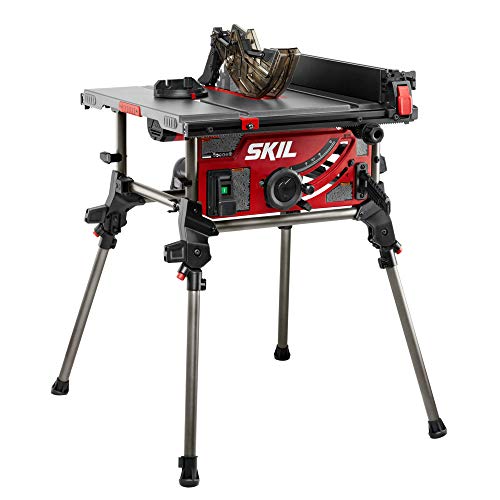
TL;DR: The SKIL TS6307 delivers 15‑amp power, 4,600 RPM speed, and a 25.5‑inch rip capacity in a portable folding‑stand design, making it a strong budget option for jobsite cuts.
What really sets this saw apart is its 15‑amp motor that spins a 10‑inch blade at 4,600 RPM, giving you a maximum cutting depth of 3.5 inches at 0° bevel and 2.5 inches at 45°. The total rip capacity reaches 25.5 inches, and the unit weighs 51.15 lb, striking a balance between heft for stability and portability. An integrated folding stand and a rack‑and‑pinion fence let you set up and break down quickly on the job.
Compared with the other eight entries in this roundup, the SKIL is noticeably heavier than the Makita HS0600 but still lighter than the Evolution R10TS and far lighter than the SawStop CTS‑120A60. It also lands at a lower price point than the Evolution and Metabo HPT models, while offering more features than the ultra‑light SKIL 5280‑01.
Users consistently highlight how the folding stand removes the need for a separate mobile base, and the rack‑and‑pinion fence earns praise for smooth, precise adjustments. Reviewers note that the 24‑tooth, high‑speed‑steel blade is well‑suited for fast ripping, and the built‑in dust port helps keep the workspace cleaner. Professional reviewers point out that the 15‑amp motor provides enough torque to slice through hardwood without bogging down.
Additional technical details reinforce its jobsite readiness: a 5/8‑inch arbor accommodates standard blades, the bevel range spans –2° to 47°, and the saw runs on 120 V AC at 60 Hz with an 1800‑watt draw. The cast‑aluminum table offers a solid 24‑inch work surface, and safety features like an anti‑restart switch and riving knife add confidence during use.
Pros
Cons
Best for: Budget-conscious buyers seeking a reliable entry-level option — the SKIL TS6307 offers Blade Teeth: 24T
Avoid if: You need advanced features or professional‑grade performance
TL;DR: The Makita HS0600 delivers a 2,000 W motor and 4,300 RPM speed in a compact 15.2‑lb package, offering 3‑13/16 in cut depth at 90° while staying affordable for contractors.
The standout spec is its 2,000 W motor paired with a 15 Amp draw and a no‑load speed of 4,300 RPM, giving the saw enough torque to slice through 4× lumber in a single pass. Its maximum cutting capacity reaches 3‑13/16 in at 90° and 2‑11/16 in at a 45° bevel, thanks to the 10‑1/4 in blade and up‑to‑50° bevel range.
At 15.2 lb, the HS0600 is heavier than the ultra‑light SKIL 5280‑01 (8.7 lb) but far lighter than the Evolution R10TS, which tips the scales at about 60 lb. Its 18.7‑in length also exceeds the 14.2‑in length of the SKIL 5280‑01, giving it a longer balance point without becoming a floor‑standing unit.
Buyers consistently reward the saw with a 4.7‑star average from 989 reviews, highlighting the large bevel capacity and the well‑balanced 12.6‑in height for comfortable handling. Professional reviewers note the flat motor housing and rubberized levers as efficiency‑focused touches, while the corded power supply is frequently mentioned as a limitation for on‑site portability.
Additional technical details include a 5/8‑in arbor, compatibility with 10‑5/8 in blades, a 2.5 m cord for decent reach, and an adjustable top guide that helps keep cuts straight. Dual front and rear bevel supports further enhance precision on angled cuts.
Pros
Cons
Best for: Budget-conscious buyers seeking a reliable entry-level option — the Makita HS0600 offers Motor Power: 2,000 W
Avoid if: You want the best value‑per‑dollar in its price range
TL;DR: The Metabo HPT C10RJS packs a 15‑amp motor, 35‑inch right‑side rip capacity and a sturdy fold‑and‑roll stand for a solid $549 price, but its 96‑lb weight can be a hassle to move.
What really sets this saw apart is the 35‑inch right rip capacity, the longest among the nine models we reviewed. With a 10‑inch blade, a 5/8‑inch arbor and a 40‑tooth carbide‑tipped blade included, it can handle full‑sheet plywood and wide lumber without needing additional extensions.
Compared with its peers, the C10RJS is noticeably heavier than the Makita HS0600 and the SKIL TS6307, and even exceeds the Evolution R10TS’s 60‑lb frame. It also outweighs the SawStop CTS‑120A60, placing it among the more robust, job‑site‑ready options. Its 35‑inch rip capacity outstrips the Evolution’s 26‑inch capacity, giving professionals a clear edge for large‑format work.
Customers frequently praise the saw’s “powerful cutting ability through hardwoods” and the “stable stand” that holds up on uneven terrain. Professional reviewers highlight the rack‑and‑pinion fence for precise adjustments and the soft‑start, electric brake and overload protection that add safety on demanding sites. Users do note, however, that the 96‑lb assembled weight (110 lb total) makes solo transport a challenge, and the single 45‑degree bevel limit can feel restrictive for cabinet‑making tasks.
Under the hood, the 15‑amp direct‑drive motor spins at 4500 RPM, delivering the torque needed for tough cuts. The table sits 36 inches high, spans 28‑3/4 inches wide and 22 inches long, and the cut depth reaches 3‑1/8 inches at 90 degrees. The included metal miter gauge and carbide‑tipped blade round out a feature set that rivals higher‑priced competitors.
Pros
Cons
Best for: Most users seeking a balanced, mainstream option — the Metabo HPT C10RJS offers Blade Teeth: 40-tooth carbide-tipped
Avoid if: You have limited desk space or need portability
TL;DR: The Evolution R10TS packs a 10‑inch 40‑tooth TCT blade, 26‑inch rip capacity and 3,300 RPM motor into a 60‑lb jobsite saw that handles wood, mild steel, aluminum and composites for $475.00.
The standout feature is the dual rack‑and‑pinion fence system that offers micro‑adjustable positioning, paired with a 40‑tooth tungsten‑carbide‑tipped blade that’s included right out of the box. With a 10‑inch blade diameter and a maximum cut depth of 3‑3/8 inches, the saw can tackle a wide range of materials without swapping blades.
At 60 pounds, the R10TS is heavier than the Makita HS0600 (15.2 lb) and the SKIL TS6307 (51.15 lb) but lighter than the Metabo HPT C10RJS (96 lb) and the SawStop CTS‑120A60 (79 lb). Its footprint—15.0 inches tall, 29.0 inches long and 29.0 inches wide—is larger than the compact SKIL 5280‑01 (8.5 inches tall, 14.2 inches long) yet still smaller than the industrial‑grade JET XACTA (85 inches long). This places the Evolution squarely in the mid‑range of portability and size for jobsite saws.
Professional reviewers praise the saw’s multi‑material capability and the soft‑start feature that helps avoid power trips on startup. However, they also note that accurate cutting hinges on careful initial calibration—checking base‑plate flatness and fence alignment before the first cut. The electronic blade brake and overload protection add safety, while the integrated carry handles make transport easier despite the weight.
Under the hood, the 15‑amp motor delivers 1,800 W of power at 3,300 RPM, running on 120 V, 60 Hz mains. The work table measures 13.4 inches high and 22.7 inches long, giving a solid platform for larger workpieces. Additional conveniences include a split‑blade safety guard with anti‑kickback pawls, a large paddle switch, and onboard storage for accessories.
Pros
Cons
Best for: Value-conscious buyers seeking quality at $475.00 — the Evolution R10TS offers Blade Teeth: 40
Avoid if: You have limited desk space or need portability
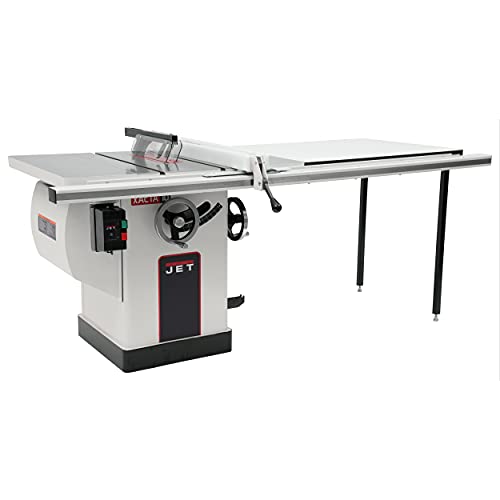
TL;DR: The Jet XACTA delivers a 3 HP motor, 50‑inch rip capacity, and a precision XACTA Fence II, but its 510‑lb weight and high price make it a serious investment for demanding woodworkers.
The standout feature is the 50‑inch commercial‑grade rip capacity, letting you cut full‑sheet plywood or large panels in a single pass. Coupled with a 3 HP, 4300 RPM motor and a 350 CFM dust collection system feeding a 4‑inch port, the saw handles dense hardwoods while keeping the workspace relatively clean.
At 510 lb, the XACTA is substantially heavier than the sub‑$500 SKIL 5280‑01 (8.7 lb) and the compact SawStop CTS‑120A60 (79 lb), yet lighter than the Grizzly G0623X3 which tips the scales at 566 lb. Its 38.0‑inch height, 85.0‑inch length and 36.0‑inch width also outsize the Evolution R10TS (15‑inch height, 29‑inch length) and the Metabo HPT C10RJS (36‑inch table height). Price‑wise, the Jet sits well above the budget‑friendly options in this roundup, positioning it as a premium‑tier cabinet saw.
Reviewers consistently praise the 50‑inch XACTA Fence II with HDPE faces for its buttery‑smooth slide and long‑term durability. The push‑button arbor lock and quick‑release riving knives also earn marks for convenience. On the flip side, users note that the cast‑iron table wings add significant heft, making assembly a challenge for a single operator, and that the base 3 HP motor may feel modest when tackling very dense hardwoods without the optional upgrade.
Pros
Cons
Best for: Those prioritizing quality and willing to pay for premium performance — the JET XACTA offers Motor Power: 3 HP
Avoid if: You're on a tight budget or only need basic functionality
TL;DR: The SawStop Contractor Saw packs a 1.75 HP motor, 30‑inch rip capacity and a patented skin‑stop safety system into a 256‑lb cabinet that’s built for serious woodworkers willing to invest in premium performance.
The standout spec is the 1.75 HP, 1‑phase TEFC motor paired with a 30‑inch Premium Fence Assembly. The fence’s heavy‑gauge steel construction keeps cuts square even under heavy loads, and the 30‑inch right‑hand rip capacity lets you tackle wide panels without additional extensions. A 4‑inch dust port and a polycarbonate thin‑profile blade guard round out the functional package.
When you line it up against the eight other saws in this roundup, the Contractor Saw is noticeably heavier. At 256 lb it outweighs the SawStop CTS‑120A60 (79 lb), Metabo HPT C10RJS (96 lb), Evolution R10TS (60 lb), Makita HS0600 (15.2 lb), SKIL TS6307 (51.15 lb) and the ultra‑light SKIL 5280‑01 (8.7 lb). Only the JET XACTA (510 lb) and Grizzly G0623X3 (566 lb) tip the scales higher. Its footprint—27 in depth by 25‑3/4 in width—also sits larger than the compact table saws but smaller than the full‑size shop beasts.
Users consistently praise the SawStop skin‑detection brake, calling it “life‑saving” and a decisive factor in choosing this model. Professional reviewers note the Premium Fence’s “fit and finish second to none,” delivering repeatable, deflection‑free cuts. On the flip side, owners mention the shipping weight of approximately 280 lb as a setup hurdle, and a few note that a separate dado brake cartridge is required for stacked dado work.
Pros
Cons
Best for: Those prioritizing quality and willing to pay for premium performance — the SawStop Contractor Saw offers Motor Power: 1.75 HP.
Avoid if: You need an ultra‑portable solution or are highly sensitive to shipping weight and price.
TL;DR: The SawStop CTS-120A60 packs a 10‑inch blade, <5 ms blade‑stop safety and a rack‑and‑pinion fence into a 68‑lb portable unit, but its $974 price makes it a premium choice.
What truly sets this saw apart is its patented Active Injury Mitigation (AIM) system that drops the blade in less than 5 milliseconds on skin contact, a safety feature no other compact job‑site saw in this roundup offers. The micro‑adjust quick‑tilt bevel lets you dial in angles from –1° to 46°, while the 10‑inch, 24‑tooth ripping blade delivers clean cuts up to 3‑1/8 in. deep at 0° bevel.
At 68 lb (shipping 79 lb) the CTS‑120A60 is lighter than the Metabo HPT C10RJS (96 lb) and far lighter than the massive JET XACTA (510 lb) or Grizzly G0623X3 (566 lb), yet it’s heavier than the Evolution R10TS (60 lb) and markedly heavier than the ultra‑light Makita HS0600 (15.2 lb). Its overall footprint—27 in. deep, 14.13 in. high and 23.5 in. wide—fits into tighter shop spaces, standing shorter than the Metabo’s 36‑in. table height and the contractor‑size SawStop model, while still offering a right‑side rip capacity of 24‑1/2 in., comparable to larger units.
Professional reviewers praise the blade‑stop speed and the rack‑and‑pinion fence for repeatable precision, noting that the included 2 blade wrenches and a 24‑tooth ripping blade add real value out of the box. Consumer sentiment is limited, but the two available reviews average 3.6 stars, hinting at mixed satisfaction. A recurring criticism is the lack of dado‑blade compatibility, which narrows the saw’s versatility for groove‑cutting tasks.
Pros
Cons
Best for: Professionals who need portable, high‑safety table saws and value the included wrenches and ripping blade.
Avoid if: You require dado‑blade capability or are looking for a budget‑friendly compact saw.
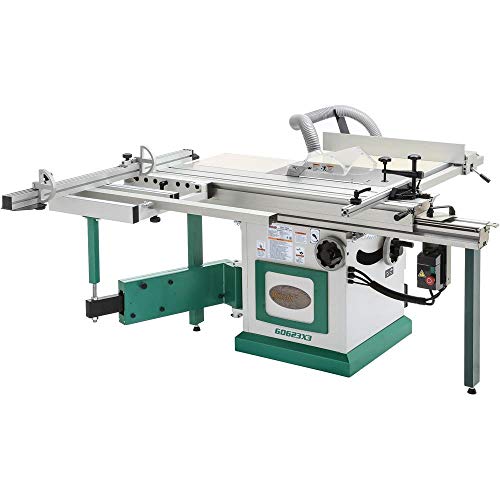
TL;DR: The Grizzly G0623X3 packs a 7 HP 3‑phase motor and a 60‑inch sliding table into a 566‑lb, 42‑inch‑tall machine, delivering heavy‑duty ripping power at a premium price.
The standout spec is the 7 HP 3‑phase motor, which professional reviewers say provides ample torque for hardwood ripping and full‑depth dado cuts. Coupled with a 10‑inch blade arbor of 5/8 inch, the saw can tilt the blade 0‑45 degrees, letting you tackle bevels without swapping tools. Its sliding table stretches approximately 60 inches, giving you a long, stable platform for sheet goods, while the built‑in scoring blade helps prevent tear‑out on plywood and melamine.
In the context of this nine‑product roundup, the G0623X3 is the heaviest option at 566 pounds, dwarfing the JET XACTA’s 510 pounds and the SawStop Contractor Saw’s 256 pounds. All other competitors sit under 260 pounds, many under 100 pounds, so Grizzly’s mass signals a shop‑floor class machine rather than a portable unit. Its footprint (42 inches high, 42 inches long, 45 inches wide) also outpaces the compact SKIL 5280‑01, which measures just 8.5 inches tall and 14.2 inches long.
User sentiment praises the motor’s quiet, steady power and the convenience of the long sliding table, especially for hobbyists moving up from contractor saws. However, owners frequently note the cast‑iron table’s flatness deviation of about 0.043 inch and the sheet‑metal extensions’ dip of roughly 0.013‑0.015 inch, issues that may require truing for precision work. Reviewers also point out that the cross‑cut capacity tops out at roughly 52 inches, meaning full 8‑foot sheets can’t be processed lengthwise without additional handling.
Pros
Cons
Best for: Those prioritizing quality and willing to pay for premium performance — the Grizzly G0623X3 offers Motor Power: 7 HP
Avoid if: You're on a tight budget or only need basic functionality
Breakdown
SKIL 5280-01
Pros
Makita HS0600
Pros
Cons
Metabo HPT C10RJS
Pros
Cons
SKIL TS6307
Pros
Cons
Based on scoring data and product specs
Personalized picks
Best Overall Pick
SKIL 5280-01
Best OverallBest for: Budget-conscious buyers seeking a reliable entry-level option — the SKIL 5280-01 offers Blade Teeth: 24
Makita HS0600
Best for: Budget-conscious buyers seeking a reliable entry-level option — the Makita HS0600 offers Motor Power: 2,000 W
Out of Stock
Skip Grizzly G0623X3 if…
You're on a tight budget or only need basic functionality
The SKIL 5280‑01 earns the top spot thanks to its unbeatable $69.00 price, a 4.7/5 rating from 14,314 reviewers, and a robust 5,300 RPM no‑load speed. Its 7‑1/4‑inch carbide‑tipped blade reaches 2‑7/16 in of depth at 90°, and the included bag and single‑beam laser guide make setup and cleanup a breeze.
Runner‑up Makita HS0600 shines when you need a larger cutting envelope. Its 10‑1/4‑inch blade delivers up to 3‑13/16 in depth at 90°, and a 50° bevel capacity handles aggressive angles. At 15.2 lbs it’s heavier, but the 2.5 m cord and auxiliary handles give you the reach and control for demanding job‑site work.
Pick the SKIL 5280‑01 for a powerful, pocket‑friendly rip saw that doesn’t compromise on core performance.
The SKIL 5280-01 packs a 2.5 HP motor, a 7‑1/4 in carbide‑tipped blade and a single‑beam laser guide for precise cuts, all for $69. Its compact size (8.5 in high, 14.2 in long) and safety‑locked trigger let you work in tight spaces without sacrificing the core features most users need.
No reviews yet — be the first to share your experience.
Please sign in to leave a review