⚡ Quick Answer
Choosing the right pressure washer pump can feel like a maze, especially when you’ve got everything from a $49.99 budget option to a $329.99 premium unit on the table. We’ve lined up 7 pumps—spanning the budget, mid‑range, and premium tiers—to help you see where performance, durability and price intersect. The VEVOR model, priced at $58.90 and backed by a 4.5‑star rating from 773 reviewers, packs a 3400 PSI maximum pressure and a 2.5 GPM flow rate, all on a lightweight 5.5 lb horizontal shaft.
On the budget side, the Toolcy ($49.99) and Biswing ($54.99) pumps both deliver 2.5 GPM at 3000‑3400 PSI, with standard seals and thermal relief valves. Mid‑range contenders include the VEVOR and Muturq ($66.29), the latter adding a pre‑filled oil system and a 3100 PSI cap. Premium choices—Hourleey ($179.99) and AAA ($329.99)—push pressures up to 4000 PSI and flow rates of 3.5 GPM, while the commercial‑grade CAT 66DX (no listed price) tops out at 4000 PSI, 3.5 GPM and features a modular regulating unloader.
Next, we’ll break down each pump’s specs, compatibility and real‑world strengths so you can match the right model to your cleaning projects.

VEVOR Pressure Washer Pump
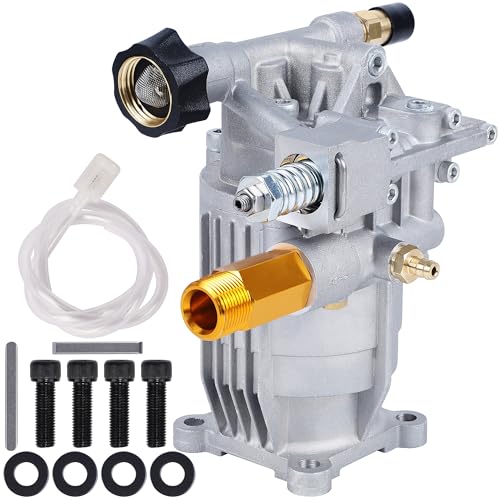
Includes four UNF5/16-24 x 1 bolts right out of the box, simplifying installation for most users.

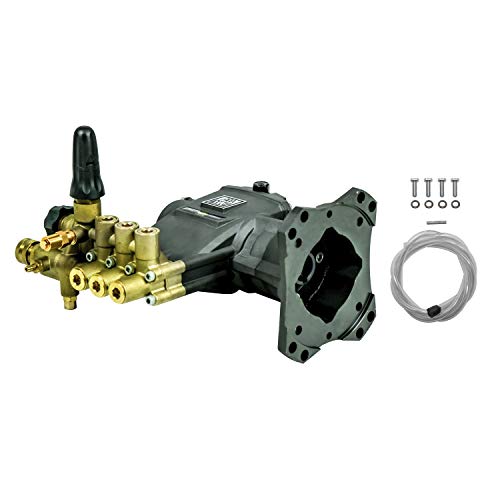
CAT 66DX
Ideal for professionals needing a 3.5 GPM flow and 4000 PSI output; price isn’t listed, so expect a premium over the $58.90 VEVOR model.

Toolcy Pressure Washer Pump
Stands out with a quick 5‑10 minute installation, letting you get to work faster than the higher‑pressure VEVOR or CAT units.
Also considered
TL;DR: The Toolcy Pressure Washer Pump delivers up to 3400 PSI and 2.5 GPM, fits most 180‑225 cc gas engines, and can be installed in just 5‑10 minutes for $49.99.
At the heart of this pump is an axial‑cam design that pushes a maximum of 3400 PSI while maintaining a steady 2.5 GPM flow rate. The horizontal 0.75‑inch shaft and direct‑drive configuration let it run at up to 3400 RPM, and the built‑in thermal relief valve adds a layer of safety. Installation is quick—most users report a 5‑10 minute setup—and the package includes three matched nozzle tips (0°, 25°, soap) for immediate use.
When you line it up with the other six contenders, Toolcy holds its own. Its 3400 PSI ceiling and 2.5 GPM flow match the Biswing and VEVOR units, while its 7.0‑inch height, 9.0‑inch length, and 8.0‑inch width make it slightly larger than VEVOR’s 7.08 × 8.26 × 7.08 inch package. Like VEVOR, it uses a 3/4‑inch shaft, but Toolcy’s weight isn’t listed, whereas VEVOR tips the scale at 5.5 pounds. Compared with Muturq, Toolcy is a touch shorter (7.0 in vs. roughly 7.8 in) and avoids the heavier 6.0‑pound build. Hourleey also offers 2.5 GPM at a similar shaft size but carries a heftier 13.3‑pound frame. The AAA 90039 pushes 3.5 GPM and 4000 PSI, but it sits in a far higher price tier and is built for larger engines.
Reviewers consistently praise the wide 2600‑3400 PSI operating range, noting it handles everything from light car washes to stubborn driveway grime. The pump’s compatibility with major brands such as Honda, Simpson, and Ryobi earns extra points, and the 4.7‑star rating from 596 reviewers underscores overall satisfaction. On the flip side, users point out the lack of a published weight, which can complicate mounting decisions, and the absence of adjustable pressure controls that some power‑washing pros expect. The pump’s 200‑hour operating lifespan and pre‑filled oil capacity are also highlighted as reliable, low‑maintenance traits.
Pros
Cons
Best for: Budget‑conscious buyers seeking a reliable entry‑level option — the Toolcy Pressure Washer Pump offers Installation Time: 5‑10 minutes
Avoid if: You need advanced features or professional‑grade performance
TL;DR: The VEVOR Pressure Washer Pump delivers 3400 PSI at 2.5 GPM, weighs just 5.5 lb, and fits 6.5‑7 HP engines, making it a high‑performance yet affordable replacement.
The pump’s headline spec is its 3400 PSI maximum pressure paired with a 2.5 GPM flow rate, giving you enough power to blast grime from driveways and decks. It’s built around a 0.75‑inch horizontal shaft and a one‑piece pump head, and it starts cold, which many users appreciate for reliability. At 5.5 lb, the unit is light enough to handle without a hoist, and its compact dimensions—7.08 in height, 8.26 in length, and 7.08 in width—fit comfortably in most residential pressure‑washer frames.
Compared with the seven other pumps in this roundup, VEVOR sits near the top of the value curve. It matches the Biswing pump’s 3400 PSI and 2.5 GPM output but is a touch pricier, while the Muturq unit is heavier and the Toolcy model lists fewer performance specs. The CAT 66DX pushes 4000 PSI and 3.5 GPM, yet it’s substantially bulkier, and the Hourleey and AAA 90039 pumps also offer higher pressure and flow but weigh over double the VEVOR’s 5.5 lb. In short, VEVOR gives you near‑top performance without the heavyweight and price premium of the larger models.
Reviewers consistently praise the pump’s strong pressure and the ease of swapping it into existing 6.5‑7 HP machines. Professional reviewers note the hardened plunger and metal shaft sleeve as signs of durable construction. A recurring theme in user feedback is the importance of confirming exact engine horsepower and shaft diameter before purchase, as a mismatch can cause fit headaches. The lack of published noise or heat‑tolerance data also leaves some uncertainty for prolonged use.
The unit works with a wide range of engines—including Honda, Simpson, RYOBI, Briggs & Stratton, Subaru, Craftsman, Homelite, and PowerStroke—so you won’t need a custom part for most small‑engine washers. It ships with four UNF5/16‑24 x 1 bolts, four D8 flat pads, four D8 spring washers, a detergent hose, and a shaft key, covering the basics you need for installation.
Pros
Cons
Best for: Most users looking for a well‑reviewed, reliable mainstream option — the VEVOR Pressure Washer Pump offers Included Bolts: 4 (UNF5/16-24 x 1)
Avoid if: You have a vertical‑shaft engine or need ultra‑high‑volume professional pressure beyond 3400 PSI
TL;DR: The Muturq 3/4" horizontal pump delivers 2.5 GPM at up to 3100 PSI, weighs 6.0 lb, and comes pre‑filled for lifetime, but costs more than many rivals.
What really sets this pump apart is its maintenance‑free design – the oil is pre‑filled for the lifetime of the unit, and a built‑in thermal relief valve helps keep temperatures in check. Together with a 120‑hour lifetime rating, the pump aims for long‑term reliability without regular oil changes.
Compared with the other six pumps in our roundup, the Muturq is a bit heavier at 6.0 lb versus the VEVOR’s 5.5 lb and lighter than the Hourleey’s 13.3 lb. Its height of 7.8 in is slightly taller than VEVOR’s 7.08 in, while its length of 7.5 in is shorter than VEVOR’s 8.26 in. Flow‑rate matches the VEVOR, Biswing and Hourleey at 2.5 GPM, but its maximum pressure of 3100 PSI sits below VEVOR’s and Biswing’s 3400 PSI.
Professional reviewers praise the OEM‑quality construction and the complete installation kit – a chemical hose with filter, mounting bolts and a shaft key – as a big convenience for DIY replacements. Users also note the clear advantage of a pre‑filled oil system, which eliminates routine maintenance. However, the listed price of $66.29 is higher than the sub‑$60 options from VEVOR and Biswing, and the 120‑hour lifetime rating may not suit continuous commercial use.
Pros
Cons
Best for: DIY homeowners and light professionals replacing failed OEM pumps on horizontal gas pressure washers – the Muturq offers a well‑reviewed, maintenance‑free solution with a solid 197 mm (7.8 in) height.
TL;DR: The Hourleey 3700 PSI, 2.5 GPM horizontal triplex pump delivers strong pressure for heavy‑duty cleaning, but its premium price and unverified durability make it a better fit for serious DIYers than for commercial fleets.
The standout spec is its 3700 PSI maximum pressure paired with a 2.5 GPM flow rate, driven by a triplex plunger design with ceramic plungers. A horizontal shaft configuration (0.75 in diameter) and brass head help it handle tough concrete or driveway jobs, while an adjustable unloader lets you fine‑tune output.
At 13.3 lb, the Hourleey pump is noticeably heavier than the VEVOR model (5.5 lb) and the Muturq unit (6.0 lb), yet it pushes a higher pressure—3700 PSI versus VEVOR’s 3400 PSI and Biswing’s 3400 PSI. It’s also lighter than the CAT 66DX (about 26.8 lb), positioning it in the middle of the weight spectrum while offering a premium pressure level.
Users praise the high cleaning power, noting it “punches above its weight” for deck and driveway work. However, several reviewers flag seal failures after 50–100 hours and shaft wobble if installation isn’t spot‑on. Professional reviewers highlight the ceramic plungers for wear resistance but caution that the lack of a verified thermal relief valve raises overheating concerns during prolonged use.
Additional technical touches include an oil change interval of every 60 hours, a sight‑glass oil level indicator, and a max inlet water temperature of 104 °F. The package ships with a detergent hose, shaft key, vent plug and a set of four D8 flat washers, giving you most of what you need for a quick install.
Pros
Cons
Best for: Those prioritizing quality and willing to pay for premium performance — the Hourleey Pressure Washer Pump offers Flow Rate: 2.5 GPM
“Punches above its weight for the spec—blasted years of grime off my deck”
TL;DR: The Biswing BPW-3400 delivers 3400 PSI at 2.5 GPM, fits 6.5‑7 HP engines, and comes with essential accessories for a budget‑friendly cold‑water pressure‑washer build.
This pump’s headline spec is a maximum pressure of 3400 PSI, driven by a 0.75‑inch horizontal axial plunger design. A built‑in thermal relief valve adds a layer of safety, and the inlet and outlet ports (3/4" NH and M22‑14) match common washer setups. The flow rate is listed at 2.5 GPM, which is adequate for most residential cleaning tasks.
Compared with the other six models in this roundup, the Biswing shares the 3400 PSI rating and 2.5 GPM flow rate of the VEVOR pump, but VEVOR’s weight is documented at 5.5 pounds while Biswing’s weight isn’t listed. The Toolcy unit does not list a flow rate, making Biswing’s performance data more transparent. Muturq also offers a thermal relief valve but is heavier at 6.0 pounds, and the Hourleey pump provides similar flow at a much higher price point.
User sentiment is reflected in a 4.5‑star average from 206 reviews, with buyers praising the strong pressure output and the convenience of included bolts, a detergent hose, flat pads, and shaft keys. A recurring note mentions uncertainty about the exact flow rate, and the lack of weight and dimension specs makes planning the pump’s placement a bit trickier. Professional reviewers highlight the pump’s compatibility with engines sized 180‑225 cc (6.5‑7 HP), which aligns with many mid‑range pressure‑washer engines.
Pros
Cons
Best for: Entry‑level buyers or those on a tight budget — the Biswing Pressure Washer Pump offers Flow Rate: 2.5 GPM.
Avoid if: You need advanced features or professional‑grade performance.
TL;DR: The AAA 90039 delivers a professional‑grade 4000 PSI, 3.5 GPM output with PowerBoost technology, but its $329.99 price and 14‑lb weight make it a premium choice for serious gas‑engine users.
This pump’s standout spec is its 4000 PSI maximum operating pressure paired with a 3.5 GPM flow rate, both listed under the Performance section. The horizontal triplex plunger design, combined with a 1.0‑inch hollow shaft and dual oversized radial ball bearings, gives it a robust build that can handle demanding cleaning jobs.
Compared with the six other pumps in our roundup, the AAA 90039 tops the pressure chart: VEVOR and Biswing cap at 3400 PSI, while the CAT 66DX matches the 4000 PSI figure but weighs 26.8 lb, nearly double the AAA’s 14.0 lb. Flow‑rate-wise, the AAA’s 3.5 GPM outpaces VEVOR’s 2.5 GPM and Hourleey’s 2.5 GPM, though it is heavier than the 5.5‑lb VEVOR and the 6.0‑lb Muturq units. Shaft‑diameter-wise, the AAA uses a 1.0‑inch shaft, whereas Muturq lists a 19 mm shaft, indicating a larger bore for the AAA.
User sentiment highlights the pump’s reliability and the ease of oil monitoring via a sight‑glass system. Professional reviewers praise the PowerBoost technology for boosting nozzle pressure and the forged‑brass head with ceramic‑coated pistons for durability. However, many owners note that the pump demands a minimum 11 HP engine to reach its rated performance, and the 22‑lb shipping weight often requires two‑person handling during installation.
Pros
Cons
Best for: Professional or semi‑pro users who need high pressure and flow, and are willing to invest in a premium pump – the AAA 90039 offers an oil capacity of 11 fl oz.
Avoid if: You have a pressure washer with less than 11 HP, prioritize lightweight components, or are sensitive to lower overall ratings.
TL;DR: The CAT 66DX delivers a robust 4000 PSI, 3.5 GPM output in a rugged triplex plunger design, earning a perfect 5‑star rating from 20 reviewers despite its heavier build.
The pump’s headline spec is a maximum pressure of 4000 PSI paired with a flow rate of 3.5 GPM, which puts it at the top of the pressure range for commercial washers. It runs on a direct‑drive, triplex‑plunger mechanism and features solid ceramic plungers, a brass manifold and a 304 stainless‑steel valve, all sealed with an NBR system. A built‑in thermal relief valve and a modular regulating unloader with a chemical injector add safety and flexibility for tough cleaning jobs.
Compared with the six other pumps in this roundup, the CAT 66DX is considerably heavier at 26.8 lbs, while the VEVOR model weighs just 5.5 lbs and the Muturq and Hourleey units sit around 6.0 lbs and 13.3 lbs respectively. Its 1‑inch shaft diameter also exceeds the 0.75‑inch shafts on the Biswing and VEVOR pumps. In terms of pressure, the CAT’s 4000 PSI tops the VEVOR, Biswing and AAA models, which cap at 3400 PSI, and its flow of 3.5 GPM outpaces the 2.5 GPM figures listed for those competitors. The overall dimensions of 11.73 × 10.51 × 8.15 in make it larger than the Toolcy pump’s 7.0‑inch height and 9.0‑inch length.
Reviewers consistently praise the pump’s high‑pressure capability and its durable construction, noting that it handles demanding commercial cleaning without faltering. The perfect 5.0‑star rating from 20 users underscores confidence in its performance. However, users also flag that the pump requires an 11‑13 HP gas engine, limiting compatibility with smaller engines, and that it does not offer adjustable pressure control, which can be a drawback for delicate surfaces. The oil capacity of 0.5625 quarts and the 0.5‑inch inlet and 0.375‑inch outlet ports round out a spec sheet that feels engineered for heavy‑duty use.
Pros
Cons
Best for: Users with specific technical requirements or compatibility needs — the CAT 66DX offers Flow Rate: 3.5 GPM.
Avoid if: You have limited desk space or need portability
Breakdown
VEVOR Pressure Washer Pump
Pros
CAT 66DX
Pros
Toolcy Pressure Washer Pump
Pros

Hourleey Pressure Washer Pump
Pros
Based on scoring data and product specs
Personalized picks
Best Overall Pick
VEVOR Pressure Washer Pump
Best Mid-Range PickBest for: Most users looking for a well-reviewed, reliable mainstream option — the VEVOR Pressure Washer Pump offers Included Bolts: 4 (UNF5/16-24 x 1)
CAT 66DX
Best for: Users with specific technical requirements or compatibility needs — the CAT 66DX offers Flow Rate: 3.5 GPM
$749.99+$691.09 vs winner
Skip Biswing Pressure Washer Pump if…
You need advanced features or professional-grade performance
The VEVOR Pressure Washer Pump takes the top spot, thanks to a solid 3400 PSI maximum pressure, a respectable 2.5 GPM flow rate, and a lightweight 5.5 lb build that makes installation and handling easy. Its one‑piece pump head and cold‑start design add durability without extra maintenance, while the 0.75‑inch horizontal shaft keeps the unit compatible with a wide range of 6.5‑7 HP engines.
The CAT 66DX lands as runner‑up, ideal for demanding commercial jobs where you need that extra punch. With a 4000 PSI ceiling and a 3.5 GPM flow rate, it out‑pressurizes most residential units, and its robust 26.8 lb construction can handle continuous heavy use. Check the current price if you’re considering this high‑pressure workhorse.
Looking beyond the top three, the Toolcy Pressure Washer Pump at $49.99 offers the best budget entry point for occasional home cleaning, while the AAA 90039 at $329.99 serves as the premium option for users who want the highest‑end features and are willing to invest more. The VEVOR remains the best mid‑range pick, balancing cost and capability.
Pick the VEVOR Pressure Washer Pump today and get professional‑grade power without breaking the bank.
At $58.90 the VEVOR delivers 3400 PSI of pressure, a 2.5 GPM flow rate and a lightweight 5.5 lb build. Its 0.75 in horizontal shaft, cold‑start design and one‑piece pump type give it a durable, maintenance‑free feel that outmatches many pricier rivals.
No reviews yet — be the first to share your experience.
Please sign in to leave a review