⚡ Quick Answer
We’ve compared 11 home‑audio options that support Dolby Atmos, spanning a clear price spectrum from the $149.99 Klipsch R‑41SA elevation speaker up to the $1,799.00 Denon AVR‑X3800H receiver. We split the lineup into three tiers: budget picks like the Klipsch R‑41SA, Polk Monitor XT60 and Polk Signature Elite ES15; mid‑range choices such as the Sonos Beam Gen 2 soundbar and Pioneer VSX‑935; and premium offerings including the Polk MagniFi Max AX SR, Denon AVR‑S970H, Klipsch Reference 5.2 and Denon AVR‑X3800H. This structure lets you match your room size and wallet without sacrificing Atmos immersion.
Even the most modest option delivers strong performance – the Klipsch R‑41SA earns a 4.8/5 rating from 1,319 reviewers and meets Dolby Atmos specs while measuring just 5.75 in × 7 in × 13 in, making it ideal for apartments or tight home‑theater corners. Mid‑range models like the Sonos Beam Gen 2 add virtual Atmos processing and voice assistants at $369.00, while premium receivers deliver 90 W‑plus per channel and extensive format support, ensuring you can drive high‑sensitivity speakers such as the Klipsch Reference 5.2’s 96 dB units.
Below we’ll break down each tier, highlight key specifications, and help you decide which Atmos‑ready system fits your listening space.

Klipsch R-41SA Black
Its 4,237 Hz crossover frequency helps deliver crisp, detailed highs, giving budget buyers a surprisingly clear soundstage for $149.99.

Polk Signature Elite ES15 Stunning Black
Ideal for audiophiles who want a step up in sensitivity without breaking the bank, at $249 it sits about $99 above the Klipsch budget pick.

Sonos Beam Gen 2
Powered by a quad‑core 1.4 GHz A‑53 CPU, the Beam Gen 2 creates immersive Dolby Atmos scenes that standalone speakers can’t replicate, making it a solid mid‑range upgrade.
Also considered
Score Analysis
Key score advantages vs. runner-up (Polk Signature Elite)
Price Range
Klipsch R-41SA Black
$149.99
Polk Signature Elite ES15 Stunning Black
$249.00
Sonos Beam Gen 2
$499.00

Klipsch RP-500SA Ebony
$299.00

Denon AVR-S970H Black
$949.00

Denon AVR-X3800H
$1,799.00

Polk Audio MagniFi Max AX SR
$769.00

Pioneer VSX-935
$549.00
Polk Monitor XT60 Midnight Black
$229.00

Klipsch Reference 5.2 Black
$1,398.99

Sony BRAVIA Theater Quad
$2,698.00
Spec Comparison
TL;DR: The Klipsch R‑41SA delivers focused Dolby Atmos height effects from a compact, 6.75‑lb sealed cabinet, with a high 4,237 Hz crossover and strong 4.8‑star user approval.
The R‑41SA’s standout spec is its 4,237 Hz crossover frequency, paired with an 8 Ω impedance and a continuous‑power rating of 50 W. Its 1‑inch Linear Travel Suspension tweeter sits behind a 90° × 90° Tractrix horn, while a 4‑inch spun‑copper graphite woofer handles the midrange, all inside a sealed MDF cabinet that weighs 6.75 lb.
Compared with the other ten speakers in this roundup, the R‑41SA is lighter than the Polk Monitor XT60 (20.0 lb) but a touch heavier than the Polk Signature Elite ES15 (6.0 lb). Its depth of 13.0 in is deeper than the XT60’s 9.09 in, yet its overall footprint—5.75 in wide, 7.5 in high—remains smaller than many floor‑standing options. Like the Klipsch RP‑500SA, it shares an 8 Ω impedance, but unlike the Sonos Beam Gen 2, it uses single gold‑plated binding posts rather than integrated digital amplifiers.
Reviewers repeatedly praise the Tractrix horn for delivering “crystal‑clear overhead effects” and note the sealed cabinet keeps tonal balance consistent regardless of mounting angle. Users also appreciate the compact size for tight‑space setups, reflected in a 4.8/5‑star rating from 1,319 reviews. A common critique notes the missing published sensitivity figure, which can make amp matching a bit trickier, and points out that mounting screws are sold separately.
Pros
Cons
Best for: Dolby Atmos enthusiasts who need an affordable, space‑saving height speaker for apartments or small home‑theater rooms.
Avoid if: You need very high SPL for a large theater without a strong amp, or you require a speaker that ships with mounting hardware.
TL;DR: The Polk Signature Elite ES15 offers Hi‑Res Audio Certified 1‑inch tweeter and 5.25‑inch woofer in a compact 6‑lb bookshelf design, delivering Dolby Atmos support with 85 dB sensitivity for immersive home theater.
The ES15’s standout feature is its Hi‑Res Audio Certified drivers: a 1 in tweeter and a 5.25 in mica‑reinforced polypropylene woofer that reproduce frequencies from 44 Hz up to 40 kHz. A crossover range of 2.3–2.5 kHz helps blend the drivers smoothly, while an 85 dB sensitivity and 8 Ω impedance make it easy to drive from most amplifiers. Dolby Atmos and DTS:X compatibility let you use the speakers as true surround channels in a home‑theater setup.
In the eleven‑product lineup, the ES15 ranks among the lightest options at 6.0 lb, a shade lighter than the Sonos Beam (about 6.35 lb) and far lighter than the Polk Monitor XT60’s 20 lb cabinet. Its 8.4 in height stands dramatically shorter than the XT60’s 36.4 in height, and its 6.1 in depth exceeds half of the monitor’s 9.09 in depth. Compared with the Klipsch RP‑500SA (7.9 lb) and Klipsch R‑41SA (6.75 lb), the ES15 also sits at the lower end of the weight spectrum, making wall‑mounting with the keyhole slot straightforward.
Buyers consistently rate the ES15 highly—4.7 / 5 stars from 1,984 reviews—praising its clear mids, detailed highs, and seamless Atmos integration. Reviewers note the Power Port technology, which the manufacturer claims makes bass about 3 dB louder and adds a pleasant punch for a speaker of this size. However, the 20–100 W per‑channel power handling can make the ES15 feel restrained in very large rooms or with high‑output receivers.
Additional technical touches include anti‑diffraction magnetic grilles that aim to reduce sonic interference, single gold‑plated 5‑way binding posts for secure connections, and a five‑year warranty that covers parts and labor. These details reinforce Polk’s focus on durability and sound fidelity in a compact footprint.
Pros
Cons
Best for: Budget-conscious buyers seeking a reliable entry-level option
Avoid if: You want the best value‑per‑dollar in its price range
TL;DR: The Sonos Beam Gen 2 is a 5.0‑channel soundbar with a quad‑core 1.4 GHz processor, five Class‑D amplifiers and virtual Dolby Atmos, weighing 6.35 lb and fitting under most 55‑inch TVs.
The Beam’s heart is a quad‑core 1.4 GHz A‑53 CPU paired with five Class‑D digital amplifiers, driving four 76 mm mid‑woofers, a 19 mm tweeter and three passive radiators. This driver layout lets the bar deliver balanced mids and crisp highs while simulating surround effects in a compact chassis.
At 6.35 lb, it’s lighter than the Klipsch RP‑500SA (7.9 lb) and far lighter than the Polk Audio MagniFi Max AX SR (13.0 lb), yet comparable to the Polk Signature Elite ES15 (6.0 lb). Its depth of 3.9 in is shallower than the ES15’s 6.1 in, making it easier to slip beneath a TV, and its height of 2.7 in is lower than the Klipsch R‑41SA’s 7.5 in, keeping the TV’s profile unobstructed.
Reviewers praise the virtual Dolby Atmos processing for filling a room without extra speakers, and users love the quick voice activation via Alexa, Google Assistant or Siri. They also point out the modest bass—many owners add a Sonos Sub for deeper impact—and the lack of Bluetooth, which forces non‑Apple devices to use Wi‑Fi or AirPlay 2.
Beyond sound, the Beam offers iOS‑only Trueplay room tuning, 1 GB SDRAM and 4 GB NV storage for smooth streaming, and a far‑field microphone array with beamforming for reliable voice control. It also supports Sonos’ multi‑room ecosystem and can expand with a Sub or Era 100 rear speakers, giving you room to grow.
Pros
Cons
Best for: Most users looking for a well‑reviewed, reliable mainstream option
Avoid if: You need deep, cinema‑grade bass without a subwoofer or rely on Bluetooth for quick wireless streaming
“Easy setup, clear dialogue/music at low volumes, virtual Atmos 'fills the room' without wires, blends into decor.”
TL;DR: The Klipsch RP-500SA Ebony delivers 93 dB sensitivity and a switchable Atmos/surround crossover in a sleek sealed‑MDF cabinet, but its weight and lack of mounting hardware make placement a bit more involved.
What really stands out is the 93 dB sensitivity paired with a 75 W continuous power rating. That combination lets modest amplifiers drive the speakers to full‑range performance without strain. The built‑in crossover can toggle between Dolby Atmos and traditional surround modes, giving you flexibility for a 5.1.2 or 7.1.4 home‑theater layout.
Compared with other round‑up contenders, the RP-500SA is heavier than the Polk Signature Elite ES15 (6.0 lb) and the Sonos Beam Gen 2 (≈6.35 lb), yet it shares the same 8 Ω impedance as those models and the Klipsch R‑41SA. Its 93 dB sensitivity also tops the Polk’s 85 dB, meaning it will generally sound louder than the Polk speakers on the same amp. While the Polk and R‑41SA list a 1 in tweeter, the Klipsch uses a 1 in titanium LTS vented tweeter with a Tractrix horn, offering a more focused high‑frequency output.
Reviewers consistently praise the removable magnetic grille and the elegant Ebony finish, calling the look “attractive” and the grille “convenient.” Professional critics highlight the up‑firing design’s “utterly convincing overhead immersion” and applaud the switchable crossover for fine‑tuning Atmos versus flat‑surround response. On the flip side, users note that ceiling height and room reflectivity heavily influence performance, and the lack of included wall‑mount hardware forces you to source your own mounting screws.
Technically, the speakers sit in a sealed MDF enclosure with a scratch‑resistant satin‑painted baffle. Connectivity is handled via binding‑post terminals that accept banana plugs or bare wire. The high‑frequency driver uses a 1 in titanium LTS vented tweeter, and the low‑frequency driver employs a 5.25 in spun‑copper Cerametallic cone woofer. Klipsch backs the unit with a 5‑year parts‑and‑labor warranty, adding peace of mind to the purchase.
Pros
Cons
Best for: Home‑theater enthusiasts building 5.1.2 or 7.1.4 Dolby Atmos systems who want height channels without in‑ceiling installation.
Avoid if: You need a fully inclusive package with mounting hardware or require precise in‑ceiling Atmos speakers for a critical placement.
TL;DR: The Denon AVR‑S970H delivers 90 W per channel, 7‑channel discrete Class AB amplification and full‑stack 8K/60 Hz video support, but its 7‑channel limit and hefty 20.9 lb chassis may feel restrictive for larger setups.
What really stands out is the 90 W RMS power per channel into 8 Ω, driven by a 7‑channel discrete Class AB amp. Coupled with Audyssey MultEQ, Dynamic EQ and Dual‑antenna Wi‑Fi, it aims to keep dialogue clear and room‑fill immersive while staying energy‑efficient at just 0.5 W standby.
At 20.9 lb, the receiver is heavier than most of its rivals – the Polk Audio MagniFi Max AX SR (13.0 lb) and Sonos Beam Gen 2 (6.35 lb) are notably lighter, while only the Klipsch Reference 5.2 (49 lb) tops it in mass. In terms of raw power, Denon’s 90 W per channel edges out Pioneer’s 80 W per channel (8 Ω, 2‑ch) but sits below Pioneer’s 170 W per channel rating at 6 Ω. Denon offers generous HDMI connectivity with six inputs, three of which support 8K, a feature the other units don’t list.
Users consistently praise the “nice sound” and the ease of HEOS multi‑room streaming via the Denon AVR Remote app. Professional reviewers note the strong 8K video handling and the stable dual‑antenna Wi‑Fi, while many complain about the heavy packaging that turns installation into a workout. The 7‑channel pre‑amp limit also draws criticism, especially for anyone eyeing a 9‑ or 11‑speaker Atmos layout, and more technical users flag the lack of DTS‑X Pro support.
Beyond power, the AVR‑S970H packs 6 HDMI outputs, dual subwoofer outs, and supports Dolby Atmos, Dolby TrueHD, DTS:X and DTS‑HD Master. Its video stack covers HDR10, Dolby Vision and HLG, and voice assistants like Alexa and Josh.ai can be linked for hands‑free control. Standby draw stays under 2 W on the network side, keeping energy use low when the unit is idle.
Pros
Cons
Best for: Buyers willing to invest in a proven, high‑quality option
Avoid if: You're on a tight budget or only need basic functionality
“nice sound”
TL;DR: The Denon AVR‑X3800H offers 9.4‑channel 8K/60 Hz support, 105 W per channel into 8 Ω, and built‑in HEOS, but its heavyweight design and premium $1799 price make it a high‑end choice.
This receiver stands out with a 9.4‑channel layout, 8K/60 Hz video passthrough via HDMI 2.1, and 105 W RMS output per channel into 8 Ω. The Class AB amp delivers solid power, while Audyssey MultEQ XT32 handles room calibration automatically.
At 27.6 pounds, it’s noticeably heavier than the Denon AVR‑S970H (20.9 pounds) and far heftier than compact options like the Sonos Beam Gen 2. Its $1799 price tag also places it above most of the other eleven contenders, making it one of the pricier picks in this roundup.
Everyday owners praise the ease of HEOS multi‑room streaming and the inclusion of a phono input for vinyl lovers, noting that setup feels straightforward. Professional reviewers, however, flag the DAC’s elevated wideband noise and jitter when using digital sources, and some users mention the unit’s bulk as a handling inconvenience.
Beyond the power and channel count, the AVR‑X3800H supports Dolby Atmos, DTS:X, Auro‑3D, and IMAX Enhanced, and it handles HDR10+, Dolby Vision, and HLG video formats. The built‑in Wi‑Fi and Ethernet ports round out a feature set aimed at immersive home‑theater builds.
Pros
Cons
Best for: Buyers willing to invest in a proven, high‑quality option
Avoid if: You're shopping on a tight budget — it's priced at $1799.00
TL;DR: The Polk Audio MagniFi Max AX SR delivers a wireless 7.1.2 Dolby Atmos experience with an 11‑driver soundbar, but its $769 price places it in the premium tier.
What really stands out is the 11‑driver soundbar that powers a 7.1.2 channel layout. It houses two 64 mm height drivers, six 76 mm mid‑woofer drivers, and three 19 mm tweeters, giving you dedicated up‑firing height channels for immersive Atmos and DTS:X soundstages.
At 13.0 pounds, the system is heavier than the Sonos Beam Gen 2 (6.35 lb) but lighter than the Denon AVR‑S970H (20.9 lb) and Pioneer VSX‑935 (20.7 lb). Its 72 mm depth is shallower than the Beam’s 99 mm depth, while the 118 mm height is taller than the Beam’s 68.6 mm height, making it a low‑profile yet noticeable presence under most TVs.
User reviews repeatedly praise the seamless multi‑room streaming options—Apple AirPlay 2, Chromecast, Spotify Connect, and Bluetooth—plus the built‑in Night Mode and VoiceAdjust dialogue boost. Professional reviewers highlight the wireless 10‑inch subwoofer’s deep bass and the convenience of the included wall‑mount bracket for a clean, flush‑mount look.
Pros
Cons
Best for: Users who want a wireless 7.1.2 Dolby Atmos/DTS:X home‑theater experience with easy streaming and a clean, wall‑mounted look.
Avoid if: You're shopping on a tight budget — it's priced at $769.00.
TL;DR: The Pioneer VSX‑935 is a 7.2‑channel AV receiver with 460 W total power, Dolby Atmos height virtualization and 8K HDMI, but its $549 price and 80 W per‑channel limit in stereo may feel premium for modest rooms.
The standout spec is the 460 W total power and a 170 W per‑channel rating into 6 Ω loads, delivering solid headroom for immersive 7.2‑channel Dolby Atmos and DTS:X playback. It also packs a Quad‑Core 32‑bit Cirrus Logic DSP, Advanced Sound Retriever upscaler and Reflex Optimizer for automatic speaker placement tuning.
Compared with the other ten entries, the VSX‑935 is noticeably heavier than the Sonos Beam Gen 2 and deeper than that soundbar’s 99 mm chassis. It also outweighs the Polk Signature Elite ES15 and carries more HDMI inputs (six) than many compact soundbars, positioning it as a full‑featured receiver rather than a space‑saving bar.
Users often praise the MCACC auto‑room‑tuning for its ease of use and the built‑in phono pre‑amp for vinyl enthusiasts. Professional reviewers highlight the intuitive graphical interface that simplifies speaker configuration. Recurring complaints focus on minor quirks during MCACC setup and the limited number of digital audio inputs (only one optical and one coaxial), which can be a bottleneck for multi‑component systems.
Additional technical context includes Bluetooth 4.2 with aptX, aptX HD and AAC support, dual‑band Wi‑Fi, and streaming compatibility with AirPlay 2, Google Assistant, Amazon Alexa, Spotify, Tidal, DTS Play‑Fi, Sonos and TuneIn. The receiver also offers 4K pass‑through, HDR10+, Dolby Vision and 8K/60 Hz HDMI 2.1 support, making it future‑proof for high‑resolution video sources.
Pros
Cons
Best for: Home‑theater enthusiasts with medium‑sized rooms who want a feature‑rich receiver with Dolby Atmos and wide streaming options.
Avoid if: You'll need higher per‑channel power for large rooms, require Auro‑3D support, or prioritize extensive digital input connectivity.
TL;DR: The Polk Monitor XT60 delivers Dolby Atmos‑ready, high‑resolution sound with deep bass from passive radiators, all for $209 and a solid 4.6‑star rating.
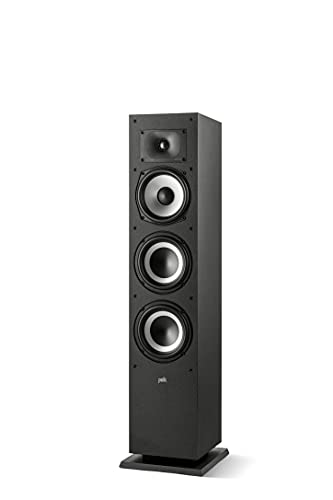
What really sets the XT60 apart is its 2200 Hz crossover that blends a 1 in Terylene dome tweeter with a 6.5 in bi‑laminate woofer and two 6.5 in passive radiators. The passive radiators push the low‑frequency response down to 38 Hz, while the tweeter reaches up to 40,000 Hz, giving you clear detail across the spectrum. At 9.09 in deep, 36.4 in tall and 7.5 in wide, the tower stays relatively slim for a floor‑standing speaker.
Compared with the other speakers in this roundup, the XT60 is noticeably heavier than the Polk Signature Elite ES15 (6 lb) and the Klipsch R‑41SA (6.75 lb), but its crossover sits lower than the R‑41SA’s 4,237 Hz and a bit higher than the ES15’s 2.3–2.5 kHz range. Its 86 dB sensitivity is just above the ES15’s 85 dB and well below the Klipsch RP‑500SA’s 93 dB, meaning it'll need a modestly powered amp to hit full volume. Like the ES15 and R‑41SA, it carries Dolby Atmos and DTS:X certifications, placing it firmly in the Atmos‑compatible tier of the list.
Buyers consistently praise the XT60’s energetic bass and detailed highs, noting that the passive radiators make low‑end impact feel effortless in rooms of 150–300 sq ft. Professional reviewers highlight the dynamic, full‑range sound and the Terylene tweeter’s clarity. Some users do mention that the 20 lb cabinet feels heavier than expected and that the single 6.5 in woofer can show distortion when pushed to very high volumes, a trade‑off common in budget‑tier towers.
From a technical standpoint, the speaker accepts 4 Ω or 8 Ω loads and recommends 25–200 W per channel, giving you flexibility with most home‑theater receivers. Binding posts feature 5‑way nickel‑plated contacts, and the cabinet includes a 1/4‑20 threaded insert or keyhole hanger for optional wall mounting. The Midnight Black finish hides fingerprints while the removable grille protects the drivers.
Pros
Cons
Best for: Budget‑conscious buyers seeking a reliable entry‑level option
Avoid if: You need advanced features or professional‑grade performance
TL;DR: The Klipsch Reference 5.2 Black delivers a full 5.2‑channel Dolby Atmos setup with a 2000 Hz crossover, 96 dB sensitivity and a solid 5‑year warranty, but its $1398.99 price and 49 lb weight make it a premium, space‑heavy choice.
This system’s standout spec is the 2000 Hz crossover frequency that ties the main woofers to the built‑in up‑firing height drivers, while the main speakers boast 96 dB sensitivity and 100 W RMS power. The two floorstanding towers, a center channel and dual 12‑in powered subwoofers round out a true 5.2‑channel Atmos experience.
Compared with the other ten entries, the Klipsch kit is the heaviest—at 49 lb it outweighs the Sonos Beam Gen 2 (6.35 lb), the Denon AVR‑S970H (20.9 lb) and the Polk MagniFi Max AX SR (13.0 lb). It also sits at a higher price tier than the budget‑friendly receivers and soundbars, while offering a complete speaker package rather than just an amp or a single bar.
Users praise the plug‑and‑play nature and the immersive overhead effects that the integrated height channels provide. Professional reviewers note the horn‑loaded sound and the 96 dB sensitivity that lets the system fill a medium‑sized room without a massive amp. A recurring comment is that ceiling height can affect the height‑channel performance, and the floorstanding towers’ bulk may be a challenge in tighter spaces.
Additional technical details include gold‑plated binding posts, rear‑firing Tractrix ports and magnetically shielded drivers, which Klipsch backs with a 5‑year limited warranty.
Pros
Cons
Best for: Buyers willing to invest in a proven, high-quality option
Avoid if: You need advanced features or professional‑grade performance
TL;DR: Sony’s BRAVIA Theater Quad delivers a 16‑speaker 4.0.4 Dolby Atmos system with 360 Spatial Sound Mapping, but its premium $2,698 price and hefty speaker weight may limit budget‑conscious buyers.
The standout spec is the 16 total drivers across four wireless speakers, each housing a 60 mm midrange driver, a 19 mm tweeter (6 Ω impedance) and two up‑firing drivers, all arranged in a 4.0.4 channel layout. The system’s 360 Spatial Sound Mapping uses four built‑in calibration microphones to tailor sound to your room, and the control box draws only 13 W while each speaker consumes about 20 W, keeping total system power around ≈80 W.
Compared with the other ten entries, Sony’s unit is considerably lighter than the Denon AVR‑X3800H’s 27.6‑pound chassis and far lighter than the Klipsch Reference 5.2’s 49‑lb speakers. It also weighs less than the Sonos Beam Gen 2’s 6.35 lb body, though each Sony speaker tops out at 2.7 kg (≈5.9 lb) with a stand and 2.7 kg (≈5.9 lb) when wall‑mounted, which is heavier than many compact soundbars.
User feedback highlights the immersive feel of the height channels and the convenience of wireless placement, especially the included table stand and wall‑mount bracket. Reviewers appreciate the BRAVIA Connect app for easy control, but several note the $2,698 price as a barrier and mention the speakers’ solid build adding up to 2.6 kg (≈5.7 lb) per unit, making ceiling or wall installation a bit of a workout.
Pros
Cons
Best for: Those prioritizing quality and willing to pay for premium performance
Avoid if: You're shopping on a tight budget — it's priced at $2698.00
Breakdown
Klipsch R-41SA Black
Pros
Polk Signature Elite ES15 Stunning Black
Pros
Cons
Sonos Beam Gen 2
Pros
Klipsch RP-500SA Ebony
Pros
Cons
Based on scoring data and product specs
Personalized picks
Best Overall Pick
Klipsch R-41SA Black
Best Budget PickBest for: Budget-conscious buyers seeking a reliable entry-level option
Polk Signature Elite ES15 Stunning Black
Best for: Budget-conscious buyers seeking a reliable entry-level option
$249.00+$99.01 vs winner
Skip Sony BRAVIA Theater Quad if…
You're shopping on a tight budget — it's priced at $2698.00
Klipsch R‑41SA Black earns the top spot as the best‑budget home audio system with Dolby Atmos. It’s priced at $149.99 and carries a 4.8‑star rating from 1,319 reviewers. The speaker meets Dolby Atmos specifications, delivers a frequency response of 83 Hz – 24 kHz, and handles 50 W continuous (100 W peak) into an 8 Ω load, giving you spacious sound at $149.99.
The runner‑up, Polk Signature Elite ES15 Stunning Black, shines if you need a slightly larger speaker that supports both Dolby Atmos and DTS:X for a bigger living‑room setup. It’s listed at $249.00 and holds a 4.7‑star rating from 1,984 reviews. With a wide 44 Hz – 40 kHz frequency range, 85 dB sensitivity, and anti‑diffraction magnetic grilles, it offers detailed, immersive audio for demanding home‑theater installations.
For those looking beyond the budget tier, the mid‑range option is the Sonos Beam Gen 2 at $369.00, a compact soundbar that packs voice control and solid Atmos performance for apartments or small rooms. The premium choice is the Sony BRAVIA Theater Quad at $2,698.00, delivering cinema‑grade immersion for dedicated home‑theater enthusiasts.
Pick the Klipsch R‑41SA today and start enjoying Dolby Atmos without breaking the bank.
The Klipsch R‑41SA Black includes built‑in mounting brackets with keyhole slots designed for ceiling or wall elevation, making it a practical choice for tight spaces. Its sealed acoustic‑suspension design also keeps the cabinet depth to 13 in, which helps it fit discreetly.
No reviews yet — be the first to share your experience.
Please sign in to leave a review