⚡ Quick Answer
If you want music that follows you from kitchen to bedroom without a tangled web of cables, a Wi‑Fi‑enabled multi‑room system's the answer. We compared six options that cover the whole price spectrum—from the $219.00 Denon Home 150 NV in the budget camp to the $949.00 Sonos One SL at the premium end. Each model ships with its own app‑driven streaming stack and a rating that reflects how owners feel about daily use.
The premium Sonos Sub 4, priced at $899.00, pushes a 25 Hz low‑frequency response and carries a 4.7‑star rating from 447 reviewers, making it a strong candidate for large‑room bass reinforcement. Mid‑range contenders like the Marantz NR1510 Black ($700.00, 4.4‑star, 85 W single‑channel output) and Yamaha YHT‑5960U ($649.00, 4.2‑star) balance power and compactness. On the budget side, the Yamaha MusicCast 20 delivers 40 W of output for $279.95 and holds a solid 4.0‑star score, while the Denon Home 150 NV offers high‑resolution playback at $219.00.
Below we outline how each tier is rated in real homes, so you can match the system that fits your space, listening habits, and budget.

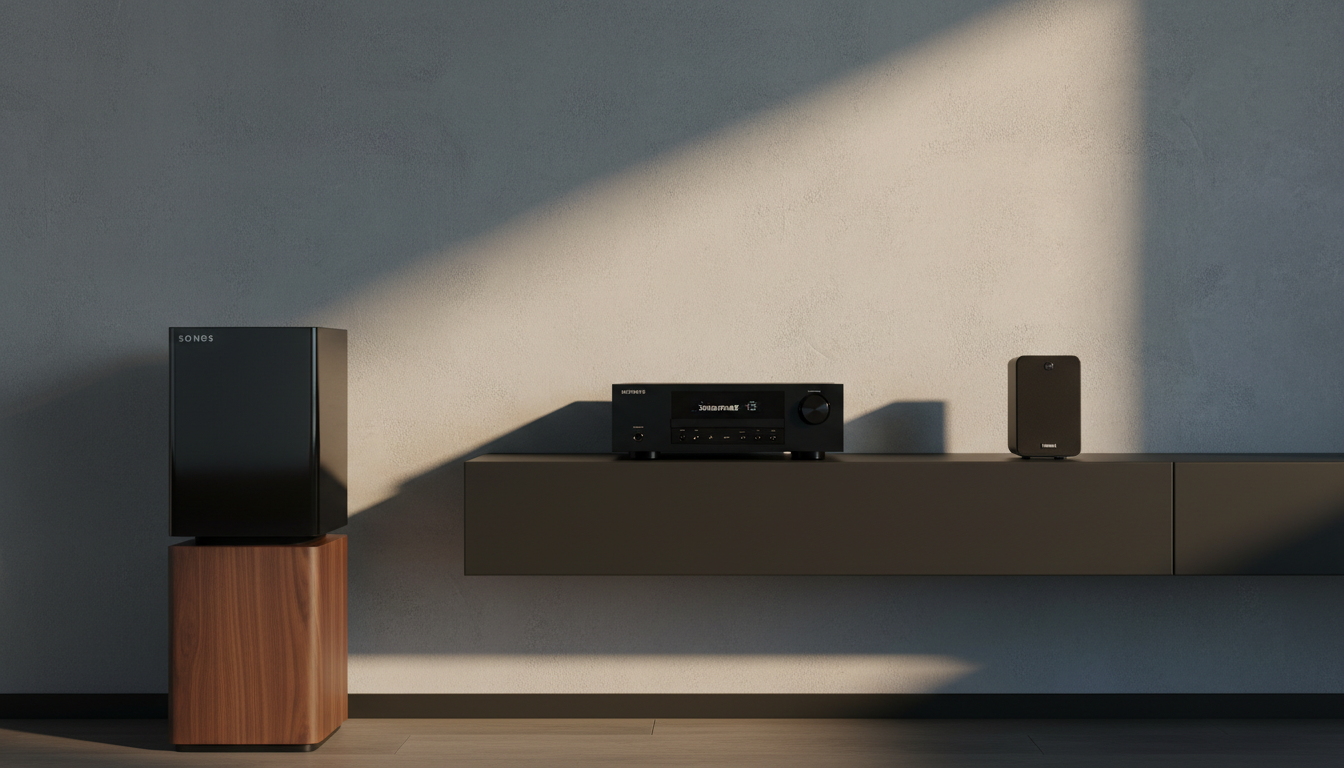
Sonos Sub 4
Its 25 Hz frequency response delivers deep, room‑filling bass, earning its top rating and premium price.

Marantz NR1510 Black
Ideal for mainstream listeners who want balanced sound without breaking the bank—priced at $700, it’s $199 cheaper than the Best Overall Sonos Sub 4.

Yamaha MusicCast 20
Stands out with a 40 W output and 192 kHz/24‑bit sample rate, delivering hi‑fi detail at a $279.95 price—perfect for tight‑budget rooms where compact power matters.
Also considered
Score Analysis
Key score advantages vs. runner-up (Marantz NR1510 Black)
Price Range
Sonos Sub 4
$863.49
Marantz NR1510 Black
$700.00
Yamaha MusicCast 20
$279.95

Yamaha YHT-5960U
$649.77

Denon Home 150 NV
$219.00
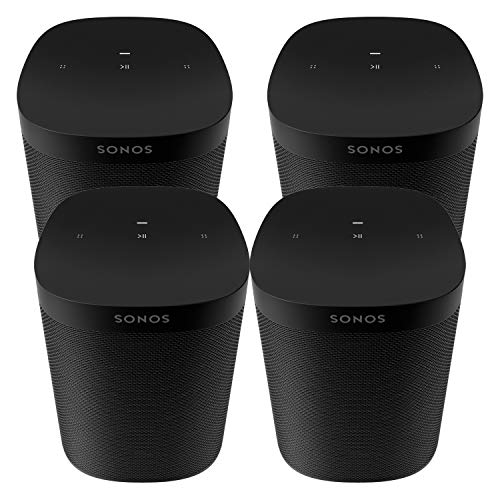
Sonos One SL
$719.00
Spec Comparison
TL;DR: The Sonos Sub 4 adds 25 Hz, force‑canceling bass through dual 5″ × 8″ woofers, runs on a Quad‑core 1.5 GHz processor, and integrates tightly with Sonos Wi‑Fi multi‑room setups.
The Sub 4’s standout spec is its 25 Hz frequency response, delivered by two inward‑facing 5″ × 8″ drivers housed in a ported cabinet. Weighing 26.46 pounds, the sub dampens vibration, and the included 2 m power cable keeps the setup tidy. Its dual Class‑D digital amplifiers and force‑canceling acoustic architecture produce distortion‑free low‑frequency punch, a point professional reviewers repeatedly praise.
Compared with the other five contenders, the Sub 4 is heavier than the Sonos One SL (10.0 pounds) and the Denon Home 150 (3.7 pounds), but lighter than the Yamaha YHT‑5960U system (54.0 pounds). Its depth of 158 mm exceeds the Yamaha MusicCast 20’s 132.08 mm depth, while its height of 402 mm is taller than the Marantz NR1510’s 104 mm. In the processor arena, the Sub 4’s Quad‑core 1.5 GHz CPU outpaces the Sonos One SL’s 1.4 GHz chip, though it carries less RAM (0.26 GB vs. 1 GB on the One SL).
User feedback consistently highlights the “pulse‑pounding bass” that feels virtually distortion‑free, thanks to the force‑canceling design. Reviewers frequently compliment Automatic Trueplay tuning, though they note that full Trueplay calibration requires an iOS device, limiting cross‑platform flexibility. Reviewers praise the Wi‑Fi‑only connectivity (802.11a/b/g/n/ac/ax) for stable, high‑bandwidth streaming, yet they criticize the lack of Bluetooth or auxiliary line‑in.
Under the hood, the Sub 4 runs a Quad‑core 1.5 GHz processor with 0.26 GB of SDRAM and 256 MB of NAND flash storage, ensuring smooth app‑driven adjustments of bass, treble, and loudness. It operates from 100‑240 V AC at 50/60 Hz and tolerates temperatures from 0 °C to 40 °C, making it suitable for most living‑room environments.
Pros
Cons
Best for: Sonos ecosystem owners who want powerful, low‑frequency reinforcement and seamless Wi‑Fi multi‑room integration.
Avoid if: You need Bluetooth or line‑in connectivity, rely on non‑iOS devices for calibration, or prefer a lightweight, portable subwoofer.
TL;DR: Marantz NR1510 is an ultra‑slim 5.2‑channel AV receiver with six HDMI inputs, 85 W per channel, and built‑in HEOS/Apple AirPlay 2, priced at $700.00.
The most distinctive spec is its ultra‑slim form factor: the chassis measures only 368 mm deep, yet it houses a 5‑channel discrete amplifier that puts out 85 W per channel into 6 Ω (100 W at 10 % THD). Six HDMI inputs—including one front‑panel slot—and dual HDMI outputs (one with eARC) give it plenty of connectivity for modern home theaters.
At 17.99 lb, the NR1510 is lighter than the Yamaha YHT‑5960U (54.0 lb) but heavier than the Yamaha MusicCast 20 (4.8 lb) and the Denon Home 150 NV (3.7 lb). Its 85 W per channel exceeds the 40 W output of the MusicCast 20 and the 30 W nominal of the Yamaha, while falling short of the 80 W per channel that Yamaha’s YHT‑5960U lists. Regarding size, the receiver’s 439 mm width exceeds the Sonos Sub 4’s 389 mm width, while its 158 mm depth matches the Sub’s depth, making it suitable for most AV racks.
Reviewers consistently praise the compact chassis and the breadth of streaming options—HEOS multi‑room, AirPlay 2, and voice control via Alexa, Google Assistant, or Siri. Users also note the low power draw in standby (0.2 W) and on network control (3.7 W), which is appreciated for energy‑conscious setups. The main criticism is the modest 85 W per channel, which some say may struggle to fill larger listening rooms, and the 5‑channel layout limits expansion beyond a 5.2‑speaker configuration.
Pros
Cons
Best for: Most users seeking a balanced, mainstream option
Avoid if: You're shopping on a tight budget — it's priced at $700.00
TL;DR: The Yamaha MusicCast 20 packs 40 W of stereo power, supports Wi‑Fi, Bluetooth 4.2 and AirPlay 2, and adds alarm presets in a compact 4.8‑lb, wall‑mountable speaker.
The standout spec is its 40 W maximum output power, paired with high‑resolution support up to 192 kHz / 24‑bit. A 3 cm tweeter and 9 cm woofer deliver balanced sound, while Bluetooth reaches 10 m and Wi‑Fi runs on dual‑band 2.4 GHz and 5 GHz networks.
Weighing 4.8 lb, the MusicCast 20 is heavier than the Denon Home 150 (3.7 lb) but dramatically lighter than Yamaha’s own YHT‑5960U system (54.0 lb). Its depth of 132.08 mm and height of 200.66 mm place it between the Sonos One SL’s compact 6‑inch cube and the larger Sonos Sub 4, which lists a 158 mm depth. In width (149.86 mm) it’s slimmer than the Marantz NR1510’s 439 mm chassis, making it a good fit for tight spaces.
User feedback frequently praises the built‑in alarm and snooze functions for bedroom or nightstand setups. Reviewers note the bass feels richer than many similarly sized speakers, while the midrange and treble sound natural but not overly bright. Professional reviewers also highlight the speaker’s sleek black finish and the convenience of MusicCast stereo pairing for multi‑room listening.
Beyond the basics, the unit supports AirPlay 2, Ethernet, and Bluetooth 4.2 with SBC and AAC codecs. It consumes 10 W during operation and drops to just 0.3 W in full standby, which is helpful for energy‑conscious households. The three preset buttons with LED indicators let you quickly switch between favorite sources, and the device is wall‑mountable with a standard 1/4"-20 thread.
Pros
Cons
Best for: Budget‑friendly rooms where you want solid stereo sound and multi‑room streaming without a built‑in voice assistant.
Avoid if: You need integrated Alexa/Google Assistant or prioritize a highly bright high‑frequency response.
TL;DR: The Yamaha YHT‑5960U delivers 725 W of 5.1 surround power, HDMI 2.1 support and easy YPAO calibration for a solid home‑theater experience at $649.00.
The system packs 725 W total system power, with 80 W per channel amplifiers feeding a five‑speaker layout and an 8‑inch powered subwoofer. It offers four HDMI inputs that meet HDMI 2.1 specifications, so you can pass‑through 8K @ 60 Hz or 4K @ 120 Hz video with eARC.
Weighing 54.0 lbs, the YHT‑5960U outweighs the Marantz NR1510, the Yamaha MusicCast 20, and the Sonos Sub 4. Its total power output far exceeds the modest output of the Denon Home 150 NV, while the bundle includes a dedicated subwoofer that the Sonos One SL lacks.
Users repeatedly praise the YPAO auto‑calibration for getting the speakers balanced without a fuss, and they appreciate the reliable Bluetooth and Wi‑Fi streaming. A common complaint cites occasional HDMI HDR handshake problems with newer consoles, and reviewers note that the lack of height speakers prevents full Atmos or DTS:X immersion.
Beyond the basics, the receiver features CINEMA DSP 3D processing, a suite of gaming enhancements like VRR, ALLM, QMS and QFT, and MusicCast multi‑room streaming that works with Alexa, Google Assistant and AirPlay 2.
Pros
Cons
Best for: Value-conscious buyers seeking quality at $649.00
Avoid if: You need Dolby Atmos or a larger room that demands deeper bass
“HDR not supported”
“Easy setup with app and wires; strong bass from 8‑inch subwoofer; reliable Bluetooth/Wi‑Fi streaming; good for movies/gaming”
TL;DR: The Denon Home 150 NV is a compact $219 wireless speaker delivering 24‑bit/192 kHz high‑resolution audio, HEOS multi‑room streaming, and AirPlay 2, all in a 4.7 × 7.4 × 4.7 in, 3.7‑lb package.
What really sets the Home 150 NV apart is its high‑resolution capability – it handles 24‑bit/192 kHz files and even DSD up to 2.8/5.6 MHz. The sound comes from a 1 in tweeter paired with a 3.5 in woofer, both driven by two Class‑D amplifiers. At just 3.7 lb and measuring 4.7 in W × 7.4 in H × 4.7 in D, it slips onto a shelf, kitchen counter, or desk without crowding the space.
Compared with the other five speakers in this roundup, the Denon is lighter than the Yamaha MusicCast 20 (4.8 lb) and far lighter than the Sonos One SL (10.0 lb). Its depth of 4.7 in is shorter than the MusicCast 20’s listed depth of 132.08 mm, making it one of the most compact options. While the Yamaha YHT‑5960U and Marantz NR1510 are full‑system receivers that weigh dozens of pounds, the Denon stays under five pounds, positioning it as a true tabletop solution.
User feedback highlights the speaker’s “mighty performer” reputation, with reviewers praising the vivid, room‑filling sound despite its size. Reviewers frequently mention the HEOS app’s tone‑adjustment tools and the three quick‑select buttons for making source switching effortless. Professional reviewers note the high‑resolution music playback and detail, confirming that the specs translate into a satisfying listening experience.
Beyond audio, the Home 150 NV offers built‑in AirPlay 2, Bluetooth, Ethernet, and a USB port for local playback, plus a two‑year warranty for peace of mind. The combination of high‑resolution support, multi‑room streaming, and a compact chassis makes it a well‑rounded choice for small‑space audio.
Pros
Cons
Best for: Entry-level buyers or those on a tight budget
Avoid if: You need powerful performance or professional‑grade features
TL;DR: The Sonos One SL delivers mic‑free, Wi‑Fi‑based multi‑room sound with a 1.4 GHz processor, 1 GB RAM, and Trueplay tuning, but its $949 price and lack of Bluetooth may limit budget‑focused buyers.
The One SL runs on a 1.4 GHz processor paired with 1 GB SDRAM and two Class‑D digital amplifiers, feeding a single tweeter and mid‑woofer. The Sonos app controls adjustable bass, treble and loudness, and iOS‑only Trueplay automatically tunes the speakers to the room’s acoustics.
At 10.0 pounds, the One SL is lighter than the Sonos Sub 4’s 26.46 pounds and the Marantz NR1510’s 17.99 pounds, yet heavier than the Yamaha MusicCast 20 (4.8 pounds) and Denon Home 150 (3.7 pounds). Its 6 ft (2 m) power cable matches the length listed for the Sub 4, while its 6.0‑inch depth and 10.0‑inch width give it a bulkier footprint than the MusicCast 20’s 132.08 mm depth. The inclusion of a 10/100 Mbps Ethernet port adds wired stability that many peers don't list.
Professional reviewers praise the One SL’s room‑filling sound and richer bass than expected for its size, noting that Trueplay delivers “perfectly adapted sound” for each environment. Everyday users love the privacy of a microphone‑free design and the ease of AirPlay 2 streaming, but several mention Wi‑Fi dropouts and the absence of Bluetooth as frustrating limitations.
Pros
Cons
Best for: Privacy‑conscious users who want premium multi‑room audio and are willing to invest in a high‑end speaker.
Avoid if: You need Bluetooth, voice‑assistant support, or a lower‑cost solution, or you are sensitive to Wi‑Fi stability and bass performance without a subwoofer.
“Hear nuance in every note”
“WiFi dependency causes dropouts if unstable”
Breakdown
Sonos Sub 4
Pros
Marantz NR1510 Black
Pros
Cons
Yamaha MusicCast 20
Pros
Cons
Yamaha YHT-5960U
Pros
Based on scoring data and product specs
Personalized picks
Best Overall Pick
Sonos Sub 4
Best OverallBest for: Those prioritizing quality and willing to pay for premium performance
Marantz NR1510 Black
Best for: Most users seeking a balanced, mainstream option
$700.00-$163.49 vs winner
Skip Sonos One SL if…
Reliability and user satisfaction are your top concerns
The Sonos Sub 4 takes the top spot thanks to its 4.7‑star rating from 447 reviews, a dual Class‑D digital amplifier and a deep 25 Hz frequency response that fills a room with low‑end punch. At 26.46 lb it’s a solid‑weight sub that can sit vertically or horizontally, and its 802.11ax Wi‑Fi ensures reliable multi‑room streaming. You can adjust the two 5″ × 8″ drivers via the app for bass, treble and loudness, and Trueplay room optimization (iOS required) fine‑tunes the sound to your space.
The Marantz NR1510 in black lands the runner‑up slot, ideal if you need a full‑featured AV receiver for a home‑theater setup that also streams across rooms. It packs a 5‑channel discrete amp delivering up to 85 W per channel, supports AirPlay 2, Bluetooth and HEOS, and comes with a three‑year warranty. With six HDMI inputs, eARC support, HDR compatibility and dual subwoofer outputs, it handles 4K video and immersive audio while keeping a sleek ultra‑slim profile.
For tight budgets, the Denon Home 150 NV at $219 offers entry‑level Wi‑Fi streaming without breaking the bank. If you sit in the mid‑range camp, the Marantz NR1510’s ultra‑slim design and 5‑channel discrete amp give you full‑home‑theater power at $700. The premium pick, Sonos One SL at $949, delivers Sonos‑ecosystem sound and voice‑assistant integration for audiophiles who want top‑tier convenience.
Pick the Sonos Sub 4 today and lock in cinematic bass for every room.
The Sonos Sub 4 costs $899 versus $700 for the Marantz NR1510, so it’s $199 more expensive. It’s praised for its dual Class‑D digital amplifiers, automatic EQ, and Trueplay room optimization, which many reviewers cite as delivering stronger value despite the higher price.
No reviews yet — be the first to share your experience.
Please sign in to leave a review