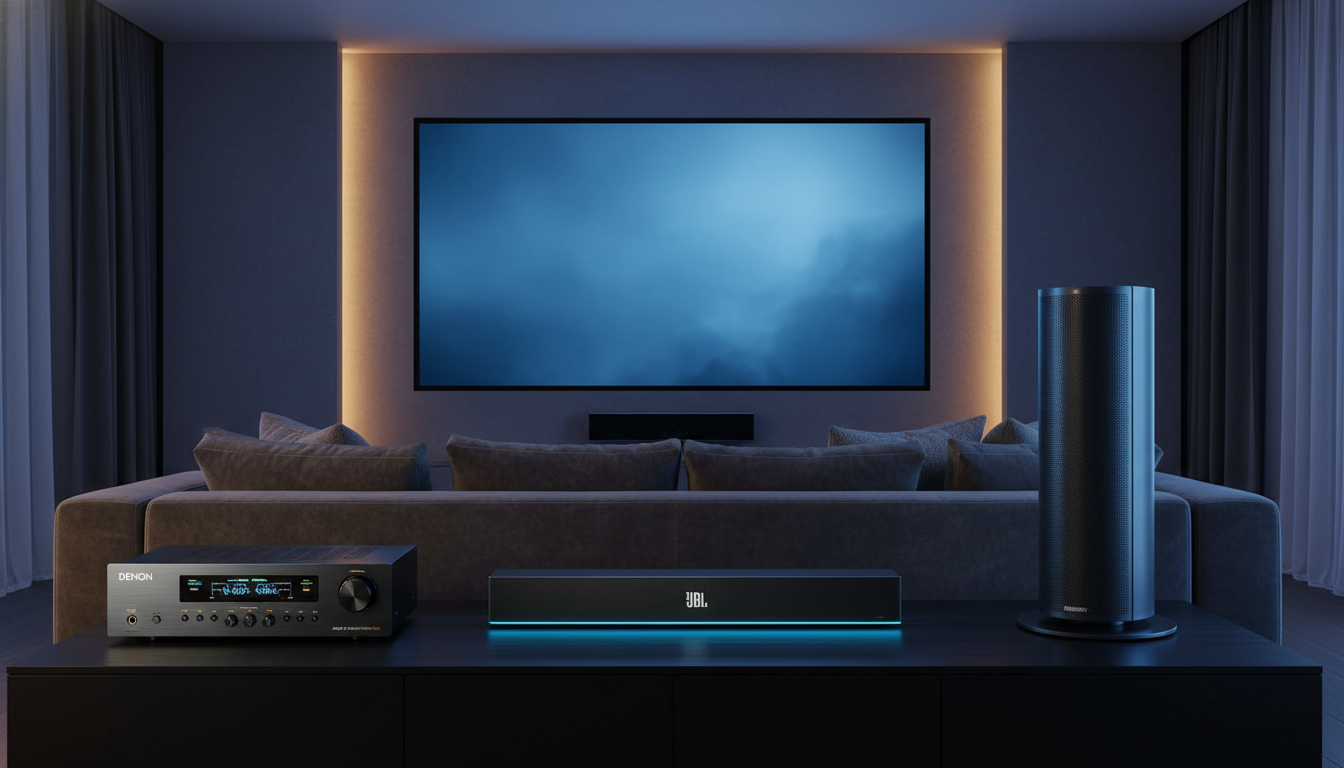
If you’re putting together a home‑theater that talks back, the market now offers seven options that blend built‑in voice assistants with streaming‑ready hardware. Prices stretch from a $419.00 Bose Smart Dolby Atmos soundbar up to the $3800.00 Marantz Cinema 40, giving you budget, mid‑range and premium tiers to scan.
The Denon AVR‑X1700H lands at $599.00, carries a 4.4‑star rating from 502 reviewers and pushes 80 W per channel into 8 Ω, while also supporting 8K/60 Hz video and Dolby Atmos. JBL’s Bar 700 commands $899.95, has a 4.5‑star score and a total system power of 620 W across its 5.1‑channel layout. For a compact, Alexa‑enabled solution, Bose’s $419.00 soundbar offers five‑channel Dolby Atmos in a 56‑mm‑high chassis. At the high end, the Marantz Cinema 40’s 4.9‑star rating reflects its 125 W per channel output and 9.4‑channel processing, and the $1799.00 Denon AVR‑X3800H provides 105 W per channel plus 9.4‑channel support.
We’ll break down each model’s voice‑assistant integration, streaming ecosystem and speaker power so you can match the system to your room size and listening habits.

Denon AVR-X1700H
Its 337.82 mm depth gives a solid, space‑saving chassis that fits most AV racks while delivering full‑range performance.

JBL Bar 700
Ideal for households wanting a sleek soundbar with built‑in voice control, and it costs about $300 more than the Denon AVR‑X1700H, at $899.95.

Marantz Cinema 40
Stands apart with 165 W into 6 Ω, delivering premium cinema‑grade power that the Denon and JBL models don’t match, perfect for audiophiles willing to invest.
Also considered
Score Analysis
Key score advantages vs. runner-up (JBL Bar 700)
Price Range
Denon AVR-X1700H
$599.00
JBL Bar 700
$899.95
Marantz Cinema 40
$3,800.00

Bose Smart Dolby Atmos
$419.00

Marantz STEREO 70s
$1,200.00

Denon AVR-X3800H
$1,799.00

Denon Home 550
$679.99
Spec Comparison
TL;DR: The Denon AVR‑X1700H delivers 8K/60 Hz and 4K/120 Hz HDMI 2.1 pass‑through, 80 W per channel, and built‑in voice assistants, making it a solid entry‑level AV receiver for medium‑sized rooms.
What really stands out is the HDMI 2.1 implementation: six HDMI inputs (three of them support 8K @ 60 Hz) and full 4K @ 120 Hz pass‑through, plus HDR10+, Dolby Vision and VRR. Pair that with 80 W per channel into 8 Ω and a dynamic range of 109 dB, and you have a receiver that can handle the latest consoles and streaming devices without bottlenecking the video signal.
At 19.0 Pounds, the X1700H is heavier than the compact Denon Home 550 and Bose Smart Dolby Atmos speakers, but it’s noticeably lighter than the higher‑end Denon AVR‑X3800H, Marantz STEREO 70s and Marantz Cinema 40, which tip the scales at over 24 Pounds. Most competitors don’t list HDMI input counts, so the six ports give you more flexibility than the JBL Bar 700’s soundbar‑only setup and the soundbars that lack HDMI 2.1 features entirely.
Consumers repeatedly mention the straightforward setup, clear 8K video pass‑through, and the immersive Atmos/DTS:X virtualization that fills a 200‑400 sq ft space. The built‑in HEOS streaming and voice control via Alexa, Google Assistant, Siri and AirPlay 2 also earn praise for convenience. On the flip side, users note that the USB port only plays music files, and a few have run into occasional HDMI handshake quirks when connecting 8K sources.
Beyond the video chops, the X1700H includes Audyssey MultEQ XT calibration, a quad‑core 300 MHz DSP, and a low output impedance of 0.17 Ω, all contributing to clean, low‑distortion playback (THD 0.08 %). The receiver also supports a long list of audio codecs—including Dolby Atmos, DTS:X, Dolby Digital, DTS, FLAC, ALAC, WAV and DSD—so you won’t be short on format compatibility.
Pros
Cons
Best for: Budget-conscious buyers seeking a reliable entry-level option
Avoid if: You have limited desk space or need portability
TL;DR: The JBL Bar 700 delivers 620 W of Dolby Atmos‑enabled sound, a 10‑inch wireless subwoofer and detachable battery‑powered surrounds, all wrapped in a sleek 884 mm‑wide bar with built‑in Alexa, Google Assistant and Siri.
The standout spec is the 620 W total system power, split between a 240 W soundbar, a 300 W subwoofer and 40 W surround speakers. Dolby Atmos support and PureVoice dialogue enhancement help fill medium‑to‑large rooms with immersive, cinema‑like audio.
Compared with the six other entries, the JBL Bar 700 measures 884 mm, making it noticeably wider than the Denon Home 550’s 659.7 mm width, and its packaging weight of 18.7 kg (41.1 lb) means it's heavier than the 7.3‑lb Denon Home 550. While the Bose Smart Dolby Atmos model lists microphones, JBL explicitly offers three major voice assistants—Amazon Alexa, Google Assistant and Siri—giving it broader smart‑home integration.
Users praise the high‑impact sound and the convenience of wireless surrounds, but they also flag the need to charge the detachable speakers regularly and the requirement for roughly 7 inches of side clearance on the bar. The 10 kg (22 lb) subwoofer, while easy to place thanks to its wireless design, it's a sizable piece that some find less discreet. Professional reviewers highlight the combination of Dolby Atmos and PureVoice as a clear dialogue‑boosting advantage.
Connectivity includes Bluetooth, dual‑band Wi‑Fi (2.4/5.0 GHz), HDMI eARC/ARC, an optical TOSLink input and a USB port. The system ships with a 1‑year limited warranty on speaker parts, and the soundbar itself is just 3.2 kg (7.04 lb), making wall‑mounting feasible.
Pros
Cons
Best for: Medium‑to‑large rooms where a wireless 5.1 Dolby Atmos system with voice‑assistant integration is desired.
Avoid if: You have limited desk space, need a compact setup, or prefer a system without regular charging of surround speakers.
“the bar is a great size and weight”
TL;DR: The Marantz Cinema 40 is a premium 9.4‑channel AV receiver with 125 W per channel, seven HDMI 2.1 inputs, and a high‑end aluminum front panel, but it carries a $3,800 price tag.
What really stands out is the 125 W per channel into 8 Ω (0.05 % THD) and the ability to process 11.4 audio channels, making it ready for 7.1.4 or 5.1.4 Dolby Atmos setups. It packs seven 8K‑capable HDMI 2.1 inputs, three HDMI outputs, and a dedicated phone HDMI input, all backed by a 710 W maximum power draw. The front panel features machined aluminum, and the HDAM modules promise the warm, detailed sound Marantz is known for. Audyssey MultEQ XT32 room‑tuning and built‑in HEOS multi‑room streaming round out a feature set that targets serious home‑theater enthusiasts.
Compared with the other six options, the Cinema 40 is noticeably heavier at about 40.57 lb, while the Denon AVR‑X3800H weighs 27.6 lb and the Denon AVR‑X1700H comes in at 19.0 lb. Its 125 W per channel also tops the Denon AVR‑X3800H’s 105 W (8 Ω) output, giving it a clear power advantage. The JBL Bar 700 and Bose Smart Dolby Atmos are soundbars rather than full‑range receivers, so the Cinema 40 offers far more HDMI connectivity and channel flexibility than those compact units. Even the Marantz Stereo 70s, which is a stereo amp, lacks the multi‑channel HDMI and room‑calibration features found here.
Users have responded positively, reflected in a 4.9‑star rating from 19 reviews. Professional reviewers highlight the luxury aluminum chassis and the HDAM modules for delivering “warm, rich, and highly detailed sound.” The extensive HDR support (HDR10+, Dolby Vision, HLG, Dynamic HDR) and gaming optimizations (VRR, ALLM, QFT) also earn praise for next‑gen console use. On the downside, Audio Science Review notes that distortion and noise figures are higher than expected for a unit in this tier, and some buyers point out the lack of disclosed SINAD/RMS numbers, leaving a bit of uncertainty about raw performance.
Beyond the power and connectivity, the Cinema 40 supports a long list of high‑resolution audio formats—including Dolby TrueHD, DTS HD Master, Auro‑3D, IMAX Enhanced, 360 Reality Audio, and MPEG‑H—plus lossless FLAC/WAV/ALAC up to 192 kHz/24‑bit and DSD up to 5.6 MHz. The unit also offers three DC trigger outputs for external power‑amp integration, a built‑in Bluetooth module, and a 5‑year warranty for peace of mind.
Pros
Cons
Best for: Those prioritizing quality and willing to pay for premium performance
Avoid if: You're shopping on a tight budget — it's priced at $3800.00
TL;DR: The Bose Smart Dolby Atmos soundbar packs Dolby Atmos, Alexa voice control and a compact 56 mm profile into a 6.9‑lb unit for under‑$420, making it a space‑saving option for modest‑sized rooms.
The standout spec is the five‑channel speaker array with upward‑firing drivers and a dedicated center tweeter, all housed in a 104 mm deep, 56 mm tall chassis. This design lets the bar sit flush beneath most TVs while still delivering ceiling‑reflected overhead effects that reviewers say give a strong sound‑to‑size ratio. Built‑in Amazon Alexa and support for Apple AirPlay 2, Chromecast and HDMI ARC add true smart‑streaming capabilities without extra hardware.
At 6.909 pounds, it's lighter than the Denon AVR‑X1700H (19 lb) and Marantz Cinema 40 (over 40 lb), and even a touch lighter than the Denon Home 550 (7.3 lb) and JBL Bar 700 (7.04 lb). Its 694 mm width sits between the JBL Bar 700’s wider 884 mm frame and the Denon Home 550’s narrower 659.7 mm footprint, while the 56 mm height matches the JBL Bar 700 and is shallower than most AVR units. The 30‑ft Bluetooth range and dual microphones also give it a more flexible placement than some bulkier competitors.
User sentiment highlights the bar’s “compact 2.21‑inch tall design” (56 mm) as a major plus for apartments and small living rooms, and professional reviewers praise the TrueSpace upmixing that fills a room with immersive sound even when the source isn’t Atmos‑encoded. Reviewers note the five‑speaker configuration delivers less impact than higher‑end models with nine drivers, and they point out the lack of an automatic room‑calibration system (ADAPTiQ) as a drawback for those seeking plug‑and‑play tuning.
Pros
Cons
Best for: Budget‑conscious buyers who need a compact, voice‑controlled soundbar with Dolby Atmos for a small to medium living room.
Avoid if: You have a large open‑concept space or require the highest speaker count and automatic room‑tuning.
TL;DR: The Marantz STEREO 70s delivers 75 W per channel into 8 Ω with a Class A/B amp, six HDMI inputs (three 8K‑ready), HEOS streaming and a sleek OLED display, but its $1200 price and modest 4.2‑star rating may deter budget shoppers.
At the heart of the STEREO 70s is a discrete Class A/B amplifier that pushes 75 W per channel into 8 Ω while keeping total harmonic distortion down to 0.08 %. The unit also offers six HDMI inputs—three of them 8K‑capable—plus an eARC output, an OLED front panel, and built‑in HEOS for multi‑room streaming. Physically it measures 15.2 inches deep, 4.3 inches high and 17.4 inches wide, and weighs 24.0 pounds, making it a true slimline option for tight cabinetry.
Compared with the seven rivals in this roundup, the Marantz is lighter than the JBL Bar 700’s 41.1‑lb packaging and the high‑end Marantz Cinema 40 at roughly 40.6 lb, yet heavier than the compact Denon Home 550 (7.3 lb) and Bose Smart Dolby Atmos (6.9 lb). Its six HDMI inputs outpace the Bose model, which lists no HDMI inputs, and give it a richer connectivity set than the single‑output designs of the JBL and Denon Home units. While the Denon AVR‑X3800H provides 135 W per channel at 6 Ω, the STEREO 70s focuses on two‑channel purity with 100 W per channel into 6 Ω, a power level that many reviewers note as ample for stereo listening without the complexity of a full‑range AV receiver.
User feedback frequently highlights the clean, high‑power stereo performance that the 0.08 % THD and 98 dB signal‑to‑noise ratio deliver. Professional reviewers also praise the “practical architecture” of the two Class A/B channels and the “extensive connectivity suite” that includes Ethernet, Wi‑Fi, Bluetooth, and a USB‑A host. The unit supports high‑resolution audio up to 192 kHz/32‑bit, DSD files at 2.8 MHz / 5.6 MHz, and lossless formats such as FLAC, WAV and ALAC, while features like ECO mode, a guided Setup Assistant and auto power‑off add convenience.
Pros
Cons
Best for: Those prioritizing quality and willing to pay for premium performance
Avoid if: You need advanced features or professional‑grade performance
TL;DR: The Denon AVR‑X3800H delivers 9.4‑channel 8K‑ready home‑theater power with 105 W per channel, built‑in HEOS streaming and Audyssey calibration, but its heavy chassis and DAC noise keep it from being flawless.
This receiver’s standout spec is its 9.4‑channel configuration paired with HDMI 2.1 support for 8K/60 Hz and 4K/120 Hz video, plus HDR10+, Dolby Vision and HLG. The 105 W per channel into 8 Ω and 135 W into 6 Ω give you plenty of headroom for demanding speaker layouts, while Audyssey MultEQ XT32 handles room correction automatically.
Compared with the six other entries, the X3800H is heavier than the Marantz Stereo 70s (27.6 lb vs 24.0 lb) and the Denon AVR‑X1700H (19.0 lb), but lighter than the JBL Bar 700’s packaging at 41.1 lb. It offers far more HDMI inputs (6) and outputs (3) than the JBL Bar 700’s soundbar design, and its 9.4‑channel audio core outpaces the 5‑channel Bose Smart Dolby Atmos and the 4‑channel Denon Home 550. The power consumption of 660 W also exceeds the 210 W listed for the Marantz Stereo 70s, reflecting its higher amplification capacity.
Users repeatedly praise the ease of HEOS multi‑room streaming and the inclusion of a phono input for vinyl lovers. Professional reviewers note the solid analog amplification and the full 3D‑audio support, but they also flag the DAC’s elevated wideband noise and jitter, especially when feeding high‑resolution digital sources. The heavy 27.6‑lb chassis can be a challenge to fit into tighter AV racks.
Pros
Cons
Best for: Buyers willing to invest in a proven, high‑quality option
Avoid if: You're on a tight budget or only need basic functionality
TL;DR: The Denon Home 550 is a compact 4.0‑channel soundbar with virtual Dolby Atmos, 2 × 0.75‑in tweeters, 4 × 2.1875‑in drivers, and HEOS multi‑room streaming, all in a 25.95‑in wide, 7.3‑lb package.
The standout feature is its six‑driver layout: two 0.75‑in tweeters and four 2.1875‑in full‑range drivers, plus three 2 × 3.5‑in passive radiators that help extend low‑frequency response without a separate subwoofer. At just 2.95 in tall, 4.72 in deep and 25.95 in wide, it slips under most 55‑ to 65‑inch TVs while still delivering virtual 4.0‑channel Dolby Atmos and DTS:X sound.
Compared with the other six entries, the Home 550 is much lighter than the Denon AVR‑X1700H (19.0 lb) and the Marantz STEREO 70s (24.0 lb), yet only a shade heavier than the JBL Bar 700 (7.04 lb) and the Bose Smart Dolby Atmos (6.909 lb). Its two HDMI ports (one input, one eARC output) give it more direct TV connectivity than some competitors that list fewer HDMI connections.
Reviewers like the straightforward HDMI eARC hookup, the space‑saving footprint, and the smooth HEOS multi‑room integration that lets you sync music across Denon devices. Professional reviewers note that the six compact drivers create a wide, balanced soundstage. Users mention the lack of a dedicated subwoofer, which can make deep bass thin in larger rooms, and the undisclosed power output creates uncertainty about volume headroom.
Pros
Cons
Best for: Entry-level buyers or those on a tight budget
Avoid if: Reliability and user satisfaction are your top concerns
Breakdown
Denon AVR-X1700H
Pros
JBL Bar 700
Pros
Marantz Cinema 40
Pros
Cons
Bose Smart Dolby Atmos
Pros
Cons
Based on scoring data and product specs
Personalized picks
Best Overall Pick
Denon AVR-X1700H
Best OverallBest for: Budget-conscious buyers seeking a reliable entry-level option
JBL Bar 700
Best for: Most users seeking a balanced, mainstream option
$899.95+$300.95 vs winner
Skip Denon Home 550 if…
Reliability and user satisfaction are your top concerns
The Denon AVR‑X1700H earns the top spot with its 4K/120 Hz pass‑through, 8K (60 Hz) support, and a wide set of voice assistants—Alexa, Google Assistant, and Siri—all built in. It also scores a solid 4.4 / 5 from 502 reviewers and offers six HDMI inputs, three of which handle 8K/60 Hz signals, providing ample connectivity for a full‑feature home theater.
If you prefer a sleek soundbar that still delivers immersive Atmos, the JBL Bar 700 is the runner‑up. It’s ideal for a living‑room where you want wireless, battery‑powered surround speakers and easy wall‑mounting, and it packs a total system output of 620 W while supporting Alexa, Google Assistant, and Siri.
For tighter budgets, the Bose Smart Dolby Atmos provides the most affordable entry at $419, offering built‑in voice assistants and Dolby Atmos in a compact package. As a solid mid‑range choice, the JBL Bar 700 (also listed above) delivers 620 W of power and detachable wireless surrounds for versatile setups. At the premium end, the Marantz Cinema 40 commands $3800 and brings high‑end audio formats and powerful performance for a dedicated home‑theater room.
Choose the Denon AVR‑X1700H for the most capable home‑theater experience today.
The Denon AVR‑X1700H offers built‑in Alexa, Google Assistant, and Siri, plus HEOS multi‑room streaming, giving you flexible voice control. It also comes at a lower price and provides a full‑feature receiver, making it a strong fit for compact spaces.
No reviews yet — be the first to share your experience.
Please sign in to leave a review
