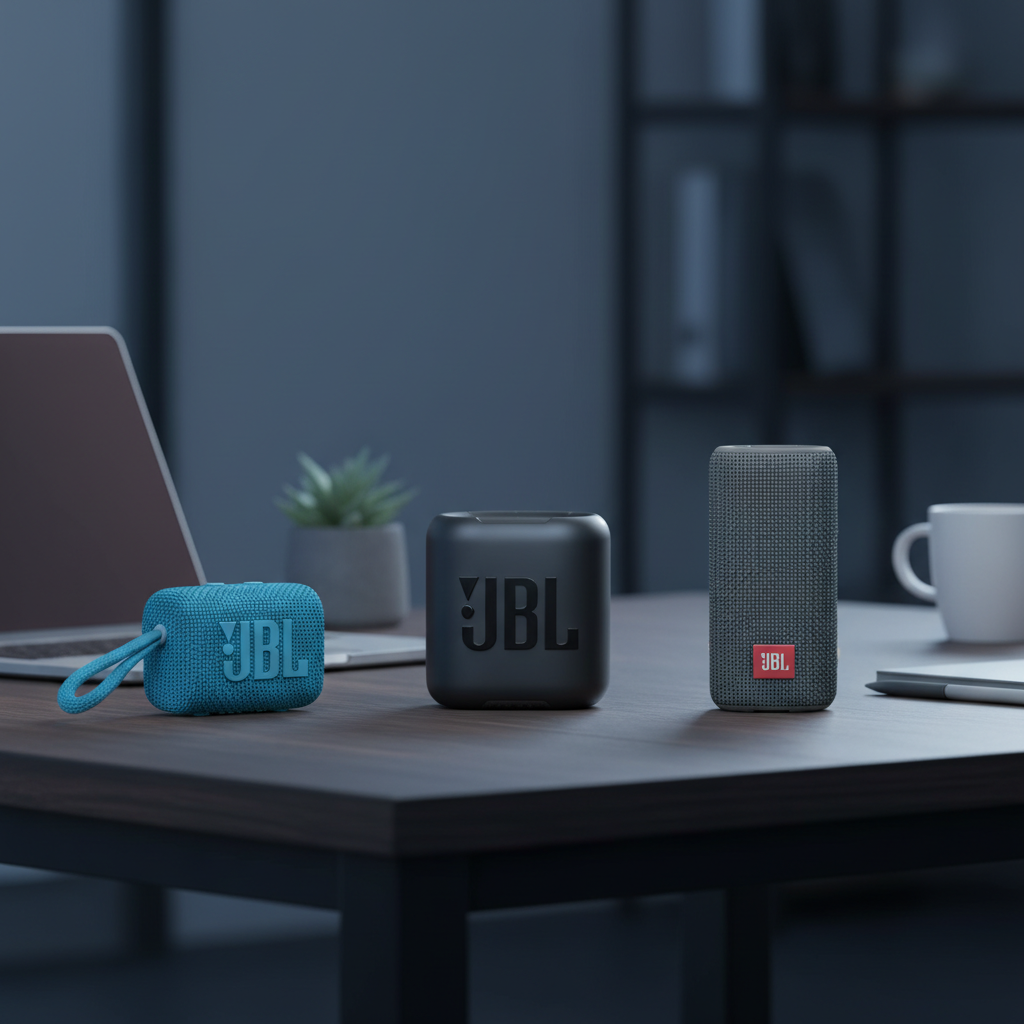
If you need a speaker that fits in a pocket yet still sounds unmistakably JBL, the JBL Go 4 Blue takes the top spot. It’s priced at $44.95, carries a 4.8/5 rating from 14,177 reviewers, and delivers up to 7 hours of playback from its 850 mAh battery. At just 0.4188782978 pounds, it’s lighter than most competitors, and its IP67 rating means you can toss it in a backpack, onto a beach towel, or even into a rain‑soaked bag without worry.
The roundup compares 10 JBL models across three price tiers. Budget‑friendly choices include the Go 4, Go 3, Clip 4 and Clip 5, all under $60. Mid‑range options like the Flip 6 ($129.95, 4.7/5 rating, 12 hours of playtime) strike a balance between power and portability. Premium picks—Flip 7, Charge 6 ($199.95, 28 hours of battery life), Xtreme 3 and Xtreme 4 ($379.95, 4.6/5 rating)—offer the longest runtimes and highest output. With this spread, you’ll find a JBL speaker that matches your budget and listening needs. Next, we’ll break down each model’s strengths and who they’re best suited for.

JBL Go 4 Blue
Its 45 mm driver delivers surprisingly clear sound for a $44.95 speaker—it's the most capable entry‑level option.

JBL Charge 6
Ideal for travelers who need marathon‑long playback, the JBL Charge 6 serves heavy‑use listeners, and at $199.95 it's $155 above the Go 4.

JBL Flip 6
The Flip 6 stands out with a 4800 mAh battery—more capacity than the Go 4 and comparable to the Charge 6—giving you longer playtime without the bulk of the larger model.
Also considered
Score Analysis
Key score advantages vs. runner-up (JBL Charge 6)
Price Range
JBL Go 4 Blue
$49.95
JBL Charge 6
$159.95
JBL Flip 6
$109.95

JBL Go 3 Blue
$39.95
JBL Flip 7
$149.95

JBL Xtreme 4
$299.95

JBL Clip 5
$79.95

JBL Clip 4
$49.95

JBL Flip 5
$89.95

JBL Xtreme 3
$249.95
Spec Comparison
TL;DR: The JBL Go 4 packs an IP67‑rated, Bluetooth 5.3‑enabled 45 mm driver and 4.2 W RMS output into a 0.4188782978‑pound, pocket‑sized speaker that runs about 7 hours on a single charge.
The Go 4’s standout durability comes from its IP67 rating, meaning it can survive full submersion up to 1 meter for 30 minutes. It also upgrades to Bluetooth 5.3 and supports Auracast™ multi‑speaker pairing, while the 45 mm driver delivers a surprisingly loud sound for its size. The speaker puts out 4.2 W RMS, and the built‑in 850 mAh Li‑ion polymer battery provides roughly 7 hours of standard playback.
At 0.4188782978 pounds, the Go 4's lighter than the earlier JBL Go 3, which tips the scales at 0.46 pounds. Its depth of 42.2 mm is a touch deeper than the Go 3’s 40.00 mm, but its footprint remains ultra‑compact (75.7 mm high × 94.3 mm wide). Battery life also outlasts the Go 3’s 5‑hour claim, giving you two extra hours of music on the go. Compared with larger models like the Clip 4 or Clip 5, the Go 4 is noticeably smaller and lighter, though those speakers push battery life up to 10‑12 hours.
Reviewers love how the tiny form factor slips into pockets or backpacks, and they've consistently praised the IP67 protection for beach trips and rainy commutes. The integrated loop makes attachment to bags or belts effortless. Professional reviewers note the upgraded Bluetooth 5.3 and Auracast™ as future‑proof features, while everyday users highlight the loudness relative to the 45 mm driver. The main criticisms focus on modest bass depth and the limited 7‑hour runtime, especially when the volume is cranked up.
Pros
Cons
Best for: Travelers, commuters, and outdoor enthusiasts who need a tiny, rugged speaker that can survive water.
Avoid if: You need deep bass, longer battery life, or a 3.5 mm aux input for larger gatherings.
“Perfect size for travel”
“Sounds bigger than it looks”
TL;DR: The JBL Charge 6 delivers 28 hours of playtime, 45 W RMS output and IP68 durability, but its larger size and missing USB‑C cable make it a premium‑tier, rugged option.
The standout spec is the 28‑hour battery life powered by a 4722 mAh built‑in powerbank, and a 10‑minute fast‑charge that adds roughly 150 minutes of playback. AI Sound Boost and a 45 W RMS output promise balanced, bass‑rich audio, while the IP68 rating protects the speaker from water, dust and a 1‑meter drop onto concrete.
Compared with its JBL siblings, the Charge 6 outlasts the Xtreme 3’s 15‑hour battery and the Flip 6’s 12‑hour run‑time. At 2.18 lb it’s heavier than the Flip 6’s 1.21 lb but considerably lighter than the Xtreme 3’s 4.339 lb, and its depth of 94 mm exceeds the Flip 6’s 71 mm height, underscoring its bulkier build.
Professional reviewers highlight the AI‑enhanced sound and lossless USB‑C playback, while everyday users rave about the deep bass and rugged reliability at beaches and campsites. Common complaints note the absence of a USB‑C charging cable and the need to use the JBL Portable App for firmware updates, and some find the speaker’s dimensions larger than they’d prefer for ultra‑portable use.
Pros
Cons
Best for: Outdoor enthusiasts, travelers needing marathon battery life, and hosts who want powerful, weather‑proof sound.
Avoid if: You need an ultra‑lightweight or ultra‑compact speaker, dislike app‑dependent features, or are on a tight budget.
“The bass is deep and punchy — sounds much bigger than it looks.”
“Used it at the beach and pool — survived sand, water, and drops with no issues.”
TL;DR: The JBL Flip 6 packs a 30 W RMS output, IP67 durability and a 12‑hour battery into a 71 mm‑high, 549 g cylinder for $129.95.
The Flip 6’s 30 W RMS output, driven by a 45 × 80 mm woofer and a 16 mm tweeter, delivers room‑filling sound that many users describe as “big for its size.” Its IP67 rating means it can survive a full submersion up to 1 meter for 30 minutes, making it a solid companion for poolside or beach outings. A 4800 mAh (17.28 Wh) battery provides up to 12 hours of playback, and a USB‑C port refills it in just 2.5 hours.
In the ten‑product lineup, the Flip 6 sits between the more affordable Flip 5 and the premium Charge 6. It’s a touch heavier than the Flip 5’s 544 g chassis, yet considerably lighter than the Xtreme 3, which weighs 1969 g. Its 12‑hour runtime matches the Clip 5’s battery life but falls short of the Charge 6’s 28‑hour endurance and the Xtreme 3’s 15‑hour playtime. Bluetooth 5.1 gives it a solid 10‑meter wireless range, while the Clip 5 enjoys a newer 5.3 version, so the Flip 6’s connectivity is reliable but not the absolute latest.
Reviewers consistently praise the Flip 6 for clear mids and deep bass, noting the sound clarity that rivals larger speakers. Professionals highlight the balanced RMS power and the solid build that lives up to JBL’s reputation. Common complaints revolve around the lack of a 3.5 mm aux input and occasional microphone quality issues, which some users find limiting for voice‑assistant use.
Technically, the speaker covers a frequency range of 63 Hz – 20 kHz and offers a signal‑to‑noise ratio above 80 dB, ensuring low background hiss even at higher volumes. PartyBoost lets you pair multiple JBL speakers for a wider soundstage, and the A2DP 1.3/AVRCP 1.6 Bluetooth profiles keep streaming smooth.
Pros
Cons
Best for: Home and office users seeking a balance of features and value
Avoid if: You're shopping on a tight budget — it's priced at $129.95
“Outstanding sound for size – many users are surprised by the volume and bass”
TL;DR: The JBL Go 3 in blue delivers JBL’s signature sound from a 40 mm driver and 4.2 W RMS amp, packs IP67 durability, and runs about five hours on a single charge for just $39.95.
The Go 3’s standout spec is its 40 mm full‑range driver paired with a 4.2 W RMS amplifier, which JBL advertises as “surprisingly big audio and punchy bass” for a speaker that weighs only 0.46 lb (209 g) and measures 40.00 mm × 68.99 mm × 86.00 mm. Its IP67 rating means it can survive full submersion and dust, and the built‑in microphone lets you answer calls without pulling out your phone.
Compared with the other nine speakers in this roundup, the Go 3 sits toward the light‑weight end: it’s lighter than the JBL Clip 4 (0.527 lb) and Clip 5 (0.628 lb) but a bit heavier than the newer JBL Go 4 (≈0.419 lb). Battery life is the shortest of the lot—five hours versus seven hours on the Go 4 and ten‑plus hours on most Clip and Flip models—so you’ll need to recharge more often than with the larger Flip 5, Flip 6, or Charge 6. Its driver is smaller than the Go 4’s 45 mm unit and far smaller than the Clip 5’s 86 mm driver, which explains why reviewers note less low‑end punch.
Users consistently praise the Go 3’s pocket‑size convenience, the handy hanging loop, and the durability of the IP67 shell. Professional reviewers highlight the “extreme portability” and the clear, if not bass‑heavy, sound signature. The most common complaint is the limited bass response, especially when the volume is turned up, and the five‑hour battery can feel restrictive for longer outings.
Pros
Cons
Best for: Budget-conscious buyers seeking a reliable entry-level option
Avoid if: You have limited desk space or need portability
“Perfect size for travel”
“Sounds bigger than it looks”
TL;DR: The JBL Flip 7 offers 35 W output, IP68 waterproofing, and up to 16 hours of playtime for $149.95, making it a rugged, high‑power portable speaker.
The standout spec is its 35 W RMS power output paired with JBL AI Sound Boost, delivering a two‑way audio system that covers 60 Hz – 20 kHz and exceeds a signal‑to‑noise ratio of >80 dB. The battery packs 4800 mAh (17.28 Wh) and can run for 14 hours normally, stretching to 16 hours with the Playtime Boost feature after a 2.5‑hour charge.
Compared with the other nine speakers in this roundup, the Flip 7 is a bit heavier than the Flip 5’s 544 g frame but lighter than the Charge 6, which is listed at 2.18 pounds. Its 35 W output tops the Flip 6’s 30 W RMS and dwarfs the sub‑10 W range of the Clip 5, Clip 4, Go 4 and Go 3 models. Battery life sits at 14 hours—more than the Flip 6’s 12 hours and the Clip series—but falls short of the Charge 6’s 28 hours and is just shy of the Xtreme 3’s 15 hours. Bluetooth 5.4 is newer than the Flip 6’s 5.4 and the Xtreme 3’s 5.1, and the device adds lossless USB‑C audio support that many peers lack.
Reviewers consistently praise the IP68 rating, noting that the speaker survives submersion to 1.5 m for 30 minutes and a 1 m drop onto concrete without a hiccup. Professionals highlight the AI Sound Boost for richer mids and tighter bass, while everyday users love the quick 2.5‑hour recharge and the PushLock system that secures the strap. The few downsides include white fabric that can splotch over time, the absence of a built‑in microphone for calls, and occasional bundles that miss the USB‑C charging cable.
Pros
Cons
Best for: Those prioritizing quality and willing to pay for premium performance
Avoid if: You're on a tight budget or only need basic functionality
“Outstanding sound for size – many users are surprised by the volume and bass”
TL;DR: The JBL Xtreme 4 packs a 100 W RMS sound system, 68 Wh battery and IP67 ruggedness into a 4.629707502‑pound speaker that can play up to 24 hours on a single charge.
The headline feature is its power: the Xtreme 4 delivers a total of 100 W RMS in AC mode (70 W RMS on battery) through two 7 cm woofers and two 2 cm tweeters, plus dual passive bass radiators. That output, combined with AI Sound Boost, gives the “enormously powerful and precise bass” reviewers rave about.
At 4.629707502 pounds, it’s a touch heavier than the earlier Xtreme 3 (4.339 pounds) but still lighter than many comparable party speakers. Its Bluetooth 5.3 is newer than the Xtreme 3’s 5.1, and the battery capacity of 9444 mAh (68 Wh) supports up to 24 hours of playback – noticeably longer than the Xtreme 3’s 15‑hour claim and close to the Charge 6’s 28‑hour runtime. The speaker also carries an IP67 rating, which lets it withstand immersion up to 1 m for 30 minutes, the same level smaller JBL models achieve.
User sentiment highlights the Xtreme 4’s endurance and ruggedness as perfect for camping, beach days, or outdoor parties. Reviewers love the built‑in power‑bank capability and the Auracast multi‑speaker streaming, while professional reviewers point out that Eco Mode can make mids and treble sound harsh. The lack of an analog AUX input and the single USB‑C port (used for both charging and power‑bank output) are common complaints, as is the need for an Allen key to replace the battery.
Pros
Cons
Best for: Buyers willing to invest in a proven, high-quality option
Avoid if: Reliability and user satisfaction are your top concerns
TL;DR: The JBL Clip 5 packs a 7 W driver, IP67 ruggedness and up to 15 hours of playtime into a 0.63‑lb, clip‑on design perfect for on‑the‑go adventures.
The standout spec is the 86 mm elliptical driver delivering 7 watts RMS, which professional reviewers note provides noticeably deeper bass than previous Clip models. Coupled with Bluetooth 5.3, the speaker pairs quickly and maintains a stable 10‑meter wireless range.
Compared with the other nine speakers, the Clip 5 is heavier than the Clip 4 (0.527 lb) and the Go 4 (0.418 lb) but lighter than the Flip 5 (1.2 lb) and Flip 6 (1.21 lb). Its 12‑hour standard battery life exceeds the Clip 4’s 10 hours and the Go 4’s 7 hours, while the Playtime Boost pushes it to 15 hours. Output power of 7 W tops the Clip 4’s 5 W and the Go 3’s 4.2 W, though it sits below the Flip 6’s 30 W. Bluetooth 5.3 is a step up from the Clip 4’s 5.0 and the Go 3’s 5.1.
User sentiment repeatedly praises the Clip 5’s durability – the IP67 rating lets it survive 1 meter of water for 30 minutes – and its compact carabiner that clips to backpacks or bike handlebars. Reviewers also appreciate the “Playtime Boost” that stretches listening sessions, while some note the lack of a built‑in microphone and the need to use the JBL app for iOS battery readouts.
Additional technical context includes a 3‑hour USB‑C charging time, a 5‑volt input, and dimensions of 86.36 mm depth, 45.72 mm width and 134.62 mm height; all use post‑consumer recycled plastic and fabric for an eco‑friendly touch.
Pros
Cons
Best for: Outdoor enthusiasts, hikers, and travelers who need a rugged, clip‑on speaker with long battery life.
Avoid if: You need a speakerphone, built‑in mic, or a larger speaker that can fill a big room.
TL;DR: The JBL Clip 4 offers 5 W RMS sound, IP67 waterproofing, a 10‑hour battery and a built‑in carabiner, all for $49.95, making it a solid ultra‑portable speaker for everyday use.
The Clip 4’s standout feature is its integrated carabiner combined with an IP67 dust‑ and water‑proof rating, so you can clip it to a backpack or bike and even submerge it briefly. At just 0.527 lb it’s light enough to carry all day, and the 10‑hour battery keeps the music going through a full outing.
Compared with the other nine speakers, the Clip 4 sits in the middle of the weight range—it’s heavier than the JBL Go 4 and Go 3 but lighter than the Clip 5, Flip 5, Flip 6, Charge 6 and Xtreme 3. Its 5 W RMS output outpaces the Go 4 and Go 3 (4.2 W) while falling short of the Clip 5’s 7 W and the Flip 6’s 30 W. Battery life also lands between the Go series (7 h and 5 h) and the larger models that push 12‑15 h, giving it a balanced endurance for short trips.
Reviewers consistently praise the Clip 4’s durability and the convenience of the carabiner, noting that the sound sounds clear and surprisingly loud for its size. However, users also mention that the speaker lacks a built‑in microphone, so you can’t take calls or use voice assistants, and the modest 5 W output means the bass can feel thin in noisy outdoor settings. Professional reviewers echo the sentiment, highlighting the solid Bluetooth 5.0 connection but noting the absence of multi‑speaker pairing.
Pros
Cons
Best for: Budget-conscious buyers seeking a reliable entry-level option
Avoid if: You need advanced features or professional‑grade performance
TL;DR: The JBL Flip 5 delivers IPX7 waterproof durability, 12 hours of playtime and PartyBoost pairing for $89.95, making it a solid mid‑range portable speaker for most everyday outings.
The standout spec is its IPX7 rating, which lets the Flip 5 survive full submersion for up to 30 minutes, and a 4800 mAh battery that the manufacturer says provides 12 hours of continuous music. Pair that with a quick 2.5‑hour USB‑C charge, and you’ve got a speaker that can keep the party going from sunrise to sunset without a plug in sight.
At 1.2 pounds, the Flip 5 is a bit heavier than the ultra‑compact JBL Clip 5 (0.628 pounds) and JBL Clip 4 (0.527 pounds), but it’s essentially on par with the newer Flip 6 (1.21 pounds). Its 12‑hour battery life matches the Clip 5 and exceeds the JBL Go 4’s 7‑hour runtime and the Go 3’s 5‑hour runtime, giving it an edge for longer outings.
Consumers repeatedly praise the Flip series for “punchy bass” and “rugged durability,” and the Flip 5 is no exception. Reviewers love the PartyBoost feature that lets you wirelessly link multiple JBL speakers for bigger sound, while professional reviewers note the clear mids and crisp highs produced by its 2‑way system with a 4.5″ woofer and 1″ tweeter. The trade‑off is the lack of a 3.5 mm AUX input and no built‑in microphone, which some users miss for hands‑free calls.
Pros
Cons
Best for: Most users looking for a well‑reviewed, reliable mainstream option
Avoid if: You have limited desk space or need portability
“Outstanding sound for size – many users are surprised by the volume and bass”
TL;DR: The JBL Xtreme 3 offers 15‑hour battery life, IP67 durability and a four‑driver system for booming sound, but its premium price and lack of an AUX jack may turn budget‑focused buyers away.
The Xtreme 3 packs a 15‑hour battery and a four‑driver plus two Bass Radiator layout, all powered by Bluetooth 5.1. At 4.339 pounds (1969 g) it feels solid, and the IP67 rating means you can toss it in sand or rain without worry. Physical controls sit on the top, and the built‑in microphone lets you take calls hands‑free.
Compared with the other nine speakers in this roundup, the Xtreme 3 sits in the higher‑price tier and is noticeably heavier than the Flip 6 (1.21 pounds) and the Clip 5 (0.628 pounds). While the Flip 5 and Go series lack PartyBoost, the Xtreme 3 includes that feature and also doubles as a power bank via its USB‑C port—capabilities the smaller models don’t list. Its depth of 134 mm and width of 298 mm make it larger than the Flip 7 (71.5 mm depth) and the Clip 4 (46 mm depth), giving it a presence that matches its louder output.
Users repeatedly praise the long run‑time and the “enormously powerful and precise bass” highlighted by professional reviewers. The AI Sound Boost algorithm delivers punchy low end. However, many note the missing AUX‑in port as a drawback, and some report that the Eco mode can sound harsh. A few owners mention that accessing the battery requires an Allen‑key tool, which adds a small inconvenience.
Pros
Cons
Best for: Buyers willing to invest in a proven, high‑quality option
Avoid if: You're on a tight budget or only need basic functionality
Breakdown
JBL Go 4 Blue
Pros
JBL Charge 6
Pros
JBL Flip 6
Pros
Cons
JBL Go 3 Blue
Pros
Based on scoring data and product specs
Personalized picks
Best Overall Pick
JBL Go 4 Blue
Best Budget PickBest for: Budget-conscious buyers seeking a reliable entry-level option
JBL Charge 6
Best for: Buyers willing to invest in a proven, high-quality option
$159.95+$110.00 vs winner
Skip JBL Xtreme 3 if…
You're on a tight budget or only need basic functionality
JBL Go 4 Blue takes the top spot as the best JBL portable Bluetooth speaker. It has a 4.8‑star rating from 14,177 reviewers, an IP67 rating that protects it down to 1 meter for 30 minutes, and a solid 7‑hour standard battery life on a single charge—all for just $44.95.
The runner‑up, JBL Charge 6, is the ideal choice if you need marathon‑long playback and a built‑in powerbank. Its 28‑hour battery life and 4 722 mAh powerbank capacity keep both the speaker and your devices alive, while the IP68 rating lets you submerge it up to 1.5 meters for 30 minutes. At $199.95, it’s a sturdy companion for outdoor adventures.
For other budgets, the JBL Flip 6 remains the best mid‑range pick, offering balanced sound and a $129.95 price that fits most households. If you want the most power and durability, the JBL Xtreme 4 serves as the premium option, positioned at $379.95 for those who need top‑level performance.
Pick the JBL Go 4 Blue today and enjoy compact, reliable sound without breaking the bank.
The JBL Go 4 is ideal for hiking because it weighs just 190 g, has an IP67 rating for water and dust protection, and offers up to 7 hours of playtime on a single charge. If you need longer runtime, the JBL Clip 5 adds a carabiner for easy attachment and delivers about 12 hours, but it’s a bit heavier at 285 g.
Please sign in to leave a review
No reviews yet. Be the first to review!
