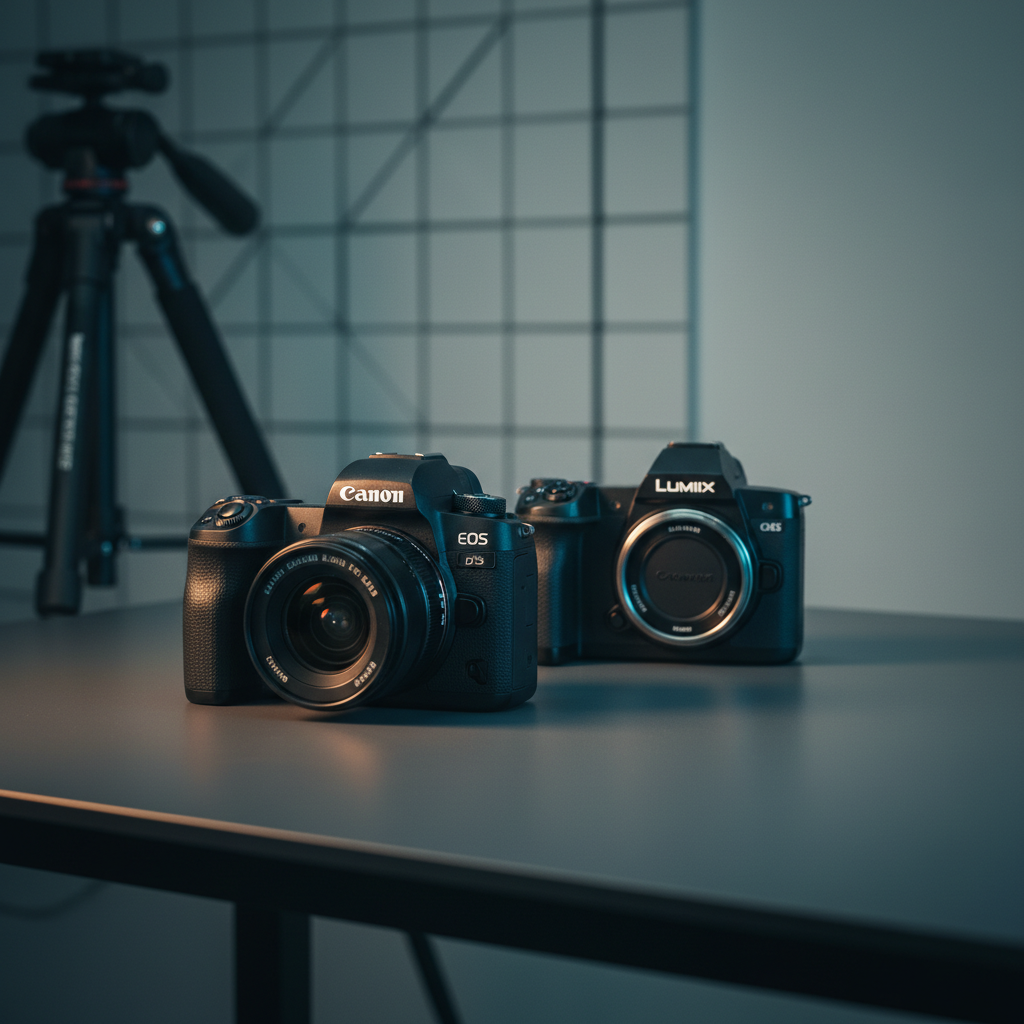
Choosing a mirrorless camera with in‑body image stabilization can feel overwhelming, especially when the market offers everything from compact budget bodies to rugged premium rigs. In this roundup we’ve compared 8 cameras that all feature MFT mounts and built‑in IBIS, sorted into three price tiers: budget options like the OM System E‑M10 Mark IV at $699.99, the mid‑range Panasonic LUMIX G85 at $897.99, and premium choices such as the Canon EOS R6 Mark II for $1999.00 and the OM System OM‑3 for $1999.99.
The Canon leads with a 4.7‑star rating from 579 reviews and a fast 4897‑point autofocus system, while its 1.3‑pound body still feels manageable. The Panasonic G85 packs a 1728‑zone metering sensor and 5‑axis IBIS that many reviewers praise for steady handheld video, all for $897.99. On the budget side, the OM System E‑M10 Mark IV offers 4.5‑stop stabilization and a lightweight 0.84‑pound chassis, making it a solid travel companion.
Below we’ll break down each model’s strengths, quirks and who they suit best, so you can match the camera to your shooting style and budget.

Canon EOS R6 Mark II
Features 4,897 AF points, delivering exceptionally detailed focus coverage across the frame.

Panasonic LUMIX G85
Avid hobbyists will appreciate its reliable performance; it costs about $1,101 less than the Canon EOS R6 Mark II.

OM System E-M10 Mark IV
Its 4.5‑stop in‑body image stabilization delivers steadier shots for under $700.
Also considered
Score Analysis
Key score advantages vs. runner-up (Panasonic LUMIX G85)
Price Range
Canon EOS R6 Mark II
$1,999.00
Panasonic LUMIX G85
$897.99
OM System E-M10 Mark IV
$699.99

OM SYSTEM Olympus E-M10 Mark IV Silver Micro Four Thirds
$699.99

Panasonic LUMIX G95
$1,048.00

Panasonic LUMIX G100
$747.99

OM System OM-D E-M10 Mark II
-$0.01

OM System OM-3
$1,999.99
Spec Comparison
TL;DR: The Canon EOS R6 Mark II packs a 24.2 MP full‑frame sensor, 4,897‑point Dual Pixel AF, 8‑stop IBIS and 40 fps burst, delivering pro‑level speed and video at $1999.00.
The standout spec is the 4,897 phase‑detect AF points that cover 100% of the 24.2 MP sensor, paired with -6.5 EV low‑light sensitivity. Coupled with up to 8 stops of 5‑axis in‑body image stabilization, the camera can keep fast‑moving subjects sharp even in shaky conditions, and the electronic shutter can fire at up to 40 fps.
At 1.3 pounds, the R6 Mark II is heavier than the Panasonic LUMIX G95 (1.06 pounds) but far lighter than the OM System OM‑3 (3.34 pounds). Its AF system dwarfs the OM‑3’s 1,053 contrast points and the G95’s 49 points, giving it a clear edge in focus coverage. The 8‑stop IBIS also outperforms the OM‑3’s maximum 6.5‑stop compensation, and the battery delivers roughly 580 LCD shots versus the OM‑3’s 420‑shot claim. Dimensionally, the R6 Mark II’s depth of 88.4 mm, height of 98.4 mm and width of 138.4 mm are more compact than the OM‑3’s 285.75 mm depth, making it easier to carry.
Reviewers consistently praise the camera’s “magic” AF performance in near darkness and the ability to shoot 40 fps bursts with full tracking. Video creators love the unlimited 4K 60p recording, 10‑bit 4:2:2 color depth and clean HDMI output up to 6K 60p. However, users note occasional overheating during long 4K 60p sessions, a menu system that can feel complex, and a micro‑HDMI port that feels less robust than larger connectors. Professional reviews highlight the combination of speed, autofocus and video quality as near‑perfect for hybrid shooters.
The DIGIC X processor drives the 3.69‑million‑dot OLED EVF with 0.76× magnification and up to 120 fps refresh, while the 76.2 mm fully articulating touchscreen offers 1.62‑million‑dot resolution for flexible composition. Connectivity includes Bluetooth 5.0, 10 Gbps USB‑C and dual UHS‑II SD slots, and the built‑in noise‑canceling mic plus 3.5 mm headphone and mic jacks make on‑the‑fly audio monitoring simple. The camera also doubles as a 1080p 30 fps webcam, adding value for streamers.
Pros
Cons
Best for: Buyers willing to invest in a proven, high-quality option
Avoid if: You're shopping on a tight budget — it's priced at $1999.00
“autofocus 'locks on and doesn’t let go'”
“the vari-angle touchscreen, clean HDMI output, and unlimited recording”
TL;DR: The Panasonic LUMIX G85 delivers 5‑axis IBIS up to 5 stops, a 16 MP Live MOS sensor, and 4K video in a weather‑sealed body for under $900.
The standout feature is its in‑body image stabilization, which Panasonic claims delivers up to 5 stops of shake reduction when paired with Dual I.S. 2 lenses. Combined with a 16,000,000‑pixel (16 MP) Live MOS sensor and 49 AF points, the camera delivers handheld performance backed by up to 5 stops of shake reduction and provides autofocus across 49 points.
At 1.11 Pounds, the G85 is lighter than the Panasonic G100 (1.3007273458 Pounds) but a touch heavier than the G95 (1.06 Pounds). Its EVF resolution of 2,360,000 dots is lower than the G100’s approx 3.68 million‑dot viewfinder, while the AF point count matches the G95’s 49 points. Battery life of 320 shots in the EVF (330 on the LCD) falls short of the OM System E‑M10 Mark IV’s approx 360‑shot rating, so you’ll recharge a bit more often on long shoots.
User sentiment highlights the camera’s sturdy magnesium‑alloy front plate and dust‑ and splash‑proof sealing as big wins for travel and vloggers. Professional reviewers praise the full‑sensor 4K 30p recording without crop, but note the electronic shutter can produce rolling‑shutter artifacts at high frame rates. Owners commonly note the modest 9 fps burst speed and limited battery capacity as trade‑offs.
Beyond stabilization, the G85 benefits from a 4/3" Live MOS sensor with no low‑pass filter, which helps retain sharpness. The Venus Engine processor handles 4K video, 8‑MP 4K burst mode at 30 fps, and a versatile ISO range from 200 to 25,600, giving you flexibility in low‑light scenarios.
Pros
Cons
Best for: Enthusiast photographers, travel shooters, and vloggers who want solid stabilization, weather sealing, and 4K video without breaking the bank.
Avoid if: You need ultra‑fast burst rates, the longest possible battery endurance, or the highest‑resolution electronic viewfinder for critical focus work.
TL;DR: The OM System E‑M10 Mark IV offers a 20.3 MP Micro Four Thirds sensor, 5‑axis IBIS up to 4.5 stops, and a fully articulating touchscreen for $699.99, making it a lightweight, travel‑ready entry‑level mirrorless.
The camera’s most distinctive feature is its 5‑axis sensor‑shift in‑body image stabilization, which provides up to 4.5 stops of shake correction. That level of stabilization pairs well with the 20.3 MP Live MOS sensor, helping you capture sharp stills even at slower shutter speeds.
At 0.84 pounds (383 g with battery and card), the E‑M10 Mark IV is lighter than the Panasonic G100 and G85, and comparable in weight to the OM‑D E‑M10 Mark II. Its depth of 49 mm is shallower than the G95 and the Silver‑edition OM‑System model, while the height of 84.4 mm matches the Silver variant and is a touch taller than the G100. The width of 121.7 mm makes it wider than the Silver edition but similar to the Mark II and narrower than the OM‑3.
Everyday users praise the camera’s compact retro styling and the fun of its manual dials, noting that the flip‑down 3.0‑inch touchscreen (1.04 M‑dot resolution) makes high‑angle shooting effortless. Professional reviewers highlight the 121‑point contrast‑detect AF system and the 8.7 fps burst without AF as solid for casual action, though they also point out that contrast‑detect AF can lag with fast subjects. The lack of an external microphone input and the flip‑under screen’s tendency to block the tripod mount are common complaints, and the body offers no weather sealing.
Technical details round out the package: a 121‑point contrast‑detect AF array, 8.7 fps burst without AF, and a battery that delivers roughly 360 shots per charge via micro‑USB. The EVF provides about 0.67× magnification, though EVF resolution isn’t listed in the available specs. The camera ships with a 1‑year manufacturer warranty.
Pros
Cons
Best for: Budget-conscious buyers seeking a reliable entry-level option
Avoid if: Reliability and user satisfaction are your top concerns
TL;DR: At $699.99, the OM SYSTEM Olympus E‑M10 Mark IV packs a 20.3 MP sensor, 5‑axis IBIS and a high‑resolution EVF into a compact, 1.1‑lb body, making it a solid entry‑level mirrorless choice.
The camera’s standout feature is its 5‑axis in‑body image stabilization, delivering up to 4.5 EV steps of shake correction. Pair that with 121 contrast‑detect AF points and a 20.3 MP (5184 × 3888) sensor, and you get detailed stills even when shooting handheld. Its electronic viewfinder shows 2,360,000 dots with about 1.23× magnification, covering roughly 100 % of the frame.
Compared with the other seven cameras in this roundup, the E‑M10 Mark IV sits in the middle of the weight range: it’s lighter than the Panasonic LUMIX G100 (around 1.3 lb) but a touch heavier than the Panasonic LUMIX G95 (about 1.06 lb). The OM System E‑M10 Mark IV peer is slimmer (49 mm depth) while this model measures 4.8 in (122 mm) deep, giving it a more substantial grip. It’s also priced higher than the G100 but lower than the premium Panasonic G85 and G95 options.
Users praise the camera’s portability, retro styling and the sharpness delivered by the 21.8 MP total pixel count. Professional reviewers highlight the 5‑axis IBIS as a key strength for handheld shooting. The most common criticism points to the contrast‑detect autofocus, which can lag on fast‑moving subjects, and the lack of an external microphone input, limiting serious video work. Battery life delivers roughly 360 shots per charge (CIPA), and the body supports USB‑C charging via micro‑USB, while 4K video at 24/25/30 p rounds out its multimedia capabilities.
Pros
Cons
Best for: Beginners, travel photographers, street shooters, and casual content creators who prioritize portability and image quality.
Avoid if: You need rugged, weather‑sealed bodies or advanced video audio options for professional work.
TL;DR: The Panasonic LUMIX G95 delivers a 20.3 MP Micro Four Thirds sensor, 5‑axis Dual I.S. 2 up to 5 stops, and unlimited 4K 30p video, all in a weather‑sealed, 1.06‑lb body.
The standout feature is the 5‑axis Dual I.S. 2 system, which Panasonic rates as providing up to 5 stops of shake correction. Coupled with 49 contrast‑detect AF points that lock focus in 0.07 seconds, the camera can shoot 9 fps in JPEG mode while maintaining sharp focus. Its 12‑stop dynamic range and ISO range of 100–25600 give plenty of latitude for both stills and video.
At 1.06 pounds, the G95 sits in the middle of the lineup—lighter than the G85, G100, Olympus E‑M10 Mark IV Silver, Canon EOS R6 Mark II and the hefty OM‑3, but a touch heavier than the compact OM‑3 Mark IV variants that weigh around 0.84 pounds. The electronic viewfinder offers 2,360,000 dots, which is lower than the G100’s approx. 3.68 million‑dot EVF but still higher than many entry‑level MFT cameras. Its AF point count matches the G85’s 49‑area focusing mode, giving it comparable autofocus coverage.
Reviewers consistently praise the G95’s handheld video capability, noting that the Dual I.S. 2 makes unlimited 4K 30p recording with V‑Log L and 4:2:2 HDMI output feel “exceptionally effective.” Users also love the rugged, weather‑sealed construction and the flip‑up OLED touchscreen that tilts roughly 250° for vloggers. The main trade‑offs include the smaller Micro Four Thirds sensor, which limits low‑light performance and shallow depth of field, a battery that delivers about 290 shots per charge, and the lack of an internal ND filter.
The camera packs a 20.3 MP (8176 × 1920) Four Thirds Live MOS sensor without a low‑pass filter, a 2‑× crop factor, and a 12‑stop dynamic range that helps preserve detail in high‑contrast scenes. Its 3.0‑inch free‑angle OLED touchscreen, rated at approx. 1,040,000 dots, flips up for self‑recording, while the 100 % viewfinder coverage and 0.74× (35 mm equiv) magnification give a clear preview. Video specs include unlimited 4K 30p, Full HD 120p, and a pre‑installed V‑Log L profile for color grading flexibility.
Pros
Cons
Best for: Those prioritizing quality and willing to pay for premium performance
Avoid if: You're on a tight budget, need deep low‑light capability, or prefer full‑frame shallow‑bokeh aesthetics
TL;DR: The Panasonic LUMIX G100 packs a 20.3 MP sensor, 4K 30p video at 100 Mbps, and three‑mic OZO audio in a lightweight 303 g body with a built‑in EVF.
The standout feature is the built‑in three‑microphone OZO audio system with directional tracking, complemented by a 3.5 mm mic input for external gear. Video‑first creators will also appreciate 4K recording at 30 p with a 100 Mbps bitrate, though the clip length tops out at 10 minutes because of heat management.
At 303 g (body only) the G100 is lighter than the Olympus E‑M10 Mark IV variants (≈0.84 lb–1.1 lb) and the Panasonic G85 and G95 (both around 1.1 lb). Its 49‑area AF grid matches the G85/G95 but falls short of the Olympus E‑M10 Mark IV’s 121 points and the Canon EOS R6 Mark II’s thousands of focus points. The EVF offers roughly 3.68 million dots, giving a clear view that rivals the higher‑priced competitors.
Reviewers consistently praise the camera’s compact form factor and the quality of its built‑in audio, calling it “excellent” for vloggers. However, the lack of in‑body image stabilization for stills and the 10‑minute 4K limit are common complaints, as is the absence of a headphone jack for real‑time audio monitoring.
Measuring 17.3 × 13.0 mm, the Live MOS sensor delivers 20.3 MP of effective resolution, with an ISO range of 100–25,600 for stills and 100–6,400 for video. Shutter speeds span 1/16,000 s to 60 s, and the camera can shoot up to 10 fps with an electronic shutter, giving flexibility for fast action at up to 10 fps.
Pros
Cons
Best for: Entry-level buyers or those on a tight budget
Avoid if: You want the best value-per-dollar in its price range
TL;DR: The OM‑System OM‑D E‑M10 Mark II packs a 16.1 MP sensor, 5‑axis IBIS up to 4 stops, an OLED EVF with 2.36 M dots, and 81 AF points in a lightweight metal body.
The camera’s standout feature is its 5‑axis in‑body image stabilization, which the manufacturer claims can compensate for up to 4 stops of shake. Pair that with a 2.36 M‑dot OLED electronic viewfinder that covers roughly 100 % of the frame, and you get a clear, stable shooting experience even in handheld situations.
Compared with the other seven models in this roundup, the E‑M10 Mark II offers 81 AF points—fewer than the 121 points found on the OM‑SYSTEM Olympus E‑M10 Mark IV but more than the 49‑point focus system of the Panasonic LUMIX G95. At 390 g, it sits between the G100’s 303 g body‑only weight and the OM‑3’s hefty 3.34 pounds, making it one of the lighter options. Its depth of 47 mm and height of 83 mm are just shy of the Mark IV’s 49 mm depth and 84.4 mm height, while its 120 mm width is marginally narrower than the Mark IV’s 121.7 mm.
Reviewers consistently praise the camera’s effective stabilization and high‑resolution viewfinder, noting that the retro metal chassis feels solid in the hand. Common criticisms focus on the lack of 4K video, the absence of an external microphone jack, and a power switch that can unintentionally fire the built‑in flash. The camera also isn’t weather‑sealed, which limits its suitability for harsh outdoor conditions.
Under the hood sits a 17.3 × 13 mm Live MOS sensor paired with the TruePic VII processor, delivering 4608 × 3456‑pixel stills and Full HD 1080p video at up to 77 Mbps. The tilting 3.0‑inch touchscreen offers 1.04 M‑dot resolution, and connectivity includes Wi‑Fi and USB 2.0 (480 Mbit/sec). Flash sync speeds of 1/200 or 1/250 sec round out the feature set.
Pros
Cons
Best for: Beginners and photography enthusiasts who want a compact, metal‑body mirrorless with strong in‑body stabilization and a high‑resolution viewfinder.
Avoid if: You need advanced features or professional‑grade performance
“autofocus 'locks on and doesn’t let go'”
“the vari-angle touchscreen, clean HDMI output, and unlimited recording”
TL;DR: The OM System OM‑3 packs a 20.4 MP stacked sensor, 1,053 AF points, and up to 7.5‑stop in‑body stabilization into a rugged, all‑metal body, but its premium $1,999 price and single card slot may deter budget‑focused shooters.
With a 1,053‑point contrast and cross‑type phase autofocus system, the OM‑3 delivers one of the highest AF point counts available in a Micro Four Thirds camera, and its stacked sensor enables 120 fps continuous shooting with full AF support.
Weighing 3.34 pounds and measuring 285.75 mm deep, the OM‑3 is noticeably larger and heavier than the Canon EOS R6 Mark II (1.3 lb) and the Panasonic G95 (1.06 lb), making it the most substantial body in this eight‑camera roundup. It also carries a single UHS‑II SD card slot, a design choice that stands out among the peers.
Reviewers highlight the camera’s premium feel, five‑axis IBIS that provides up to 7.5 stops of Sync IS at the center, and the front‑mounted Creative Dial that unlocks computational tools such as Live ND and Handheld High‑Res. Everyday users echo these praises but frequently mention the desire for a second card slot, note the EVF’s 2.36 M‑dot resolution feels modest compared with flagship rivals, and point out the lack of a built‑in microphone input for video.
Beyond the stabilization, the OM‑3 offers a 20.4 MP effective (22.9 MP total) 4/3 stacked BSI Live MOS sensor, low‑light AF sensitivity down to –5.5 EV, a 3.0‑inch vari‑angle touch screen with 1.62 M‑dot resolution, and a battery rated for approximately 420 shots per charge.
Pros
Cons
Best for: Those prioritizing quality and willing to pay for premium performance
Avoid if: You need advanced features or professional‑grade performance
Breakdown
Canon EOS R6 Mark II
Pros
Cons
Panasonic LUMIX G85
Pros
OM System E-M10 Mark IV
Pros
Cons
OM SYSTEM Olympus E-M10 Mark IV Silver Micro Four Thirds
Pros
Based on scoring data and product specs
Personalized picks
Best Overall Pick
Canon EOS R6 Mark II
Best ValueBest for: Buyers willing to invest in a proven, high-quality option
Panasonic LUMIX G85
Best for: Most users looking for a well-reviewed, reliable mainstream option
$897.99-$1,101.01 vs winner
Skip OM System OM-3 if…
You need advanced features or professional-grade performance
Winner: Canon EOS R6 Mark II earns the top spot thanks to its industry‑leading in‑body image stabilization of up to 8 stops, a 24.2 MP full‑frame CMOS sensor, and a stellar 4.7/5 rating from 579 reviewers. The dual‑pixel CMOS AF II system covers 100 % of the sensor with 4,897 focus points, delivering fast, reliable tracking for both stills and video, while the $1,999.00 list price offers strong value for the performance delivered.
Runner‑up: Panasonic LUMIX G85 shines when you need a rugged, weather‑sealed kit for outdoor shooting on a budget. Its 5‑axis sensor‑shift stabilization provides up to 5 stops of shake reduction, and the magnesium‑alloy front plate remains dust‑ and splash‑proof. At $897.99 it also offers 4K video, a fully articulating 3.0″ LCD, and a 16 MP Live MOS sensor, making it a solid choice for travel and adventure photography.
For other budgets, consider these alternatives: Budget pick – OM SYSTEM Olympus E‑M10 Mark IV Silver at $699.99 delivers a compact Micro Four Thirds body perfect for beginners. Mid‑range pick – Panasonic LUMIX G85 (already highlighted) balances price and durability for enthusiasts. Premium pick – OM System OM‑3 at $1,999.99 offers professional‑grade build and features for those who demand the highest performance.
Choose the Canon EOS R6 Mark II today—it's the best overall value and top‑tier stabilization.
The Canon EOS R6 Mark II lists a low‑light AF sensitivity down to –6.5 EV, up to 8 stops of in‑body image stabilization and an electronic‑shutter burst of up to 40 fps, which together give it a clear edge for fast, dimly lit action. The Panasonic G85 is rated to –4 EV, offers up to 5 stops of IBIS and a mechanical burst of 9 fps, making it competent but not as strong in extreme low‑light sport scenarios.
Please sign in to leave a review
No reviews yet. Be the first to review!
