Our top pick is the Polk Audio MagniFi Max AX SR, which commands a solid 4.4‑star rating from 797 reviewers and carries a list price of $899.00. Weighing 13.0 lb, it packs a 7.1.2‑channel layout, a 10‑inch wireless subwoofer, and two wireless surround speakers. The system offers one HDMI eARC 4K port plus three additional HDMI 4K inputs, giving you plenty of room for a 4K TV and other devices while keeping dialogue crisp with its VoiceAdjust tech.
We compared 11 soundbars that span three price tiers. Budget‑friendly choices include the Vizio 5.1 Soundbar SE at $198.00, Creative Katana V2X at $282.99, JBL Bar 500M2 at $649.95, and Philips FB1 at $299.95. Mid‑range options feature Sony HTS60 for $698.00 and LG S95QR for $799.99, both delivering true 5.1 surround. Premium selections round out the list with the Polk Audio flagship, Sonos Arc Ultra at $1,079.00, JBL Bar 700MK2 at $899.95, and Bose Smart Ultra at $999.00, each offering higher power output and advanced Dolby Atmos or DTS:X support.
Below you’ll find a closer look at each model’s key strengths, connectivity options, and the room sizes they’re best suited for.

Polk Audio MagniFi Max AX SR
It offers a dedicated HDMI eARC 4K (60Hz) port plus three HDMI 4K inputs, delivering strong connectivity for immersive 5.1+ sound.

Sony HTS60
Ideal for mainstream households wanting solid performance without the premium price—at $698 it’s $201 less than the Best Overall Polk Audio MagniFi Max AX SR.

Sonos ARCG2US1
Stands out with a dedicated Ethernet port and Bluetooth 5.3, offering rock‑solid wired networking and the latest wireless link—features the other two lack.
Also considered
Score Analysis
Key score advantages vs. runner-up (Sony HTS60)
Price Range
Polk Audio MagniFi Max AX SR
$769.00
Sony HTS60
$698.00
Sonos ARCG2US1
$1,069.99
Creative Katana V2X
$279.99

Vizio 5.1 Soundbar SE
$198.00

JBL Bar 500M2
$649.95

JBL Bar 700MK2
$899.95

LG S95QR
$799.99

Bose Smart Ultra
$999.00

Philips FB1
$299.95

LG SP7R
$347.99
Spec Comparison
TL;DR: The Polk Audio MagniFi Max AX SR delivers true 7.1.2‑channel Atmos immersion with an 11‑driver soundbar, a 10‑inch wireless subwoofer and two surround speakers for $899.00.
What really sets this system apart is its 7.1.2‑channel configuration built around an 11‑driver soundbar and a 254 mm (10‑inch) wireless subwoofer. The soundbar itself measures 71.1 mm high, 1143 mm wide and 116.8 mm deep, and the subwoofer adds 398.8 mm depth, 406.4 mm height and 302.3 mm width, giving the kit a solid physical presence.
Compared with the other ten entries, Polk’s unit is slightly heavier than the Bose Smart Ultra’s 12.68 lb but lighter than the JBL Bar 700MK2’s 32.0 lb. Its subwoofer driver size matches the 10‑inch driver found in the JBL Bar 700MK2, and both share a single HDMI eARC 4K (60 Hz) port, a spec the Bose model also lists.
Users consistently praise the system for crystal‑clear dialogue—thanks to the VoiceAdjust technology—and the deep, room‑filling bass from the large subwoofer. People frequently call the wireless setup of the subwoofer and two surround speakers “straightforward,” while professional reviewers note the OLED front display and Roku‑TV readiness as handy extras. The most common complaints revolve around the infrared remote’s need for line‑of‑sight, occasional Wi‑Fi hiccups due to the lack of an Ethernet port, and the 45‑inch‑wide soundbar is a tight fit for smaller living rooms.
Beyond the core audio, the MagniFi Max AX SR supports PCM, Dolby Mono, Digital, Digital Plus, Atmos, Atmos True HD, DTS Digital Surround, DTS‑HD, DTS‑HD Master Audio, DTS:X and DTS Virtual X. Connectivity includes Bluetooth 5.0, dual‑band Wi‑Fi (2.4 GHz & 5 GHz) with 802.11 a/n/ac, three HDMI 4K (60 Hz) inputs, one HDMI eARC output, a Toslink optical port, and a USB port for firmware updates.
Pros
Cons
Best for: Buyers willing to invest in a proven, high‑quality option
Avoid if: You're on a tight budget or only need basic functionality
“Dialogue is crystal clear”
“Bass is powerful and deep”
TL;DR: Sony’s HTS60 delivers a full 5.1‑channel surround experience with a 1,000 W output, lightweight design and solid Bluetooth 5.3 connectivity, though it relies on virtualized height effects and USB‑only firmware updates.
The standout spec is the combined 1,000 W total power output, split between a 30 W amplifier and a 60 W subwoofer, giving the system enough punch for cinematic bass while staying under a modest 5.75 pounds overall.
When you line it up against the other ten entries, the HTS60 is dramatically lighter than the JBL Bar 500M2’s 24.3 pounds and the Polk Audio MagniFi Max AX SR’s 13.0 pounds, making it a better fit for smaller living rooms. Its Bluetooth version 5.3 matches the JBL Bar 500M2, but the Sony system lacks Wi‑Fi, AirPlay or Chromecast that some rivals list, so you’ll be leaning on wired HDMI eARC and Bluetooth for most connections.
Reviewers consistently praise the immersive 5.1 surround, noting the subwoofer’s “room‑filling” bass and the center channel’s clear dialogue—especially when paired with Sony TVs that support Voice Zoom. Professional reviewers also highlight the seamless HDMI eARC integration. On the flip side, users report that they must perform firmware updates via a USB drive, which can be finicky, and they must plug the rear speakers into nearby outlets, so they aren’t truly battery‑free.
From a technical standpoint, the system supports virtualized Dolby Atmos and DTS:X, S‑Force PRO and a Vertical Surround Engine, giving you a sense of height without dedicated upward‑firing drivers. The included BRAVIA Connect app lets you adjust sound profiles from your phone, and the 1‑year warranty covers the whole bundle.
Pros
Cons
Best for: Home‑theater enthusiasts who want a real 5.1 setup without a full AV receiver, especially Sony BRAVIA TV owners.
Avoid if: You need built‑in Wi‑Fi, AirPlay, or fully battery‑powered rear speakers, or you prioritize audiophile‑grade music fidelity.
“Explosions and music have real punch — you feel the bass in your chest.”
“Dialogue is always clear, even during loud scenes.”
TL;DR: The Sonos Arc Ultra packs a 9.1.4‑channel Dolby Atmos setup, 15 class‑D amps and 5.3 Bluetooth into a 12.7‑lb bar, delivering immersive sound but lacks HDMI inputs.
The standout spec is its 9.1.4‑channel configuration, which uses seven silk‑dome tweeters, six midrange woofers and a four‑motor Sound Motion woofer. At 110.5 mm deep, 79.4 mm high and 1173.5 mm wide, the bar weighs 12.7 pounds, making it a sizable yet wall‑mountable unit with a mounting depth of just 6.5 mm.
Compared with the other ten entries, the Arc Ultra is marginally heavier than the Bose Smart Ultra (12.68 pounds) and far lighter than the JBL Bar 700MK2 (32 pounds). Its Bluetooth 5.3 version is newer than Bose’s Bluetooth 4.2, while many peers such as the Polk Audio MagniFi Max and JBL Bar 500M2 include HDMI inputs that the Sonos bar omits.
Professional reviewers praise the “spacious three‑dimensional soundstage” and “deep, tuneful bass” that rivals separate subwoofers, while everyday owners highlight crystal‑clear dialogue and a straightforward Trueplay calibration that uses internal mics. The trade‑off most users note is the need to route all sources through the TV because the soundbar provides only an HDMI eARC output and no native HDMI inputs.
Technical depth includes a quad‑core ARM Cortex‑A55 processor at 1.9 GHz, 2 GB SDRAM and 8 GB of internal storage, plus 15 class‑D digital amplifiers that power the driver array. Trueplay offers both a quick internal‑mic tune and an advanced room‑measurement option via a mobile device.
Pros
Cons
Best for: Buyers willing to invest in a proven, high-quality option
Avoid if: You're on a tight budget or only need basic functionality
“Bass is shockingly deep for a soundbar — I didn’t think I’d need a sub”
“Dialogue is crystal clear, even in action scenes”
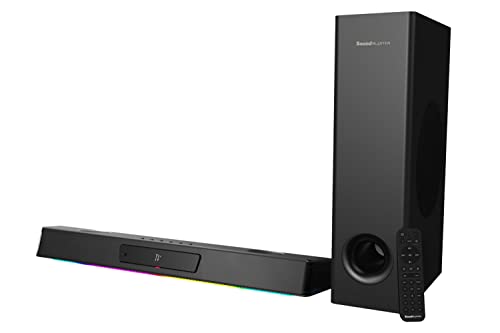
TL;DR: The Creative Katana V2X packs a 90 W RMS tri‑amplified system, 5‑driver layout and 5.0 Bluetooth into a compact 15.17‑lb soundbar with customizable RGB lighting, making it a solid space‑saving gaming solution.
The standout spec delivers 90 W RMS total system power via five individual drivers, including a 63 mm mid‑range pair and a 19 mm tweeter pair, all managed by Creative’s Super X‑Fi UltraDSP chip. The built‑in beamforming microphones and 5.0 Bluetooth connectivity round out a feature set aimed at immersive gaming and streaming.
At 15.17 lb, the Katana V2X is slightly lighter than the Philips FB1 (15.87 lb) but noticeably heavier than the Sony HTS60 (5.75 lb) and far lighter than the JBL Bar 500M2 (24.3 lb). Its 90 W RMS output sits below Vizio’s listed 180‑watt total output, while its Bluetooth version 5.0 trails Vizio’s 5.2, indicating a modest trade‑off in raw power and wireless bandwidth compared with some peers.
Reviewers consistently praise the virtual 5.1 surround created by Super X‑Fi and the space‑saving subwoofer, noting that the compact design fits well on cramped desks. Professional reviewers highlight the solid build quality and the vibrant RGB lighting that can be tuned via the Creative app. Common complaints focus on the reduced bass depth from the smaller subwoofer driver and occasional micro‑scratches on the front display panel.
Pros
Cons
Best for: Gamers with limited desk or room space who want virtual surround, built‑in microphones and customizable lighting.
Avoid if: You need deep, room‑filling bass or the highest power‑per‑dollar value in this segment.
“These soundbar speakers are the cheapest around for this performance.”
“Fast shipping and value for money.”
TL;DR: The Vizio 5.1 Soundbar SE delivers true 5.1 surround with Dolby Atmos support, 96 dB SPL and a subwoofer that reaches 50 Hz, all for $198 and a solid 4.1‑star rating.
The standout feature is the full 5.1 channel layout: a 33‑inch soundbar, two wired rear satellite speakers, and a wireless subwoofer that can reproduce frequencies down to 50 Hz (45 Hz under load). Combined with Dolby Atmos, DTS:X and DTS Virtual:X, the system promises an immersive movie‑night experience, and its 96 dB sound pressure level indicates a room‑filling output.
When you line it up against the other ten entries, Vizio’s Bluetooth 5.2 sits between the Creative Katana V2X’s Bluetooth 5.0 and the JBL Bar 500M2’s Bluetooth 5.3. While some competitors tout higher RMS power—Creative’s 50 W RMS for the soundbar and Sony’s 1000 W total output—the Vizio’s 180‑watt total output still holds its own for a budget‑focused package. It also brings more connectivity options than the Sony HTS60, which lists only a single HDMI eARC input like Vizio, but Vizio adds a USB port for WAV playback.
Reviewers consistently highlight the crisp dialogue enabled by the ClearDialog voice‑enhancement mode and the punchy bass from the subwoofer, which reaches down to 50 Hz. Professional outlets praise the quick setup through HDMI eARC and say the QuickFit wall‑mount system saves time. Users love controlling everything from the VIZIO mobile app, though a few mention occasional Bluetooth dropouts and a clunky app experience. Users most commonly complain about the missing optical input and the lack of a dedicated remote, especially owners of older TVs.
Pros
Cons
Best for: Shoppers on a tight budget who want the most for their money
TL;DR: The JBL Bar 500M2 packs a 750 W total output, 10‑inch wireless subwoofer and Dolby Atmos support into a sleek 24.3‑lb soundbar, earning a 4.6‑star rating from 89 reviewers.
What really stands out is the system’s 750 W maximum power, split between a 450 W soundbar and a 300 W wireless subwoofer that houses a 10‑inch driver. Dolby Atmos, DTS Virtual:X and a 40 Hz‑20 kHz frequency response give you a wide, immersive soundstage, while Bluetooth 5.3 and Wi‑Fi 6 keep streaming stable.
Compared with its peers, the Bar 500M2 is heavier than the Sony HTS60’s 5.75 lb chassis but lighter than the JBL Bar 700MK2’s 32.0 lb package. Its total output of 750 W sits below Sony’s 1000 W but tops the LG S95QR’s 220 W subwoofer rating, and it matches the JBL 700MK2’s 10‑inch subwoofer driver size while delivering a slightly lower 750 W versus 780 W total power. Unlike the Polk MagniFi Max AX SR, it offers only one HDMI input, but it still includes HDMI eARC and an optical TOSLINK input, matching the connectivity depth of many competitors.
Reviewers consistently praise the deep, punchy bass from the 10‑inch subwoofer and the clarity of dialogue, often attributing it to JBL’s PureVoice processing. Professional outlets note the “bold, dynamic sound” and “excellent voice clarity,” while everyday users love the hassle‑free setup and reliable Bluetooth/Wi‑Fi streaming. The main trade‑offs mentioned are the virtual‑only surround (no physical rear speakers) and the US‑only USB port that supports only MP3 files, which some find limiting.
On the technical side, the Bar 500M2 runs at a low standby draw of under 2 W, supports 5.3 Bluetooth, Wi‑Fi 6, Chromecast built‑in, Alexa and AirPlay 2, and comes with a 1‑year manufacturer warranty. The soundbar’s dimensions (104 mm depth, 50.5 mm height, 940 mm width) and the subwoofer’s 325 mm cube footprint makes it a solid fit for most living‑room setups, and the 600 mm wall‑mount spacing gives flexibility for placement.
Pros
Cons
Best for: Most users seeking a balanced, mainstream option
Avoid if: You need advanced features or professional‑grade performance
“deep, punchy bass and how it transforms movie nights”
“crystal‑clear dialogue, especially during news and dialogue‑heavy shows”
TL;DR: The JBL Bar 700MK2 delivers a true 7.1‑channel experience with a 390 W RMS output, detachable wireless surrounds and a 10‑inch subwoofer, but its premium $899.95 price may deter budget‑focused buyers.
This soundbar’s headline spec is its 390 W RMS power and a total system output of 780 W, with a 10‑inch (260 mm) subwoofer that pumps out 300 W. Coupled with Dolby Atmos and DTS Virtual:X support, it creates an immersive home‑theater soundstage that reviewers say feels “cinematic.” The detachable wireless surround speakers add flexibility, and the JBL ONE app handles room calibration and setup.
At 32.0 pounds, the Bar 700MK2 is heavier than most peers such as the Polk Audio MagniFi Max AX SR (13.0 pounds) and the Bose Smart Ultra (12.68 pounds), yet it’s a shade lighter than LG’s S95QR (33.0 pounds). Its 390 W RMS power dwarfs the 120 W output Bose lists, and its single HDMI eARC input and output give it more connectivity than the Sonos system, which only offers an eARC output.
User sentiment highlights the “true 7.1 channel surround” and the “deep, impactful bass” from the 10‑inch subwoofer as major wins. Professional reviewers praise the MultiBeam 3.0 technology for filling larger rooms, while everyday owners love the wireless flexibility. Common complaints focus on the USB port’s MP3‑only playback, the lack of HDMI 2.1 gaming features such as VRR or ALLM, and the need to recharge the detachable speakers, which offer about 10 hours of battery life.
Additional technical notes include a frequency response of 35 Hz – 20 kHz (‑6 dB), Night Listening and PureVoice 2.0 modes, and voice‑assistant compatibility with Google Assistant and Siri via AirPlay. The system runs on 100‑240 V AC and draws less than 2.0 W in standby, fitting well into typical living‑room power budgets.
Pros
Cons
Best for: Those prioritizing quality and willing to pay for premium performance
Avoid if: You need advanced gaming features, longer battery life for wireless speakers, or a lower‑cost solution
“deep, punchy bass and how it transforms movie nights”
“crystal‑clear dialogue, especially during news and dialogue‑heavy shows”
TL;DR: The LG S95QR delivers a true 9.1.5‑channel experience with 17 speakers and 810 W total output, but its premium $799.99 price and modest subwoofer performance may limit its appeal.
The standout spec is its 9.1.5‑channel layout, which uses 17 speaker units and delivers a total output of 810 W. Each front channel pushes 45 W, the center and center‑height drivers deliver 40 W, and the wireless subwoofer contributes 220 W of power. Dolby Atmos, DTS:X, IMAX Enhanced and Meridian tuning round out a feature‑rich audio suite.
At 33.0 pounds, the S95QR is heavier than the JBL Bar 700MK2 (32.0 pounds) but considerably heftier than the Polk Audio MagniFi Max AX SR, which weighs 13.0 pounds. LG offers two HDMI inputs, exceeding the single HDMI input listed for the JBL Bar 500M2. Its Bluetooth version 5.0 trails the 5.3 implementations found in the JBL Bar 500M2 and Sony HTS60, a modest generational gap.
Everyday owners praise the plug‑and‑play wireless setup and the ability to fill a large room with loud, immersive sound for movies and gaming. Professional reviewers highlight the 17‑speaker configuration, seamless wireless connectivity and the broad format support as strong points. However, both users and experts note that the subwoofer and surround speakers can sound mediocre, with bass that overwhelms and surround effects that lack precision. Height‑channel immersion is also described as limited despite the five up‑firing drivers.
Technical extras: AI Room Calibration PRO automatically tunes the system, a 5‑character auto‑dimming LCD displays status, and the unit supports Wi‑Fi (2.4 GHz/5 GHz), Google Assistant, Amazon Alexa, Chromecast, Apple AirPlay 2, Spotify Connect and Tidal. The soundbar draws 78 W, the subwoofer draws 40 W and the rear speaker kit draws 33 W, with standby consumption under 0.5 W for each component.
Pros
Cons
Best for: Large‑room home‑theater enthusiasts who want a high‑channel count, all‑in‑one solution with minimal wiring.
Avoid if: You're shopping on a tight budget — it's priced at $799.99
TL;DR: The Bose Smart Ultra delivers immersive 5.1.2 Dolby Atmos sound with AI‑enhanced dialogue, 120 W output and built‑in Alexa, but its bass is modest without a subwoofer and it lacks HDMI inputs.
The standout spec is its 5.1.2 channel layout powered by nine drivers—including three tweeters and six racetrack full‑range drivers—producing a 120 W output and a frequency response of 40 Hz – 20 kHz. AI Dialogue Mode and TrueSpace technology further refine vocal clarity and up‑mix non‑Atmos material.
At 12.68 pounds, the Ultra is virtually the same weight as the Sonos ARCG2US1 (12.7 pounds) but far lighter than JBL’s Bar 700MK2 (32.0 pounds) and LG’s S95QR (33.0 pounds). Its depth of 4.21 inches (107 mm) is slightly shallower than Sonos (110.5 mm) and Polk Audio (116.8 mm), yet a touch deeper than JBL Bar 500M2 (104 mm). Bluetooth 4.2 trails the 5.3 version found in most peers, which some users note can lead to occasional dropouts. Like Sonos and Polk, it offers a single Ethernet port and one HDMI eARC port, but it doesn't provide any additional HDMI inputs.
Professional reviewers praise the Ultra’s “large, room‑filling sound field” and “detailed surround sound,” highlighting the height and width effects that make a one‑piece bar feel like a full system. Everyday owners echo the praise for immersive imaging and the convenience of ADAPTiQ calibration, yet many point out that bass feels shallow unless a separate subwoofer is added. The lack of DTS:X support and the absence of HDMI video passthrough are common criticisms, alongside requiring the calibration headset for optimal setup.
Pros
Cons
Best for: Those prioritizing quality and willing to pay for premium performance
Avoid if: You're on a tight budget or only need basic functionality
TL;DR: The Philips FB1 packs a 7.1.2‑channel, all‑in‑one soundbar with 310 W RMS power, a dual 3.5‑inch subwoofer and full‑stack Dolby Atmos, but its calibration software can be finicky.
The FB1’s headline spec is its 7.1.2‑channel driver layout: four full‑range drivers and two tweeters on the front left/right, a D’Appolito‑style center with two full‑range drivers and one tweeter, side‑firing surrounds, up‑firing height drivers, plus an integrated dual 3.5‑inch subwoofer, totaling 15 drivers. It pushes 310 W RMS (620 W max) and can reach a maximum SPL of 96 dB, giving the kind of room‑filling impact you’d expect from a separate subwoofer.
Compared with the other soundbars in this roundup, the FB1 is a bit heavier than the Creative Katana V2X (which weighs 15.17 pounds) but lighter than the JBL Bar 500M2 (24.3 pounds). Its Bluetooth version 5.0 matches the Katana’s, while the Vizio SE steps up to 5.2. In terms of driver count, the FB1’s 15 drivers outnumber the Katana’s five and sit just below the LG S95QR’s 17‑unit configuration. The FB1 also offers more HDMI eARC functionality than the Vizio SE, which lists a single HDMI eARC input.
Everyday owners love the “powerful bass without a separate sub” and the immersive height effects that bring movies to life, echoing professional notes about strong spatial imaging and clear vocals. However, both users and reviewers flag the auto‑room‑calibration routine as “buggy” and sometimes responsible for audio drop‑outs. The sound signature leans toward a bass‑heavy, bright profile, which some describe as “harsh at high volumes” and less neutral than reference‑grade systems.
Beyond the driver array, the FB1 supports Dolby Atmos, Dolby TrueHD, DTS:X and IMAX Enhanced, and it auto‑adjusts lip‑sync up to 200 ms. Connectivity is generous: one HDMI input and one HDMI eARC/ARC output, optical, USB playback, Bluetooth 5.0, Wi‑Fi (dual‑band), AirPlay 2, Chromecast built‑in and Spotify Connect, which you can control via the Philips Fidelio app. The unit ships with a 2‑year manufacturer warranty.
Pros
Cons
Best for: Movie and TV enthusiasts seeking a room‑filling, cinematic experience without multiple speakers.
Avoid if: You want the best value‑per‑dollar in its price range or need a neutral, reference‑grade sound profile for critical listening.
“The bass is incredible for a soundbar without a sub”
“Movies sound huge—height effects are convincing”
TL;DR: The LG SP7R costs $347.99, lands at the bottom of the 11‑product lineup with a 3.1‑star rating, and users are split between praise for its surround feel and complaints about reliability.
LG’s SP7R arrives at a mid‑range price point of $347.99 and currently holds the lowest rating among the eleven soundbars we evaluated, earning a 3.1 out of 5 from seven reviewers. As an LG offering, it’s backed by the brand’s reputation for home‑audio products, but the score suggests it struggles to meet expectations compared with its peers.
Reviewers who enjoy the system highlight the immersive surround experience and the ability to play high‑quality audio files, noting that the wireless subwoofer and rear speakers help create a cinema‑like atmosphere without a full receiver. On the flip side, many users report that the unit powers down after a short period of inactivity, that the bass sounds weak, and that users find the manual and setup process confusing. Several complaints also note that the package arrives with scratches or missing components, adding friction to the first‑time experience.
Given its price and rating, the SP7R sits in the budget‑friendly tier of multi‑channel soundbars, but the mixed feedback means it may not satisfy buyers looking for a hassle‑free, high‑performance home theater upgrade.
Pros
Cons
Best for: Entry-level buyers or those on a tight budget
Breakdown
Polk Audio MagniFi Max AX SR
Pros
Sony HTS60
Pros
Sonos ARCG2US1
Pros
Creative Katana V2X
Pros
Cons
Based on scoring data and product specs
Personalized picks
Best Overall Pick
Polk Audio MagniFi Max AX SR
Best OverallBest for: Buyers willing to invest in a proven, high-quality option
Sony HTS60
Best for: Most users seeking a balanced, mainstream option
$698.00-$71.00 vs winner
Skip LG SP7R if…
Reliability and user satisfaction are your top concerns
The Polk Audio MagniFi Max AX SR ranks first thanks to its expansive 7.1.2‑channel layout, an 11‑driver array that includes dual 76.2 mm mid‑woofers and a 254 mm subwoofer, and a solid 4.4‑star rating from 797 reviewers. Its connectivity is future‑proof with one HDMI eARC port, three additional 4K HDMI inputs, and Bluetooth 5.0, while the 13.0‑pound package remains manageable for wall‑mounting.
The Sony HTS60 earns runner‑up honors for anyone who wants seamless integration with a Sony BRAVIA TV and a single‑hub design. Its virtualized Dolby Atmos and DTS:X processing, 5.1‑channel amplifier delivering a total 1000 W output, and Bluetooth 5.3 make it a strong choice for a living‑room cinema that leans on wireless rear speakers, all at $698.00.
For tighter budgets, the Vizio 5.1 Soundbar SE delivers 5.1 sound at just $198.00, making it the top entry‑level pick. If you’re looking for a mid‑range option, the Sony HTS60 (already highlighted above) balances price and performance nicely. At the premium end, the Sonos ARCG2US1 stands out with its high‑end features and $1,079.00 price tag, offering a luxury‑grade audio experience.
Choose the Polk Audio MagniFi Max AX SR for the most complete multi‑channel soundbar available.
The Vizio 5.1 Soundbar SE is the most compact, measuring just 58 mm deep and 82 mm high, and it mounts directly to the wall with QuickFit hardware. Its all‑in‑one design eliminates a bulky subwoofer and the rear speakers are wired, keeping the footprint minimal.
Please sign in to leave a review
No reviews yet. Be the first to review!
