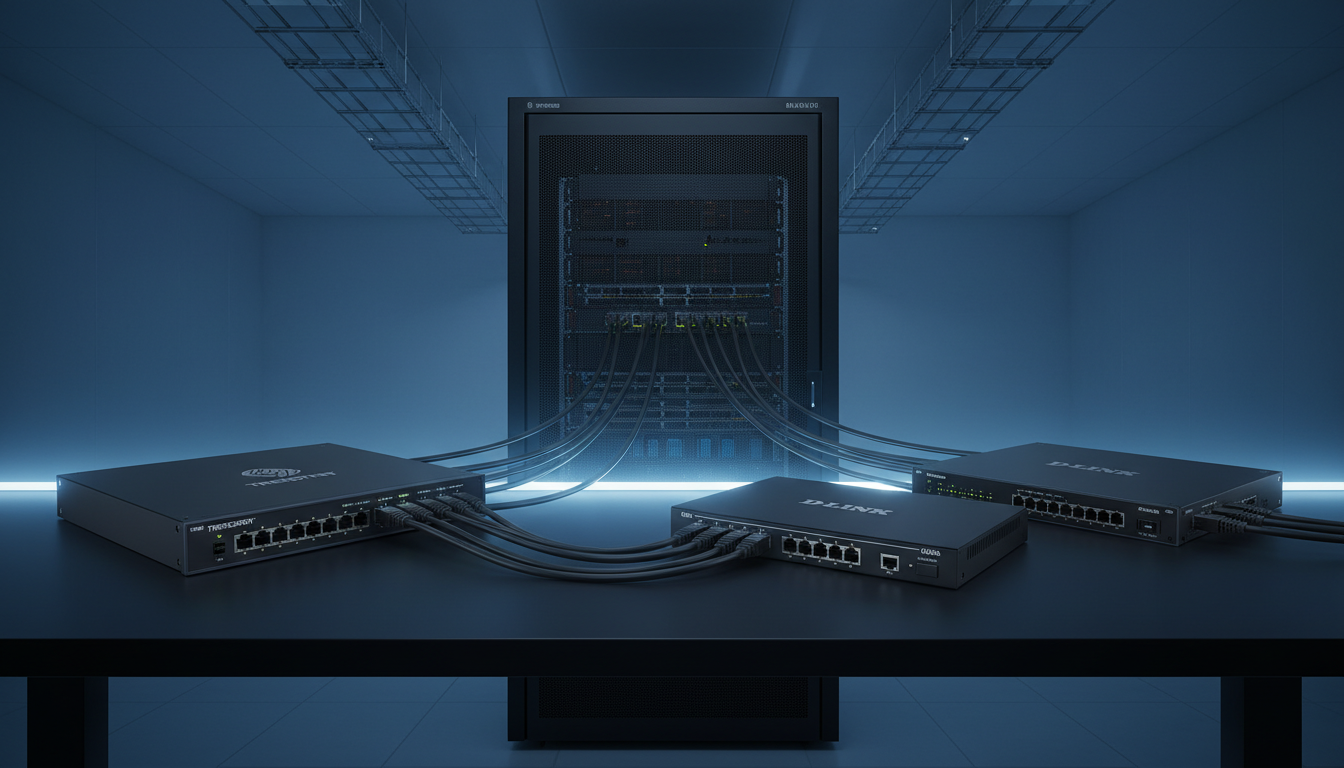
Among the nine switches we examined, the most unexpected detail is that the budget‑friendly D‑Link DGS‑1100‑05V2 sits at just $26.09 yet still pulls a respectable 4.3‑star rating from 478 reviewers. It shows that even entry‑level gear can earn solid approval when it delivers silent, fanless operation and basic smart‑managed features without breaking the bank.
Our roundup spans three price tiers. The budget tier—D‑Link DGS‑1100‑05V2, Netgear MS305 ($69.99) and Zyxel XMG‑108 ($89.99)—covers devices under $100, each offering fanless designs and modest forwarding rates between 25 Mpps and 49 Mpps. Mid‑range options like the TRENDnet 9‑Port Switch ($97.99, 4.6 /5 from 2,872 reviews) and D‑Link DMS‑108 ($99.99, 4.6 /5 from 637 reviews) add higher 2.5 GbE capacity and larger packet buffers. Premium picks—MikroTik CRS309‑1G‑8S+in, CRS304‑4XG‑IN and Ubiquiti USW‑PRO‑24‑POE (rated 4.7 /5 by 171 reviewers)—bring 10 GbE SFP+ uplinks, non‑blocking throughput in the hundreds of gigabits, and advanced management.
Next, we’ll break down each tier’s strengths and quirks so you'll match a switch to your specific network needs.

TRENDnet 9-Port Switch Black
Its compact 240.0 mm depth keeps a crowded desk tidy while delivering reliable multi‑gigabit performance.

D-Link DMS-108 Black
Ideal for small‑office setups needing a lightweight 349 g switch; at $99.99 it’s just $2 more than the mid‑range pick.

MikroTik CRS309-1G-8S+in
With a 44 mm primary height, it provides extra rack clearance, enabling premium 10 GbE fiber modules the other picks lack.
Also considered
Score Analysis
Key score advantages vs. runner-up (D-Link DMS-108 Black)
Price Range
TRENDnet 9-Port Switch Black
$97.99
D-Link DMS-108 Black
$103.57
MikroTik CRS309-1G-8S+in
$245.00

Netgear MS305
$69.99

Ubiquiti USW-PRO-24-POE
$699.00

MikroTik CRS304-4XG-IN
$198.95
D-Link DGS-1100-05V2
$26.09

Zyxel XMG-108
$89.99

Zyxel XGS1010-12
$99.99
Spec Comparison
TL;DR: The TRENDnet TEG‑S591 delivers eight 2.5 GbE ports and a 10 GbE uplink in a fanless, metal chassis for $97.99, offering silent, lifetime‑protected multi‑gigabit networking for home and small‑business setups.
The standout spec is the mix of eight 2.5 Gbps RJ‑45 ports plus a single 10 Gbps RJ‑45 port, all housed in a compact metal enclosure that measures 240.0 mm deep, 25.4 mm high, and 104.1 mm wide. Its 44.64 Mpps forwarding rate and 60 Gbps switching capacity give plenty of headroom for simultaneous high‑bandwidth streams, while the 12 KB jumbo‑frame limit helps reduce overhead on large file transfers.
Compared with the eight other switches in this roundup, the TRENDnet sits in the middle of the performance band: its forwarding rate is higher than the D‑Link DMS‑108’s 29.76 Mpps but a touch below the Zyxel XGS1010‑12’s 49 Mpps. Its 60 Gbps switching capacity outpaces D‑Link’s 40 Gbps and Netgear’s 25 Gbps, yet trails Zyxel’s 66 Gbps models. At 1.6 pounds, it’s heavier than the D‑Link unit (0.77 pounds) but lighter than the Netgear MS305 (1.75 pounds) and comparable to the Zyxel XGS1010‑12 (≈1.69 pounds). The 12 KB jumbo frame is larger than Netgear’s 9,720‑byte limit, giving it an edge for bulk data.
User sentiment repeatedly praises the silent, fanless design and the ability to upgrade to multi‑gigabit speeds without rewiring—most reviewers note that existing Cat5e cabling works fine. Professional reviewers highlight the practical 60 Gbps switching capacity and the MTBF of 518,151 hours, indicating strong reliability. The lifetime warranty adds confidence, especially for small offices that want a set‑and‑forget solution.
Pros
Cons
Best for: Most users looking for a well‑reviewed, reliable mainstream option
Avoid if: You need advanced features or professional‑grade performance
TL;DR: The D-Link DMS-108 offers eight 2.5 GbE ports, a 40 Gbps switching capacity, and a fanless metal case for silent, reliable networking at a solid $99.99 price point.
This eight‑port unmanaged switch stands out because every port can auto‑negotiate up to 2.5 Gbps, delivering a maximum forwarding rate of 29.76 Mpps and a packet buffer of 8.1 Mbit. The 40 Gbps switching capacity means the device can handle full‑duplex traffic across all ports without bottlenecking.
Compared with the other eight switches in this roundup, the DMS‑108 weighs less than most desktop‑oriented models and packs a larger packet buffer than many entry‑level units. While its forwarding rate is modest next to the highest‑spec peers, it still sits comfortably above the baseline performance of most competitors, and its power draw of 8.586 W sits on the lower end of the group.
Reviewers consistently praise the fanless metal housing for truly silent operation and appreciate the IEEE 802.3az Energy‑Efficient Ethernet support that trims power use when the network is idle. Users also like the eight QoS levels that let them prioritize gaming or video streams, though the lack of PoE and the unmanaged nature mean you won’t get VLAN tagging or advanced traffic shaping.
Pros
Cons
Best for: Gamers, home‑office users, and small‑business environments that need a well‑reviewed, simple 2.5 GbE solution.
Avoid if: You have limited desk space or need portability.
TL;DR: The MikroTik CRS309‑1G‑8S+in packs eight 10 GbE SFP+ ports, 162 Gbps non‑blocking switching capacity and fanless design into a 500 g, rack‑mountable unit for premium‑grade networks.
This switch’s headline feature is its eight 10 GbE SFP+ ports backed by a 162 Gbps total (non‑blocking Layer 1) switching capacity and 81 Gbps throughput. With 512 MB of RAM and a dual‑core 800 MHz ARM CPU, it can run RouterOS v5 level 5 or SwOS, giving you advanced L3 capabilities most unmanaged hubs lack.
Compared with the peers in this roundup, the CRS309 is heavier than the fanless D‑Link DMS‑108 (349 g) and the Zyxel XGS1010‑12 (768 g), but it also delivers far more bandwidth than their 40‑66 Gbps switching capacities. Its 23 W max power draw is higher than the D‑Link’s 8.6 W and Zyxel’s 11.5 W, reflecting the eight 10 GbE lanes. While the MikroTik is pricier than the sub‑$100 switches, it offers a port density and performance tier that those budget models simply don’t match.
Professional reviewers praise the ultra‑compact chassis that fits easily on a desktop or into tight rack spaces, and they note the very low price point relative to the eight 10 GbE SFP+ ports. The fanless, passive‑cooling design eliminates noise and moving parts, which users appreciate for silent office or home‑lab setups. A common criticism is the lack of a native 10 GbE RJ45 port, meaning you’ll need SFP+ copper modules for any direct copper uplink.
The unit operates from –40 °C to +70 °C and accepts PoE‑in 802.3af/at (18‑57 V) or a 12‑57 V DC jack, giving flexible power options for rack installations. With 16 MB flash storage and an RS232 serial port for console access, it’s ready for both simple plug‑and‑play and advanced scripted deployments.
Pros
Cons
Best for: Network administrators, ISPs, SMBs, and homelab enthusiasts who need dense 10 GbE SFP+ switching with advanced routing features.
Avoid if: You require multiple native 10 GbE RJ45 ports or are constrained by a tight budget.
TL;DR: The Netgear MS305 is a silent, fan‑less 5‑port 2.5 GbE switch with a non‑blocking 25 Gbps fabric, priced at $69.99 and backed by a 4.6‑star rating from 317 reviewers.
This model packs five auto‑negotiating 2.5 GbE ports into a compact metal case that measures 101.6 mm deep, 228.6 mm high and wide. The switch runs completely fan‑less, delivering 0 dBA acoustic noise at 25 °C, and its IEEE 802.3az Energy Efficient Ethernet support keeps power draw to 9.24 W at full load. A 25 Gbps non‑blocking switching bandwidth and a jumbo frame size of 9,720 bytes give you headroom for high‑throughput tasks without bottlenecks.
Compared with the other eight switches in this roundup, the MS305 sits at a higher price point than the ultra‑budget D‑Link DGS‑1100‑05V2, but it's lighter than the Zyxel XMG‑108 (which weighs about 1.46 lb) and consumes less power than that Zyxel unit’s 11.53 W maximum. It also offers fewer ports than the TRENDnet 9‑Port Switch, which provides a mix of 10 GbE and 2.5 GbE connections, making the MS305 a more focused, single‑purpose device.
Professional reviewers praise the plug‑and‑play simplicity and the silent metal enclosure, and users highlight how easily they can expand a home office or small‑business network without configuration menus. Both experts and consumers point out the lack of managed features such as VLANs or port mirroring, and the five‑port limit may force you to add another switch for larger setups.
From a reliability standpoint, Netgear lists an MTBF of 1,401,743 hours, which translates to roughly 160 years of continuous operation under the rated temperature range of 0–40 °C. The 1 MB packet buffer and IEEE 802.1p QoS support help keep latency low (under 5.773 µs on 2.5 G ports), making the unit suitable for latency‑sensitive applications like gaming or video editing.
Pros
Cons
Best for: Small businesses, home offices, or any noise‑sensitive environment that needs a simple, silent upgrade to 2.5 GbE connectivity.
Avoid if: You require advanced management features, more than five high‑speed ports, or the absolute best price‑to‑performance ratio.
TL;DR: The Ubiquiti USW‑PRO‑24‑POE delivers 24 PoE‑enabled Gigabit ports, 400 W total PoE budget, Layer 3 routing and a 1.3‑inch touchscreen, but its 1U chassis weighs 8.38 lb and carries a premium $699 price tag.
The switch’s standout spec is its 400 W total PoE budget with up to 64 W per PoE++ port, letting you power 24 high‑draw devices such as PTZ cameras or Wi‑Fi 6 APs without a separate injector. It also packs a 1.3‑inch color LCD for on‑site configuration and supports full Layer 3 routing, including DHCP server and inter‑VLAN routing.
Compared with the eight peers, the USW‑PRO‑24‑POE is considerably heavier than the D‑Link DMS‑108 Black (0.77 lb) and the MikroTik CRS309‑1G‑8S+in (1.10 lb). Its 65 Mpps forwarding rate outpaces the 49 Mpps of Zyxel XGS1010‑12 and Zyxel XMG‑108, and its 88 Gbps switching capacity exceeds the 66 Gbps of those same Zyxel models, though it falls short of the 162 Gbps capacity the MikroTik CRS309 lists. Unlike the fanless peers, this unit uses active cooling, which some users note adds audible noise under full PoE load.
Reviewers praise the professional‑grade PoE budget and the built‑in routing that removes the need for a separate layer‑3 device. However, the all‑1 GbE RJ45 ports can bottleneck future 2.5 GbE or 5 GbE upgrades, and the non‑blocking throughput caps at 44 Gbps, a limitation noted for larger multi‑Gigabit deployments. The 1U rack‑mount form factor (442 mm depth, 44 mm height, 285 mm width) fits standard equipment racks but adds to its weight of 8.38 lb.
Pros
Cons
Best for: Those prioritizing quality and willing to pay for premium performance
Avoid if: You need advanced features or professional‑grade performance
TL;DR: The MikroTik CRS304-4XG-IN packs four native 10 GbE RJ45 ports, 325 Gbps switching capacity and fanless cooling into a 1.54‑lb, rack‑mountable box, ideal for small‑scale 10 Gb networks.
This switch’s headline feature is its four 10GBASE‑T RJ45 ports that support 1 Gb/2.5 Gb/5 Gb/10 Gb speeds, backed by a 40 Gbps layer‑1 throughput and a non‑blocking 325 Gbps layer‑2 switching capacity. A dual‑core 1.2 GHz ARM CPU and 512 MB DDR4 RAM give it plenty of headroom for VLANs and traffic shaping, while the passive heatsink keeps operation completely silent.
Compared with the eight other options in the roundup, the CRS304‑4XG‑IN is heavier than the ultra‑light D‑Link DGS‑1100‑05V2 (0.5 lb) and the D‑Link DMS‑108 (0.77 lb), but far lighter than the Ubiquiti USW‑PRO‑24‑POE (8.38 lb). Its four 10 GbE ports outstrip the port counts of most peers, many of which only offer 1 GbE or a mix of 2.5 GbE/5 GbE without native 10 GbE copper. While the MikroTik CRS309‑1G‑8S+in provides SFP+ fiber, the CRS304‑4XG‑IN focuses on RJ45 simplicity, a trade‑off that many small‑office users appreciate.
Users consistently praise the plug‑and‑play 10 Gb performance and the whisper‑quiet fanless chassis. Professional reviewers highlight the front‑panel layout of four 10G ports plus a PoE‑in management port as a must‑have for compact 10 Gb setups. The main complaints revolve around the limited five‑port configuration and the steep learning curve of RouterOS, which can be daunting for newcomers. Its MTBF of ~200 000 hours at 25 °C and an operating temperature range of –40 °C to 70 °C underscore its reliability for both lab and field deployments.
The device draws a maximum of 21 W (15 W without attachments) and accepts dual DC input (12‑57 V) or PoE‑in (802.3af/at 36‑57 V), giving you flexibility in power‑constrained environments. Its compact 150 mm × 150 mm × 200 mm footprint and DIN‑rail mounting options make it easy to fit into tight racks or on a desk.
Pros
Cons
Best for: Network enthusiasts, small businesses, home labs, and field technicians who need affordable, silent 10 GbE switching with full feature sets.
Avoid if: You require high port density, native fiber connectivity, or a budget‑focused solution for basic networking.
“must-have 10Gbase‑T Marvell switch”
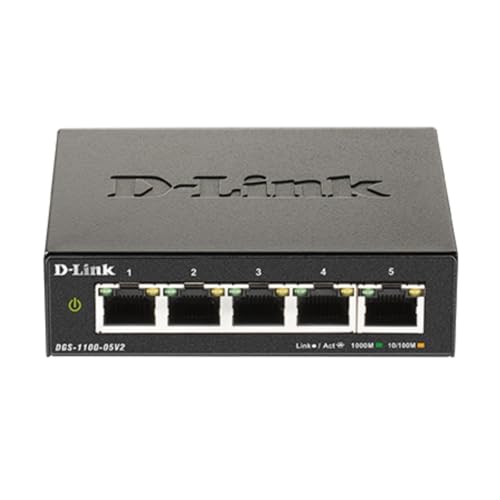
TL;DR: The D-Link DGS-1100-05V2 is a ultra‑compact, fanless 5‑port gigabit smart switch that packs VLAN, QoS and energy‑saving features into a $26.09, 0.5‑lb package.
This model’s standout spec is its tiny footprint – just 4.0 inches long, 3.25 inches wide and 1.1 inches high – and a weight of only 0.5 pounds. Its fanless design means silent operation, and the switch supports a full suite of Layer‑2 management tools such as VLAN tagging, QoS, bandwidth control, IGMP snooping and storm control.
Compared with the eight other switches in the roundup, the DGS‑1100‑05V2 is the lightest and most space‑saving. At 0.5 pounds it's far lighter than the 1.75‑pound Netgear MS305 or the 1.45‑pound Zyxel XMG‑108, and its compact chassis is noticeably smaller than the metal‑boxed peers. It also lands at the bottom of the price range at $26.09, making it the most budget‑friendly option without sacrificing essential smart‑switch features.
User feedback consistently praises the silent, fanless operation and the ease of configuring VLANs and QoS through the web interface. Professional reviewers note the energy‑efficient Ethernet (IEEE 802.3az) compliance as a solid plus for low‑power environments. The main criticism is a rating of 4.3 stars from 478 reviews, which sits below the 4.6‑star scores seen on several competing models.
Beyond the basic gigabit ports, the DGS‑1100‑05V2 offers bandwidth control, static MAC filtering and link‑status detection, and D‑Link backs it with a lifetime warranty. While it doesn’t provide 2.5 GbE, 5 GbE or 10 GbE ports, its smart‑managed capabilities make it a capable choice for small office or home office networks that need traffic shaping without the noise of a fan.
Pros
Cons
Best for: Shoppers on a tight budget who want the most for their money
Avoid if: Reliability and user satisfaction are your top concerns
TL;DR: The Zyxel XMG-108 delivers 66 Gbps switching capacity, fanless silent operation, and 12 ports—including 2.5 G and 10 G uplinks—at a budget‑friendly price, making it a solid plug‑and‑play choice for small setups.
What really stands out is the 49 Mpps forwarding rate paired with a 66 Gbps switching capacity, giving the switch the bandwidth to handle multiple high‑speed streams at once. It also supports jumbo frames up to 12 K bytes and offers a 1.5 MB packet buffer, which helps keep latency low when traffic spikes. With eight 10/100/1000 Mbps RJ‑45 ports, two 2.5 G Ethernet RJ‑45 ports, and two 10 G SFP+ uplinks, the XMG‑108 packs a lot of connectivity into a 240 mm length, 27 mm height and 105 mm width chassis.
Compared with the eight other switches in this roundup, the XMG‑108’s forwarding rate matches the top‑rated Zyxel XGS1010‑12 and exceeds the D‑Link DMS‑108 (29.76 Mpps) and TRENDnet 9‑Port Switch (44.64 Mpps). The XGS1010‑12 shares the same 66 Gbps switching capacity and it’s well above the 40 Gbps of the D‑Link DMS‑108. At 661 g, it’s lighter than the XGS1010‑12 (768 g) but heavier than the D‑Link DMS‑108 (349 g). Power draw peaks at 11.53 W, matching the XGS1010‑12, yet exceeds the 8.586 W of the D‑Link DMS‑108 and the 9.24 W of the Netgear MS305.
Users consistently praise the plug‑and‑play setup and the silent, fanless design, noting that the unit runs quietly even in a home office or bedroom gaming setup. Professional reviewers highlight the high port density and the ability to future‑proof a network for Wi‑Fi 6/6E devices without having to re‑cable. The IEEE 802.3bz compliance means you can run 2.5 G or 10 G speeds over existing Cat5e/Cat6 cabling, which many reviewers say simplifies upgrades.
Pros
Cons
Best for: Entry-level buyers or those on a tight budget
Avoid if: You need advanced features or professional‑grade performance
TL;DR: The Zyxel XGS1010-12 is a fanless 12‑port unmanaged switch that packs 2 × 10G SFP+, 2 × 2.5G RJ‑45 and 8 × 1G RJ‑45 ports into a compact 250 × 104 × 27 mm chassis, delivering 49 Mpps forwarding and 66 Gbps switching at $99.99.
This model’s standout spec is its mixed‑speed port layout: two 10‑gigabit SFP+ uplinks, two 2.5‑gigabit RJ‑45 ports and eight standard gigabit RJ‑45 ports, all backed by a 49 Mpps forwarding rate and a 66 Gbps non‑blocking switching capacity. The fanless design keeps noise at zero, and the 1.5 MB packet buffer helps sustain throughput during bursts.
Compared with the other eight switches in the roundup, the XGS1010‑12 is heavier than the D‑Link DMS‑108 (349 g vs 768 g) and a bit deeper than the TRENDnet 9‑Port (250 mm vs 240 mm). Its forwarding rate matches the Zyxel XMG‑108’s 49 Mpps, but its 66 Gbps switching capacity falls short of the MikroTik CRS304‑4XG‑IN’s 325 Gbps. Power‑wise, it draws a maximum of 11.53 W, which's higher than the D‑Link DMS‑108’s 8.586 W, yet still modest for a 12‑port multi‑gigabit device.
Reviewers consistently note the silent, fanless operation as a major plus for home offices and small‑room setups. The compact 250 × 104 × 27 mm footprint fits comfortably on a desk, and users appreciate the plug‑and‑play nature of an unmanaged switch. The main criticism centers on the lack of VLAN, QoS and remote‑management features, and users mention the external power adapter as a minor inconvenience for tight spaces.
Pros
Cons
Best for: Home users and small‑office environments that need a quiet, plug‑and‑play switch with 10G SFP+ and 2.5G uplinks.
Avoid if: You need advanced managed features such as VLANs, QoS, or professional‑grade throughput.
Breakdown
TRENDnet 9-Port Switch Black
Pros
D-Link DMS-108 Black
Pros
MikroTik CRS309-1G-8S+in
Pros
Netgear MS305
Pros
Cons
Based on scoring data and product specs
Personalized picks
Best Overall Pick
TRENDnet 9-Port Switch Black
Best Mid-Range PickBest for: Most users looking for a well-reviewed, reliable mainstream option
D-Link DMS-108 Black
Best for: Most users looking for a well-reviewed, reliable mainstream option
$103.57+$5.58 vs winner
Skip Zyxel XGS1010-12 if…
You need advanced features or professional-grade performance
The TRENDnet 9‑Port Switch Black takes the top spot thanks to its solid 8 × 2.5 GbE ports, a 60 Gbps switching capacity and a 44.64 Mpps forwarding rate, which together give you plenty of headroom for multi‑gigabit traffic. It also carries a lifetime warranty and a strong 4.6‑star rating from 2,872 reviewers, showing confidence from a large user base. At $97.99 it lands comfortably in the mid‑range price tier.
The D‑Link DMS‑108 Black is the runner‑up and shines when you need a compact, fanless eight‑port unit that still supports 2.5 GbE alongside 1 GbE and 100 Mbps links. Its 40 Gbps switching capacity and 29.76 Mpps forwarding rate are sufficient for small‑office or home‑lab setups, and the 4.6‑star rating from 637 reviews confirms solid satisfaction. Priced at $99.99 it’s a practical alternative if space or a lower power draw matters more than the extra ports.
For tighter budgets, the D‑Link DGS‑1100‑05V2 at $26.09 offers a cost‑effective entry point, while the Ubiquiti USW‑PRO‑24‑POE at $699.00 stands out as the premium choice, which has the highest overall rating in the category.
Pick the TRENDnet 9‑Port Switch Black for the best blend of performance, warranty and value, and you’ll be ready for any multi‑gigabit network you build.
The TRENDnet 9‑Port Switch Black is wall‑mountable, fanless, and built with a metal enclosure, making it ideal for tight office spaces. It offers eight 2.5 GbE ports and a lifetime warranty at $97.99, while the D‑Link DMS‑108 is fanless but not listed as wall‑mountable.
No reviews yet — be the first to share your experience.
Please sign in to leave a review
