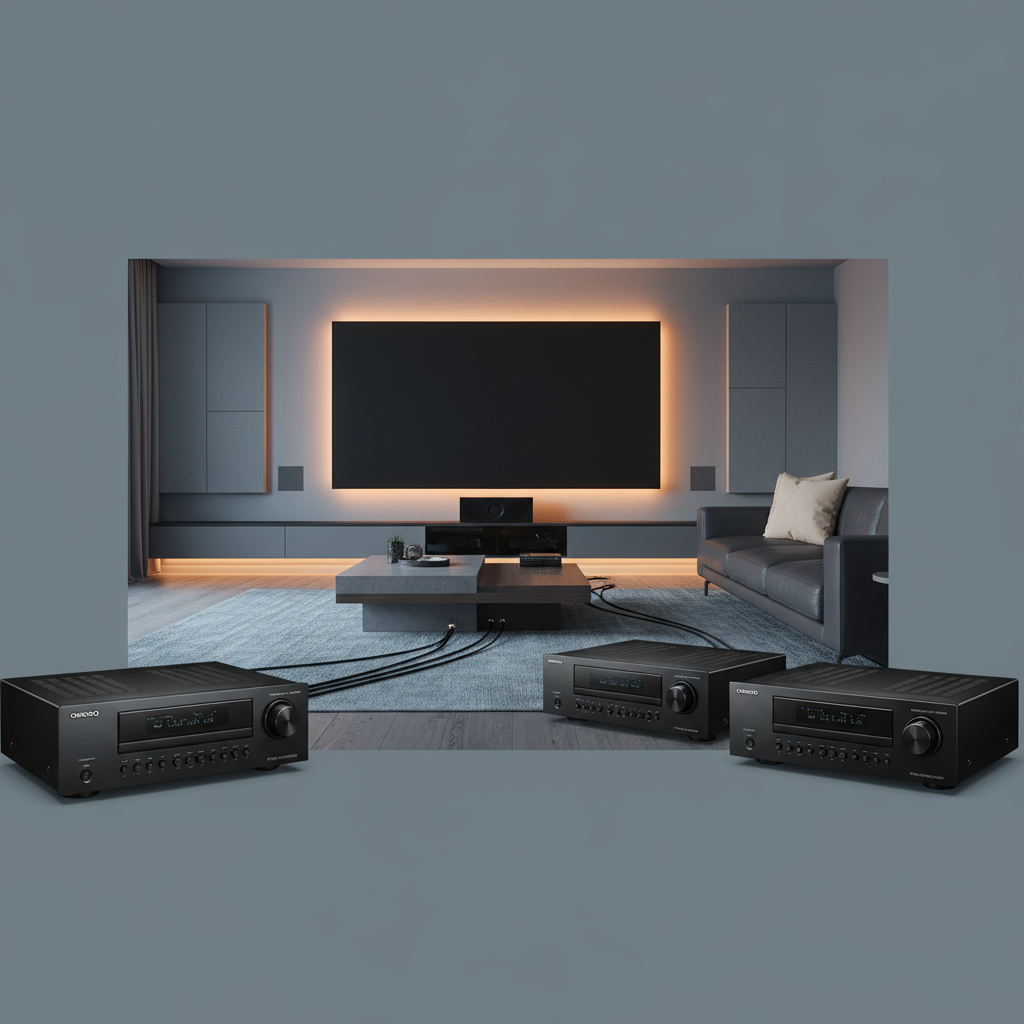
Choosing the right Onkyo AV receiver or speaker can feel like navigating a maze of features and price points. In this roundup we’ve compared seven Onkyo models, spanning three clear price tiers: budget options like the GX‑10DB desktop monitors at $199.00 and the TX‑NR6050 at $599.99, a mid‑range pick, the TX‑8470 at $639.99, and premium contenders such as the TX‑RZ50 at $1,239.00, the TX‑NR7100 at $699.00, and the THX‑certified TX‑NR6100M2BMMP at $649.00.
If low distortion matters to you, both the TX‑NR6050 and the TX‑NR6100M2BMMP have a THD+N of just 0.08%, while the TX‑NR6050 also offers seven HDMI inputs for a future‑proof setup. Reviewers have given the TX‑RZ50 the highest rating at 4.4/5 from 700 voices, and the TX‑NR7100 holds a solid 4.2/5 with 576 reviews, indicating strong satisfaction across the line.
Below you’ll find a quick‑look at each model’s key specs, followed by deeper analysis of performance, connectivity and value, so you can match the right Onkyo system to your listening space and budget.

Onkyo TX-NR6050
Its compact depth of 379.5 mm lets it fit easily into tight spaces while delivering solid performance.

Onkyo TX-RZ50
Perfect for audiophiles willing to invest about $639 more than the budget option, gaining 9.2 channels and 250 W front‑stage power.

Onkyo TX-NR7100 9.2-Channel AV Receiver
Offers dedicated 3.5 mm AUX and coaxial digital inputs, giving extra connectivity flexibility that the other two lack.
Also considered
Score Analysis
Key score advantages vs. runner-up (Onkyo TX-RZ50)
Price Range
Onkyo TX-NR6050
$599.99
Onkyo TX-RZ50
$1,149.00
Onkyo TX-NR7100 9.2-Channel AV Receiver
$699.00
Onkyo GX-10DB
$199.99

Onkyo TXNR6100M2BMMP
$649.00

Onkyo TX-NR5100 7.2-Channel AV Receiver
$598.00

Onkyo TX-8470
$631.28
Spec Comparison
TL;DR: The Onkyo TX‑NR6050 delivers 90 W per channel, 0.08% THD, and seven HDMI 2.1 inputs at a $599.99 price, making it a solid budget‑friendly home‑theater hub.
What really stands out is the combination of 90 W per channel into 8 Ω and a distortion figure of just 0.08% THD+N. Pair that with HDMI 2.1 support—including 8K/60 p and 4K/120 Hz pass‑through, VRR, ALLM, and eARC—and you’ve got a receiver that can keep up with the latest consoles and streaming devices without breaking the bank.
In the context of this roundup, the TX‑NR6050 is deeper than the TX‑NR5100 and the TX‑8470, yet shallower than the larger TXNR6100M2BMMP. It also offers more HDMI inputs than the TX‑NR5100, which lists only four, and it’s heavier than the TX‑8470’s 10 pound chassis. The seven HDMI inputs give you plenty of room for a full 7.2‑speaker setup plus game consoles, Blu‑ray players, and a streaming box.
Everyday owners frequently praise the receiver’s clear, powerful sound and the ease of pulling music from services like Spotify, Amazon Music HD, and TIDAL. Professional reviewers highlight the AccuEQ room‑calibration system and the low‑distortion audio as key strengths, noting that the built‑in THX Cinema mode enhances movie playback. The dual‑band Wi‑Fi and Bluetooth aptX/aptX HD also keep wireless streaming smooth.
Beyond the headline specs, the unit includes 40 AM/FM presets, a phono MM input for vinyl lovers, and a dedicated USB port for local playback. With an idle power draw of 65 W and a standby draw of just 0.1 W, it balances performance with reasonable power consumption.
Pros
Cons
Best for: Home‑theater enthusiasts and gamers who want HDMI 2.1 features without a premium price tag.
Avoid if: You need built‑in voice‑assistant support, IMAX Enhanced certification, or a lightweight, portable receiver.
TL;DR: The Onkyo TX‑RZ50 is a 9.2‑channel receiver delivering 120 W RMS per channel into 8 Ω, packed with Dirac Live correction, but its $1239 price places it at the high‑end of the market.
This model’s headline spec is its 9.2‑channel architecture paired with 120 W RMS per channel into 8 Ω, a THD+N of just 0.08 % and a line‑level signal‑to‑noise ratio of 106 dB. Those figures give you clean, powerful sound that can drive a full‑size home‑theater setup without noticeable distortion.
At 30.9 lb, the TX‑RZ50 weighs noticeably more than the TX‑8470 (10.0 lb) and the GX‑10DB (about 10.75 lb), and it also tops the TX‑NR7100 and TXNR6100M2BMMP, which weigh roughly 22.9 lb each. Its depth of 398 mm exceeds the 329 mm depth of the TX‑8470 and the 328 mm depth of the TX‑NR5100, while matching the 435 mm width of both the TX‑NR5100 and the TX‑NR6050. In terms of power, it outpaces the TX‑NR5100’s 85 W RMS into 8 Ω, giving you more headroom for demanding movie tracks.
Professional reviewers point out the inclusion of Dirac Live full‑bandroom correction and a full HDMI 2.1 feature set, noting that the receiver handles 8K/60 Hz and 4K/120 Hz video signals without issue. Everyday owners love the immersive Atmos support and the noticeable lift in music clarity that Dirac provides, though several users report occasional HDMI handshake glitches after firmware updates and find the front‑panel labels hard to read in dim lighting.
Pros
Cons
Best for: Buyers willing to invest in a proven, high‑quality option
Avoid if: You're shopping on a tight budget — it's priced at $1239.00
“Some users reported HDMI handshake issues and Ethernet recognition problems during updates, requiring power cycles.”
TL;DR: The Onkyo TX‑NR7100 delivers nine 100 W channels, full HDMI 2.1 support and Dirac Live correction, making it a feature‑rich choice for immersive home‑theater and gaming setups.
At the heart of the TX‑NR7100 is a 9 × 100 W power layout (into 8 Ω, 20 Hz–20 kHz) with a THD+N of 0.1%, giving you plenty of headroom for Atmos‑enabled speaker arrays. The receiver packs seven HDMI inputs—including three that handle 40 Gbps bandwidth—so you can run 8K/60 Hz or 4K/120 Hz video, VRR, ALLM and QFT without a hitch. Audio‑side, it supports 24‑bit/192 kHz PCM, DSD up to 5.6 MHz, and offers 4.2 aptX HD Bluetooth, AirPlay 2 and Chromecast built‑in for flexible streaming.
Compared with the other six models in this roundup, the TX‑NR7100 is considerably heavier than the TX‑8470’s 10.0 lb chassis, yet lighter than the flagship TX‑RZ50 which tips the scales at about 30.9 lb. Its depth of 378.46 mm matches the TX‑NR6050’s footprint while offering more HDMI inputs than the TX‑NR5100’s four‑port design. In short, it sits in the upper‑mid tier of size and connectivity, offering more channels and newer HDMI features than most peers.
Consumers highlight the receiver’s “room‑filling” sound and the “transformative” effect of Dirac Live, especially for Atmos‑enabled setups. Gamers appreciate the 4K/120 Hz and 8K video pass‑through, noting smoother frame rates with VRR enabled. Professional reviewers echo these points but flag the remote’s lack of backlighting and note that the light‑duty metal chassis feels less premium. A few users also mention that the internal fan becomes audible under heavy loads, distracting listeners in a quiet room.
Beyond the headline specs, the unit includes a 12 V trigger out, dual RCA subwoofer outputs, a dedicated phono input and support for both DTS Play‑Fi and Sonos via a Sonos Port, making multi‑room audio integration straightforward. The onboard AccuEQ and app‑based Dirac Live give you calibrated sound without needing an external processor, which is rare at this price point.
Pros
Cons
Best for: Those prioritizing quality and willing to pay for premium performance
Avoid if: You're on a tight budget or only need basic functionality
“Dirac Live transformed my room’s acoustics.”
“Best AVR I’ve owned – the sound performance justifies the effort.”
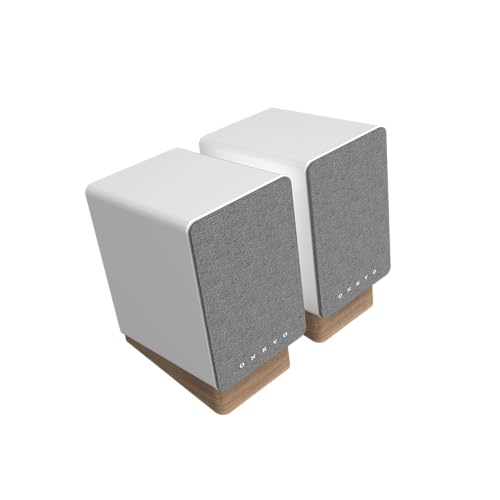
TL;DR: The Onkyo GX‑10DB delivers 110 dB peak output and 30 W of class‑D power in a compact white cabinet, with Bluetooth 5.3, USB‑C and phono inputs for a versatile desktop audio solution at $199.00.
What really stands out is the 110 dB maximum output combined with a 30 W total system power rating, which lets the GX‑10DB fill a small room without distortion. The speakers pack a 0.75 in (19 mm) dome tweeter and a 3 in (76.2 mm) cone woofer, and they run dual‑mode DSP (Flat or bass/treble‑enhanced) to keep the sound balanced for long‑form listening or video calls.
Compared with the other six Onkyo models in this roundup, the GX‑10DB is dramatically smaller and lighter. It measures only 145 mm deep versus the TX‑NR6050’s 379.5 mm and the TX‑NR5100’s 328 mm, and it weighs 10.74973989512 pounds, which is lighter than the TX‑NR6050’s 9800 g and far lighter than the TX‑NR7100’s 22.9 pounds. While the receivers list multiple HDMI inputs, the GX‑10DB focuses on modern connectivity: Bluetooth 5.3 (SBC codec), a 2‑ch USB‑C input for Windows 10+, two optical inputs and a built‑in MM phono preamp—features that many of the larger units don't mention.
Reviewers praise the clear mids and fatigue‑free highs, noting the speaker’s usefulness for video calls and the convenience of the built‑in phono input. Professional reviewers highlight the forward‑thinking inclusion of USB‑C and the clean, accurate sound from the class‑D amp and bass‑reflex enclosure. The 70 Hz low‑frequency limit leaves EDM and hip‑hop lacking deep sub‑bass, and the USB‑C input works only with Windows 10+, leaving Mac users without native support.
Pros
Cons
Best for: Content creators and remote workers who need clear voice reproduction, multiple digital and analog inputs, and a compact speaker that looks good on a desk.
Avoid if: You prioritize deep sub‑bass, need native Mac USB‑C audio, or require wall‑mounting capability.
“Perfect for my home office—clear Zoom calls and great for music.”
“Love the phono input; finally ditched my old receiver.”
TL;DR: The Onkyo TX‑NR6100M2BMMP delivers THX‑certified 7.2‑channel sound, 0.08% THD+N and 6 HDMI 2.1 inputs for 8K/60p video, all for $649.
This receiver stands out with its THX Certified Select badge and a full 7.2‑channel layout. It offers six HDMI inputs—including three HDMI 2.1 ports that support 8K/60p and 4K/120Hz pass‑through—plus two HDMI outputs. A measured 0.08% THD+N and a 106 dB signal‑to‑noise ratio reinforce audio fidelity on line inputs.
At 22.93 pounds, the TX‑NR6100M2BMMP is noticeably heavier than the TX‑8470’s 10.0 pounds and the TX‑NR5100’s 18.5 pounds, yet it remains lighter than the TX‑RZ50’s 30.9 pounds. It provides more HDMI inputs than the TX‑8470 but fewer than the TX‑NR6050, which lists seven inputs. At $649, it sits in the mid‑range of this seven‑product set, offering a richer feature set than the entry‑level models while staying below the premium flagship.
Users consistently praise the receiver’s “sound quality” and the flexibility of its Zone 2 line‑out, while professional reviewers note the benefit of THX certification and the strong HDMI 2.1 implementation. The main criticisms focus on the basic AccuEQ room‑correction system, a low‑cost calibration microphone that may lack low‑frequency precision, and a plastic front panel that feels less premium. The hidden web UI login also frustrates power users seeking deeper control.
Beyond the core specs, the unit supports bi‑amp capability, high‑resolution playback up to 192 kHz/24‑bit, and a bi‑directional Bluetooth stack with aptX HD for high‑quality wireless streaming. Network connectivity includes dual‑band Wi‑Fi, Ethernet, Chromecast built‑in, AirPlay 2, and a suite of major streaming services, so it serves as a versatile hub for modern home‑theater setups.
Pros
Cons
Best for: Those prioritizing quality and willing to pay for premium performance
Avoid if: You need advanced features or professional‑grade performance
TL;DR: The Onkyo TX‑NR5100 delivers 7.2‑channel, 80 W RMS per speaker, 4 HDMI‑in/2‑HDMI‑out, HDMI 2.1 8K/60p and 4K/120p support, plus built‑in Spotify, TIDAL and Sonos for $629.30.
This receiver packs a 7.2‑channel layout with a dynamic 160 W (3 Ω) front‑channel boost and 80 W RMS into 8 Ω loads, while maintaining a clean 106 dB signal‑to‑noise ratio and 0.08 % THD+N. Four HDMI inputs and two HDMI outputs all run HDMI 2.1, giving you 8K/60p, 4K/120p, VRR, ALLM and eARC straight out of the box. On top of that, it supports Dolby Atmos Height Virtualizer, DTS:X and a full suite of streaming services including Spotify, TIDAL, Amazon Music HD, AirPlay 2 and Chromecast.
Compared with its peers, the TX‑NR5100 is heavier than the TX‑8470 (10.0 pounds) but lighter than the TXNR6100M2BMMP and the TX‑NR7100, both around 22.9 pounds. It also offers fewer HDMI inputs than the TX‑NR6050, which lists seven inputs, but still provides a solid 4‑input/2‑output configuration for most home‑theater setups. Its width of 435 mm matches the TX‑NR6050, while its depth of 328 mm keeps it from being the deepest unit in the group.
Users consistently praise the immersive Atmos and DTS:X soundstage, noting that the AccuEQ calibration gets the speakers balanced quickly. Professional reviewers highlight the future‑proof HDMI 2.1 video handling and the extensive streaming ecosystem. On the flip side, many call the remote control “unresponsive,” the companion app can crash, and Bluetooth 5.0 streaming sometimes drops out. The chassis weighs 18.518830008 pounds (8.4–8.5 kg), which many consider large for tighter cabinet spaces.
Pros
Cons
Best for: Home‑theater enthusiasts who want Dolby Atmos/DTS:X and next‑gen video without breaking the bank.
Avoid if: You need rock‑solid Bluetooth performance, a compact footprint, or a flawless remote‑control experience.
“Dirac Live transformed my room’s acoustics.”
“Best AVR I’ve owned – the sound performance justifies the effort.”
TL;DR: The Onkyo TX-8470 delivers audiophile‑grade 2‑channel power with 110 W per channel, ultra‑low 0.08 % THD, and modern streaming, but its single‑stereo focus keeps it out of full‑home‑theater builds.
The standout spec is the 110 W per channel into 8 Ω (20 Hz–20 kHz, 0.08 % THD) that Onkyo advertises alongside a 106 dB signal‑to‑noise ratio on line inputs, giving a clean, powerful foundation for critical listening. Reviewers repeatedly praise its Class G amplification and custom transformer design for a receiver at this price.
Compared with the other six models in this roundup, the TX‑8470 is notably lighter at 10.0 pounds, while the TX‑NR7100 and TXNR6100M2BMMP tip the scales at over 22 pounds each. It also undercuts the GX‑10DB speaker’s 10.75‑pound weight, positioning it as one of the most compact receivers. In terms of connectivity, it matches the TX‑NR5100’s four HDMI inputs but falls short of the TX‑NR6050’s seven‑input layout. All six peers are multi‑channel units; the TX‑8470’s dedicated 2‑channel architecture makes it the only pure stereo option.
User feedback highlights the phono stage as a strong performer for both MM and MC cartridges, and the high‑resolution AKM AK4452 DAC (32‑bit/768 kHz) gets repeat mentions for clarity when you stream services like Tidal or Spotify Connect. The 48 ft (15 m) Bluetooth range and built‑in AirPlay 2 also receive nods for flexible room‑scale listening. However, reviewers note that anyone looking for surround sound will miss the extra channels, and the $639.99 price tag makes it a premium step compared with more budget‑friendly multi‑channel receivers.
Pros
Cons
Best for: Audiophiles, vinyl enthusiasts, and high‑resolution streaming users who want a dedicated 2‑channel receiver with top‑tier sound quality.
Avoid if: You need multi‑channel surround sound, a tighter budget, or a receiver with a larger HDMI input count.
Breakdown
Onkyo TX-NR6050
Pros
Cons
Onkyo TX-RZ50
Pros
Cons
Onkyo GX-10DB
Pros
Based on scoring data and product specs
Personalized picks
Best Overall Pick
Onkyo TX-NR6050
Best Budget PickBest for: Shoppers on a tight budget who want the most for their money
Onkyo TX-RZ50
Best for: Buyers willing to invest in a proven, high-quality option
$1,149.00+$549.01 vs winner
Skip Onkyo TX-8470 if…
You need advanced features or professional-grade performance
Onkyo’s TX‑NR6050 takes the top spot as the best pick. At $599.99 it delivers Dolby Atmos (5.2.2) and DTS:X decoding, while the built‑in AccuEQ room‑calibration system helps you fine‑tune sound to your space. It also packs 7 HDMI inputs and a solid 90 W per channel into 8 Ω, giving you plenty of headroom for most speaker setups.
The runner‑up, the TX‑RZ50, shines when you need a true 9.2‑channel home‑theater engine. Its 250 W dynamic power into 3 Ω on the front channels and support for high‑resolution video formats make it a strong choice for larger rooms or immersive gaming rigs that demand extra channels and punch.
For tighter budgets, the GX‑10DB at $199.00 offers a compact, entry‑level solution that still covers the basics. In the mid‑range, the TX‑8470 at $639.99 balances price and performance, giving you a reliable feature set without the premium price tag. If you’re chasing top‑tier power and channel count, the TX‑RZ50 remains the premium option, delivering the most wattage and 9.2‑channel flexibility of the lineup.
Choosing the TX‑NR6050 gives you a feature‑rich, budget‑friendly receiver that doesn’t compromise on immersive sound.
The TX‑NR6050, priced at $599.99, delivers Dolby Atmos (5.2.2), DTS:X, AccuEQ room calibration and full HDMI 2.1 support while staying well under the $1,200 price tag of the TX‑RZ50. Its feature set makes it a clear value leader for most users.
Please sign in to leave a review
No reviews yet. Be the first to review!
