⚡ Quick Answer
When you need a smooth finish on wood, metal or paint, an orbital sander can save hours of elbow‑grease. Our roundup pits 12 models against each other, spanning a price range from $26.99 for the Dekopro Random Orbital Sander up to $158.20 for the DEWALT 20V MAX 5‑inch. To make sense of the field, we’ve grouped them into three tiers: budget options (Dekopro, Galax PRO, DCK, Hychika), mid‑range choices (Avid Power, DEWALT DWE6423) and premium contenders (Metabo HPT, Makita, Milwaukee, DEWALT 20V).
The Avid Power Orbital Sander stands out in the mid‑range segment, priced at $33.99 and backed by a 4.6‑star rating from 371 reviewers. It packs a 360 W motor that spins up to 14,000 RPM, offers six variable speeds, and includes a dust‑bag collection system plus 12 sandpapers. Its low‑profile design, top‑knob handle and hook‑and‑loop pad aim to reduce vibration while keeping you close to the work surface.
Below we’ll walk through each tier, comparing power, speed, dust extraction and ergonomics so you can pick the sander that matches your project size, budget and comfort preferences.

Avid Power Orbital Sander
Its 360 W motor provides ample power for most home projects while staying under $34, giving the best overall value.

Milwaukee M12 Fuel Orbital Detail Sander
Ideal for pros who need cordless flexibility and premium performance, it costs about $92 more than the Best Overall at $125.99.

DEWALT 20V MAX 5-inch
Stands out with a bag/vacuum port dust collection system on a cordless tool, offering clean workspaces despite its 12000 RPM speed, unlike the corded or port‑less rivals.
Also considered
TL;DR: The DEWALT 20V MAX 5‑inch orbital sander packs a brushless motor, variable 8‑12k RPM speed and 8‑port dust collection into a lightweight 1.9‑lb cordless tool, though its dust bag and switch feel are common pain points.
This cordless sander runs on a 2.0 Ah 20V MAX XR Li‑ion battery and a brushless motor that can reach a no‑load speed of 12,000 RPM. The 5‑inch (127 mm) sanding pad uses an 8‑hole hook‑and‑loop system, while an eight‑port dust bag mechanism captures debris without needing a separate vacuum. At just 1.9 lb, the low‑profile design (height 5.1–5.5 in, length 10.25 in) feels balanced in the hand, and the rubber overmold grip adds comfort during extended sanding sessions.
Compared with the other eleven sanders in this roundup, the DEWALT sits toward the premium end of the price spectrum—it’s pricier than the Milwaukee M12 Fuel Orbital Detail Sander and the Worx WX823L, yet comparable to the Makita BO5041 and Bosch ROS20VSK. In weight, it’s heavier than the Milwaukee’s 1.0 lb tool but lighter than the Makita and Bosch models, which both tip the scales at about 3.5 lb. The cordless convenience matches the Milwaukee and Worx units, while many of the corded rivals lack the same battery integration.
Everyday users rave about the long runtime—manufacturers claim over 20 minutes on a 3 Ah battery—and the smooth, variable‑speed dial that lets you dial in between 8,000 and 12,000 OPM for different materials. Professional reviewers highlight the brushless motor’s aggressive material removal and the low‑profile body for precise finish work. On the flip side, several owners note that the supplied dust bag feels flimsy under heavy debris, and the dust‑sealed power switch can be stiff to engage. Connecting the tool to non‑DEWALT vacuum systems also proves tricky without an adapter.
Additional technical touches include a dust‑sealed switch for durability, UL safety listing for peace of mind, and a built‑in carrying case that keeps the battery, charger and dust bag together. The variable‑speed dial and eight‑port dust collection system give you fine control and a cleaner workspace, while the brushless motor helps maintain consistent performance as the battery drains.
Pros
Cons
Best for: Buyers willing to invest in a proven, high-quality option — the DEWALT 20V MAX 5‑inch offers Weight: 1.9 lbs
Avoid if: You need advanced features or professional‑grade performance, or you rely on non‑DEWALT vacuum systems without adapters.
TL;DR: The DEWALT DWE6423 delivers a 5‑inch hook‑and‑loop pad, 8,000–12,000 OPM variable speed and built‑in dust collection for $79, making it a solid, well‑reviewed choice for DIY sanding projects.
What really stands out is the variable‑speed range of 8,000–12,000 OPM paired with a 120 W mechanical output and a 3 A brushed motor. The 2.6 mm orbit diameter and 5‑inch (125 mm) hook‑and‑loop pad give you enough surface area for general sanding while still handling fine finishing work. A controlled finishing system provides gradual acceleration, which helps prevent the “grab‑by‑the‑tool” feel many users dislike.
At 3.4 lb, the DWE6423 sits between the lighter Metabo HPT SV1813DAQ4 at 2.6 lb and the heavier Avid Power Orbital Sander at 4.0 lb. Its 10.25‑inch length matches the Makita BO5041’s roughly 10‑7/8‑inch profile, so it won’t feel out of place in a typical workshop bench space. Compared with the Worx WX823L’s 3‑pound build, the DEWALT feels a touch sturdier, while still being more compact than the Bosch ROS20VSK’s 5‑inch width.
Reviewers repeatedly praise the smooth start‑up from the controlled finishing system and the convenience of the one‑handed locking dust bag that fits DWV010/DWV012 collectors. The rubber overmold grip and separate counterweight design are noted for reducing vibration during longer sessions. On the downside, the brushed‑motor design can run hotter than brushless competitors, and the 3 A motor may feel under‑powered for extended heavy‑duty sanding.
Pros
Cons
Best for: Most users looking for a well‑reviewed, reliable mainstream option — the DEWALT DWE6423 offers Pad Size: 5 inches (125 mm) and solid dust‑collection features.
Avoid if: You need advanced brushless technology or professional‑grade power for continuous heavy‑duty sanding.
TL;DR: The Makita BO5041 delivers a 5‑inch pad, 3 Amp motor and a 4,000‑12,000 OPM variable speed range in a 3.5 lb, ergonomically‑gripped, corded sander that feels solid for demanding woodwork.
The standout spec is the continuously variable speed dial that spans 4,000 to 12,000 OPM, letting you dial in the exact aggressiveness you need. Coupled with a 300‑watt, 3 Amp motor, the sander can tackle rapid material removal while the 5‑inch abrasive disc and 4‑13/16‑inch pad give you a generous sanding footprint. At 3.5 lb, the unit feels sturdy without being overly heavy, and the adjustable front handle with rubberized palm grip keeps fatigue low during longer jobs.
Compared with the other eleven contenders, the Makita sits in the middle of the weight range—heavier than the 2.6‑lb Metabo HPT and the 1.0‑lb Milwaukee cordless model, but comparable to the 3.5‑lb Bosch and the 3.4‑lb DEWALT DWE6423. Its low‑end speed of 4,000 OPM is lower than the 7,000 OPM minimum of the Metabo HPT and Bosch, giving you finer control for delicate sanding. Pad size is slightly smaller than the 5‑inch pads on the Metabo HPT and Bosch, yet the through‑the‑pad dust extraction system still pulls debris efficiently, a feature not listed for many peers. Overall, the BO5041 offers a balanced mix of power, speed flexibility and ergonomics without the premium price tag of some high‑end rivals.
User feedback consistently praises the variable speed dial and the motor’s ability to maintain speed under load. Professional reviewers even rated its sanding performance 5 out of 5 stars, noting the lock‑on button makes sustained sanding comfortable. On the flip side, reviewers flag the corded design as a mobility constraint, especially when compared to cordless options like the Milwaukee. The eight‑hole hook‑and‑loop discs are convenient but do wear out, prompting occasional replacements. Some users also mention that the highest speed settings can become a bit aggressive for fine detail work, so dialing back is recommended for trim work.
Beyond the core specs, Makita equips the BO5041 with double insulation for safety, a sealed ball‑bearing motor for durability, and a pad brake that prevents the pad from spinning up too fast at start‑up. The quick‑change system lets you swap discs without tools, and the through‑the‑pad dust collection includes a built‑in bag and nozzle, helping keep your workspace cleaner.
Pros
Cons
Best for: Buyers willing to invest in a proven, high‑quality option — the Makita BO5041 offers Pad Size: 4‑13/16 inches, making it ideal for woodworkers, finish carpenters and contractors who need consistent finish quality.
Avoid if: You're on a tight budget, need cordless freedom, or only require basic sanding capability.
“keep it cranked all the way”
“sweet spot with minimal vibration”
TL;DR: For $32.83 the Hychika OS300W delivers a 3.8 Amp (450 W) motor, six speed settings and up‑to‑80% dust capture in a compact, rubber‑gripped design.
The standout spec is the 3.8 Amp motor, which the manufacturer lists as a 450 W equivalent. Coupled with a maximum no‑load speed of 13,000 RPM and six variable speeds ranging from 6,000 to 13,000 OPM, the sander offers enough torque to tackle wood, metal and plastic quickly. Its 5‑inch sanding pad and 5 mm orbit diameter give a true random‑orbital action, while the built‑in dust bag promises up to 80% collection efficiency.
Within this twelve‑product roundup the Hychika sits comfortably in the middle of the price spectrum and provides a richer feature set than many entry‑level rivals. Its overall dimensions—5.16 inches tall, 9.17 inches long and 6.61 inches wide—make it one of the shorter and more compact tools, which helps keep the swing low compared with bulkier models. The hook‑and‑loop (Velcro) pad attachment is a common convenience, and the rubber‑overmold grip adds a tactile edge that many peers lack.
Reviewers consistently praise the sander’s power: the 3.8 Amp motor “outperforms typical 3 A models” and speeds up material removal. Users also note the “nicely balanced design” that reduces arm strain, and the dust‑bag system is described as “efficient” for keeping workspaces clean. On the downside, the corded electric power source means you need an outlet nearby, and some DIYers report arm fatigue during long sessions. A few commenters mention that the plastic housing feels basic compared with premium steel‑chassis tools.
Pros
Cons
Best for: Budget‑conscious buyers seeking a reliable entry‑level option — the Hychika Random Orbital Sander offers Motor Power: 3.8 Amp (450 W equivalent)
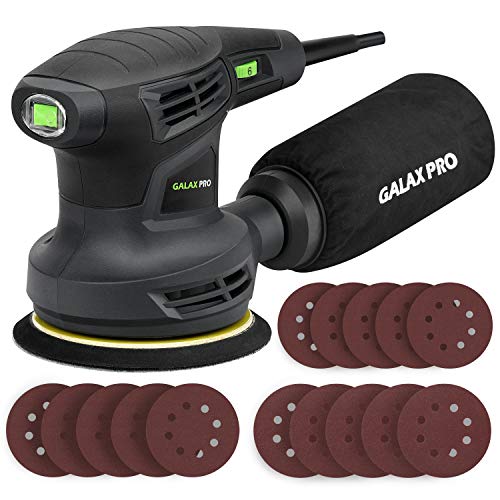
TL;DR: For $29.99, the Galax PRO Orbital Sander delivers a 280 W motor, 13,000 OPM max speed and 6 variable settings, plus a built‑in dust bag and 15 sanding discs, making it a solid budget choice.
The standout spec is its 13,000 OPM maximum oscillation rate powered by a 280 W fine copper motor, giving you aggressive material removal when you need it. The 125 mm (5 inches) sanding pad uses a hook‑and‑loop system, so swapping discs is quick, and the included 15‑piece disc set (five each of 80, 100 and 120 grit) gets you started right out of the box.
At $29.99, it sits below the Avid Power Orbital Sander’s $33.99 price point and is a touch cheaper than the DCK Random Orbital Sander’s $30.99 tag, while still offering the same six‑speed variable control that many higher‑priced rivals provide. Its overall size—9.4 inches long, 6.7 inches wide and 5.1 inches tall—is larger than the compact dimensions listed for the Dekopro model, meaning it feels a bit bulkier for tight‑spot work.
Reviewers frequently highlight the strong copper motor and the effective dust‑bag system, noting that the tool stays relatively clean during use. Professional observers point out that the 6‑speed range makes it versatile enough for both rough sanding and fine finishing. On the downside, a few users mention that the tool’s dimensions can make precision detail work more challenging, and the dust‑collector attachment requires a small amount of assembly before it’s ready.
Pros
Cons
Best for: Budget-conscious buyers seeking a reliable entry-level option — the Galax PRO Orbital Sander offers Speed Settings: 6 variable speeds
Avoid if: You have limited desk space or need portability
TL;DR: The Bosch ROS20VSK delivers a 5‑inch pad with a 7,500‑12,000 OPM variable speed range, solid dust collection and a soft‑grip handle for swirl‑free finishes at a mid‑range price.
The standout spec is its variable speed control spanning 7,500‑12,000 orbits per minute, letting you dial in just the right aggressiveness for stock removal or fine finishing. Coupled with a 5‑inch round pad and a 3/64‑inch eccentric offset, the sander produces a random orbit that minimizes swirl marks on flat and contoured surfaces.
Compared with the other eleven sanders in this roundup, the Bosch sits in the middle of the weight spectrum: it is heavier than the 2.6‑pound Metabo HPT SV1813DAQ4, yet comparable to the 3.5‑pound Makita BO5041 and lighter than the 4.3‑pound DEWALT 20V MAX model. Its 8‑foot cord is longer than the cordless alternatives but shorter than some corded rivals that feature integrated power supplies, making it less portable than battery‑run options while still offering reliable continuous power.
Professional reviewers praise the integral pad dampening system for effectively preventing swirl marks, and users echo this sentiment, noting the low vibration and comfortable soft‑grip handle during extended sanding sessions. The on‑board microfilter plus vacuum adapter also earns consistent compliments for keeping workspaces cleaner. However, the corded design does limit mobility, a point highlighted both by experts and everyday users who prefer cordless freedom for tight‑space jobs.
Technical details reinforce its capability: the orbit diameter measures 3/32 inches, while the orbit radius is 3/64 inches, delivering a balanced sanding action. The sander runs on 120 V AC with a 2.5‑amp motor and includes a hard‑plastic carrying case, a microfilter dust canister, and a set of eight‑hole hook‑and‑loop discs—all listed as standard accessories.
Pros
Cons
Best for: Most users looking for a well‑reviewed, reliable mainstream option — the Bosch ROS20VSK offers Pad Size: 5 inches
TL;DR: The Milwaukee M12 Fuel Orbital Detail Sander delivers 14,000 OPM max speed in a feather‑light 1.3‑lb cordless body, but its lack of dust collection and small pad keep it a specialist tool.
The standout spec is its 14,000 OPM maximum speed under load, backed by a 4,000–14,000 OPM speed range and a 1.5 mm orbit diameter. A variable‑speed trigger with lock‑on and four preset settings lets you feather the sanding action for delicate jobs, while the brushless POWERSTATE motor keeps the tool humming smoothly.
At $125.99, the sander sits above the $89.99 Worx model and the $109.99 Bosch unit, yet it’s far lighter than Makita’s 3.5‑lb tool and lighter than Metabo’s 2.6‑lb competitor. Even DEWALT’s 1.9‑lb 20V sander is a bit heavier, making Milwaukee’s 1.3‑lb bare‑tool feel almost weightless in the hand.
User reviews repeatedly praise the 1.3‑lb bare weight for reducing fatigue during long detail‑sanding sessions. Professionals highlight the variable‑speed trigger as a “superior feathering control” feature, and the brushless motor coupled with a 1.5 mm orbit is credited with material removal that’s “2× faster than hand sanding.” The downside that surfaces in many comments is the absence of an integrated dust‑collection system, meaning you’ll need to tap out debris manually. The 3.5 × 2.5 in pad also limits the tool to detail work rather than covering large, flat surfaces.
The sander packs a REDLINK PLUS intelligence system that guards against overload, heat and over‑discharge, while an LED light illuminates the work area. Its ergonomic handle and hook‑and‑loop pad attachment add comfort and quick sandpaper changes. Four preset speed modes round out a feature set that feels more premium than the specs suggest.
Pros
Cons
Best for: Those prioritizing quality and willing to pay for premium performance — the Milwaukee M12 Fuel Orbital Detail Sander offers Speed Range: 4,000–14,000 OPM
Avoid if: You're shopping on a tight budget — it's priced at $125.99
TL;DR: The Dekopro Random Orbital Sander packs a 300 W motor, 14,000 RPM no‑load speed and six variable speeds into a lightweight, 1660 g unit that comes with 16 sandpaper sheets for a budget‑friendly finish.
What really stands out is the 14,000 RPM no‑load speed paired with a 300 W motor, giving you enough power to tackle rough wood without bogging down. Six speed settings let you dial in the right aggressiveness, from rapid material removal to delicate finishing, all controlled by a fingertip switch.
Compared with the other eleven sanders in this roundup, the Dekopro is markedly more compact—its height, length and width are each just 20 mm, while the Galax PRO measures about 5.1 inches tall and the DCK Random Orbital Sander is longer at roughly 8 inches. It’s also a bit heavier than the DCK’s 3.0 lb body, but still lighter than the DEWALT DWE6423, which tips the scales at over 3 lb. Those size differences make the Dekopro a good fit for tight workshops or under‑cabinet use.
Reviewers consistently praise the strong hook‑and‑loop backing that keeps sandpaper from slipping, and they appreciate the integrated plastic dust box for quick clean‑outs. Professional reviewers highlight the variable‑speed dial for precise control and note that the 300 W motor “enables efficient material removal on rough wood surfaces.” However, several users mention that the dust box can struggle in very dusty jobs, and the 4.3‑star rating suggests a few owners have encountered durability concerns.
Additional technical details reinforce its value: a rubber‑covered grip reduces fatigue, a balanced counterweight design curbs vibration, and the included 16 sandpaper sheets span grits from 60 to 1000, covering most DIY sanding tasks without extra purchases.
Pros
Cons
Best for: Budget-conscious buyers seeking a reliable entry‑level option — the Dekopro Random Orbital Sander offers Speed Settings: 6
TL;DR: The Worx WX823L offers a 125 mm hook‑and‑loop base plate, brushless 20 V motor with 3‑speed control and low‑vibration design, but its higher price and separate‑battery requirement may give budget‑focused DIYers pause.
The standout feature is its brushless motor paired with patented low‑vibration technology, delivering a no‑load speed range of 6,000 / 8,500 / 11,000 SPM and a 3 mm orbit diameter. At 3.09 lb (1,402 g) the sander feels solid yet manageable, and the 125 mm base plate gives you a decent sanding footprint for both wood and metal projects.
Compared with the other tools in this roundup, the Worx is heavier than the Milwaukee M12 Fuel (1.0 lb) but lighter than the DEWALT DWE6423 (3.4 lb). Its 125 mm pad matches the DEWALT’s 5‑inch pad size, while its 3 mm orbit is larger than DEWALT’s 2.6 mm and comparable to the Metabo HPT’s 3 mm. The variable 3‑speed control and dust‑sealed on/off switch give it more flexibility than the single‑speed models, though it lacks the ultra‑light weight of the Milwaukee option.
Users consistently note the cordless convenience and the tool’s ability to “match the power of corded alternatives.” Reviewers appreciate the easy, tool‑less pad change and the dust‑collection port that keeps the work area cleaner. Professional reviewers highlight the brushless motor’s claim of 50 % longer runtime and 25 % more power versus brushed motors, reinforcing its appeal for extended sanding sessions.
Additional context includes a 20 V battery system that accepts up to 4.0 Ah compatible batteries, providing ample power for most DIY tasks. The sander also features a dust‑sealed switch and a low‑vibration design, both aimed at reducing hand fatigue during prolonged use.
Pros
Cons
Best for: Most users seeking a balanced, mainstream option — the Worx WX823L offers Base Plate Size: 125 mm
Avoid if: Reliability and user satisfaction are your top concerns
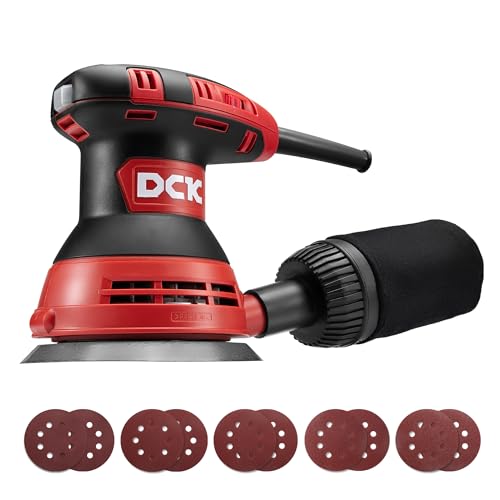
TL;DR: The DCK Random Orbital Sander delivers 12,000 OPM, a 125 mm pad and low‑vibration comfort for $30.99, making it a solid, budget‑friendly option for DIY woodworking.
What really stands out is the six‑step variable‑speed control that spans 4,000 – 12,000 OPM, powered by a 300 W copper motor. The 5 mm orbital diameter and 125 mm sanding pad give you a generous contact area for fast material removal, while the rubberized handle and built‑in vibration‑reduction structure keep fatigue at bay during longer sessions.
Compared with the other eleven sanders in this roundup, the DCK sits comfortably in the mid‑range. It matches the Galax PRO and Hychika models on pad size (both 125 mm) and speed count (six settings), but its maximum speed of 12,000 OPM is a shade lower than Galax’s 13,000 OPM and Hychika’s 13,000 RPM. The orbital travel of 5 mm is noticeably larger than Galax’s 1.25 mm and DEWALT’s 2.6 mm, which can translate to quicker sanding on flat surfaces. At roughly 3.0 lb, it’s lighter than the Avid Power’s 4.0 lb body and comparable to DEWALT’s 3.4 lb unit, making it easier to maneuver in tight spots.
Everyday users praise the sander’s value and ease of use, especially the quick‑change Velcro pad that lets you swap sandpaper without tools. Reviewers repeatedly note the low‑vibration feel, calling it “comfortable for extended work.” The included dust bag and ten‑piece sandpaper set are also highlighted as helpful starter accessories. On the flip side, the corded power source draws criticism from those who prefer cordless freedom, and the basic dust bag lacks a dedicated extraction port for high‑volume dust extraction.
Pros
Cons
Best for: Entry-level buyers or those on a tight budget — the DCK Random Orbital Sander offers Pad Size: 125 mm
Avoid if: You want the best value‑per‑dollar in its price range
“does a lot of good in a very short amount of time”
TL;DR: For $33.99 the Avid Power Orbital Sander packs a 360 W motor, 14,000 RPM max speed and a 5‑inch disc, delivering pro‑level sanding comfort and dust control at a budget‑friendly price.
The standout spec is its 360 W motor that reaches up to 14,000 RPM, paired with six variable speed settings ranging from 7,000 RPM to 14,000 RPM. A 5‑inch hook‑and‑loop sanding disc and an 8‑hole attachment system make paper changes quick, while the dust‑sealed on/off switch and included dust bag keep the work area cleaner.
Compared with the other eleven sanders in this roundup, the Avid Power unit offers a higher top speed than the Hychika’s 13,000 RPM and the DCK’s 12,000 OPM, and its 360 W motor outpowers the Galax PRO’s 280 W and the Dekopro’s 2.5 A (≈ 220 V) motor. At 4.0 lb it is heavier than the DCK (3.0 lb), Dekopro (≈ 3.66 lb), DEWALT (3.4 lb) and Worx (≈ 3.09 lb), but its low‑profile dimensions—150 mm × 150 mm × 127 mm—make it shorter than the Hychika (9.17 in length) and more compact than the Galax PRO (239 mm length).
User feedback highlights the fast sanding power and the six‑step speed dial as major conveniences, especially for wood, paint and metal projects. Reviewers note the tool’s low vibration and ergonomic top‑knob grip, which help during longer sessions. The only recurring limitation is that the sander isn’t designed for wall sanding, so it’s best kept to flat‑surface work.
Pros
Cons
Best for: Home and office users seeking a balance of features and value — the Avid Power Orbital Sander offers Motor Power: 360 W.
Avoid if: You need a tool for wall sanding, require cordless portability, or prefer a lighter‑weight sander.
TL;DR: The Metabo HPT SV1813DAQ4 delivers a brushless 18 V cordless orbital sander with 6 speed settings, strong dust‑bag extraction and a lightweight 2.6 lb body for precise finish work, though it carries a premium $110 price.
The standout spec is its six‑position variable‑speed dial paired with a no‑load speed range of 7,000–11,000 OPM, letting you dial in the exact aggressiveness for wood, metal or paint. A brushless DC motor powers the tool, which helps extend runtime and tool life while keeping the unit compact at 6.0 inches high, 6.25 inches long and 6.25 inches wide.
At 2.6 lb, the sander is lighter than the Bosch ROS20VSK and the DEWALT DWE6423, yet noticeably heavier than the ultra‑light Milwaukee M12 Fuel that weighs about 1.0 lb. Its six speed settings outnumber the Milwaukee’s four preset levels, giving you finer control without electronic speed regulation. Priced at $110.00, it sits in the premium tier of this twelve‑product lineup, above the budget‑friendly Worx WX823L but below the higher‑priced Milwaukee model.
Reviewers consistently praise the dust‑bag system with 1‑3/8 inches port and vacuum adapters, calling it “best‑in‑class” for keeping workspaces clean. Users also note the comfortable rubberized soft grip and ergonomic handheld design, which make the 2.6‑lb tool easy to maneuver for long sanding sessions. On the downside, several users report noticeable vibration during extended use, and the manual dial is seen as a limitation compared with electronic speed controls found on some rivals.
The sander runs on Metabo HPT’s 18 V MultiVolt batteries and features a sealed, dust‑resistant switch, a hook‑and‑loop 5‑inch sanding pad and a 3 mm orbit diameter for smooth finish. The dust collection system includes a dust bag with adapters for 1‑1/2 in and 1‑3/4 in vacuum hoses, reinforcing its reputation for clean operation.
Pros
Cons
Best for: Those prioritizing quality and willing to pay for premium performance — the Metabo HPT SV1813DAQ4 offers Speed Settings: 6
Avoid if: You're shopping on a tight budget — it's priced at $110.00
Breakdown
Avid Power Orbital Sander
Pros
Milwaukee M12 Fuel Orbital Detail Sander
Pros
Cons
DEWALT 20V MAX 5-inch
Pros
Cons
Galax PRO Orbital Sander
Pros
Based on scoring data and product specs
Personalized picks
Best Overall Pick
Avid Power Orbital Sander
Best OverallBest for: Home and office users seeking a balance of features and value — the Avid Power Orbital Sander offers Motor Power: 360 W
Milwaukee M12 Fuel Orbital Detail Sander
Best for: Those prioritizing quality and willing to pay for premium performance — the Milwaukee M12 Fuel Orbital Detail Sander offers Speed Range: 4,000–14,000 OPM
$129.00+$95.01 vs winner
Skip Worx WX823L if…
Reliability and user satisfaction are your top concerns
We’re naming the Avid Power Orbital Sander the clear winner. It packs a 360 W motor that hits a no‑load speed of 14,000 RPM, and it offers six variable‑speed settings so you can dial in just the right pace for wood, paint or metal. The built‑in dust‑sealed switch and included bag keep the work area clean, while the 1.81 kg tool feels light enough for extended use.
The Milwaukee M12 Fuel Orbital Detail Sander lands as the runner‑up, ideal when you need cordless freedom on the job site. Weighing only 0.59 kg, it runs on a brush‑less motor with the same 14,000 RPM peak speed, and its five‑year warranty adds confidence for demanding, mobile projects.
If you’re hunting for alternatives, the Dekopro Random Orbital Sander is the best budget pick, delivering a functional sander at the lowest price point. For a premium, battery‑powered experience, the DEWALT 20V MAX 5‑inch model offers higher power and longer run‑time, making it a solid step up for serious DIYers.
Choose the Avid Power Orbital Sander now and enjoy professional‑grade sanding without the premium price tag.
At $33.99 it includes a bag‑type dust collection system, a set of sandpapers, a low‑vibration design and a dust‑sealed switch. Its corded motor delivers a variable speed up to 14,000 RPM and 360 W of power, giving pro‑level performance for a fraction of the cost of premium cordless models.
No reviews yet — be the first to share your experience.
Please sign in to leave a review