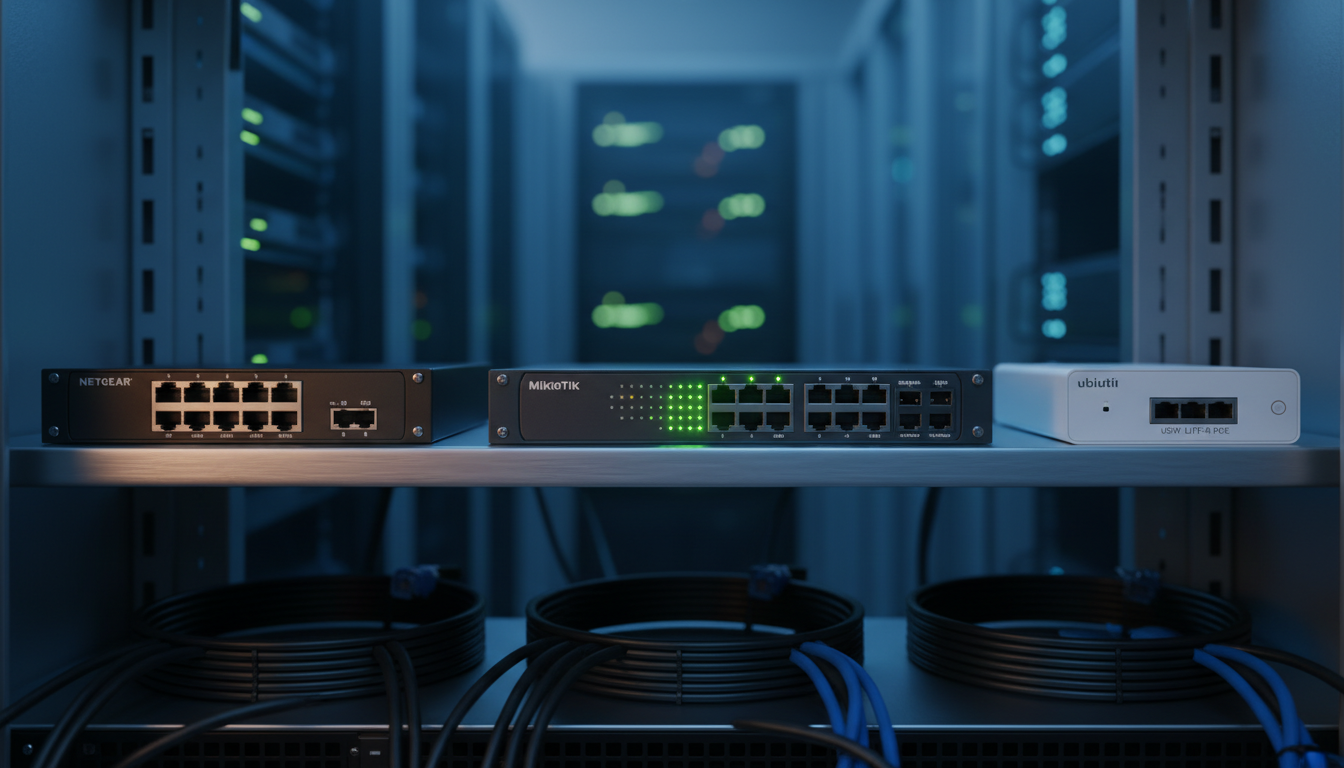
Choosing a PoE switch can feel like balancing power, ports, and price. This roundup covers 9 models, from entry‑level units that start at $59.99 up to the $475.00 flagship. Ratings cluster between 4.4 and 4.8 stars, showing strong user approval across the board. The list splits into three price tiers – budget (Netgear GS308EP, Zyxel GS1200‑8HP, D‑Link DGS‑1008P Black), mid‑range (Linksys LGS116P, Ubiquiti USW‑LITE‑8‑POE, Ubiquiti USW Ultra) and premium (Ubiquiti Switch Lite 16 PoE, Ubiquiti UniFi 16‑Port PoE, MikroTik CRS328‑24P‑4S+RM).
When you compare them, look at the PoE power budget, port density and whether you need management features. For example, the Netgear GS308EP packs a 62 W budget and a fanless design in a compact 157.48 mm × 101.6 mm × 27.94 mm chassis, ideal for a quiet home office. On the other end, the MikroTik CRS328‑24P‑4S+RM delivers a 128 Gbps switching capacity and a 64 Gbps non‑blocking throughput for demanding SMB environments. The guide breaks down each tier so you'll match a switch to your specific setup.

Netgear GS308EP
Its shallow 27.94 mm height lets the switch fit easily into tight rack spaces, delivering solid value at $59.99.

MikroTik CRS328-24P-4S+RM
Network enthusiasts who need advanced features pay $475.00—about $415 more than the Netgear budget pick.

Ubiquiti USW-LITE-8-POE
Its 99.6 mm length offers a compact eight‑port layout, bridging the gap between the ultra‑budget Netgear and feature‑rich MikroTik at $109.00.
Also considered
Score Analysis
Key score advantages vs. runner-up (MikroTik CRS328-24P-4S+RM)
Price Range
Netgear GS308EP
$59.99
MikroTik CRS328-24P-4S+RM
$475.00
Ubiquiti USW-LITE-8-POE
$109.00

Ubiquiti Switch Lite 16 PoE
$199.00

Ubiquiti USW Ultra
$159.00
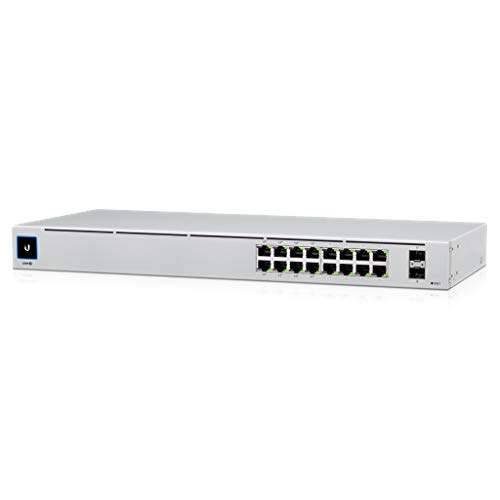
Ubiquiti UniFi 16-Port PoE
$299.00

Linksys LGS116P
$98.98

D-Link DGS-1008P Black
$60.07

Zyxel GS1200-8HP
$59.99
Spec Comparison
TL;DR: The Netgear GS308EP offers eight fanless Gigabit PoE+ ports, a 62 W power budget, and a web‑based management interface at a $59.99 price, making it a solid budget‑friendly switch for small setups.
The GS308EP packs eight PoE+ Gigabit Ethernet ports into a compact 157.48 mm × 27.94 mm × 101.6 mm chassis that weighs about 2.43 lb. It delivers a 62 W PoE budget and supports jumbo frames up to 9216 bytes, which helps reduce overhead on high‑traffic links. The fanless design keeps the unit silent, and the Easy Smart web GUI (also available via mobile app) lets you enable or disable PoE per port, set power limits, and configure VLANs.
Compared with the other eight switches in this roundup, the GS308EP is heavier than the Zyxel GS1200‑8HP (1.43 lb) and D‑Link DGS‑1008P (1.35 lb), but lighter than the Switch Lite 16 PoE (2.65 lb) and far lighter than the MikroTik CRS328‑24P‑4S+RM (10.01 lb). Its depth of 157.48 mm exceeds Zyxel’s 105 mm and D‑Link’s 150 mm, while its height matches D‑Link’s 28 mm. The 62 W PoE budget sits between D‑Link’s 60 W and Zyxel’s 68 W, though it’s lower than Linksys’s 80 W offering.
Users consistently praise the silent operation and the intuitive Easy Smart web interface, noting that managing PoE ports and VLANs feels straightforward even for a home office. A recurring comment is the external power adapter, which adds a small cable to the setup. Reviewers also point out that the 62 W budget may limit the number of high‑power devices you can run simultaneously, especially compared with higher‑budget models.
The switch includes a 4K‑entry MAC address table and a 192 KB packet buffer, giving enough headroom for typical small‑business traffic. Advanced QoS and VLAN support round out the feature set, making the GS308EP a capable choice for quiet, space‑constrained environments that need reliable PoE power.
Pros
Cons
Best for: Budget-conscious buyers seeking a reliable entry-level option
Avoid if: You have limited desk space or need portability
TL;DR: The MikroTik CRS328-24P-4S+RM delivers 24 PoE‑enabled Gigabit ports, a 450 W PoE budget, and four 10 Gbps SFP+ uplinks, backed by 95.2 Mpps forwarding and 128 Gbps switching capacity.
What really sets this switch apart is the combination of 24 PoE‑capable Ethernet ports with a 450 W total PoE budget and four 10 Gbps SFP+ uplink slots. It runs dual OSes—SwOS for simple switching and RouterOS for advanced routing—so you can choose the level of control you need. The device consumes up to 44 W when no PoE devices are attached, and its built‑in 500 W power supply easily handles the full PoE load.
Compared with the other eight switches in the roundup, the CRS328 is noticeably heavier at 10.01 pounds and deeper at 300 mm, while most peers sit under 7 pounds and are shallower than 200 mm. Its 95.2 Mpps forwarding rate dwarfs the 27 Mpps of the Ubiquiti UniFi 16‑Port PoE and the 24 Mpps of the Ubiquiti Switch Lite 16 PoE. Likewise, the 128 Gbps switching capacity far exceeds the 36 Gbps maximum those models achieve, and its PoE power per port (30 W) matches the high‑power offerings of the smaller units while delivering a far larger overall budget.
Reviewers consistently praise the auto‑sensing multi‑standard PoE, noting that it simplifies powering a mix of cameras, phones and access points without manual configuration. The non‑blocking layer‑2 switching and dual‑boot OS highlight strong points for tech‑savvy users. The main criticism centers on the premium price tag of $475.00, which many say is justified only for larger deployments that can use the full PoE capacity.
The switch runs on an 800 MHz ARM CPU with 512 MB of RAM, giving it enough headroom for the 95.2 Mpps forwarding rate. It also offers full monitoring—CPU and PCB temperatures, voltage and current sensors—plus an MTBF of roughly 200,000 hours at 25 °C and an operating range from –20 °C to 60 °C, which makes it reliable for demanding environments.
Pros
Cons
Best for: Enterprises and SMBs that need dense PoE provisioning for IP cameras, VoIP phones, or wireless access points.
Avoid if: You're shopping on a tight budget — it's priced at $475.00
TL;DR: The Ubiquiti USW‑Lite‑8‑POE is a fanless, wall‑mountable 8‑port switch with four PoE+ ports, a 12 Mpps forwarding rate and a compact 31.7 mm height, ideal for quiet small‑office setups.
What really stands out is the silent, fanless design housed in a polycarbonate case that’s only 31.7 mm tall, 99.6 mm long and 163.7 mm wide, weighing just 295 g (about 1.57 lb). It packs four PoE+ ports that can each deliver up to 30 W, plus four standard Ethernet ports, giving you eight connections in a space‑constrained environment.
Compared with the other eight switches in this roundup, the USW‑Lite‑8‑POE is lighter than the Netgear GS308EP (which weighs over 2 lb) and more compact than the Linksys LGS116P (which is taller and deeper). Its 16 Gbps switching capacity is half of the 32 Gbps found in the Linksys and the Ubiquiti Switch Lite 16‑PoE, but its 12 Mpps forwarding rate edges out the D‑Link DGS‑1008P’s 11.90 Mpps. Heat dissipation sits at 27.3 BTU/hr, lower than the 51.2 BTU/hr of the larger Ubiquiti USW Ultra.
Reviewers praise the silent operation and the ease of mounting the unit on a wall or desk. The compact chassis fits neatly into cramped server racks, and the fanless design eliminates noise complaints in quiet offices. On the downside, users note the 52 W total PoE budget can run out quickly if you try to power several high‑draw devices, and the switch remains layer‑2 only, so you’ll need a separate router for advanced routing features.
Technical details show it’s suitable for modest networks: a forwarding rate of 12 Mpps, a 0.5 MB packet buffer, a MAC address table of 8 000 entries, and support for up to 128 IPv4 and 128 MAC access‑list entries. The unit draws up to 60 W with PoE and just 8 W without, keeping power consumption modest.
Pros
Cons
Best for: Small business networks, UniFi ecosystem deployments, and quiet office environments where space and noise are at a premium.
Avoid if: You need high‑throughput routing, a larger PoE budget, or a fully managed Layer‑3 switch for enterprise‑scale use.
TL;DR: The Ubiquiti Switch Lite 16 PoE packs 16 Gigabit ports, 8 PoE+ ports at 32 W each, a 32 Gbps switching capacity and a fanless design into a compact 185.4 mm deep, 43.2 mm high case for $199.
The standout spec is its 24 Mpps forwarding rate paired with a non‑blocking 32 Gbps switching capacity, which puts it ahead of most entry‑level switches in raw throughput. It also delivers 8 PoE+ ports that can each supply up to 32 W, though the overall PoE budget tops out at 45 W. The fanless, polycarbonate enclosure keeps noise to a minimum, and the unit weighs 2.65 lb, making it easy to place on a desk or mount on a wall.
Compared with the other eight switches in this roundup, the Lite 16’s forwarding rate doubles the 12 Mpps of the USW Ultra and USW‑LITE‑8‑POE, yet remains far below the 95.2 Mpps of the MikroTik CRS328‑24P‑4S+RM. Its 32 Gbps switching capacity matches the Linksys LGS116P and exceeds the 16 Gbps capacity of the USW Ultra, USW‑LITE‑8‑POE, and Zyxel GS1200‑8HP, while staying below the 36 Gbps that the UniFi 16‑Port PoE provides and the massive 128 Gbps of the MikroTik. At 2.65 lb, it’s heavier than the ultra‑light USW Ultra (0.71 lb) and USW‑LITE‑8‑POE (1.57 lb) but lighter than the UniFi 16‑Port PoE (6.17 lb) and the MikroTik (10.01 lb), placing it in the mid‑range for weight.
Users consistently praise the silent operation and the compact footprint that fits snugly into small office desks or home labs. Professional reviewers note the extensive Layer 2 feature set—VLANs, LLDP‑MED, port ACLs and spanning‑tree—makes it feel more enterprise‑grade than its price suggests. The most common complaint is the limited 45 W total PoE budget, which can’t fully power multiple high‑draw PoE+ cameras or access points, and the lack of SFP ports means you can’t add fiber uplinks.
Pros
Cons
Best for: Small businesses, home labs, and SMBs that need a managed Gigabit PoE switch with quiet, compact design.
Avoid if: You need a high PoE power budget, fiber uplinks, or a rack‑mountable solution.
TL;DR: The Ubiquiti USW Ultra is a compact, fanless 8‑port Gigabit switch that delivers 12 Mpps forwarding, 16 Gbps switching capacity, and up to 30 W per PoE+ port, all in a 0.71‑lb, wall‑mountable case.
The standout spec is its ultra‑small footprint—203 × 76 × 33 mm—and a weight of just 0.71 lb (320 g), making it easy to hide on a desk or mount on a wall. It packs eight Gigabit RJ45 ports, seven of which provide up to 30 W PoE+ output, while the eighth accepts 802.3bt PoE++ input. The switch runs fanless, so it stays silent even in noise‑sensitive rooms.
Compared with the other eight switches in this roundup, the USW Ultra is lighter than the Switch Lite 16 PoE (2.65 lb) and the USW‑LITE‑8‑POE (1.57 lb). Its 100 mm depth is also shallower than the Switch Lite 16 PoE’s 185.4 mm depth, giving it a tighter profile than most peers. Forwarding speed matches the USW‑LITE‑8‑POE at 12 Mpps but trails the Switch Lite 16 PoE’s 24 Mpps and the MikroTik’s 95.2 Mpps. Heat dissipation is modest at 15 BTU/hr, well below the 51.2 BTU/hr of the Switch Lite 16 PoE and the 27.3 BTU/hr of the USW‑LITE‑8‑POE, reinforcing its quiet operation.
User reviews consistently praise the silent, fanless design and the flexibility of desktop, wall, or magnetic mounting. The 4.8‑star rating from 56 reviewers highlights high satisfaction, while comments note that the $159.00 price is higher than many entry‑level alternatives. Professionals also point out the solid 4,000‑entry MAC address table and the 16 Gbps switching capacity as reliable for small‑to‑medium networks.
Pros
Cons
Best for: Most users seeking a balanced, mainstream option
Avoid if: You're shopping on a tight budget — it's priced at $159.00
TL;DR: The Ubiquiti UniFi 16‑Port PoE delivers 36 Gbps switching capacity, 27 Mpps forwarding, eight 32 W PoE+ ports, and a fanless 1U design for quiet SOHO networks.
This switch’s headline spec is its 36 Gbps switching capacity paired with a 27 Mpps forwarding rate, which comfortably handles a typical small‑office traffic load. Eight PoE+ RJ45 ports can each supply up to 32 W, and the unit fits into a 1U rack with a depth of 7.9 in, height of 1.7 in, and width of 17.4 in. At 6.17 pounds, the chassis feels solid, and the built‑in 1.3‑in touchscreen gives quick local status checks.
Compared with the other eight switches in this roundup, the UniFi 16‑Port PoE is pricier than the Ubiquiti Switch Lite 16 PoE and the USW Ultra, but it also offers a higher switching capacity (36 Gbps vs. 32 Gbps and 16 Gbps) and a faster forwarding rate (27 Mpps vs. 24 Mpps and 12 Mpps). It’s heavier than the Switch Lite 16 PoE (2.65 lb) and the ultra‑compact USW Ultra (0.71 lb), yet lighter than the MikroTik CRS328‑24P‑4S+RM (10.01 lb). Heat dissipation sits at 61.4 BTU/hr, which is above the Switch Lite’s 51.2 BTU/hr but well below the 27.3 BTU/hr of the USW‑LITE‑8‑POE, indicating solid thermal design for a fanless unit.
Reviewers consistently praise the fanless design for its silent operation, especially in noise‑sensitive office spaces. The Layer 2 feature set—LACP, STP, RSTP, IGMP snooping, 802.1X, MAC ACLs, device isolation, DHCP snooping and guarding—receives high marks for flexibility. Users note that the 8000‑entry MAC address table and support for up to 1000 VLANs provide ample capacity for most SOHO deployments, though the total PoE budget of 42 W can feel limiting when powering many devices simultaneously.
Pros
Cons
Best for: Those prioritizing quality and willing to pay for premium performance
Avoid if: You're on a tight budget or only need basic functionality
TL;DR: The Linksys LGS116P offers 16 gigabit ports, eight PoE+ outputs with an 80 W budget, and a 32 Gbps switching capacity in a compact, fanless metal case for under $100.
What sets this switch apart is its eight PoE+ ports delivering a total 80 W power budget, while each of the 16 gigabit ports runs at 1000 Mbps. A 32 Gbps non‑blocking switching capacity and an 8 K MAC address table keep traffic flowing smoothly, and Energy Efficient Ethernet (IEEE 802.3az) plus auto power‑down cut idle draw down to just 2.66 W.
At 1.77 lb, the LGS116P sits between the ultra‑light Ubiquiti USW Ultra (about 0.7 lb) and the heavier Netgear GS308EP (about 2.4 lb). Its 32 Gbps switching capacity outpaces the 16 Gbps that many eight‑port rivals, such as the Ubiquiti USW‑Lite‑8‑PoE and Zyxel GS1200‑8HP, provide, and it matches the capacity of the larger Ubiquiti Switch Lite 16 PoE. The 80 W PoE budget also exceeds the 60 W budget of the D‑Link DGS‑1008P and the 62 W budget of the Netgear GS308EP, giving you more headroom for cameras or access points.
Reviewers consistently praise the plug‑and‑play setup, the silent fanless metal chassis, and the lifetime warranty. Professional reviewers highlight the reliable 32 Gbps throughput and the solid build quality. The unmanaged nature limits monitoring and advanced configuration because there’s no web GUI or VLAN support.
Additional technical notes: jumbo‑frame support is enabled, QoS follows 802.1p and DSCP standards, and Smart Power management optimises power delivery. The switch draws a maximum of 13.41 W and a minimum of 5.18 W when PoE is idle, keeping operating costs low.
Pros
Cons
Best for: Most users looking for a well‑reviewed, reliable mainstream option
Avoid if: You need advanced features or professional‑grade performance
TL;DR: The D-Link DGS‑1008P delivers eight Gigabit ports, four with up to 30 W PoE, in a compact fan‑less case for under $65, making it a quiet, plug‑and‑play choice for small‑office setups.
This switch’s standout spec is its PoE capability: four ports can each supply up to 30 W, giving a total budget of 60 W. Combined with a forwarding rate of 11.90 Mpps and a 4 K entry MAC address table, it handles typical SOHO traffic without a bottleneck. Its desktop footprint measures just 150 mm × 98 mm × 28 mm and it’s only 1.35 Pounds (383 g), so it slips easily onto a desk or shelf.
Compared with the other eight switches in this roundup, the DGS‑1008P is lighter than the Netgear GS308EP (which tips the scales at over 2 Pounds) and a touch slimmer than the Zyxel GS1200‑8HP. Its forwarding rate sits just shy of the Ubiquiti USW‑LITE‑8‑POE’s 12 Mpps, but it still outpaces many budget models. While its 60 W PoE budget is a few watts lower than Netgear’s 62 W and Zyxel’s 68 W, the D‑Link unit remains one of the more power‑efficient options, especially given its ultra‑quiet, fanless design.
Reviewers consistently praise the silent operation and the truly plug‑and‑play experience—professional reviewers note the “quick deployment without configuration.” Users love the solid Gigabit speeds and the compact size, but the limited 60 W total PoE budget and the fact that only half the ports are PoE‑enabled surface as common complaints, especially when trying to power multiple high‑draw devices simultaneously.
Beyond PoE, the switch uses store‑and‑forward transmission and auto MDI/MDI‑X, which helps reduce packet errors on mixed cabling. Power consumption rises from 4.258 W when PoE’s off to 66.458 W when fully active, drawing 1.2 A at 54 V from its external adapter. It's 4 K MAC address table is ample for a small office or home network, and the unmanaged design keeps setup straightforward.
Pros
Cons
Best for: Entry‑level buyers or those on a tight budget who need a quiet, easy‑to‑install PoE switch for a small office or home setup.
Avoid if: You need advanced management features, more than four PoE ports, or a higher total PoE power budget for larger enterprise deployments.
TL;DR: The Zyxel GS1200‑8HP is a compact, fanless 8‑port Gigabit switch with four PoE+ ports delivering up to 30 W each and a 16 Gbps switching capacity, priced at $59.99.
The switch’s most eye‑catching spec is its four PoE+ ports, each capable of 30 W, with a combined PoE budget of 68 W. Its fanless metal case keeps it silent even under load, and the web‑GUI makes basic configuration straightforward. At 1.43 pounds, it’s lightweight enough for wall mounting, while its 105 mm depth, 240 mm height and ultra‑slim 26 mm width let it fit into tight spaces.
Compared with the other eight switches in this roundup, the Zyxel sits in the middle of the pack on several dimensions. It’s lighter than the Netgear GS308EP (2.425084882 pounds) but heavier than the ultra‑light Ubiquiti USW‑LITE‑8‑POE (295 g). Its 105 mm depth is shallower than Netgear’s 157.48 mm and D‑Link’s 150 mm, yet deeper than the USW Ultra’s 100 mm. At 240 mm tall, it towers over the 27.94 mm Netgear and 28 mm D‑Link units, while its 26 mm width is dramatically slimmer than the 101.6 mm Netgear or 98 mm D‑Link. The 16 Gbps switching capacity matches the Ubiquiti USW‑LITE‑8‑POE and USW Ultra but falls short of the Linksys LGS116P’s 32 Gbps and the MikroTik CRS328‑24P‑4S+RM’s 128 Gbps. Its 68 W PoE budget beats Netgear’s 62 W and D‑Link’s 60 W, yet it lags behind Linksys’s 80 W total.
Professional reviewers note that the fanless metal chassis delivers truly silent operation, a plus for office environments. Users appreciate the ability to power up to four IP cameras or Wi‑Fi access points without extra injectors, but many point out that the 68 W total budget prevents running four devices at the full 30 W limit simultaneously. The 4.4/5 star rating from 50 reviews sits below many peers, suggesting mixed satisfaction. The switch also supports ACLs, VLANs, QoS, and IGMP snooping, giving small offices enough control without stepping into full Layer 3 territory.
Pros
Cons
Best for: Entry-level buyers or those on a tight budget
Avoid if: Reliability and user satisfaction are your top concerns
Breakdown
Netgear GS308EP
Pros
MikroTik CRS328-24P-4S+RM
Pros
Cons
Ubiquiti USW-LITE-8-POE
Pros
Ubiquiti Switch Lite 16 PoE
Pros
Based on scoring data and product specs
Personalized picks
Best Overall Pick
Netgear GS308EP
Best Budget PickBest for: Budget-conscious buyers seeking a reliable entry-level option
MikroTik CRS328-24P-4S+RM
Best for: Audiophiles and enthusiasts seeking premium sound quality and advanced features
$475.00+$415.01 vs winner
Skip Zyxel GS1200-8HP if…
Reliability and user satisfaction are your top concerns
Netgear’s GS308EP takes the top spot as the best PoE network switch, thanks to its rock‑solid 4.7‑star rating from over 2,000 reviewers, an ultra‑affordable $59.99 price tag, and a full set of eight PoE+ ports delivering a 62 W power budget. Its fanless, energy‑efficient design means quiet operation in any space, while the 5‑year limited warranty adds peace of mind for long‑term use.
The runner‑up, MikroTik’s CRS328‑24P‑4S+RM, shines when you need a high‑density solution with enterprise features – think a small data‑center or a tech‑savvy office that requires 24 Ethernet ports, four 10 Gbps SFP+ uplinks, and a hefty 450 W PoE budget. Its dual‑boot SwOS/RouterOS platform and support for up to 4 K VLANs make it ideal for advanced network segmentation.
For those looking beyond the winner, the Ubiquiti USW‑LITE‑8‑POE offers a solid mid‑range choice at $109.00, providing reliable 8‑port PoE performance for modest office setups. If you’re ready to step up to a premium tier, the MikroTik CRS328‑24P‑4S+RM (also our runner‑up) delivers expansive port density and 10 Gbps uplinks for demanding environments.
Pick the Netgear GS308EP today and get a budget‑friendly, highly rated PoE switch that covers the essentials without breaking the bank.
The Netgear GS308EP costs $59.99, just a few cents less than the D‑Link DGS‑1008P at $60.07, so price is essentially the same. It offers eight PoE+ ports versus only four PoE ports on the D‑Link, plus a five‑year limited warranty, making it a clearer value for most small‑office setups.
No reviews yet — be the first to share your experience.
Please sign in to leave a review
