⚡ Quick Answer
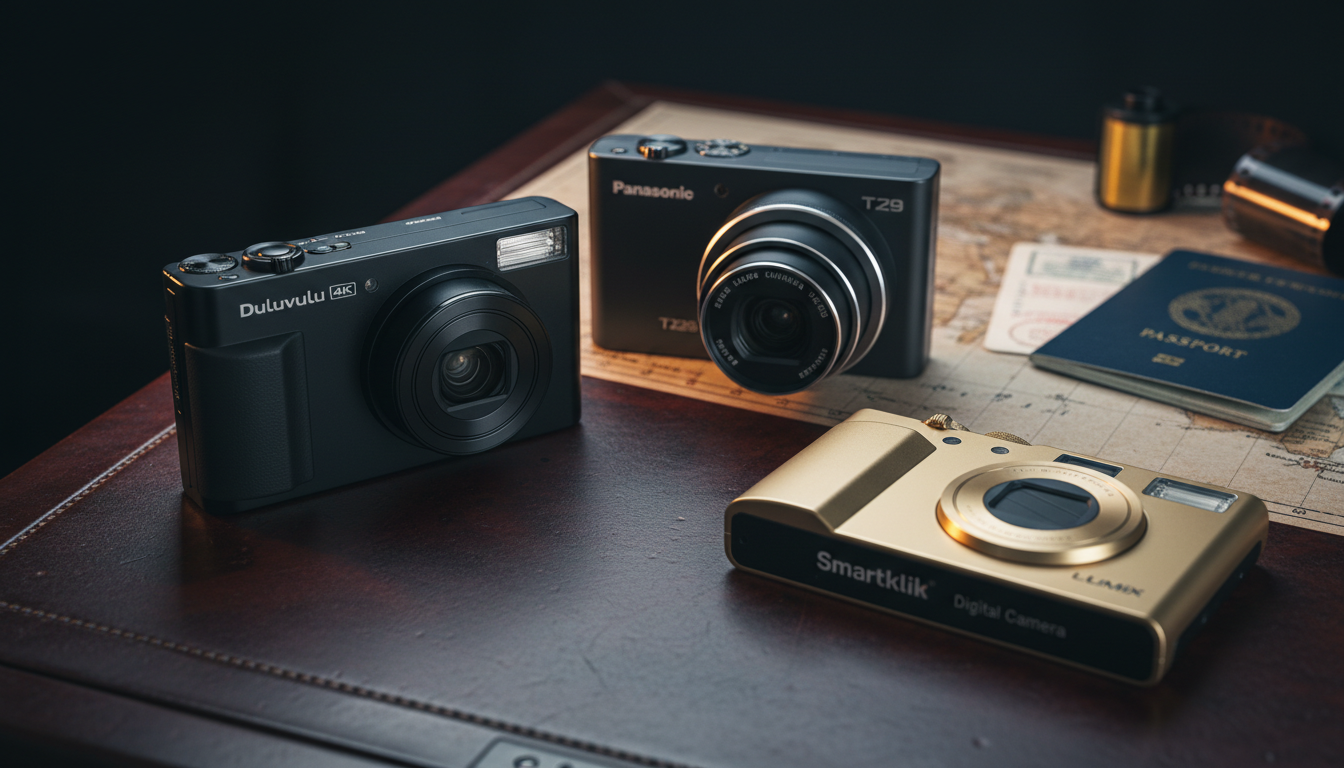
Choosing a point‑and‑shoot that can capture crisp 4K video and stills isn’t easy, especially with ten models on the table. We’ve grouped the lineup into three price tiers so you can quickly spot what fits your budget. The budget corner holds the Smartklik Digital Camera Gold at $35.03 with a 4.1‑star rating, plus the Fjfjopk, Lecnippy and Jgipl options that all sit under $60. Mid‑range contenders like the Duluvulu 4K Camera Black ($59.99, 4.2 ★) and Yigllo ($59.99, 4.0 ★) give you 48‑MP stills and 4K Ultra HD video without breaking the bank. Premium picks such as Panasonic’s LUMIX TZ99 ($589.20, 4.2 ★), Sony’s ZV‑1 ($898.00, 4.4 ★), Canon’s PowerShot SX740 HS and Xtra Edge’s Xtra Muse bring larger sensors, faster autofocus and advanced stabilization for serious vloggers and travelers.
Each camera brings its own mix of features – from the Duluvulu’s 3.0‑inch 180° flip screen to the Panasonic’s 5‑Axis Hybrid O.I.S. and Sony’s 315‑point hybrid autofocus. In the sections that follow, we’ll break down how those specs translate into real‑world use cases, so you can match the right model to your shooting style.

Duluvulu 4K Camera Black
Its 48 MP effective pixels deliver detailed 4K shots, giving strong value at $59.99.

Panasonic LUMIX TZ99
Enthusiasts who need premium performance find the TZ99 justifies its $589.20 price—about $529 more than the Duluvulu—thanks to its professional‑grade battery capacity.

Smartklik Digital Camera Gold
At 280 g, the Smartklik Gold is ultra‑light, letting budget shoppers capture 44 MP photos without the bulk or price of the higher‑end models.
Also considered
Score Analysis
Key score advantages vs. runner-up (Panasonic LUMIX TZ99)
Price Range
Duluvulu 4K Camera Black
$58.97
Panasonic LUMIX TZ99
$634.95
Smartklik Digital Camera Gold
$36.97

Jgipl 4K Camera Black
$58.99
Sony ZV-1
$798.00
Xtra Edge Xtra Muse
$419.00
Fjfjopk 4K Camera Black
$46.99

Lecnippy Digital Camera
$46.99

Canon Point and Shoot Camera Silver
$671.60

Yigllo Digital Camera
$59.99
Spec Comparison
TL;DR: The Duluvulu DC101 delivers 48 MP stills and 4K video on a 3‑inch 180° flip IPS screen for $59.99, making it a compact, beginner‑friendly point‑and‑shoot with solid connectivity.
The camera packs a 48 MP CMOS sensor and records 4K (3840×2160) video, while a 3.0‑inch IPS display that flips 180° lets you see yourself for selfies or vlogging. Autofocus and a built‑in anti‑shake system aim to keep shots sharp, and the 16X digital zoom extends your framing range.
Its 3‑inch screen matches the size of the Yigllo, Jgipl, Panasonic LUMIX TZ99 and Canon point‑and‑shoot models, and it’s noticeably larger than the Xtra Edge Xtra Muse’s 2.0‑inch display. Several rivals such as Yigllo and Lecnippy also offer a 16X digital zoom, so you won’t lose ground on that front. While Duluvulu doesn’t list a weight, many competitors note sub‑0.65‑pound bodies, making the Duluvulu’s heft a question mark compared to the ultra‑light 0.62‑pound Xtra Edge.
Reviewers appreciate the camera’s pocket‑friendly shape, the included SD card, two rechargeable batteries and a protective case, and they highlight the USB webcam mode for easy streaming. However, users frequently mention that the 16X digital zoom can become pixelated, the anti‑shake struggles in motion or low‑light scenes, and the flip screen feels fragile after repeated travel use. Users also describe battery life as short, so keep that in mind for day‑long outings.
Additional technical perks include a hotshoe for external microphones, a USB port that doubles as a webcam connection, and handy controls like a self‑timer, smile detection and time‑lapse modes. The camera’s 180° flip screen, anti‑shake feature and 48 MP resolution aim to balance ease of use with decent creative flexibility for beginners.
Pros
Cons
Best for: Value‑conscious buyers seeking quality at $59.99
“great little camera”
“easy to use and user-friendly interface, ideal for beginners”
TL;DR: The Panasonic LUMIX TZ99 packs a 60× digital zoom, 4K 30p video and a 20.3 MP 1/2.3‑inch sensor into a 0.71‑lb pocket‑friendly body for $589.20.
The standout feature is its 60× digital zoom combined with a 24‑720 mm (35 mm‑equiv) Leica lens, letting you capture distant subjects without swapping lenses. It records 4K video at 30 fps and offers a 4K Photo mode up to 30 fps, while the 5‑Axis Hybrid O.I.S. helps keep handheld shots steady (though it’s disabled during 4K video).
At 0.71 pounds (322 g), the TZ99 is heavier than the Canon point‑and‑shoot (0.61 lb) and the Sony ZV‑1 (0.65 lb) but lighter than the Jgipl 4K Camera (1.43 lb). Its 3.0‑inch tilting touchscreen matches the screen size of most peers, and its 60× digital zoom dwarfs the 16× digital zoom found on the Duluvulu, Yigllo, Jgipl, Lecnippy and Fjfjopk models. Battery capacity sits at 1025 mAh, delivering an estimated 280‑380 shots per charge—a respectable figure among the lineup.
Users love the camera’s portability and the freedom of a long zoom in a pocket‑sized package, noting the tilting screen makes creative angles easy. Professional reviewers praise the Leica optics and hybrid stabilization, but they note that the 1/2.3‑inch sensor struggles in low‑light scenes and the O.I.S. turns off for 4K recording. Bluetooth 5.0 and USB‑C charging add modern connectivity, and features like Post Focus and RAW support give extra creative control.
Pros
Cons
Best for: Travelers, vloggers and casual shooters who value a long zoom and 4K video in a pocket‑sized camera.
Avoid if: You need strong low‑light capability or are shopping on a tight budget — it’s priced at $589.20.
TL;DR: The Smartklik Digital Camera Gold delivers 44 MP stills, 4K video and a 2.8‑inch LCD in a 280 g pocket‑sized body for $35.03, making it the most affordable entry‑level option, though image quality falls short of expectations.
The camera advertises a 44 MP sensor and 4K (3840×2160) video capture, both you access via a 2.8‑inch LCD screen. At just 280 g, it truly fits in a pocket, and the bundle includes a 64 GB SD card, a camera bag, two lanyards, a USB cable and a wiping cloth.
Compared with the nine rivals, the Smartklik shares the same 16x digital zoom used across the group. Its 2.8‑inch display matches the Lecnippy and Fjfjopk models but is smaller than the 3‑inch screens on most others. At 280 g it's heavier than Lecnippy’s 258 g body yet lighter than Fjfjopk’s 299 g unit, placing it in the middle of the weight range.
Reviewers love how light and portable the camera feels, noting the kid‑friendly button layout and the generous accessory package. Professional reviewers, however, call the image output “pixelated and grainy” and point out that the 44 MP claim and 4K video often fall short of expectations. Reviewers describe the plastic build as “toy‑like,” and label the low‑light performance “limited.”
Additional context shows a 1‑year manufacturer warranty and two rechargeable lithium‑ion batteries, giving beginners enough power for short outings without worrying about extra purchases.
Pros
Cons
Best for: Kids, teens and absolute beginners who want an ultra‑light, budget‑friendly camera for casual snapshots and travel.
Avoid if: You need advanced features, professional‑grade image quality, reliable low‑light performance, or a more robust build.
“picture quality a joke”
“Kids love it for birthdays, making memories with friends”
TL;DR: The Jgipl 4K Camera Black offers a 48 MP sensor, 4K video, and a 3‑inch flip‑screen for $58.99, but its all‑plastic build and digital‑only zoom keep it in the budget tier.
What really stands out is the 48 MP maximum image resolution paired with 4K (3840×2160) video capture, all packed into a compact 6.85 × 5.63 × 3.86‑inch body. The 3.0‑inch IPS LCD flips 180°, making self‑portraits and vlogging easier than on many fixed‑screen rivals.
Compared with the other nine cameras, the Jgipl matches the common 16x digital zoom you’ll see on the Duluvulu, Yigllo, Lecnippy and Fjfjopk models. Its screen is larger than the 2.8‑inch displays on the Lecnippy and Fjfjopk cameras, while the 48 MP sensor aligns with most budget options, though Yigllo pushes to 72 MP. At about 1.43 lb, the Jgipl feels heavier than the lightweight Lecnippy (258 g) and Fjfjopk (299 g) units, a result of its all‑plastic construction.
Reviewers like the generous starter kit: two rechargeable batteries, a 32 GB micro‑TF card and a wide‑angle adapter arrive right out of the box, extending shooting time without extra purchases. Experts note the 48 MP stills are “more than fine” for social‑media sharing, while also calling the plastic body cheap and the advertised optical zoom misleading because it’s digital‑only. Users frequently mention the flip screen as a plus for selfies, yet they also cite poor low‑light performance from the 1/3‑inch CMOS sensor and the lack of Wi‑Fi or Bluetooth as a workflow inconvenience.
Pros
Cons
Best for: Beginners, kids, travelers, and vloggers who need a pocketable, inexpensive camera with 4K video.
Avoid if: You want the best value‑per‑dollar in its price range, need true optical zoom, or require a rugged, metal‑body design.
“great little camera”
“easy to use and user-friendly interface, ideal for beginners”
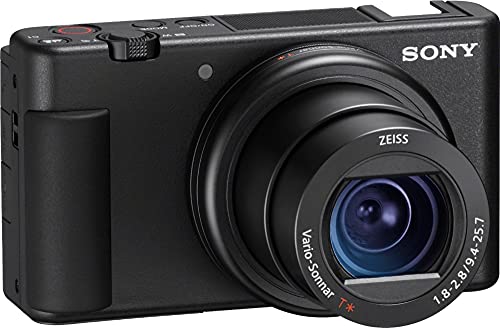
TL;TD: The Sony ZV-1 packs a 20.1 MP 1‑inch sensor, 315‑point hybrid AF and 4K 30p video into a 294 g, fully‑articulated pocket camera, but it carries a premium $898 price tag.
The standout spec is the 20.1 MP stacked CMOS sensor paired with a fast 24‑70 mm f/1.8‑2.8 Zeiss lens and 315‑point hybrid autofocus, giving you sharp stills and reliable eye‑tracking for vlog‑style video. The camera also records 4K UHD (3840 × 2160) at up to 30 fps and can hit 120 fps in 1080p, while the 3.0‑inch fully articulated touchscreen makes framing easy from any angle.
Compared with the other nine cameras in this roundup, the ZV‑1 is heavier than the Canon Point and Shoot Camera Silver (0.606 lb) and the Panasonic LUMIX TZ99 (0.710 lb), but considerably lighter than the Jgipl 4K Camera Black (1.433 lb). Its depth of 43.5 mm is similar to the Panasonic’s 43.1 mm and a bit deeper than the Canon’s 40.64 mm. The ZV‑1’s 105.5 mm width exceeds the compact Xtra Edge Xtra Muse (42.2 mm) and Fjfjopk 4K Camera (299 g, 0.659 lb) but is narrower than the Panasonic’s 67.8 mm width. In terms of resolution, its 20.1 MP sensor sits just below the Canon’s 20.3 MP effective count and matches the Panasonic’s 20.3 MP sensor, while offering a far larger 1‑inch sensor than many budget 4K cams use, which rely on 2‑inch or smaller formats.
Users repeatedly praise the ZV‑1’s pocket‑size portability (294 g) and the ease of one‑handed operation, especially for solo creators. Professional reviewers note the 315‑point phase‑detect AF and 4K/30p video as strong points for a compact camera, while also calling out the reliance on digital SteadyShot rather than in‑body sensor‑shift stabilization. Reviewers often describe the battery endurance of about 260 CIPA shots as short when shooting lots of video, and the lack of weather sealing limits outdoor use. The inclusion of a windscreen, built‑in microphone and webcam capability rounds out its creator‑focused feature set.
Pros
Cons
Best for: Buyers willing to invest in a proven, high‑quality option
Avoid if: You need advanced features or professional‑grade performance
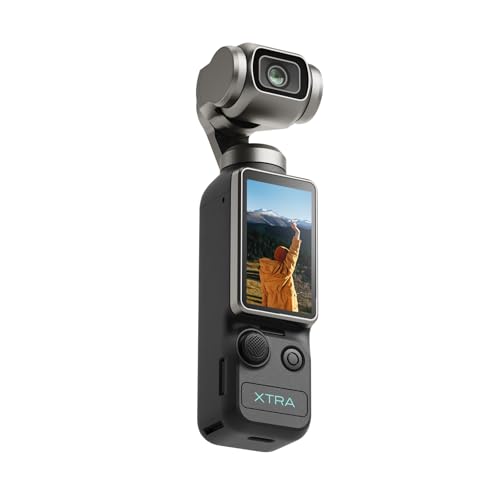
TL;DR: The Xtra Edge Xtra Muse packs a 1‑inch sensor, 3‑axis gimbal and 4K video up to 120 fps into a 0.62‑lb, pocket‑sized body, but it lacks built‑in storage and battery details.
This camera’s standout hardware is its 1‑inch CMOS sensor paired with a fast f/2.0 lens (20 mm equivalent) and a 3‑axis gimbal that can pan from –230° to 53°, tilt –115° to 65° and roll –45° to 45°. Those specs let you record 4K (3840 × 2160) video at up to 120 fps with a maximum bitrate of 130 Mbps, while still delivering a 9.4 MP still image.
At 0.62 lb (281 g), the Muse weighs less than the Panasonic LUMIX TZ99 (≈0.71 lb) and the Jgipl 4K Camera (≈1.43 lb), yet it’s only a shade heavier than the Canon Silver (≈0.61 lb). Its 2.0‑inch display is the smallest among the nine rivals, most of which sport 3.0‑inch screens, and it’s also slimmer than the bulkier models that list depths of 40 mm or more. Compared with the Fjfjopk and Lecnippy units, which weigh around 0.66 lb and 0.71 lb respectively, the Muse feels more pocket‑friendly.
Reviewers consistently praise the buttery‑smooth stabilization from the gimbal and the sensor’s ability to handle low‑light video with an ISO range of 50‑16 000. However, the lack of any internal storage means you must carry a microSD card, and the manufacturer doesn’t disclose battery endurance, leaving runtime uncertain for long shoots. The 750‑nit screen brightness helps in bright environments, but the modest 2.0‑inch size can feel cramped when framing shots.
Pros
Cons
Best for: Vloggers, social‑media creators, and travelers who need a compact camera with strong stabilization and low‑light 4K capability.
Avoid if: You need built‑in storage, guaranteed long battery life, or a larger on‑camera display for precise framing.
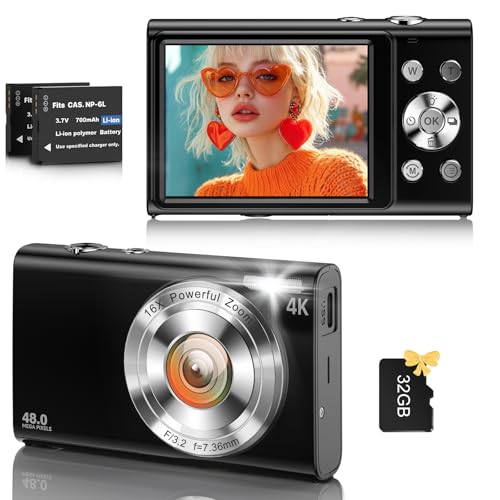
TL;DR: The Fjfjopk 4K Camera Black packs a 48 MP sensor, 4K video and 16× digital zoom into a compact 0.66‑lb body for $46.99, making it a solid entry‑level option despite its modest build.
The standout spec is its 48 MP CMOS sensor paired with 4K (3840×2160) Ultra HD video, delivering high‑resolution stills and crisp footage. It also offers 16× digital zoom (up to 18× at maximum) and a 2.8‑inch IPS touchscreen that rotates 270°, giving you flexible framing while you shoot.
Compared with the other nine cameras in this roundup, Fjfjopk’s 299 g (0.66 lb) chassis weighs a touch more than the 258 g Lecnippy model, yet less than the 1.43‑lb Jgipl, and sits roughly on par with the 281 g Xtra Edge. Its screen size matches the 2.8‑inch displays on Lecnippy and Smartklik, while the Duluvulu, Yigllo and Jgipl models sport larger 3‑inch screens. Digital zoom mirrors Lecnippy, Duluvulu and Yigllo at 16×, and its included 32 GB SD card mirrors the storage boost found on several peers.
Users consistently praise the camera’s sharp autofocus and effective anti‑shake stabilization, noting that the 48 MP sensor produces detailed images even in bright conditions. Professional reviewers note the 4K video quality, but they also flag the PVC body as flimsy and the touchscreen as occasionally unresponsive. Many complain about battery life, saying it only lasts a couple of hours of continuous recording, matching the “poor” battery remarks in the aggregated sentiment.
Beyond the core specs, the Fjfjopk includes a USB‑C port for quick charging, a built‑in LED fill light, night‑vision mode, and nine shooting presets ranging from landscape to backlight. The camera also supports webcam mode, making it a handy tool for streaming or video calls without extra hardware.
Pros
Cons
Best for: Entry‑level buyers or those on a tight budget
Avoid if: You need advanced features or professional‑grade performance
“great little camera”
“easy to use and user-friendly interface, ideal for beginners”
TL;DR: The Lecnippy DC402 offers a 48 MP sensor, 4K video, 16× digital zoom, and a 2.8‑inch flip screen for just $46.99, making it a lightweight, budget‑friendly point‑and‑shoot for beginners.
The Lecnippy pairs a 48 MP CMOS sensor with 4K video capture, all packed into a compact body that weighs only 258 g (about 0.71 lb). Its 2.8‑inch IPS screen flips up for selfie framing, and the camera ships with a 32 GB SD card, two rechargeable batteries, and a Type‑C charging cable.
At roughly 0.71 lb, the Lecnippy sits between the feather‑light Xtra Edge (about 0.62 lb) and the much heavier Jgipl 4K Camera (about 1.43 lb). Its 2.8‑inch screen matches the Fjfjopk and Smartklik models but is smaller than the 3‑inch displays found on Jgipl, Duluvulu, Yigllo, Panasonic LUMIX, and Canon Point‑and‑Shoot. The 16× digital zoom mirrors the zoom range of Fjfjopk, Jgipl, Duluvulu, and Yigllo, giving it comparable reach without an optical lens. Storage-wise, the included 32 GB card lines up with Fjfjopk and Yigllo, though Smartklik bundles a larger 64 GB card.
Users consistently praise the camera’s feather‑light build and pocketable size, noting that the reliable autofocus works well for quick snaps. Professional reviewers highlight the convenience of the flip screen for beginner vloggers and the built‑in digital anti‑shake. However, the reliance on digital‑only zoom and stabilization can lead to noticeable quality loss at the extreme end, and the limited manual controls may feel restrictive for enthusiasts. Reviewers also note the small grip as a potential comfort issue during longer shooting sessions.
The camera’s feature set includes continuous shooting, exposure compensation, face detection, adjustable ISO and white balance, a self‑timer, smile capture, and a webcam mode. Record‑while‑charging lets you keep shooting even when the batteries run low, and the dual‑battery package extends usage time without needing a spare charger.
Pros
Cons
Best for: Budget-conscious buyers seeking a reliable entry-level option
Avoid if: You need advanced features or professional‑grade performance
“picture quality a joke”
“Kids love it for birthdays, making memories with friends”
TL;DR: The Canon PowerShot SX740 HS packs a 40× optical zoom, 4K video at 29.97 fps, and a flip‑up 3‑inch screen into a 0.61‑lb body, making it a solid travel companion for daylight shooting.
The standout spec is its 40× optical zoom (160× combined with 4× digital), which lets you capture distant subjects without swapping lenses. It records 4K video at 29.97 fps and offers a 3.0‑inch TFT‑LCD that tilts 180° upward for selfies or vlogging. At 0.60625 pounds, the camera feels lightweight enough for a pocket, and its ISO 3200 ceiling gives some flexibility in brighter conditions.
Compared with the other nine cameras, the SX740 HS is lighter than the Panasonic LUMIX TZ99 (0.71 lb) and the Sony ZV‑1 (0.65 lb), while still being slimmer than the Xtra Edge Xtra Muse’s 33.5 mm height. The Xtra Edge Xtra Muse lists a modest 20 mm focal length, so the SX740’s 40× optical zoom gives it a clear advantage for reach. Screen size matches the Panasonic and Sony models at 3.0 inches, but the flip‑up design adds versatility those peers lack.
Users consistently praise the extreme zoom and the tilt screen for quick framing, noting solid daytime image and video quality thanks to the DIGIC 8 processor and optical image stabilization. Professional reviewers highlight the 40× zoom as rivaling a full‑frame 300 mm lens for travel photography, and they commend the 4K time‑lapse and burst mode for capturing fast action. Common complaints focus on grainy low‑light images, the absence of slow‑motion video (max 60 fps at 720p), and the lack of a panorama mode.
Pros
Cons
Best for: Travelers, beginners and casual vloggers who need a pocketable super‑zoom for daylight wildlife and selfie video.
Avoid if: You require strong low‑light performance, slow‑motion video, or a built‑in panorama mode.
TL;DR: The Yigllo DC101 offers a 72 MP sensor, 12× optical zoom and a 3‑inch flip screen for $59.99, but its 4K video and autofocus fall short of expectations.
What really stands out on the Yigllo DC101 is the 72 MP photo resolution paired with a 12× optical zoom – numbers that out‑pace the 48 MP and 44 MP resolutions seen on most of the other nine cameras in this roundup. The 3‑inch 180° flip LCD also gives you a comfortable framing angle for selfies or vlogging, while the built‑in anti‑shake helps keep handheld shots steadier.
At roughly the same price point as the Duluvulu and Jgipl models, the Yigllo matches their 16× digital zoom and 3‑inch screens, yet it adds true optical zoom that the Jgipl’s “digital‑only” zoom lacks. Compared with the Lecnippy and Fjfjopk cameras, which list 48 MP sensors, the Yigllo’s 72 MP claim is a clear resolution advantage. Most peers bundle a 32 GB card and two batteries, so the Yigllo’s accessory set isn’t unique, but the inclusion of a hot‑shoe mount and HDMI port gives it a bit more flexibility than the slimmer spec lists of some rivals.
Professional reviewers warn that the advertised 4K video often resembles low‑resolution webcam footage, and users echo this, noting blurry results and a sluggish, unpredictable autofocus that sometimes locks onto the wrong subject. Reviewers describe the plastic housing as feeling “toy‑like,” and the battery life drains quickly even with the two supplied rechargeable cells. On the plus side, the menu layout is simple enough for absolute beginners, and the camera’s live‑streaming and webcam modes make it handy for quick online content.
Pros
Cons
Best for: Absolute beginners, children or casual users who want an inexpensive, ready‑to‑shoot camera for simple photography and occasional video.
Avoid if: Reliability and user satisfaction are your top concerns, especially if you need true 4K video, solid build quality, or dependable autofocus.
“picture quality a joke”
“Kids love it for birthdays, making memories with friends”
Breakdown
Duluvulu 4K Camera Black
Pros
Panasonic LUMIX TZ99
Pros
Cons
Smartklik Digital Camera Gold
Pros
Cons
Jgipl 4K Camera Black
Pros
Cons
Based on scoring data and product specs
Personalized picks
Best Overall Pick
Duluvulu 4K Camera Black
Best Mid-Range PickBest for: Value-conscious buyers seeking quality at $59.99
Panasonic LUMIX TZ99
Best for: Those prioritizing quality and willing to pay for premium performance
$634.95+$575.98 vs winner
Skip Yigllo Digital Camera if…
Reliability and user satisfaction are your top concerns
The Duluvulu 4K Camera Black ranks first with its 48 MP sensor, 4K Ultra HD video capture, and a 180°‑flip 3.0‑inch IPS screen—all for $59.99. Its 4.2‑star rating from 2,439 reviewers and the inclusion of a carrying case, flash control and lens cap give you a fully‑kitted package right out of the box.
The Panasonic LUMIX TZ99 ranks second, ideal if you need serious zoom power and pro‑grade handling. It offers a 60× digital zoom, 4K 30p video and 5‑Axis Hybrid O.I.S., plus a 20.3 MP 1/2.3‑inch MOS sensor that delivers sharp stills and smooth motion for travel or wildlife shooting.
Beyond the top two, the Smartklik Digital Camera Gold is the best budget pick at $35.03, delivering basic 4K video in a compact, ultra‑affordable shell. For those willing to splurge, the Sony ZV‑1 stands out as the premium option at $898.00, built around advanced video features and a fast lens for creators who demand top‑tier performance.
Choose the Duluvulu 4K Camera Black today and get solid 4K capability without breaking the bank.
The Duluvulu 4K Camera Black offers 48 MP stills, 4K video, a 180° flip screen and comes with a carrying case, flash and extra battery for just $59.99, making it an excellent low‑cost choice for travelers who need a compact, versatile shooter.
No reviews yet — be the first to share your experience.
Please sign in to leave a review