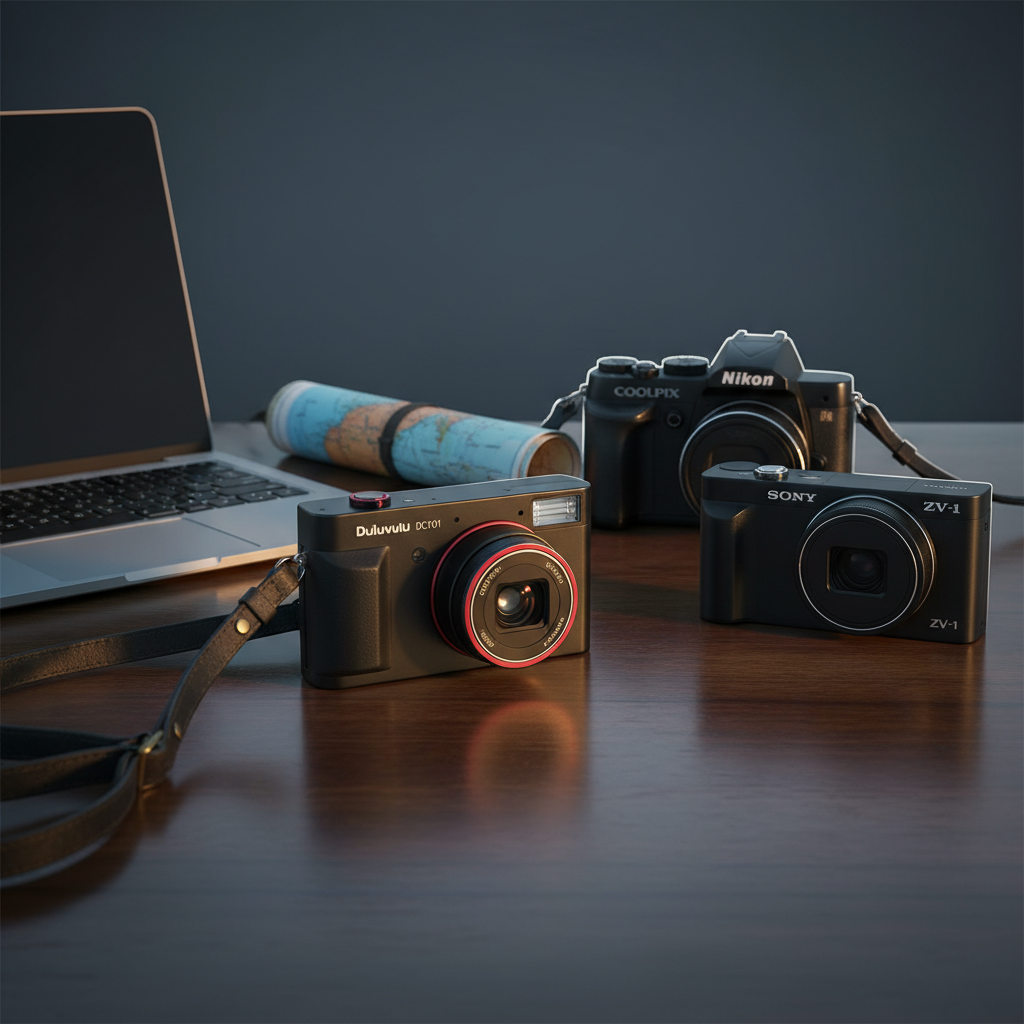
Choosing a point‑and‑shoot that can capture 4K video without breaking the bank can feel overwhelming. We narrowed the field to 12 cameras, spanning the budget tier (Kasukani DC13, Fjfjopk DC402, Duluvulu DC101), mid‑range (Panasonic DC‑FZ80DK, Canon Cameras US, Panasonic DC‑ZS99K) and premium (Nikon COOLPIX P1100, Sony ZV‑1, Nikon COOLPIX P950). Prices range from $42.99 to $1,046.95, and ratings sit between 4.2 and 4.5 stars.
If you’re a beginner vlogger or a traveler who needs a lightweight tool, the Duluvulu DC101 stands out with its $58.97 price, 48 MP interpolated photos and a 180° flip screen, earning the budget‑category win. For those who want serious reach, the Nikon COOLPIX P1100’s 125× optical zoom and 4K video deliver the premium‑category champion. Meanwhile, the Sony ZV‑1, with a 20.1 MP 1‑inch sensor and side‑flip touchscreen, offers a premium experience for solo creators who value autofocus and built‑in audio.
Below you’ll find a closer look at each model, so you can match the camera that fits your shooting style and budget.

Duluvulu DC101
Offers 16X digital zoom with two included batteries, delivering solid value for its price.

Nikon COOLPIX P1100
Ideal for enthusiasts needing long‑run shooting, it provides ~260 still shots and over an hour of video, but it's $988 more than the Duluvulu DC101.
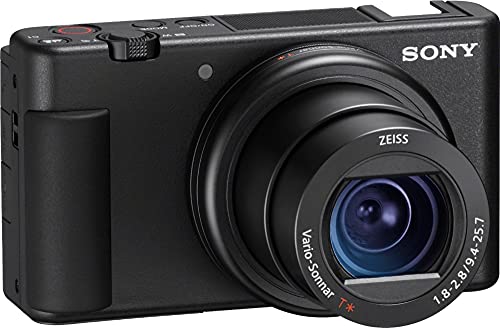
Sony ZV-1
Stands out with 65 minutes of standard‑mode 4K recording and BLE 4.1 Bluetooth, offering a proven high‑quality solution for creators willing to invest.
Also considered
Score Analysis
Key score advantages vs. runner-up (Nikon COOLPIX P1100)
Price Range
Duluvulu DC101
$58.97
Nikon COOLPIX P1100
$1,046.95
Sony ZV-1
$898.00

Nikon COOLPIX P950
$746.95

Panasonic DC-FZ80DK
$497.99
Fjfjopk DC402
$64.99

Panasonic DC-ZS99K
$697.99

Canon Cameras US Point and Shoot Digital Camera
$649.00

Kasukani DC13
$43.99
Gatatol 64MP Vlogging Camera
$29.99
Lecnippy 48MP Compact
$46.99
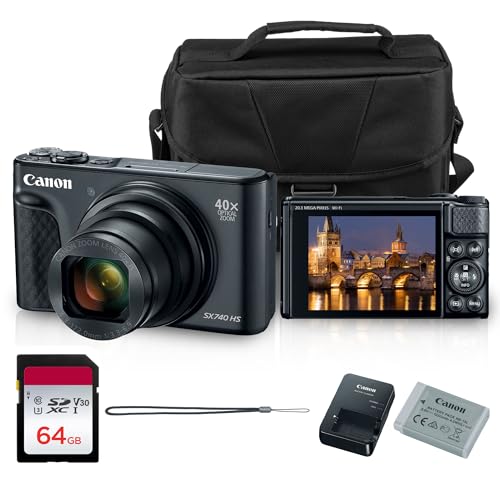
Canon PowerShot SX740 HS Digital Camera
$1,099.99
Spec Comparison
TL;DR: At $58.97 the Duluvulu DC101 delivers 4K video (4096×2160), a 48 MP max photo resolution, 16× digital zoom and a 180°‑flip 3.0‑in IPS screen, all in a compact 0.59‑lb body.
The camera’s headline spec features 4K video capture at 4096×2160 pixels paired with a 48 MP maximum photo resolution, both using an 8 MP CMOS sensor that the manufacturer interpolates up to 44 MP. A 16× digital zoom and a fixed F/3.2 aperture round out the imaging core, while the 180°‑flip 3.0‑in IPS LCD makes framing selfies and vlogs effortless. You also get two rechargeable lithium‑ion batteries, a USB‑C charging stand and a 32 GB SD card right out of the box.
Compared with the other eleven cameras in this roundup, the DC101’s screen exceeds the 2.8‑in displays on Lecnippy, Fjfjopk and Gatatol, and its flip capability stands alone among the listed peers. Lecnippy matches the 16× digital zoom yet weighs only 113 g, while Fjfjopk also offers two batteries and 16× digital zoom but tips the scales at 299 g and lacks a flip screen. Kasukani boasts a higher effective still resolution (56 MP) and an optical 16× zoom, but it’s bulkier (depth 3.5 cm) and heavier (360 g). Panasonic and Canon sit in a higher price tier and carry larger bodies (Panasonic at 1.41 lb, Canon at 0.60625 lb), so the Duluvulu becomes the most compact, budget‑friendly option with a full starter kit.
Users consistently praise the camera’s ease of use, the flip screen for quick vlogging, and the value of the included accessories. Professional reviewers highlight the sharpness of daylight 4K footage and the detail of 48 MP stills, but they also note that low‑light scenes can become noisy and that the basic digital anti‑shake struggles with fast motion. The AVI file format, while widely compatible, results in larger video files that some editors find cumbersome.
Technical details worth noting: the sensor’s exposure compensation ranges from ±3.0 EV, shutter speeds span 1/10 sec to 1/2650 sec, and the camera offers eight white‑balance presets. Connectivity includes HDMI (cable included), a standard 1/4‑in tripod thread, OTG support via adapter, and a hot shoe that can hold a microphone or fill light. The 1‑year warranty and the included 32 GB SD card round out a very complete package for beginners.
Pros
Cons
Best for: Beginner vloggers, TikTok creators, and travelers who want a compact, ready‑to‑shoot kit with 4K video and a flip screen.
Avoid if: You need professional low‑light capability, optical zoom, or advanced stabilization for fast‑action shooting.
“Perfect for my 13-year-old daughter’s YouTube channel.”
“The flip screen makes vlogging so easy.”
TL;DR: The Nikon COOLPIX P1100 packs a massive 125× optical zoom, 4K video, and 4‑stop VR in a rugged bridge camera, but its $1,046.95 price and 3.11‑lb body make it a premium, heavyweight choice.
The standout feature is its 125× optical zoom (24–3000 mm equivalent) paired with a 16.0 MP back‑illuminated 1/2.3‑inch CMOS sensor. Dual Detect Optical VR promises up to 4.0 stops of shake reduction, and the camera records 4K UHD video at 3840×2160 @30p. A 3.2‑in vari‑angle TFT LCD (8.1 cm) and a 1 cm OLED EVF give flexible framing, while the 77 mm filter thread lets you add accessories. Battery life delivers roughly 260 still shots and about 1 hour 10 minutes of 4K video, and the whole package weighs 3.11 pounds.
Compared with its peers, the P1100 is heavier than the Sony ZV‑1 (≈0.65 lb) and the Canon PowerShot SX740 (2.73 lb), and it weighs more than the Panasonic DC‑FZ80DK (1.41 lb). Its optical zoom far exceeds the SX740’s 40×, while the digital zoom matches the SX740’s approximate 4×. Video runtime is slightly longer than the Sony ZV‑1’s 65‑minute limit, and its still‑image battery capacity of ≈260 shots is on par with the SX740’s 265‑shot rating. The $1,046.95 price puts it in a premium tier above the more budget‑friendly Panasonic and Canon options.
Reviewers consistently praise the extreme zoom reach for wildlife and moon photography, noting that the 4‑stop VR makes handheld shots usable even at the telephoto end. The 4K video capability and the articulating LCD are highlighted as strong points for vloggers and travel shooters. The main criticism centers on the high price and the relatively bulky body, which can be a drawback for casual travelers.
Under the hood, the EXPEED image‑processing engine handles the 17‑element lens (5 ED, 1 super ED) and supports RAW (NRW) capture. The camera offers a 5‑level brightness‑adjustable LCD, 2,359k‑dot EVF coverage of about 99 % both horizontally and vertically, and a 4× digital zoom that complements the massive optical range. Connectivity includes Bluetooth 5.2, Wi‑Fi, USB‑C, and a clean micro‑HDMI output, while the optional ML‑L7 Bluetooth remote adds remote shooting flexibility.
Pros
Cons
Best for: Those who prioritize quality and are willing to pay for premium performance
Avoid if: You're shopping on a tight budget — it's priced at $1,046.95
TL;DR: The Sony ZV-1 packs a 20.1‑MP 1‑inch sensor, ZEISS 24‑70 mm f/1.8‑2.8 lens and a 3.0‑inch side‑flip screen into a 0.64815905028‑pound body, delivering strong autofocus and 4K video for vloggers.
The standout hardware is the 1‑inch stacked Exmor RS CMOS sensor with 20.1 megapixels, paired with a ZEISS Vario‑Sonnar T* 24–70 mm lens that opens to F1.8 at the wide end and F2.8 at telephoto. The camera also sports a 3.0‑inch side‑articulating touchscreen, letting you flip the display rightward for selfie framing without sacrificing the rear‑view ergonomics.
At 0.64815905028 pounds, the ZV-1 is lighter than the Nikon COOLPIX P950 (2.20462262 pounds) and the Panasonic DC‑FZ80DK (1.41 pounds), but a touch heavier than the Canon US Point‑and‑Shoot (0.60625 pounds). Video‑wise it records 4K 3840×2160 at up to 30 fps with a maximum bitrate of 100 Mbps, and offers up to 8× stabilization improvement in 4K mode. Battery life gives you roughly 65 minutes of standard‑mode 4K recording before you need to recharge via USB‑C.
Professional reviewers praise the Real‑time Eye AF and AI‑based tracking for reliable focus on faces and subjects, while everyday users love the intuitive Bokeh button that toggles between F1.8 and F5.6 for quick background blur control. The built‑in ND filter, 10 preset LUTs and soft‑skin effect add creative flexibility without extra gear. However, the camera doesn't have a headphone jack, and multiple reviews note that extended 4K shoots can trigger overheating, limiting continuous takes to a few minutes.
Pros
Cons
Best for: Buyers willing to invest in a proven, high‑quality option
Avoid if: You need advanced features or professional‑grade performance
TL;DR: The Nikon COOLPIX P950 packs an 83× optical zoom and 4K video in a rugged 2.2‑lb body, delivering strong reach and stabilization, but it’s got a small sensor and limited battery life.
The standout spec is the 83× optical zoom (24–2000 mm equivalent), which dwarfs the 40× zoom found on many competitors. It also records 4K UHD video at 3840 × 2160 @ 30p and offers an OLED EVF with 2,359,000 dots, giving a clear view for precise framing. Dual Detect Optical VR provides up to 5.5 stops of shake reduction, which helps when shooting at the tele end.
Compared with the other cameras in this roundup, the P950 feels noticeably heavier than the Sony ZV‑1 (about 0.65 lb) and the Panasonic ZS99 (about 0.69 lb), yet lighter than the Nikon P1100 (over 3 lb) and the Canon SX740 (around 2.73 lb). Its zoom reach also exceeds the 40× optical zoom of the Canon point‑and‑shoot, giving it the longest reach among the listed models.
Reviewers praise the extreme reach and the ability to capture wildlife, birds, and the moon without swapping lenses. The 4K video and external mic input earn high marks for creators who need quality footage. Common complaints focus on the 1/2.3‑inch sensor because it produces noticeable noise at higher ISO settings, and on the roughly 2.2‑lb body, which feels cumbersome on long outings. Battery life gives about 290 still shots and roughly 1 hour 20 minutes of video, which some users find limiting for extended shoots.
Pros
Cons
Best for: Buyers willing to invest in a proven, high-quality option
Avoid if: You need advanced features or professional‑grade performance
TL;DR: The Panasonic DC-FZ80DK delivers a massive 60× optical zoom and 4K UHD video in a compact 1.41‑lb body for under $500, though its tiny 1/2.3″ sensor and lack of Wi‑Fi keep it in the enthusiast‑level camp.
What really sets this camera apart is its 60× optical zoom (20–1200 mm equivalent) paired with 4K UHD recording at 3840×2160 30 fps. The 1/2.3″ MOS sensor packs 18.1 MP of effective resolution, and the 3.0‑inch TFT LCD (1,840k‑dot) can be used as a touchscreen for focus and shutter release. Continuous shooting reaches 10 fps, and the 4K Burst mode can capture up to 30 fps straight from the sensor, giving you frame‑by‑frame flexibility.
Compared with the other eleven cameras in this roundup, the FZ80’s 60× zoom outpaces the Canon point‑and‑shoot’s 40× zoom, while its weight of 1.41 lb makes it heavier than the Canon, Sony ZV‑1 and Panasonic ZS99K, yet lighter than the Nikon COOLPIX P950. It also carries no Wi‑Fi or Bluetooth, a shortfall the Sony model avoids with BLE support. Battery capacity sits at 895 mAh delivering about 90 minutes of shooting, which is less than the 1025 mAh battery in the Panasonic ZS99K but comparable to the Canon’s 265‑shot estimate.
User sentiment praises the camera’s “massive zoom” and “budget‑friendly 4K video,” noting that everyday shooters find it easy to hold and use for travel or wildlife snaps. Professional reviewers echo the zoom praise but caution that the small 1/2.3″ sensor hampers low‑light performance and dynamic range. Users complain about the lack of wireless connectivity and a menu that feels “cumbersome,” especially if they’re used to modern mirrorless bodies.
Additional technical context includes a versatile aperture range of f/2.8–f/5.9, 39 AF points, and a minimum focusing distance of just 1 cm, which helps with macro‑style subjects. ISO sensitivity spans 80–3200 natively (extendable to 6400), and the built‑in pop‑up flash adds fill light when needed. The electronic viewfinder offers 0.74× magnification with a 2,360k‑dot OLED panel, giving a clear preview even in bright conditions.
Pros
Cons
Best for: Travel, wildlife and casual shooters who want a long zoom and 4K video without breaking the bank
Avoid if: You need advanced low‑light capability, wireless connectivity, or professional‑grade video features
“Given as a gift, he loves it”
“It feels good in the hand and the zoom range is outstanding”
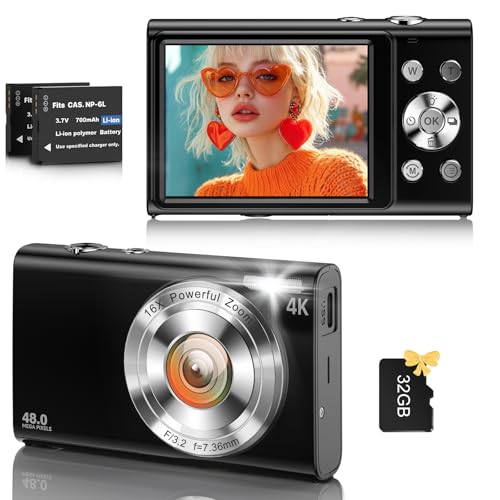
TL;DR: The Fjfjopk DC402 delivers 48 MP photos and 4K video at 30 FPS in a compact, budget‑friendly body that includes a 32 GB SD card and AA rechargeable batteries.
The camera’s standout spec is its 48 MP effective still resolution paired with 3840×2160 4K video at 30 FPS; it captures both on a 1/3.2‑inch CMOS sensor. Optical image stabilization helps keep footage steady, and a 2.8‑inch IPS LCD lets you frame shots accurately.
At $46.99, the DC402 is slightly pricier than the Kasukani DC13, which lists a $42.99 price tag, but it’s lighter at 299 g compared with Kasukani’s 360 g. It also carries more shooting features than the Duluvulu DC101, which only notes basic exposure modes. Compared with the ultra‑light Lecnippy 48MP Compact (113 g), the Fjfjopk feels a bit bulkier, yet it still fits comfortably in a pocket. Unlike the Panasonic DC‑FZ80DK and Canon point‑and‑shoot models, the DC402 lacks Wi‑Fi, Bluetooth, and a built‑in flash.
Reviewers consistently highlight the surprisingly sharp images and smooth 4K clips, especially given the $46.99 price. Reviewers praise the included 32 GB SD card and two AA rechargeable lithium‑polymer batteries as great value. However, users note that autofocus can be slow in low light and that the 16× digital zoom introduces noticeable quality loss. Professional reviewers point out the solid USB‑C webcam mode as a handy feature for beginner streamers.
Pros
Cons
Best for: Entry-level buyers or those on a tight budget
Avoid if: You want the best value‑per‑dollar in its price range
“really happy”
“Image and video quality described as “surprisingly good” for casual use”
TL;DR: The Panasonic DC‑ZS99K packs a 30× optical zoom, 4K video and a flip‑up 3.0‑inch touchscreen into a 0.69‑lb pocketable body, but its small sensor and modest battery keep it in the mid‑range camp.
The standout spec is the 30× optical zoom (24–720 mm equivalent) paired with a 20.3 MP 1/2.3‑inch MOS sensor, letting you capture distant subjects without swapping lenses. It also records 4K video at 3840×2160 px 30p and offers 1080p slow‑motion at 120 fps, while the 1,840k‑dot tiltable touchscreen makes framing from low angles a breeze.
Compared with the other eleven cameras, the ZS99K is lighter than the Nikon COOLPIX P950 (which tips the scales at over 2 lb) and sits between the Canon point‑and‑shoot (around 0.6 lb) and the Panasonic DC‑FZ80DK (about 1.4 lb). Its 30× zoom outpaces the Canon’s 40× reach but stays short of the Nikon’s 5 m tele focus range, and it offers more autofocus points than the Canon’s 49‑area system while keeping a compact footprint.
Travelers and vloggers love the camera’s pocketable dimensions (112 mm × 67.8 mm × 43.1 mm) and the flip‑up screen for selfies, noting the smooth 4K footage and effective 5‑axis Hybrid O.I.S. Professional reviewers praise the long zoom range, yet they flag the small sensor’s impact on low‑light performance and the lack of a built‑in viewfinder. Everyday users echo the softness and noise at full telephoto, and many mention the modest battery life of 280 shots (380 shots per the manufacturer’s estimate).
Technically, the camera ships with Bluetooth 5.0, USB‑C charging, and a 1025 mAh lithium‑ion battery. It supports 4K Burst at 30 fps, extracting 8 MP stills, and offers focus‑stacking, post‑focus and pre‑burst modes for creative flexibility. The ISO range stretches from 80 to 6400, and exposure compensation spans ±5 EV in 1/3‑EV steps.
Pros
Cons
Best for: Travelers, vloggers, and casual shooters who need a long zoom in a compact package.
Avoid if: You need professional‑grade low‑light performance, a viewfinder, or longer battery endurance.
“Perfect for travel—fits in my pocket and zooms in on distant landmarks”
“Love the flip screen for selfies and vlogging”
TL;DR: The Canon point‑and‑shoot packs a 40× optical zoom, 4K 3840×2160 video and a 3.0‑inch tilting LCD into a 0.60625‑pound body for $659, making it a strong travel‑friendly option.
The standout spec is the 40× optical zoom paired with Optical Image Stabilizer, letting you reach a 960 mm 35mm‑equivalent focal length while keeping handheld shake in check. It also records 4K UHD video at 3840 × 2160 pixels and offers a 3.0‑inch tilt‑type LCD that flips up 180° for selfies or vlogging.
At 0.60625 pounds, this camera is lighter than the Panasonic DC‑FZ80DK (1.41 pounds) and far lighter than the Nikon COOLPIX P950 (over 2 pounds). It also undercuts the Sony ZV‑1 (about 0.65 pounds) and it's a touch lighter than the Panasonic DC‑ZS99K (0.69 pounds). In terms of zoom reach, Panasonic’s DC‑FZ80DK lists a 20–1200 mm equivalent range, which exceeds Canon’s 960 mm equivalent, but Canon’s 40× zoom still beats many rivals that lack such extreme magnification. Continuous shooting peaks at up to 10 fps, matching the burst speed of the Panasonic DC‑FZ80DK.
Reviewers love the “extreme zoom” and note that the 4K footage is sharp, especially when the built‑in Wi‑Fi and Bluetooth make sharing a breeze. Professional reviewers highlight the effective OIS at long focal lengths. On the flip side, the 1/2.3‑inch sensor (6.17 × 4.55 mm) limits low‑light performance, and the 4K mode applies a ~3.5× crop that narrows the wide‑angle view. Users also mention a modest battery capacity of 265 shots, which can feel short during extended Wi‑Fi or 4K shooting, and the zoom mechanism can be noisy in video.
Technical details round out the package: a 20.3 MP CMOS sensor, lens aperture ranging from f/3.3 to f/6.9, and a minimum focus distance of just 1 cm for close‑up work. The camera runs on a DIGIC 8 processor and supports Bluetooth Low Energy, NFC and Wi‑Fi for quick transfers.
Pros
Cons
Best for: Travelers and vloggers who want powerful zoom and 4K video in a compact, lightweight body.
Avoid if: You need top‑tier low‑light performance, a viewfinder, or professional video features like external audio input.
TL;DR: The Kasukani DC13 delivers 56 MP photos and 4K 3840×2160 video on a compact 3.0‑inch flip screen for just $42.99, making it a budget‑friendly starter for vloggers and travelers.
The standout spec is the 56 MP effective still resolution paired with 4K 3840×2160 video at 30 FPS. A 16× optical zoom lens (f/2.8 – f/5.6) lets you get close without digital degradation, and the 3.0‑inch LCD flips 180° for easy framing when you’re in front of the camera. The camera runs on a 2000 mAh rechargeable lithium‑ion battery, which the manufacturer says lasts several hours of intermittent use.
Compared with the other eleven entries, the DC13 is heavier than the ultra‑light Lecnippy (113 g) but lighter than the Panasonic DC‑FZ80DK, which tips the scales at about 1.41 pounds. Its 3.0‑inch screen is larger than the 2.8‑inch displays on the Fjfjopk DC402, Lecnippy, and Gatatol models. The 56 MP stills out‑resolve the Fjfjopk’s 48 MP and Duluvulu’s 44 MP sensors, though the Gatatol pushes 64 MP. Digital zoom matches the 16× that most peers provide, but the DC13 is one of the few that also offers a 16× optical zoom.
Users praise the camera’s simplicity, fast autofocus and the flip screen for quick vlogging. Professional reviewers note the accurate colour reproduction and the detail that 56 MP provides for chroma‑key work. Common complaints focus on the lack of optical image stabilization, which makes handheld 4K clips feel shaky, and the limited manual exposure controls that frustrate more advanced shooters. Battery life can dip quickly in cold weather, which several owners highlight.
Pros
Cons
Best for: Shoppers on a tight budget who want the most for their money
Avoid if: You prefer products with extensive real‑world feedback and proven track records
“Perfect for YouTube vlogs — the flip screen makes framing so easy.”
“No image stabilization — videos get shaky when walking.”
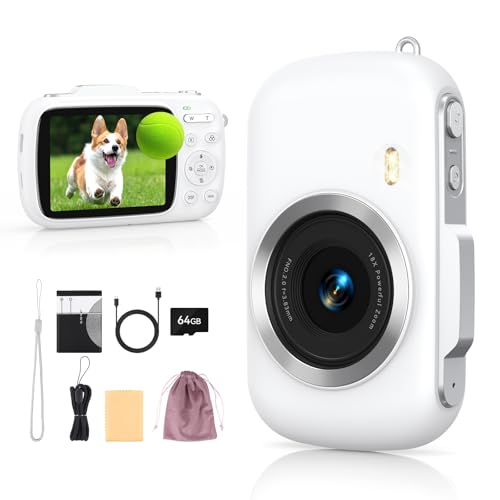
TL;DR: The Gatatol G7‑A packs a 64 MP sensor, 4K video and 18× digital zoom into a compact 408 g body, making it a kid‑friendly point‑and‑shoot with a full accessory kit.
What really stands out is the 64 MP effective still resolution, paired with 4K (2160p) video at up to 60 FPS, all captured on a 1/4‑inch CMOS sensor. You get a 2.8‑inch LCD for framing your shots, and the camera offers an 18× digital zoom. The lithium‑polymer battery lasts about 90 minutes of continuous shooting.
Among the twelve cameras in this roundup, the G7‑A delivers the highest still‑resolution figure – the Kasukani DC13 tops out at 56 MP, the Fjfjopk DC402 at 48 MP, and the Panasonic and Canon models stay well below 30 MP. Its 18× digital zoom edges out the 16× zoom found on the Kasukani, Fjfjopk, Duluvulu and Lecnippy units. At 408 g it’s heavier than the Lecnippy 48MP Compact (113 g) and the Kasukani DC13 (360 g), but the extra heft can help steady handheld shots. The 90‑minute battery life matches the Panasonic DC‑FZ80DK, while many peers don’t list a comparable figure. The 2.8‑inch display matches the Fjfjopk DC402 and Lecnippy, giving you a familiar view.
Everyday users love how the camera feels intuitive – the icon‑driven menu, face‑detection autofocus and the built‑in LED flash let kids snap clear pictures without fiddling with settings. Reviewers repeatedly highlight the 20+ creative filters and the included 64 GB microSD card as a fun, ready‑to‑go bundle. However, the digital‑only zoom often produces softer details, and the 90‑minute battery run‑time can run out quickly during longer vlogging sessions. Professional reviewers note the lack of optical image stabilization and the small 1/4‑inch sensor limits low‑light performance.
The lens aperture ranges from f/2.8 to f/5.6, and the ISO can be set between 100 and 6400, giving you reasonable flexibility in daylight. USB connectivity lets you use the camera as a webcam, and the included USB cable makes that switch painless. LED flash offers automatic and fill‑flash modes, while the self‑timer provides 2‑, 5‑ and 10‑second delays.
Pros
Cons
Best for: Kids and beginner photographers who want a simple, portable camera with 4K video and high‑resolution photos, plus a ready‑made accessory kit.
“ideal for children: easy to use, complete, and perfect for starting in photography”
“Perfect first camera for my 8-year-old”
TL;DR: The Lecnippy 48MP Compact delivers 48‑MP photos and 4K video from a feather‑light 113‑gram body, with a flip‑screen and a full set of accessories for just $64.99.
What really stands out is the 48 MP effective still resolution paired with 3840 × 2160 (4K UHD) video capture at 30 fps. The camera records in 12‑bit depth, offers 16× digital zoom, and sports a 2.8‑inch IPS LCD flip screen that makes framing selfies and vlogs a breeze. It also includes two 700 mAh Lithium‑Ion batteries, a 32 GB microSD card and a USB‑C charging stand right out of the box.
In the context of this roundup, Lecnippy is noticeably lighter than the Fjfjopk DC402’s 299 g chassis and far lighter than the Panasonic DC‑FZ80DK’s 1.41 pounds. Its 16× digital zoom matches the Duluvulu DC101 and the Kasukani DC13’s optical zoom, though the latter pushes 56 MP stills. Compared with the Gatatol 64MP Vlogging Camera’s 64 MP sensor, Lecnippy’s 48 MP stills are a step down, yet still high for its price tier. The camera’s weight and flip screen also give it an edge over bulkier options like the Canon Point‑and‑Shoot, which tips the scales at about 0.606 pounds.
Users consistently praise the camera’s ease of use, especially the face‑detect autofocus and the handy flip screen for selfies or webcam work. Reviewers frequently shout out the bundle of accessories—extra batteries, a charging stand and a 32 GB card—for its value. On the flip side, reviewers note that low‑light performance suffers from noise and blur, and the plastic construction feels cheap compared with higher‑priced rivals. Both everyday users and professional reviewers note that the 16× digital zoom softens images at full extension.
Pros
Cons
Best for: Entry-level buyers or those on a tight budget
Avoid if: You need powerful performance or professional‑grade features
“Great starter camera for vlogging and everyday use!”
“Exceeded expectations—4K video is sharp and vibrant.”
TL;DR: The Canon PowerShot SX740 HS packs a 40× optical zoom and 4K video into a compact 2.73‑lb body, but its $1,099.99 price and modest 3.9‑star rating make it a premium‑tier travel superzoom.
The SX740 HS stands out thanks to its 40× optical zoom, a 1/2.3‑inch CMOS sensor and DIGIC 8 processor that deliver 20.3 MP stills and 4K UHD video at 3840×2160 30p. Canon rates its 5‑axis optical image stabilization as effective up to 3.5 stops, and the 3.0‑inch TFT LCD flips up 180° for easy selfie framing.
Weighing 2.73 lb, the camera weighs more than the ultra‑light Sony ZV‑1 (≈0.65 lb) and the Canon US Point‑and‑Shoot (≈0.61 lb), but lighter than the Nikon COOLPIX P1100 (3.11 lb). Its 40× optical zoom matches the Canon US model and dwarfs the 4× digital zoom of the Nikon P1100. Unlike the Sony ZV‑1’s 3.0‑inch touchscreen, the SX740 HS uses a fixed TFT panel. Video recording stops at 30 minutes, which is shorter than Sony’s 65‑minute 4K limit and the roughly hour‑plus video battery life of the Nikon P950 and Panasonic ZS99K.
Users love the pocketable superzoom for travel, especially the flip‑up screen that makes quick selfies and vlogs simple. Reviewers highlight the effective 5‑axis OIS and the ability to extract stills from 4K footage. Common complaints include a noticeable shutter lag of up to a second in auto mode and softer detail at the extreme zoom end, particularly in low light. The lack of RAW capture also limits post‑processing flexibility for enthusiasts.
Technically, the SX740 HS can shoot at 10.0 fps in high‑speed burst (up to 59 frames) and 7.4 fps with continuous servo AF (up to 127 frames). ISO ranges from 100 to 3200, extendable to 6400, and the built‑in pop‑up flash reaches 8.2 ft at the tele end. Bluetooth 4.1, Wi‑Fi, and a micro HDMI output round out the connectivity, while the included 64 GB memory card lets you start shooting immediately.
Pros
Cons
Best for: Travel photographers and casual shooters who need a pocket‑sized superzoom with 4K video.
Avoid if: You require professional‑grade low‑light performance, RAW files, or a touchscreen interface.
Breakdown
Duluvulu DC101
Pros
Nikon COOLPIX P1100
Pros
Cons
Sony ZV-1
Pros
Nikon COOLPIX P950
Pros
Based on scoring data and product specs
Personalized picks
Best Overall Pick
Duluvulu DC101
Best Budget PickBest for: Users with specific technical requirements or compatibility needs
Nikon COOLPIX P1100
Best for: Those prioritizing quality and willing to pay for premium performance
$1,046.95+$987.98 vs winner
Skip Canon PowerShot SX740 HS Digital Camera if…
Reliability and user satisfaction are your top concerns
The Duluvulu DC101 earns the top spot as the best point‑and‑shoot with 4K video. At a list price of $58.97 it undercuts every competitor, yet it still delivers true‑4K resolution (4096 × 2160) and a 48 MP maximum photo size. Its 180° flip IPS LCD and 16× digital zoom make framing easy, and a solid 4.2‑star rating from 2,419 reviewers shows broad user satisfaction.
The Nikon COOLPIX P1100 is the runner‑up and shines for bird‑watching or wildlife photography where extreme reach matters. It offers a staggering 125× optical zoom, a dedicated bird‑watching AF mode, and 4K UHD video (3840 × 2160 @30p). At $1,046.95 it provides the high‑end features you need for distant subjects without compromising image quality.
If you want alternatives, the Kasukani DC13 offers the lowest‑cost entry at $42.99, the Panasonic DC‑FZ80DK ranks as the most popular mid‑range choice at $497.99, and the Canon PowerShot SX740 HS delivers a premium feature set for $1,099.99.
Choose the Duluvulu DC101 today and start shooting 4K without breaking the bank.
The Duluvulu DC101 at $58.97 provides 4K video, up to 48 MP interpolated photos, a 180° flip IPS LCD, a hot‑shoe for accessories, and includes a 32 GB SD card, making it far cheaper than any other listed model while still covering core features.
Please sign in to leave a review
No reviews yet. Be the first to review!
