Finding a screen that slides into a backpack without sacrificing clarity can be tricky, we selected 14 portable monitors that stay under 18 inches. The lineup stretches from the $49.99 Vilva V156F1 – the cheapest entry in our budget tier – up to premium options like the Uperfect 160T01, which retails for $109.99 and pushes 500 nits of brightness. Mid‑range choices such as the ViewSonic VA1653 sit comfortably at $89.99, offering a balance between cost and features.
Weight and connectivity often decide which model fits your workflow. The Asus ZenScreen MB169CK weighs 2.1164377152 pounds, carries a 4.4/5 rating from 2,717 reviewers, and offers a single USB‑C cable for power and video. If you need a built‑in stand and dual USB‑C ports, the ViewSonic VA1653 delivers 250 cd/m² brightness and two USB‑C connections. For color‑critical tasks, the Uperfect 160T01 shines with 120% sRGB coverage and a 500‑nit panel, while still weighing just 1.4991433816 pounds.
Below, we break down the winners for travel‑light setups, on‑the‑go productivity, and high‑performance gaming, so you can spot the perfect match for your next desktop‑free day.

Asus ZenScreen MB169CK
Offers two built‑in USB‑A ports, giving you easy peripheral connectivity on the go.

ViewSonic VA1653
Ideal for users who want built‑in speakers for casual media, and it’s just $0.99 pricier than the Asus mid‑range pick.

Vilva V156F1
Stands out with a 7.62 mm thickness, making it the slimmest option for ultra‑portable setups where space is at a premium.
Also considered
Score Analysis
Key score advantages vs. runner-up (ViewSonic VA1653)
Price Range
Asus ZenScreen MB169CK
$79.00
ViewSonic VA1653
$79.99
Vilva V156F1
$49.99
Uperfect 160T01 16-inch
$119.99

Flytocca N3 16-inch
$74.96

Uperfect U27 14.5-inch
$229.99

Uperfect 16006DD 16-inch
$255.99

Lenovo L15
$149.99

Uperfect MDS-15608
$65.99

Acer PM161Q 15.6-inch
$99.99

Ufyql 15.6-inch Portable Monitor
$47.48

Uperfect M180K01 18-inch
$249.99
AOC 16T20
$49.99

Lepow 15.6-inch
$90.09
Spec Comparison
TL;DR: The Asus ZenScreen MB169CK is a 15.6‑inch Full HD IPS monitor that packs a 250 cd/m² anti‑glare panel, USB‑C plug‑and‑play, and TÜV‑certified eye‑care into a 2.1164377152‑pound, ultra‑thin frame.
What really sets this monitor apart is its single‑cable USB‑C solution that carries both video and up to 7.64 W of power, letting you power the display straight from a laptop or phone without a separate adapter. The IPS panel delivers a native 1920 × 1080 resolution on a 15.6‑inch viewable area, with a 0.179 mm pixel pitch and a 5 ms (GTG) response time, which feels comfortable for everyday productivity.
Compared with the 14‑product roundup, the ZenScreen weighs a bit more than the ViewSonic VA1653 (1.5 pounds) and the Flytocca N3 (1.46 pounds), yet it stays lighter than the Acer PM161Q (2.4 pounds). Unlike the ViewSonic, it doesn’t include built‑in speakers, so you’ll need external audio. It matches the ViewSonic’s two USB‑C ports and shares the same 250 cd/m² brightness, while offering a slimmer profile at 1.2 cm depth without a stand.
User feedback frequently praises the monitor’s thin 0.6‑inch total width and the detachable 360° kickstand, calling it “highly portable” and “easy to set up” thanks to the auto‑rotation feature in the DisplayWidget Center. Reviewers also note the TÜV‑Rheinland certified low‑blue‑light and flicker‑free technology as a relief for long‑hour screen time. On the downside, the 250 cd/m² brightness and 800:1 contrast ratio can feel modest in bright environments, and the lack of built‑in speakers or a dedicated power button is a common complaint.
Pros
Cons
Best for: Mobile professionals, remote workers, and students who need a reliable, well‑reviewed secondary display that’s easy to set up on the go.
Avoid if: You need built‑in audio, high brightness for bright rooms, or advanced features like HDR and high refresh rates for gaming or color‑critical work.
TL;TD: The ViewSonic VA1653 is a 15.6‑inch Full HD IPS portable monitor that weighs just 1.5 lb, folds flat, and offers dual USB‑C, Mini HDMI, and a 250 cd/m² display for $89.99.
The monitor’s standout feature is its ultra‑thin 0.65 in (16.5 mm) profile combined with a net weight of 1.54 lb, making it easy to slip into a backpack for on‑the‑go work or travel. Its 15.6‑inch viewable IPS panel delivers Full HD (1920 × 1080) resolution, 250 cd/m² brightness, and 178° viewing angles, while the 7 ms GTG response time keeps motion reasonably smooth.
Compared with the other 13 contenders, the VA1653 sits near the lightest end: it’s lighter than the Lepow model (1.76 lb) and the Acer PM161Q (2.4 lb), and roughly on par with the Flytocca N3 (1.46 lb). Its thickness of 0.65 in is a bit deeper than Lepow’s 0.13–0.30 in range, but still slimmer than many bulkier alternatives. Brightness at 250 cd/m² is modest against Lepow’s 300–320 cd/m², while its dual USB‑C ports and Mini HDMI match the connectivity mix offered by rivals like Asus ZenScreen and Acer.
Users repeatedly praise the monitor’s portability, clear image quality, and the sturdy built‑in stand that tilts 63° backward and 30° forward. Professional reviewers note the plug‑and‑play ease with most devices and the consistent IPS colors, yet they point out the plastic chassis feels less premium than metal‑framed competitors. The built‑in speakers are modest—two speakers at 0.8 W each—so audio is quiet, and the 15 W USB‑C power delivery may not charge power‑hungry laptops quickly. The specs don’t list VESA mount compatibility.
Pros
Cons
Best for: Remote workers, digital nomads, students, and casual gamers who need a well‑reviewed, lightweight secondary screen.
Avoid if: You need advanced features or professional‑grade performance, such as high‑refresh gaming, powerful laptop charging, or a metal‑build premium feel.
“Perfect for working from coffee shops—light and easy to set up.”
“Great for extending my MacBook Air screen—sharp image and no lag.”
TL;DR: The Vilva V156F1 offers a 15.6‑inch Full HD IPS screen with 300 nits brightness, dual speakers and a magnetic leather cover at a $49.99 price, but it needs external power and a Mini‑HDMI cable.
The monitor’s 15.6‑inch IPS panel delivers 1920 × 1080 resolution, 72% NTSC and sRGB colour gamut, and 300 nits brightness, all packed into a 7.62 mm‑thin, 3.84045260404‑pound chassis. A built‑in dual stereo speaker pair and an on‑screen volume control round out the feature set, while USB‑C provides video and Power Delivery.
Compared with the other 13 entries, the V156F1 weighs more than the Ufyql (1.41 lb) and AOC (1.54 lb) models but weighs less than the Asus ZenScreen (2.116 lb). Its 7.62 mm thickness is noticeably slimmer than Ufyql’s 13.2 mm and Flytocca’s 15 mm, giving it a sleek profile that many rivals lack. Brightness at 300 nits outshines the Uperfect’s 220 nits and ViewSonic’s 250 cd/m², yet it matches Flytocca’s 300‑nits spec.
Reviewers consistently praise the plug‑and‑play USB‑C connection, the premium magnetic leather cover that doubles as a stand, and the low‑blue‑light mode for long work sessions. The dual speakers receive frequent mentions for sounding surprisingly clear on a portable screen. On the downside, users note the lack of an internal battery, the need for a dedicated Mini‑HDMI‑to‑HDMI cable, and that 300 nits can feel dim in bright sunlight. A few reports mention the hinge loosening after repeated use.
Pros
Cons
Best for: Remote workers, digital nomads, students, and casual gamers who value portability, easy setup and solid colour performance on a budget.
Avoid if: You need high refresh rates for competitive gaming, outdoor use in bright sunlight, or a monitor with a built‑in battery.
“Perfect for working in cafes — lightweight and sets up in seconds.”
“Great for dual-monitor coding — makes a huge difference in workflow.”
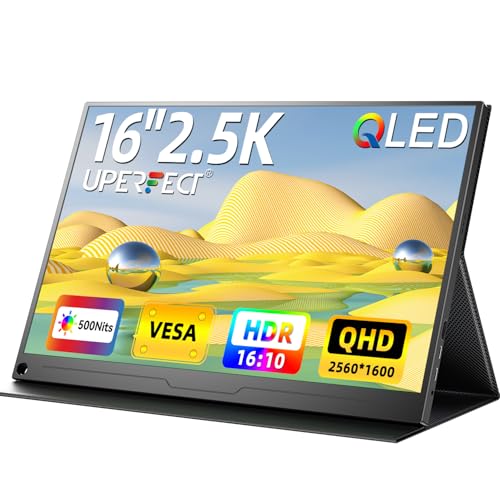
TL;DR: The Uperfect 160T01 16‑inch portable monitor packs a 240 Hz refresh rate, 2.5K QHD resolution, full DCI‑P3 color and 500 nits brightness into a 1.5‑lb, VESA‑mountable frame for $109.99.
The headline feature is the 240 Hz refresh rate combined with a 2560 × 1600 pixel QHD panel. At just 0.5 inches thick and 0.51 inches deep, the screen delivers ultra‑smooth motion and crisp detail without bulking up your bag. Its QLED panel reaches 500 nits (manufacturer‑claimed) and covers 100 % of the DCI‑P3 color space, so HDR content looks vibrant even in well‑lit rooms.
Compared with the other 13 monitors in this roundup, the Uperfect is notably lighter than the Acer PM161Q (2.4 lb) and the Lepow 15.6‑inch (1.76 lb), and its 0.5‑inch thickness undercuts Acer’s 0.4‑inch panel thickness while still being slimmer than many competitors’ bulkier designs. Its 240 Hz refresh rate dwarfs the 60 Hz panels found in the ViewSonic VA1653, Asus ZenScreen MB169CK and Flytocca N3, and its brightness outshines the 300–320 cd/m² range of the Lepow and the 250 cd/m² of the ViewSonic. While the price sits above budget options like the Lepow, it’s well below premium‑tier models such as the Lenovo L15.
Users repeatedly praise the “crisp visuals” and “buttery‑smooth gameplay,” especially when paired with a high‑end GPU. Reviewers highlight the adaptive‑sync support and HDMI 2.1 input as solid gaming conveniences. The monitor includes two full‑featured USB‑C ports that handle power, video and data over a single cable, plus a Mini HDMI 2.1 port, making it easy to connect laptops, consoles or handheld PCs. A VESA‑mount pattern (75 × 75 mm) adds desk‑side flexibility, while the built‑in 1 W stereo speakers provide basic audio without needing external speakers.
Pros
Cons
Best for: Competitive gamers and creative professionals who need high refresh rates, QHD resolution and accurate color in a portable package.
Avoid if: You have a tight budget, lack a high‑performance GPU, or need a self‑contained, battery‑powered monitor.
TL;DR: The Flytocca N3 packs a 16‑inch 1920 × 1200 IPS panel with full sRGB, 300 nits brightness, and a 360° detachable stand, all for $74.96 and just 1.46 lb of weight.
The standout feature is its 16‑inch matte IPS display that delivers 1920 × 1200 resolution, 100% sRGB coverage, 300 nits brightness, a 2 ms response time and a 60 Hz refresh rate, all in a 0.59‑in (15 mm) thick chassis. At 1.46 lb (662 g) it’s genuinely portable, and the 360° rotating stand lets you flip between landscape and portrait without a desk.
Compared with other monitors in this roundup, the N3 is lighter than the Uperfect MDS‑15608 (about 2 lb) and a shade lighter than the ViewSonic VA1653 (1.5 lb). Its 300 nits brightness outshines the Uperfect’s 220 nits and the ViewSonic’s 250 nits, while the 100% sRGB gamut beats the Uperfect’s 72% sRGB and ViewSonic’s 64% sRGB. The 2 ms response time is also far quicker than the Uperfect’s 30 ms, giving smoother motion on the same 60 Hz refresh rate.
Users repeatedly praise the crisp, vibrant image and the ultra‑slim, zero‑frame design that fits easily into a backpack. Professional reviewers highlight the excellent color accuracy and the flexibility of the detachable stand. The most common complaints focus on the built‑in speakers, which users describe as low‑volume despite the 180 W peak claim, and on occasional flickering when the monitor is powered solely via USB‑C, indicating a need for a stable power source.
Additional technical details include a 16:10 aspect ratio, matte anti‑glare coating, 178° horizontal and vertical viewing angles, and a full suite of connectivity: USB‑C (DisplayPort Alt Mode and Power Delivery), mini‑HDMI, a USB‑A port, a 3.5 mm headphone jack, and a premium smart cover that doubles as a stand. Plug‑and‑play operation requires no drivers, making it a hassle‑free addition to any laptop or tablet setup.
Pros
Cons
Best for: Entry-level buyers or those on a tight budget
Avoid if: You want the best value‑per‑dollar in its price range
TL;DR: The Uperfect U27 packs a 3840 × 2400 IPS panel, 500 nits brightness and dual speakers into a 14.5‑inch, 2.65‑lb body, ideal for creators who value color accuracy and portability.
The standout spec is its 3840 × 2400 pixel resolution on a 14.5‑inch screen, yielding roughly 298 PPI and crisp text for design work or photo editing. Combined with 100% sRGB coverage, 1.06 billion colors and a matte IPS panel, professional reviewers praise the display’s color fidelity.
At 2.645547144 pounds, the U27 is lighter than the Lenovo L15’s 4.75 pounds but heavier than the Lepow 15.6‑inch (1.76 pounds) and ViewSonic VA1653 (1.5 pounds). Its 500 nits brightness outshines the Lenovo’s 250 nits and ViewSonic’s 250 cd/m², though it falls short of the Uperfect 16006DD’s 1200 nits. The monitor’s single Mini HDMI port and two full‑featured USB‑C ports give you video, data and power, but you won’t find a full‑size HDMI or DisplayPort like some competitors provide.
User feedback repeatedly highlights the razor‑sharp QUXGA display and the convenience of the magnetic smart cover, which also houses the built‑in dual speakers. Reviewers note the flicker‑free and low‑blue‑light eye‑care tech as a plus for long sessions. The main complaints focus on the lack of an internal battery, the modest 60 Hz refresh rate for fast‑moving content, and the limited port variety.
Pros
Cons
Best for: Buyers willing to invest in a proven, high‑quality option
Avoid if: You're on a tight budget, need a built‑in battery, or require high refresh rates for competitive gaming
“Incredibly sharp display—perfect for coding and photo editing.”
“Smart cover is genius—protects the screen and holds it at a great angle.”
TL;DR: The Uperfect 16006DD 16‑inch portable monitor packs a 4K 3840 × 2400 matte IPS panel with 1200 nits brightness, but its 4.4‑lb weight makes it less feather‑light than many rivals.
The standout feature is the 1200 nits peak brightness combined with a 3840 × 2400 resolution on a 16‑inch matte IPS screen that covers 100% of the sRGB color gamut. Professional reviewers highlight the “excellent glare reduction” and the crisp, detail‑rich image that makes photo and video work feel native.
Compared with the other 13 monitors in this roundup, the Uperfect 16006DD is noticeably heavier than the sub‑2‑lb Uperfect 160T01 and the 1.76‑lb Lepow 15.6‑inch, but its brightness far outshines the 500‑nit Uperfect U27 and the 250‑nit Lenovo L15. The 60 Hz refresh rate matches most budget‑oriented options, though it lags behind the higher‑refresh models that some gamers prefer.
Customers rave about the vivid 4K image and the ability to work outdoors thanks to the high brightness. The single USB‑C port that carries video and power delivery receives praise for its simplicity, and the included PU‑leather smart cover doubles as a stand. On the flip side, reviewers repeatedly call the cover “flimsy,” note the monitor’s heft for a “portable” device, and mention occasional USB‑C port reliability issues.
Additional technical context includes a 1 ms response time, FreeSync support, HDR capability, and a recyclable aluminum alloy body that feels solid on the go. The monitor also supports a 75 × 75 mm VESA mount, giving you flexibility to attach it to a desk arm or wall bracket. A 2‑year warranty rounds out the package.
Pros
Cons
Best for: Buyers willing to invest in a proven, high‑quality option
Avoid if: You're on a tight budget or only need basic functionality
“4K image is stunning—perfect for editing and gaming.”
“Bright enough to use outside—game-changer for remote work.”
TL;DR: The Lenovo L15 is a 15.6‑inch Full HD IPS portable monitor that weighs 860 g, offers a single‑cable USB‑C connection, and delivers solid color accuracy at a premium $149.99 price.
The standout spec is its 15.6‑inch IPS panel with a 1920 × 1080 resolution and 141 PPI pixel density, paired with an anti‑glare surface and a tilt range of up to 90°. It runs on a single 1 m USB‑C cable that supplies both power (up to 9.5 W max) and video, so you don’t need an external adapter. The monitor’s height‑adjustable stand adds ergonomic flexibility for laptop desks or bedside tables.
Compared with the other 13 monitors in this roundup, the L15 is heavier at 4.75 pounds (860 g) than ultra‑light rivals such as the Uperfect 160T01 or ViewSonic VA1653, which sit around 1.5 pounds. Its 250 nits brightness is also lower than the 500 nits delivered by the Uperfect U27 and 160T01, though it matches the 250 cd/m² of the ViewSonic model. The L15 lacks built‑in speakers, a feature present on the Uperfect U27, while many competitors include mini‑HDMI ports that the L15 omits. On the upside, its USB‑C power‑delivery and full‑function video port offer more versatility than the power‑only USB‑C input on the ViewSonic VA1653.
Users consistently praise the monitor’s lightweight feel and the “dream” of a single‑cable setup for MacBook or modern Windows laptops. Professional reviewers highlight the smooth USB‑C integration and the stability of the height‑adjustable stand. However, several owners note that the 250 nits brightness can feel dim in bright cafés, and the absence of speakers means you’ll need headphones or external audio. The 60 Hz refresh rate and 6 ms extreme response time serve productivity and casual gaming, but they fall short for competitive gamers.
Pros
Cons
Best for: Those prioritizing quality and willing to pay for premium performance
Avoid if: You're shopping on a tight budget — it's priced at $149.99
TL;DR: At $61.96, the Uperfect MDS‑15608 delivers a 15.6‑inch Full HD IPS screen with HDR10, FreeSync and plug‑and‑play USB‑C in a lightweight 1.99‑lb package, though its 220‑nit brightness and 60 Hz refresh limit bright‑room use and gaming.
The monitor’s standout spec is its 15.6‑inch IPS panel that supports HDR10 and AMD FreeSync while running at a 60 Hz refresh rate and a 30 ms response time. At 220 nits brightness and 72 % sRGB coverage, it offers decent color for everyday tasks, and the 141.21 PPI pixel density keeps text crisp.
Compared with the other 13 entries, the Uperfect is lighter than the Vilva V156F1’s 3.84‑lb chassis but a touch heavier than the Ufyql 15.6‑inch Portable Monitor’s 1.41‑lb build. Its 220‑nit brightness falls short of Vilva’s and Flytocca N3’s 300‑nit panels, though most peers offer a 60 Hz refresh rate. The dual 1 W speakers sound modest compared with Flytocca’s higher‑output audio claim.
User feedback highlights the convenience of a single USB‑C cable that supplies both power and video, so it’s a popular remote‑work companion. Reviewers appreciate the matte anti‑glare finish and the smart PU‑leather cover that doubles as a stand. Common complaints focus on the low brightness in sunny cafés and the quiet built‑in speakers, which many say are insufficient for multimedia without headphones.
Technically, the screen delivers a native 1920 × 1080 resolution with a 0.18 mm pixel pitch and 178° viewing angles, while low blue‑light and flicker‑free eye‑care features reduce strain during long sessions. The device is driver‑free, supports plug‑and‑play operation, and includes a 75 × 75 mm VESA mount for added flexibility.
Pros
Cons
Best for: Budget-conscious buyers seeking a reliable entry-level option
Avoid if: You need advanced features or professional‑grade performance
“Perfect second screen for remote work”
“Easy setup with USB‑C”
TL;DR: The Acer PM161Q offers a 15.6‑inch Full HD IPS screen, dual USB‑C ports, and a magnetic cover stand for $99.99, but its modest 220‑nit brightness and limited color gamut keep it in the mid‑range.
It houses a 15.6‑inch IPS panel (1920 × 1080) in a slim 0.4‑in panel thickness and a 0.5‑in depth when the magnetic cover folds into a stand. At 2.4 pounds it feels solid yet portable, and the cover doubles as a stand for quick setup. Connectivity centers on two USB‑C ports that support DP Alt Mode, 5 Gbps data speed and 15 W Power Delivery, plus a Mini HDMI port for legacy sources.
Among the 14 monitors under 18 inches, the PM161Q is heavier than the 1.5‑pound ViewSonic, the 1.76‑pound Lepow, the 1.50‑pound Uperfect, the 1.46‑pound Flytocca, and the 1.99‑pound Uperfect MDS, and only a shade lighter than the 2.12‑pound Asus. Its real‑world brightness peaks at 220 nits, which is dimmer than Lepow’s 300–320 nits, Flytocca’s 300 nits, and Uperfect’s 400–500 nits, but matches the 220 nits reported for the Uperfect MDS. The dual full‑function USB‑C ports give it an edge over ViewSonic, whose ports are split between power‑only and video/power.
User feedback praises the plug‑and‑play simplicity of a single‑cable USB‑C connection and the convenience of the magnetic cover‑stand, especially for remote workers and students. Professional reviewers highlight the crisp IPS panel and flexible connectivity, yet note that the 170–220 nits brightness falls short of the advertised 250 nits, leading to washed‑out images in bright rooms. The ~65% sRGB coverage and HDR10 badge, which is tone‑mapped to SDR, limit its appeal for color‑critical work.
Technically, the monitor delivers a 60 Hz refresh rate and a 4 ms (G‑to‑G) response time, backed by a 1000:1 contrast ratio and 178° viewing angles. It includes two 1 W built‑in speakers for basic audio, and its power draw stays under 12 W in normal operation, dropping below 1 W in power‑save mode. Acer backs the unit with a three‑year parts‑and‑labor warranty, and the 4.4‑star rating from 816 reviewers reflects generally satisfied owners.
Pros
Cons
Best for: Most users looking for a well‑reviewed, reliable mainstream option
Avoid if: You need advanced features or professional‑grade performance
TL;DR: The UFYQL 15.6‑inch portable monitor packs a Full HD IPS screen, HDR support, and a feather‑light 1.41 lb, 13.2 mm‑thin design for on‑the‑go use, though its 250‑300 nits brightness may limit outdoor visibility.
The monitor’s standout dimension is its ultra‑slim 13.2 mm thickness combined with a lightweight 1.41 lb (640 g) chassis, making it easy to slip into a backpack. It delivers a 15.6‑inch Full HD IPS panel with HDR capability, a 178° viewing angle, and a response time of 5 ms at a 60 Hz refresh rate. Brightness ranges from 250 to 300 nits, and the contrast ratio sits at 1200:1.
Compared with the other 13 entries in this roundup, the UFYQL is considerably lighter than the Vilva V156F1 (over 3.8 lb) and the Asus ZenScreen (about 2.1 lb), while only a shade heavier than the AOC 16T20 (1.54 lb) and Flytocca N3 (1.46 lb). Its 13.2 mm depth is a touch thicker than the Asus ZenScreen’s 12 mm profile but still slimmer than many bulkier models. Brightness peaks at the same 300 nits that the Vilva lists, yet several peers push higher numbers, which explains why reviewers note the screen can feel dim in bright rooms.
User feedback repeatedly praises the monitor’s sharp, colorful picture and the convenience of plug‑and‑play setup via its dual USB‑C ports and a Mini‑HDMI input. Professionals highlight the HDR support and the wide viewing angles as strong points for collaborative work. On the downside, customers mention that the built‑in stereo speakers sound tinny, the brightness struggles under strong ambient light, and the kickstand can feel a bit flimsy at steep angles. Some also report occasional USB‑C signal drops, which expert reviewers note as “connectivity issues.”
Beyond the display, the UFYQL includes a 3.5 mm headphone jack, stereo built‑in speakers, and full‑featured USB‑C ports that provide both power delivery and data. It operates without an internal battery, drawing power directly from the host device, and comes with a one‑year manufacturer warranty. The IPS panel’s 1920 × 1080 resolution, together with HDR, delivers vivid colors that many users describe as “sharp and colorful,” making it a solid companion for remote work, travel, or casual gaming.
Pros
Cons
Best for: Budget-conscious buyers seeking a reliable entry-level option
Avoid if: You need advanced features or professional‑grade performance
TL;DR: The Uperfect M180K01 delivers a bright 18‑inch 2K IPS panel with 144 Hz refresh, excellent color coverage and solid build quality for $249.99, but its weight and price put it above many ultra‑light alternatives.
This monitor’s standout spec is its 18‑inch 2560 × 1600 IPS display, offering a 16:10 aspect ratio and 100 % DCI‑P3 as well as 100 % sRGB coverage. A 400‑nit brightness (up to 500 nits observed) pairs with a fast 3 ms response time, while the USB‑C connection can push a 144 Hz refresh rate (120 Hz via Mini HDMI). At 2.425084882 pounds, it feels solid without being overly bulky.
Compared with the other 13 monitors in this roundup, the M180K01's the largest screen – most peers sit at 16 inches or less. Its 144 Hz refresh outpaces the 60 Hz limits of the Uperfect 16006DD, Lenovo L15 and several others, making it the most gaming‑focused option. Brightness sits below the 1200‑nit peak of the 16006DD but matches the 500‑nit levels of the Uperfect U27 and 160T01. Weight‑wise, it's lighter than the 4.4‑pound Uperfect 16006DD and the 4.75‑pound Lenovo L15, yet heavier than the 1.76‑pound Lepow and the 1.50‑pound Uperfect 160T01, so it sits in the mid‑range of portability.
User reviews repeatedly praise the crisp 2K image and buttery‑smooth 144 Hz gameplay, especially when paired with handheld consoles or MacBooks. Professional reviewers echo this sentiment, noting the “outstanding display performance” and “excellent image quality.” However, many owners report that brightness drops to the minimum after the monitor sleeps or is unplugged, and the side‑dial OSD can feel fiddly. The built‑in dual speakers are weak, which aligns with the “underpowered built‑in speakers” comment from experts.
Beyond the screen, the M180K01 includes eye‑care features like flicker‑free technology and low blue‑light mode, plus AMD FreeSync for smoother frame pacing. The rotatable panel supports portrait and landscape orientations, and a 75 × 75 mm VESA mount adds desk‑mount flexibility. A supplied 30 W PD charger handles power delivery, letting you run the monitor directly from a laptop without an extra brick.
Pros
Cons
Best for: Buyers willing to invest in a proven, high‑quality option
Avoid if: You're shopping on a tight budget — it's priced at $249.99
“Perfect second screen for my MacBook Pro – matches the aspect ratio exactly.”
“Gaming on my ROG Ally is so much better with this 144 Hz screen.”
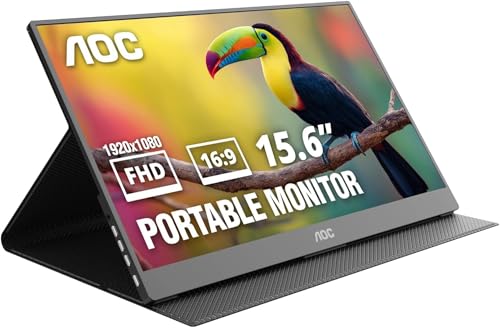
TL;DR: At $49.99 and a 4.3‑star rating from 349 reviewers, the AOC 16T20 offers a cheap, portable screen that users love for its easy setup but criticize for weak audio and missing accessories.
AOC is a well‑known monitor maker, and the 16T20 lands at the low‑price end of this portable‑monitor roundup. Priced at $49.99 and backed by a 4.3‑star rating from 349 reviews, it sits toward the bottom of the overall scores.
Reviewers consistently praise its lightweight feel, plug‑and‑play connectivity and the handy Smart Cover that doubles as a stand. Reviewers describe the Full HD IPS panel as sharp, making it useful for work, study or casual gaming. Common complaints focus on the weak built‑in speakers, the absence of a power adapter and HDMI cable in the box, limited brightness in bright rooms, a glossy surface that can reflect light, and occasional hiccups with certain laptops.
Based purely on price and rating, the AOC 16T20 positions itself as a budget‑friendly entry for anyone needing a second screen without breaking the bank. It works best for users who can tolerate a few trade‑offs in audio and accessories in exchange for affordability and portability.
Pros
Cons
Best for: Entry-level buyers or those on a tight budget
“Excellent portability”
“The speakers are weak, I need headphones for any decent audio”
TL;DR: The Lepow 15.6‑inch portable monitor delivers a full‑HD IPS panel with 100% sRGB, HDR, and dual USB‑C ports in an ultra‑slim, 1.76‑lb package, making it a solid mid‑range choice for on‑the‑go work and play.
What sets this monitor apart is its ultra‑thin chassis—listing its thickness at 0.13 in to 0.30 in—while weighing just 1.76 lb. The 15.6‑inch IPS screen offers a 1920 × 1080 resolution, 300–320 cd/m² brightness, 1000:1 contrast, and a 178° viewing angle. Color coverage spans 100% sRGB, 90% AdobeRGB, and 85% NTSC, and the panel supports HDR mode at a 60 Hz refresh rate.
Compared with other models in this roundup, the Lepow is a bit heavier than the ViewSonic VA1653 (1.5 lb) and the Flytocca N3 (1.46 lb), but lighter than the Asus ZenScreen MB169CK (around 2.12 lb) and the Acer PM161Q (2.4 lb). Its brightness of up to 320 cd/m² outshines ViewSonic’s 250 cd/m² and matches Flytocca’s 300 nits, while the Uperfect 160T01 pushes higher at 500 nits. In color gamut terms, Lepow’s 90% AdobeRGB and 100% sRGB coverage far exceeds ViewSonic’s 45% NTSC and 64% sRGB figures. Connectivity matches peers, offering dual full‑function USB‑C ports, a Mini HDMI input, and a 3.5 mm headphone jack—similar to the dual‑USB‑C setups on Asus and Acer.
Reviewers consistently praise the monitor’s portability and the magnetic smart‑cover that doubles as an adjustable stand for portrait or landscape use. Professional reviewers highlight the vibrant IPS panel and the convenience of plug‑and‑play via USB‑C. On the downside, users note that the built‑in speakers (two 1 W drivers) are weak, the included screen protector is low quality and prone to damage, and the lack of an internal battery means the display must stay tethered to power.
Pros
Cons
Best for: Remote workers, students, frequent travelers, and gamers who need a lightweight secondary display.
Avoid if: You require a built‑in battery, powerful built‑in audio, or the highest possible brightness.
“Perfect second screen for my MacBook”
“Great for gaming on the Switch”
Breakdown
Asus ZenScreen MB169CK
Pros
ViewSonic VA1653
Pros
Vilva V156F1
Pros
Uperfect 160T01 16-inch
Pros
Based on scoring data and product specs
Personalized picks
Best Overall Pick
Asus ZenScreen MB169CK
Best Mid-Range PickBest for: Most users looking for a well-reviewed, reliable mainstream option
ViewSonic VA1653
Best for: Most users looking for a well-reviewed, reliable mainstream option
$79.99+$0.99 vs winner
Skip Lepow 15.6-inch if…
Reliability and user satisfaction are your top concerns
The Asus ZenScreen MB169CK wins the Best Portable Monitor title. It ships for $89.00, carries a 4.4‑star rating from 2,717 reviewers, and stays light at 2.1164377152 pounds. Its 15.6‑inch IPS panel delivers 250 cd/m² brightness, and the dual USB‑C ports with DisplayPort Alt Mode let you power and drive the screen from a single cable. Add the 360° detachable kickstand and TÜV‑Rheinland eye‑care certification, and you’ll get a well‑rounded, travel‑ready display.
The ViewSonic VA1653 takes the runner‑up spot, especially if you need a built‑in stand and portrait orientation for coding or reading on the go. Priced at $89.99, it offers a foldable stand that tilts 63° backward and 30° forward, plus 0.8 W built‑in speakers for casual media. Its USB‑C port provides 15 W Power Delivery while handling video over DisplayPort Alt Mode, making a single‑cable setup effortless.
For tighter budgets, the Vilva V156F1 at $49.99 gives you a solid 15.6‑inch IPS screen without breaking the bank. If you prefer a larger, premium experience, the Uperfect M180K01 at $249.99 delivers an 18‑inch display and higher‑end build quality for users who want extra screen real‑estate.
Pick the Asus ZenScreen MB169CK today and you’ll get a well‑rounded portable monitor without overpaying.
Monitors with a higher brightness rating handle sunlight better; the Vilva V156F1 and Flytocca N3 both list 300 nits, which is higher than the 250 cd/m² of the Asus ZenScreen and ViewSonic VA1653. If you need extra visibility outdoors, choosing one of the 300‑nit models will give you a clearer view.
Please sign in to leave a review
No reviews yet. Be the first to review!
