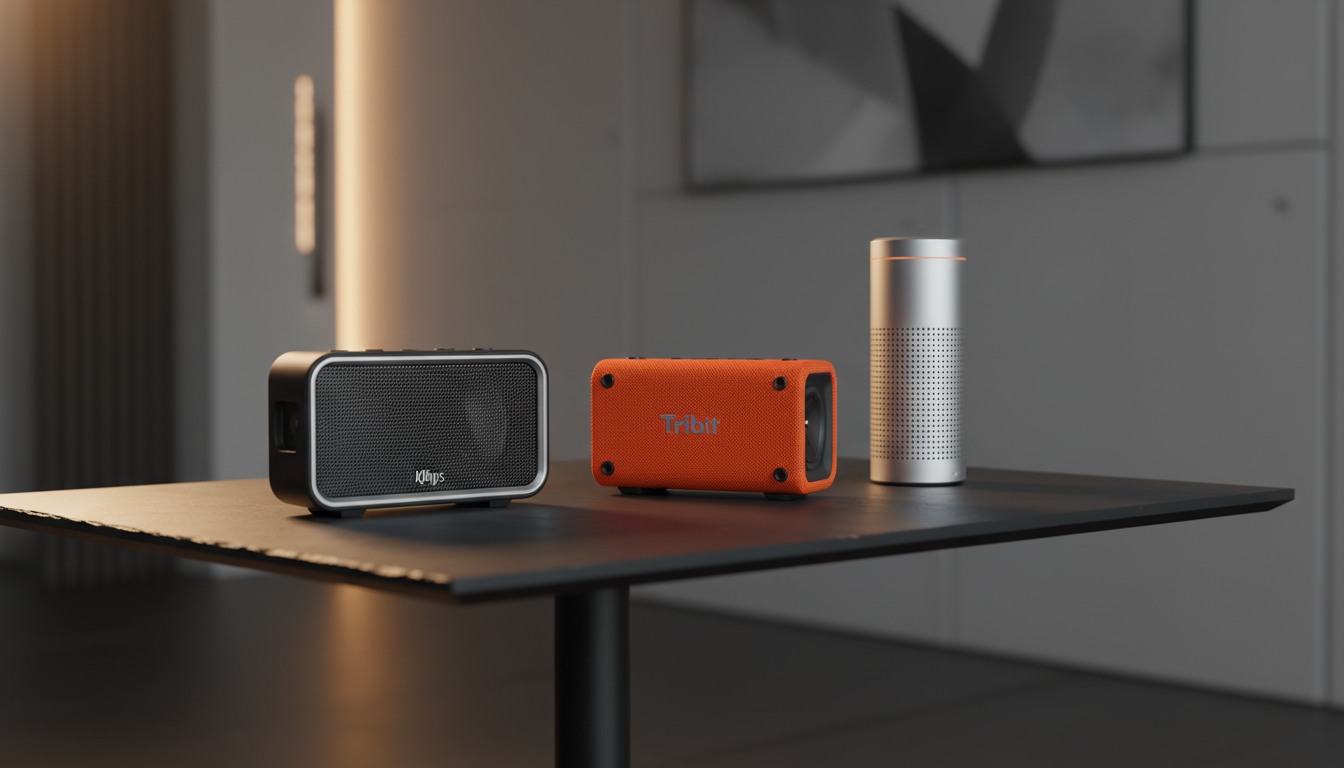
⚡ Quick Answer
From the $29.99 Altec Lansing HydraMotion up to the $329.00 Bose SoundLink Revolve+, we compared 10 portable speakers that promise 360° omnidirectional sound. All models carry solid user ratings of at least 4.3/5, with the Klipsch Nashville and Bose Revolve+ both earning 4.6/5. Battery life spans a wide range—from 12 hours on the Tribit StormBox Mini+ to over 32 hours on the Marshall Emberton III—so you can match endurance to your outing.
We split the lineup into four budget options (Altec Lansing HydraMotion, Tribit StormBox Mini+, Tribit StormBox 2, Ultimate Ears WONDERBOOM 4), two mid‑range picks (Klipsch Nashville, Ultimate Ears Boom 4), and four premium models (Marshall Emberton III, Ultimate Ears EVERBOOM, Ultimate Ears MEGABOOM 4, Bose SoundLink Revolve+). Each speaker brings its own blend of driver size, Bluetooth range and durability, letting you prioritize price, portability or power.
Below you’ll find a quick look at each speaker’s strengths so you can decide which one fits your listening lifestyle.

Klipsch Nashville
It's 2.25 in driver delivers strong mids for mainstream listening, underpinning its value and reliability.

Bose SoundLink Revolve+
Ideal for audiophiles willing to spend extra for premium sound; at $329 it costs about $211 more than the Klipsch Nashville.

Tribit StormBox 2
Offers a compact 48 mm driver and 40 W output, delivering solid volume at a lower $79.85 price, a distinct budget-friendly alternative.
Also considered
Score Analysis
Key score advantages vs. runner-up (Bose SoundLink Revolve+)
Price Range
Klipsch Nashville
$117.99
Bose SoundLink Revolve+
$329.00
Tribit StormBox 2
$79.99

Tribit StormBox Mini+
$39.99
Altec Lansing HydraMotion
$35.69

Ultimate Ears WONDERBOOM 4 Blue
$69.99

Marshall Emberton III
$158.99

Ultimate Ears Boom 4 Blue
$124.99

Ultimate Ears EVERBOOM Charcoal Black
$157.99

Ultimate Ears MEGABOOM 4 Blue
$167.00
Spec Comparison
TL;DR: The Klipsch Nashville delivers 360° sound with a 57 mm driver, IP67 durability, and a 24‑hour battery, earning a 4.6‑star rating for solid, portable performance.
What really sets the Nashville apart is its 360° audio dispersion paired with dual 57 mm full‑range drivers and dual passive radiators measuring 96.8 mm × 63.5 mm. The sealed IP67 rating means it can survive dust and submersion to 1 m for 30 minutes, while the 20 W amplifier pushes enough power for room‑filling sound in a handheld package that weighs just 1.76 lb (800 g). A 24‑hour battery life means you can keep the party going from sunrise to sunset without hunting for an outlet.
Compared with the nine other speakers in this roundup, the Nashville lands in the middle of the pack on size and weight. It’s heavier than the Marshall Emberton III (1.48 lb) and the Tribit StormBox Mini+ (1.20 lb), but lighter than the Ultimate Ears EVERBOOM (3.13 lb) and MEGABOOM 4 (2.65 lb). Its 24‑hour battery matches the Tribit StormBox 2’s 1440‑minute runtime and outlasts the Ultimate Ears Boom 4 (15 h) and Wonderboom 4 (14 h). However, its Bluetooth range of 12.2 m is shorter than the Boom 4’s 45 m and the EVERBOOM’s 55 m, so you’ll stay a bit closer to the source than with those models.
Everyday users praise the Nashville’s “sound quality” and “powerful bass” that fills a small room even at moderate volume. Professional reviewers note the punchy, rich tone and the wide 360° soundstage that works best when listeners sit about 3 feet away. The same reviewers warn that the bass and mids start to distort once you crank the volume past roughly 50‑60 % of maximum, a limitation echoed by consumer complaints. The speaker also lacks on‑device playback controls or wired inputs, which some users find inconvenient.
Beyond the core specs, the Nashville supports stereo pairing and a Broadcast Mode that can sync up to ten units for a larger sound field. The built‑in microphone and Klipsch Connect app let you manage EQ settings, including a +6 dB bass boost, while the reverse‑charging port can output 10 W to charge other devices—handy for a day at the beach.
Pros
Cons
Best for: Most users looking for a well‑reviewed, reliable mainstream option
Avoid if: You need advanced features or professional‑grade performance
TL;DR: The Bose SoundLink Revolve+ offers 360° sound, up to 17 hours of playback and an IP55‑rated, 2‑lb body, but its $329 price puts it at the premium end of portable speakers.
What really sets the Revolve+ apart is its omnidirectional acoustic design that combines a full‑range transducer, dual passive radiators and an acoustic deflector, delivering a 360° soundstage. Bose lists a maximum SPL of 87.0 dB, with 3.44 dB of dynamic‑range compression at that level, and the unit weighs 2.0 lb while providing up to 17 hours of battery life on a single charge.
Compared with the other nine speakers in this roundup, the Revolve+ sits in the middle of the weight spectrum: it’s lighter than the Ultimate Ears MEGABOOM 4 at 2.65 lb and the Ultimate Ears EVERBOOM at 3.13 lb, yet heavier than the Tribit StormBox Mini+ at 1.20 lb and the Marshall Emberton III at 1.48 lb. Its Bluetooth range of 9 m is shorter than the 45 m range of the MEGABOOM 4 and the 55 m range of the EVERBOOM, but it still meets the typical room‑scale needs. In terms of durability, the Revolve+ carries an IP55 rating, while the Klipsch Nashville also offers water resistance but at a lower depth rating.
Reviewers consistently praise the sturdy aluminum grille, fabric handle and the ability to fill a space with even sound, noting that the built‑in microphone with echo reduction works well for calls. Professional outlets highlight the smooth Bose Connect app, Party Mode and Stereo Mode as convenient features. However, users also report that pushing the speaker to its 87 dB SPL ceiling introduces audible distortion, and users see the reliance on a Micro‑USB charging port as a drawback compared with newer USB‑C options.
Pros
Cons
Best for: Buyers willing to invest in a proven, high-quality option
Avoid if: You're shopping on a tight budget — it's priced at $329.00
TL;DR: The Tribit StormBox 2 packs a 40 W 360° soundstage, 24 hours of playtime, and IP67 durability into a compact 580 g cylinder for under $80.
The standout spec is its 40 W output paired with a 48 mm driver, delivering full‑range, omnidirectional audio that fills a backyard or patio. It runs on a 5000 mAh battery, which the manufacturer lists as 1440 minutes of play – that’s roughly 24 hours on a single charge – and it recharges in 420 minutes. At 180 mm tall and 69 mm square, the cylindrical shape stays portable while still offering IP67 waterproof protection.
In the context of the ten‑speaker roundup, the StormBox 2 sits in the middle of the weight spectrum. It’s heavier than the Ultimate Ears WONDERBOOM 4 (420 g) and the Tribit StormBox Mini+ (545 g), but lighter than the Ultimate Ears Boom 4 (≈797 g) and the Marshall Emberton III (673 g). Compared with the bulkier Klipsch Nashville (≈800 g) and the much larger Ultimate Ears MEGABOOM 4 (≈1202 g), it feels relatively easy to carry in a backpack.
Consumer feedback repeatedly praises the long battery life and the convenience of the built‑in power‑bank function, which lets you charge phones while the speaker keeps playing. Reviewers also note the pronounced low‑end punch from Tribit’s XBass technology, especially impressive for a speaker of this size. The most common complaints focus on the 580 g weight, which some find a bit hefty for pocket‑sized use, and the Bluetooth 5.0 version, which older rivals have upgraded to 5.4 implementations. Additionally, users miss an auxiliary input for wired sources.
Beyond the raw specs, the StormBox 2 supports multi‑device pairing for two sources, RunStretch technology for seamless Bluetooth reconnection, and true‑wireless stereo (TWS) pairing, letting you double the soundstage with another unit. The 2.1‑channel configuration with a dedicated woofer helps deliver that 360° sound field that reviewers describe as “room‑filling” without sacrificing clarity.
Pros
Cons
Best for: Budget-conscious buyers seeking a reliable entry-level option
Avoid if: You want the best value‑per‑dollar in its price range
“fits in a backpack”
“surprising bass from small woofers”
TL;DR: The Tribit StormBox Mini+ packs a 12 W output, dual 48 mm drivers and IPX7 water resistance into a 1.20‑lb speaker that runs up to 12 hours on a single charge.
What really stands out is that two 48 mm drivers deliver 12 W of power with 360° omnidirectional sound, all while staying under 1.20 pounds. The IPX7 rating means you can toss it in a pool or shower without worry, and the built‑in passive radiator helps smooth out low‑frequency response despite the compact size.
Compared with the other nine speakers in this roundup, the Mini+ is lighter than the Altec Lansing HydraMotion (1.23 lb) and the Tribit StormBox 2 (1.28 lb), yet it shares the same 12 W output as HydraMotion while falling short of StormBox 2’s 40 W. Its 30‑meter Bluetooth range sits close to HydraMotion’s 100‑ft range and is a bit shorter than the 40 m range of the Ultimate Ears WONDERBOOM 4, which also weighs less (420 g). Battery life at 12 hours matches HydraMotion’s lower‑end estimate and trails the WONDERBOOM 4’s 14‑hour claim, but it still outlasts many larger models that list shorter runtimes.
User feedback repeatedly praises the Mini+ for its lightweight portability and dependable all‑day battery life, especially for hikes and beach trips. Reviewers note the sound is clear and dynamic for the price, though several mention the bass feels modest and the rear‑panel buttons sit in a spot that's hard to reach without looking. Professional reviewers echo the “clear, dynamic stereo sound” and highlight the inclusion of a custom EQ via the app, as well as the 2+1‑band DRC and passive radiator that aim to boost low‑frequency detail.
Pros
Cons
Best for: Entry-level buyers or those on a tight budget
Avoid if: You need powerful performance or professional‑grade features
“fits in a backpack”
“surprising bass from small woofers”
TL;DR: The Altec Lansing HydraMotion delivers 360° sound, IP67 ruggedness and up to 16 hours of play for $29.99, making it a compact, budget‑friendly outdoor speaker.
What really sets the HydraMotion apart is its 360‑degree sound system built around full‑range Neodymium drivers and a 12 W power output. Its 112 mm × 112 mm × 208 mm shell houses the speaker, which weighs 558 g (about 1.23 lb) and carries an IP67 rating, an antimicrobial coating that kills 99.9 % of bacteria, and a floatable design. The speaker also sports 11 built‑in LED light modes that pulse to the beat, a carabiner clip for easy attachment, and USB‑C quick charge.
At 558 g the HydraMotion sits between the 545 g Tribit StormBox Mini+ and the 580 g Tribit StormBox 2, making it lighter than the latter but a touch heavier than the former. Its 12‑16 hour battery life matches the Mini+ and exceeds many entry‑level options, though the Klipsch Nashville and Ultimate Ears WONDERBOOM 4 push out 24 and 14 hours respectively. Power‑wise, the HydraMotion’s 12 W output equals the Mini+ but is lower than the 40 W output of the StormBox 2.
Users consistently praise the speaker’s durability in harsh conditions—its IP67 seal, antimicrobial surface and floatability keep it alive on hikes, campsites or by the pool. The built‑in voice‑assistant button and True Wireless Pairing also earn nods from reviewers. On the downside, several owners note that the short feet can let the unit roll when placed horizontally, and the high‑frequency clarity isn’t as strong as some competitors, which may matter to audiophiles.
Technical extras include a USB‑C quick‑charge port, compatibility with Siri and Google Assistant, and the ability to pair two speakers for synchronized playback. Professional reviewers highlight the 100‑foot Bluetooth range (as listed) and the rugged “EverythingProof” build as key strengths for outdoor adventures.
Pros
Cons
Best for: Outdoor adventurers who need a rugged, waterproof speaker that’s easy to carry and offers solid battery life.
Avoid if: You prioritize a stationary desk setup or need exceptionally detailed high‑frequency performance.
“the speaker's vertical orientation, which easily fits into small spaces in a kitchen, contrasting it favorably with horizontal speakers that take up more room”
“when used horizontally, the short feet may cause the speaker to roll occasionally”
TL;DR: The Ultimate Ears WONDERBOOM 4 delivers 360° sound, IP67 durability and up to 14 hours of playtime in a feather‑light 420 g package for $79.99.
What really sets the WONDERBOOM 4 apart is its 40 mm active driver paired with a maximum SPL of 87 dB, delivering a loud, omnidirectional output of up to 87 dB for a speaker that measures just 203.2 mm tall and weighs 420 g. The IP67 rating means it’s dust‑proof, waterproof and even floatable, while the built‑in carry loop makes it easy to sling onto a backpack for hikes or beach trips.
Compared with the nine other speakers in this roundup, the WONDERBOOM 4 is lighter than the Tribit StormBox 2 (580 g) and far lighter than the Ultimate Ears Boom 4 (about 797 g). Its driver is smaller than the Tribit’s 48 mm unit, but the 40 m Bluetooth range matches the higher‑end models that list similar coverage. The 5 ft drop‑height rating puts it on par with the drop‑resistant claims of the Boom 4 while staying more compact than the bulkier Klipsch Nashville.
User feedback repeatedly praises the rugged design – the floatable body and drop resistance survive beach sand and campsite drops without a hiccup. Professional reviewers note the clean sound at maximum volume, though they also flag the limited bass depth and a dip around 9 kHz that can make treble feel recessed. Many consider the micro‑USB charging port a dated choice, but the 14‑hour battery life keeps the speaker running through a full day of outdoor activity.
Pros
Cons
Best for: Outdoor enthusiasts, beach‑goers, hikers, and casual listeners who need a lightweight, waterproof speaker with 360° sound.
Avoid if: You want the best value‑per‑dollar in its price range or need deep, powerful bass for large indoor spaces.
TL;DR: The Marshall Emberton III delivers 360° True Stereophonic sound, IP67 ruggedness and a marathon‑long 32+ hour battery in a compact, vintage‑styled package.
The standout spec is its 32+ hour battery life, letting you stream all day without hunting for a charger, while the 38+ W amplifier pushes enough power for clear, distortion‑free audio in any setting. At just 1.48 lb (673 g), it’s noticeably lighter than bulkier rivals such as the Ultimate Ears Boom 4 and Klipsch Nashville, yet still feels solid enough to survive a weekend adventure.
Compared with the nine other speakers in this roundup, the Emberton III sits in the middle of the size spectrum – taller than the ultra‑compact Wonderboom 4 but shorter than the larger Boom 4. Its weight advantage means it won’t weigh down a backpack as much as the heavier 800 g models, while still offering a more premium build than the lightest 420 g option.
Professional reviewers applaud the “True Stereophonic 360°” soundstage and the balanced, bass‑rich tone that feels larger than the speaker’s dimensions suggest. Users echo this sentiment, repeatedly noting the rich clarity and the rugged IP67 rating as ideal for poolside or campsite use. The only recurring gripe is the limited EQ selection – only three presets are available and there’s no custom‑EQ or voice‑assistant integration.
Pros
Cons
Best for: Buyers willing to invest in a proven, high‑quality option
Avoid if: You're on a tight budget or only need basic functionality
“competes head‑to‑head with the best.”
“the one to beat”
TL;DR: The Ultimate Ears Boom 4 delivers 360° sound, a 15‑hour battery, and 1.5 m drop protection in a waterproof, float‑ready package for $124.99.
The standout spec is its 1524 mm (1.5 m) drop‑resistance height, meaning the speaker can survive a fall from standing height onto most surfaces. Combined with an IPX7 rating and float capability, it serves beach trips, poolside hangouts, and rugged camping adventures. The built‑in hook adds a convenient way to hang it from a backpack strap or tree branch.
At about 1.76 lb, the Boom 4 is heavier than the Marshall Emberton III (≈1.48 lb) but roughly the same as the Klipsch Nashville (≈1.76 lb). It’s considerably lighter than the Ultimate Ears EVERBOOM (≈3.13 lb) and the MegaBoom 4 (≈2.65 lb), while still bulkier than the Tribit StormBox 2 (≈1.28 lb) and StormBox Mini+ (≈1.20 lb). Its Bluetooth range of 45 meters outpaces the Klipsch Nashville’s 12.2 m and matches the MegaBoom 4, giving you solid connectivity even when you’re spread out on a patio.
Reviewers consistently praise the 360° cylindrical design for filling a space with balanced audio, and professional reviewers highlight the durability of the IPX7 enclosure and the convenience of wireless charging. Users love the long‑lasting 15‑hour battery for day‑long outings, but several note that the maximum volume feels modest for larger gatherings and that the micro‑USB charging port can be fiddly to connect.
Pros
Cons
Best for: Most users looking for a well‑reviewed, reliable mainstream option
Avoid if: You have limited desk space or need portability
TL;DR: The Ultimate Ears EVERBOOM delivers 360° sound, up to 20 hours of playback and a 55 m Bluetooth range in a rugged, floatable design, but its premium $159.99 price and 3.13 lb weight may deter budget‑focused users.
What really stands out is the combination of two 56.6 mm full‑range transducers, two passive radiators and true 360° sound, all powered by a battery that lasts up to 20 hours. The speaker also reaches a Bluetooth range of up to 55 meters, letting you control music from across a backyard or campsite.
Compared with the other nine speakers in this roundup, the EVERBOOM is heavier than the Marshall Emberton III, the Boom 4 and the Tribit StormBox Mini+, yet lighter than the larger MEGABOOM 4. Its 20‑hour battery matches the top‑tier MEGABOOM 4 but falls short of the Emberton III’s 32+ hour claim. On connectivity, the EVERBOOM’s 55 m range exceeds the 45 m range listed for both the MEGABOOM 4 and the Boom 4, giving it an edge for outdoor setups.
Users consistently applaud the bass‑forward, “bombastic” sound and the floatable body that survives drops from 1 meter. Reviewers note the Outdoor Boost mode serves as a practical tool for open‑air listening, while professional outlets highlight the long battery life and NFC‑enabled quick pairing. On the downside, owners mention the 3.13 lb heft as a drawback for long hikes, and the emphasis on low‑frequency response can mask high‑frequency detail, which audiophile‑focused critics echo.
Beyond the core specs, the EVERBOOM includes a built‑in microphone for calls, NFC for instant pairing, and a carabiner clip that makes attaching the speaker to a backpack or bike effortless. The 5.0 in height and width keep the footprint compact, and the 7.0 in depth provides enough internal volume for its dual drivers and passive radiators.
Pros
Cons
Best for: Those prioritizing quality and willing to pay for premium performance
Avoid if: Reliability and user satisfaction are your top concerns
TL;DR: The Ultimate Ears MEGABOOM 4 delivers 360° sound with two 50.8 mm drivers, 20 hours of playtime and IPX7 waterproofing, but its 2.65 lb weight and premium price keep it out of the ultra‑light camp.
What really sets the MEGABOOM 4 apart is its dual 50.8 mm full‑range drivers paired with two 101.6 mm passive radiators, creating immersive 360° sound that fills a backyard or poolside gathering. The speaker also features a 20‑hour battery, a 45 m Bluetooth range and an IPX7 rating that lets you submerge it up to 1 m without worry.
Compared with the nine other speakers in this roundup, the MEGABOOM 4 sits at the higher end of the price scale and carries a heftier build than the Ultimate Ears Boom 4 (1.76 lb) while still being lighter than the Everboom (3.13 lb). Its Bluetooth reach matches the Boom 4’s 45 m but falls short of the Everboom’s 55 m range. Battery life aligns with the Everboom’s “up to 20 hours” claim, giving it one of the longest runtimes among the group.
Reviewers consistently praise the thundering bass and the speaker’s ability to float, noting that the 20‑hour battery keeps parties going all day. Professional outlets highlight the richer mids and balanced treble compared with earlier UE models. The main complaints revolve around the 2.65 lb weight, which makes it less convenient for backpack travel, and the lack of USB‑C charging, which some users find limiting.
Pros
Cons
Best for: Buyers willing to invest in a proven, high‑quality option
Avoid if: You need advanced features or professional‑grade performance
Breakdown
Klipsch Nashville
Pros
Bose SoundLink Revolve+
Pros
Cons
Tribit StormBox 2
Pros
Cons
Tribit StormBox Mini+
Pros
Based on scoring data and product specs
Personalized picks
Best Overall Pick
Klipsch Nashville
Best Mid-Range PickBest for: Most users looking for a well-reviewed, reliable mainstream option
Bose SoundLink Revolve+
Best for: Buyers willing to invest in a proven, high-quality option
$329.00+$211.01 vs winner
Skip Ultimate Ears MEGABOOM 4 Blue if…
You need advanced features or professional-grade performance
The Klipsch Nashville takes the top spot thanks to its true 360° audio dispersion, an impressive 24‑hour battery life, and an IP67 rating that lets you submerge it in up to 1 m of water for 30 minutes. At $117.99 it’s also offering 20 W of amplifier power while staying lightweight at 1.76 lb, and it pairs with up to eight devices via Bluetooth 5.3 (40 ft range). With a 4.6‑star rating from 769 reviewers, it delivers solid performance without breaking the bank.
The Bose SoundLink Revolve+ lands as the runner‑up, ideal if you need a premium, rugged speaker for outdoor gatherings where a built‑in flexible fabric handle and NFC quick‑pairing are valuable. It provides up to 17 hours of playback, an IP55 water‑resistance rating, and a sturdy aluminum grille, all for $329.00. Its 4.6‑star rating from 7,248 reviews underscores its popularity among party‑ready users.
For tighter budgets, the Altec Lansing HydraMotion shines at just $29.99, offering basic 360° sound at a pocket‑friendly price. If you’re after a high‑end option, the Ultimate Ears EVERBOOM Charcoal Black stands out at $159.99, delivering premium build quality and a louder, fuller soundstage for those willing to invest a bit more.
Choose the Klipsch Nashville for the best 360° portable speaker experience.
The Klipsch Nashville is listed with a 24‑hour battery life, while the Bose SoundLink Revolve+ offers up to 17 hours per charge. This gives the Klipsch a noticeably longer runtime for all‑day use.
No reviews yet — be the first to share your experience.
Please sign in to leave a review