If you need a simple, low‑power personal cloud, the QNAP TS‑133 1‑bay tops our list. At $159.00 it packs a 1.8 GHz quad‑core ARM Cortex‑A55 CPU, 2 GB DDR4 RAM and a 1 Gbps Ethernet port, and its 4.4‑star rating from 303 reviewers shows users appreciate its silent operation and AI‑enhanced photo management.
Our roundup of 9 QNAP devices spans three price tiers. The budget tier – TS‑133 ($159.00), TS‑216G ($269.00) and TS‑433 ($409.00) – delivers solid home‑office performance. Mid‑range models like the TS‑264 ($489.00) and TS‑932PX ($659.00) bring 2.5 GbE or 10 GbE networking and up to 16 GB RAM for small teams. Premium picks such as the TVS‑h874 i5 ($2199.00, 4.8‑star rating) and TVS‑h874 i7 ($2719.00) offer 8‑bay capacity, Intel i5/i7 CPUs, 32 GB RAM and PCIe Gen4 expansion for demanding creative workflows.
Below we break down each model’s strengths, note common user feedback like the TS‑433’s dual‑Ethernet advantage or the TS‑216G’s 2.5 GbE speed, and help you’ll match the right QNAP cloud storage solution to your workflow.

QNAP TS-133 1-bay
Operates from 0 °C up to 40 °C, which gives reliable performance across a wide temperature range.

QNAP TVS-h874 i5 8-bay
Designed for power users who demand premium performance, it costs $2,199—about $2,040 more than the $159 Best Overall model.

QNAP TS-216G 2-bay
Offers built‑in 4 GB flash memory for dual‑boot OS protection, a safeguard the other models don’t list.
Also considered
Score Analysis
Key score advantages vs. runner-up (QNAP TVS-h874 i5)
Price Range
QNAP TS-133 1-bay
$159.00
QNAP TVS-h874 i5 8-bay
$2,289.00
QNAP TS-216G 2-bay
$269.00

QNAP TS-264 2-bay
$489.00
QNAP TS-932PX 5+4-bay
$659.00

QNAP TVS-h874 i7 8-bay
$2,664.00

QNAP TS-AI642 6-bay AI
$734.99

QNAP TS-253E 2-bay
$559.00

QNAP TS-433 4-bay
$409.00
Spec Comparison
TL;DR: The QNAP TS‑133 packs a 1.8 GHz quad‑core ARM CPU, an AI NPU and 4 GB OS flash into a 157.6 mm‑deep, sub‑kilogram chassis for a quiet, low‑power personal cloud at $159.
The standout feature is the built‑in Neural Processing Unit that powers QuMagie’s AI‑enhanced photo management, delivering up to 6× faster face and object recognition. Coupled with a 1.8 GHz 4‑core Cortex‑A55 processor, 4 GB of flash memory for OS protection and 2 GB DDR4 RAM, the TS‑133 runs QTS 5.2.6 smoothly for home media and backup tasks.
In the context of the nine‑product roundup, the TS‑133 is the most compact and lightweight option. Its depth of 157.6 mm and net weight of 970 g are notably smaller than the 220.6 mm‑deep TS‑216G and the heavier TS‑433, making it a good fit for a desk or shelf where space is at a premium. While it offers only a single 1 GbE port, it still supports up to 200 concurrent CIFS connections, matching the networking capability of its larger siblings.
Everyday users praise the device’s ultra‑low power draw—just 2.74 W in disk‑standby and 7.32 W under typical load—plus the silent operation of its 50 mm smart fan. Reviewers also highlight the convenience of 4K HDMI output (3840 × 2160 @ 60 Hz) for direct media playback. The main trade‑offs include the single‑bay design (no RAID redundancy), fixed 2 GB RAM and the lack of 2.5 GbE or 10 GbE networking, which power users see as limiting.
Technically, the TS‑133 runs on a 64‑bit ARM architecture with AES‑256 hardware encryption and hardware‑accelerated transcoding via ARM NEON. It supports up to an 18 TB drive and can expand to a 308 TB storage pool through external expansion or cloud integration, giving plenty of room for photos, videos and backups.
Pros
Cons
Best for: Home users, families and photographers who want a low‑power, AI‑enhanced personal cloud without breaking the bank.
Avoid if: You need data redundancy, extensive RAM, or high‑speed networking for power‑user or virtualization scenarios.
“Setup took 15 minutes — so easy even my parents can use it.”
“QuMagie recognizes faces in my 10-year photo library instantly.”
TL;DR: The QNAP TVS‑h874 i5 packs a 6‑core 12‑thread 12th‑gen Intel CPU, 32 GB DDR4 RAM and eight 3.5‑inch bays in a tower chassis, delivering high‑end NAS power for creative pros at a premium price.
The Intel Core i5‑12400 powers the unit with a 2.5 GHz base clock and a boost up to 4.4 GHz, paired with 32 GB DDR4 SODIMM (expandable to 64 GB). Two PCIe Gen4 slots and dual M.2 2280 slots let the unit host fast NVMe caches while still offering eight hot‑swappable 3.5‑inch SATA bays.
Compared with the other eight devices in this roundup, the TVS‑h874 i5 is larger and heavier than the compact TS‑264 (226.5 mm depth, 5.11 lb) and the tiny TS‑133 (1‑bay). It also carries far more memory than the TS‑433’s fixed 4 GB and the TS‑216G’s 4 GB, and it doubles the AI642’s 2.5 GbE ports. While the TVS‑h874 i7 model shares the same 8.95 kg gross weight and similar dimensions (280.8 mm depth), the i5 version adds a USB Type‑C port that the i7 lacks. The TS‑932PX includes built‑in 10 GbE SFP+ ports, which the TVS‑h874 i5 supports only via an optional PCIe card.
Users consistently praise the smooth 4K transcoding, fast 2.5 GbE transfers and the convenience of direct HDMI playback for media editing. Professional reviewers highlight the AI acceleration through Intel OpenVINO and the reliability of the ZFS‑based QuTS hero OS for demanding workloads. Some users note that the HDMI 1.4b output caps at 4K @ 30 Hz and that the fan can become audible under heavy load.
Pros
Cons
Best for: Creative professionals, IT enthusiasts and small‑to‑medium businesses that need premium performance, extensive expandability and robust ZFS‑based storage.
Avoid if: You need out‑of‑the‑box 10 GbE, 4K @ 60 Hz HDMI output, or a low‑power, plug‑and‑play solution for beginners.
TL;DR: The QNAP TS-216G packs a 2.5 GbE port, 4 GB DDR4 RAM and a quad‑core 2.0 GHz ARM CPU into a compact 3.2‑lb chassis, offering solid home‑office storage at a budget price.
The standout hardware feature is the native 2.5 GbE Ethernet port paired with a secondary 1 GbE link, delivering faster LAN speeds than many entry‑level NASes. It runs on an ARM Cortex‑A55 quad‑core 2.0 GHz processor and 4 GB DDR4 RAM that’s soldered in, so you’ve got smooth QTS 5.2.8 operation without worrying about memory upgrades. The unit measures 220.6 mm deep, 165 mm high and 102 mm wide, and it weighs 3.196702799 Pounds, making it easy to fit on a desk or shelf.
Compared with the other eight devices in this roundup, the TS‑216G is lighter than the four‑bay TS‑433 (around 4.56 lb) and the six‑bay TS‑264 (about 5.11 lb). Its 4 GB of RAM matches the TS‑433 but falls short of the 8 GB found in the TS‑264 and the higher‑end TS‑253E. Network‑wise, it outpaces the single‑gigabit‑only TS‑133, while the TS‑264 offers link‑aggregation up to 5 Gbps—still a step above the TS‑216G’s single 2.5 GbE port.
Everyday users praise the TS‑216G for its quiet fan operation and the intuitive QTS interface that makes file sharing and media streaming feel effortless. Reviewers note its performance matches the price and appreciate the built‑in AI acceleration, even though the device lacks an HDMI output for direct video playback. The main complaints revolve around the fixed 4 GB RAM, the absence of M.2 SSD slots for cache, and the single 2.5 GbE port, which power users might find limiting.
The NAS supports up to 38.6 TB of raw capacity (44 TB with 22 TB drives) and offers RAID 0, RAID 1, JBOD and Single modes, giving flexibility for backup or media libraries. Power draw stays modest at 13.907 W during typical operation and drops to 4.973 W in disk‑standby mode, while the 70 mm fan runs under smart‑control to keep noise low.
Pros
Cons
Best for: Entry-level buyers or those on a tight budget
Avoid if: You want the best value‑per‑dollar in its price range
TL;DR: The QNAP TS‑264 offers a quad‑core Celeron at 2.0 GHz (burst to 2.9 GHz), 8 GB RAM, dual 2.5 GbE ports and 4K HDMI 2.1 in a compact 2‑bay chassis for $489.00.
You can team its two 2.5 GbE ports for up to 5 Gbps link aggregation, and SSD caching can push random I/O performance to up to 50,000 IOPS. A 70 mm fan provides cooling while the unit consumes just 18.288 W in standby.
Physically, the TS‑264 measures 226.5 mm deep, 165 mm high and 105 mm wide, making it shorter than the 17.0 in depth of the TS‑253E and far narrower than the TS‑253E’s 23.0 in width. At 2.61 kg (5.1147244784 lb) it is heavier than the 3.196702799‑lb TS‑216G but lighter than the 7.9‑lb TS‑932PX. Compared with the 4‑bay TS‑433, it is slimmer and offers twice the maximum RAM capacity (16 GB vs 4 GB) while weighing less than the TS‑433’s 4.56 lb.
Everyday users praise the fast I/O, the ability to stream 4K video directly through the HDMI 2.1 output, and the flexibility of adding a PCIe network card. However, they often note that the single 70 mm fan can become noisy under heavy load, that an M.2 heatsink is advisable, and that the NAS lacks built‑in 10 GbE. Professional reviewers highlight the feature set, especially the combination of AES‑NI encryption, hardware‑accelerated transcoding and the reliable 2.5 GbE connectivity.
Beyond networking, the TS‑264 includes a 4 GB flash module for dual‑boot OS protection, supports RAID 0, 1 and JBOD, and can run either QuTS hero or QTS. The device operates from 0 °C to 40 °C and stores data safely between –20 °C and 70 °C. With a typical power draw of 29.086 W, it balances performance and efficiency for home offices or small creative studios.
Pros
Cons
Best for: Value-conscious buyers seeking quality at $489.00
Avoid if: You need advanced features or professional-grade performance
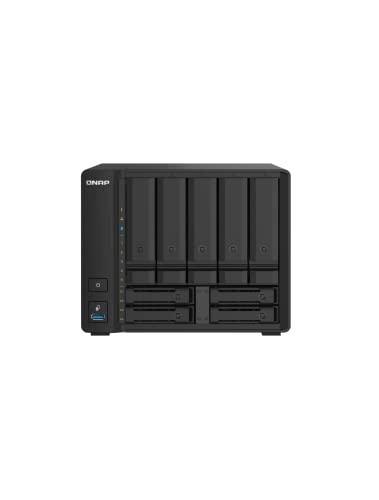
TL;DR: The QNAP TS‑932PX‑4G offers a 9‑bay hybrid NAS with dual 10 GbE, 1.7 GHz 4‑core ARM CPU, and up to 16 GB RAM for $659.00, ideal for SMBs needing fast, flexible storage.
The standout spec is the pair of 10 GbE SFP+ ports combined with two 2.5 GbE RJ‑45 ports, giving you enterprise‑grade bandwidth in a sub‑$1K box. Its 1.7 GHz, 4‑core 64‑bit ARM processor and 4 GB of DDR4 SODIMM (expandable to 16 GB) provide enough headroom for mixed workloads, while hardware‑accelerated AES‑256 encryption keeps data secure without a big performance hit.
At 7.9 lb and a cubic footprint of 11.0 in on each side, the TS‑932PX sits heavier than the entry‑level 2‑bay TS‑216G and the 4‑bay TS‑433, yet it’s still lighter than the larger enterprise‑grade TVS‑h874 series. Its $659.00 price tag lands it above the budget‑friendly 2‑bay units but comfortably below the high‑end 8‑bay models, making it a mid‑range sweet spot for growing teams.
User sentiment praises the 10 GbE SFP+ and 2.5 GbE ports and the flexible hybrid storage – five 3.5″ bays for bulk HDD capacity plus four 2.5″ bays that can serve as SSD cache or all‑SSD volumes. Reviewers also note the low standby power draw of 23.833 W and a quiet 18.6 dB(A) fan, which helps keep operating costs down in a small office. Professional reviewers highlight the SSD tiering feature as a way to deliver consistent performance across varied workloads.
Pros
Cons
Best for: Small to medium businesses and power users who need high‑speed file sharing, hybrid storage with SSD caching, and AES‑256 encryption.
Avoid if: You're shopping on a tight budget — it's priced at $659.00, or if you require x86‑only applications, dual‑channel memory, or a built‑in HDMI display output.
TL;DR: The QNAP TVS‑h874 i7 packs a 12‑core Intel i7‑12700E, 32 GB RAM and eight 3.5‑inch bays into a tower that delivers enterprise‑grade ZFS protection and future‑proof PCIe Gen4 expansion, but it carries a premium price tag.
The standout hardware is the 12‑core Intel Core i7‑12700E processor with 20 threads, paired with 32 GB DDR4 SODIMM memory out of the box. Combined with two built‑in 2.5 GbE ports, dual PCIe Gen4 slots (one x16, one x4) and two M.2 2280 Gen4 slots, the unit is built for heavy virtualization, container workloads, and fast NVMe caching. Its eight 3.5‑inch SATA bays give a maximum internal capacity of 154 TB, and you can expand to 396 TB using QNAP JBOD enclosures.
Compared with the other eight NASes in this roundup, the TVS‑h874 i7 is pricier than the compact 2‑bay models such as the TS‑216G and TS‑133, and it also feels heavier than the lightweight TS‑433, which lists a gross weight of 4.56 pounds. It offers far more drive bays than the 2‑bay and 4‑bay units, and its 2.5 GbE connectivity outstrips the single‑port 2.5 GbE found on the TS‑216G, while still lacking the native 10 GbE of some higher‑end peers that require an add‑in card. The device’s 8.95 kg gross weight and tower form factor place it in the premium desktop class, unlike the smaller rack‑mount or wall‑mount designs elsewhere.
Professional reviewers note the “enterprise‑grade performance in a desktop form factor” and praise the PCIe Gen4 slots for future upgrades to 10/25 GbE or GPU acceleration. Users love the raw processing power for VMs and the flexibility of ZFS‑based snapshots, inline deduplication and compression. The same feedback mentions that fan noise becomes noticeable under heavy loads and that the ZFS setup can be steep for newcomers. The unit draws 98.959 W during typical operation and 81.798 W in standby, which is reasonable for its class but adds to the total power budget.
Pros
Cons
Best for: Those prioritizing quality and willing to pay for premium performance
Avoid if: You need advanced features or professional-grade performance
TL;DR: The QNAP TS‑AI642 is a 6‑bay tower NAS with an 8‑core ARM CPU, 6 TOPS NPU and dual HDMI outputs, delivering AI‑enhanced storage at $734.99 for home or small‑office use.
The standout hardware is the dedicated 6 TOPS Neural Processing Unit, which works alongside an 8‑core ARM Cortex processor (four cores @ 2.2 GHz and four cores @ 1.8 GHz). Together they enable hardware‑accelerated transcoding and AI‑driven media analysis. The unit also sports two HDMI 1.4b ports, letting you connect directly to a 4K display for on‑the‑fly playback.
Compared with the other eight devices in this roundup, the TS‑AI642 is heavier than the compact 2‑bay models such as the TS‑216G and TS‑433, but lighter than the high‑end TVS‑h874 series. Its 2.5 GbE port gives it faster native networking than many peers that only offer Gigabit Ethernet, while none of the listed competitors include an AI‑specific NPU. At $734.99 it’s in the premium tier, offering more AI‑focused features for a comparable price.
Professional reviewers highlight the low‑power ARM architecture (typical draw 33.33 W, 14.005 W in HDD‑sleep mode) and appreciate the reliable AI face‑detection that many everyday users mention. However, user feedback notes that object‑recognition can be inconsistent and the AI accuracy isn’t on par with higher‑end solutions. The lack of built‑in 10 GbE and USB‑C, plus a QTS interface that some find daunting, are recurring complaints.
Beyond AI, the TS‑AI642 ships with 8 GB LPDDR4X system memory and a 4 GB flash module for OS protection. It supports up to 308 TB of pooled storage across six 3.5‑inch SATA bays, with RAID options ranging from JBOD to RAID 60. The device hardware‑accelerates encryption and can handle up to 1,500 concurrent CIFS connections, making it suitable for small‑office file sharing.
Pros
Cons
Best for: Home and small‑office users who need AI‑enhanced photo/video organization or surveillance capabilities.
Avoid if: You require high‑end AI accuracy, extensive RAM for heavy virtualization, or a device with a long track record of user reviews.
“Perfect for my home surveillance setup—AI face detection works well.”
“Dual HDMI is great for connecting directly to my TV.”
TL;DR: The QNAP TS-253E packs a quad‑core Intel Celeron, dual 2.5 GbE ports with 5 Gbps aggregation, two HDMI outputs and up to 16 GB RAM in a 2‑bay tower for small‑business and power‑user workloads.
The TS-253E’s standout hardware includes an Intel® Celeron® J6412 CPU that runs at 1.8 GHz base and can burst to 2.6 GHz, paired with 8 GB DDR4 onboard memory and two SODIMM slots for a maximum of 16 GB. It also offers two M.2 2280 PCIe Gen 3 x2 slots for NVMe SSD caching, and dual 2.5 GbE ports that can be teamed for up to 5 Gbps aggregate bandwidth. On the video side, two HDMI 1.4b ports support 4K @ 30 Hz, a rare feature in this class.
Compared with the other eight NASes in this roundup, the TS-253E is a bit heavier at 5.67 lbs, making it heavier than the TS-264 (≈5.11 lbs) but lighter than the larger TS-932PX (≈7.9 lbs). Its typical power draw of 24.238 W is lower than the TS-264’s 29.086 W, though its standby draw of 20.943 W is a touch higher than the TS-264’s 18.288 W. Memory‑wise, the TS-253E’s 8 GB onboard (expandable to 16 GB) outpaces the 4 GB‑only models like the TS-433 and TS-216G, and matches the TS-264’s maximum capacity. The dual HDMI outputs are unique among the peers, most of which list only one or no video ports.
User feedback highlights the fast 2.5 GbE networking and SSD caching as real‑world speed boosters, especially for surveillance video streams and media playback directly to a monitor. Reviewers also praise the hardware‑accelerated AES‑NI encryption and the ability to run virtual machines thanks to the Intel Celeron’s transcoding support. On the downside, several owners note that the fan can become audible under heavy load, and a subset of units ship with the 8 GB RAM soldered in a way that prevents later expansion, which limits future upgrades. Reviewers describe the QTS interface as feature‑rich but occasionally less intuitive than rival UIs.
Technical depth includes AES‑256 encryption (FIPS 140‑2 validated), hardware‑accelerated transcoding, and iSCSI support for block‑ and file‑based LUNs up to 250 TB per LUN. You can take snapshots as often as every 5 minutes, and the system hosts up to 512 shared folders within a maximum pool size of 308 TB. RAID options cover JBOD, RAID 0 and RAID 1, giving flexibility for redundancy or performance.
Pros
Cons
Best for: Small businesses, managed service providers, and power users who need virtualization, surveillance or media playback on a compact 2‑bay NAS.
Avoid if: You require an ultra‑quiet office environment, more than 8 GB RAM out‑of‑the‑box, or a simpler, less feature‑dense user interface.
TL;DR: The QNAP TS-433 offers a 4‑bay NAS with a 2.0 GHz quad‑core ARM CPU, 4 GB RAM, 2.5 GbE networking and AI photo tagging, all for $409.
The standout feature is the built‑in Neural Processing Unit that powers AI‑enhanced photo tagging, paired with a 2.0 GHz ARM Cortex‑A55 quad‑core processor and 4 GB DDR4 RAM. The unit also includes a 2.5 GbE port alongside a standard 1 GbE link, and it draws just 22.54 W when fully populated and 8.45 W in standby, which makes it quieter and more energy‑friendly than many competing models.
Compared with its peers, the TS‑433 is lighter than the QNAP TS‑264 (which weighs about 5.1 lb) but a bit heavier than the TS‑216G at roughly 3.2 lb. It’s priced lower than the TS‑264 and offers more bays than the TS‑216G, though both of those models provide expandable memory options that the TS‑433 lacks. The dual‑NIC design doesn’t support aggregation, though some higher‑priced units in the roundup do.
Users consistently praise the fast, accurate AI photo organization and the quiet operation of the single 120 mm fan. Professional reviewers highlight the forward‑thinking inclusion of a 2.5 GbE port for quicker backups and streaming. On the downside, the fixed 4 GB RAM limits multitasking and virtualization, and the ARM architecture can restrict third‑party app availability. The lack of SSD cache slots or PCIe expansion means you can’t boost performance beyond the native SATA drives.
Pros
Cons
Best for: Home users and families who want a compact, AI‑powered personal cloud with modest power consumption and a budget‑friendly price.
Avoid if: You need high concurrency, extensive virtualization, or expandability for future upgrades.
“smartly designed home NAS”
“excellent AI photo tagging”
Breakdown
QNAP TS-133 1-bay
Pros
QNAP TVS-h874 i5 8-bay
Pros
QNAP TS-216G 2-bay
Cons
QNAP TS-264 2-bay
Pros
Based on scoring data and product specs
Personalized picks
Best Overall Pick
QNAP TS-133 1-bay
Best OverallBest for: Shoppers on a tight budget who want the most for their money
QNAP TVS-h874 i5 8-bay
Best for: Those prioritizing quality and willing to pay for premium performance
$2,289.00+$2,130.00 vs winner
Skip QNAP TS-433 4-bay if…
Reliability and user satisfaction are your top concerns
The QNAP TS‑133 1‑bay takes the top spot as the best cloud storage device. At just $159.00 it’s the most affordable option, yet it still ships with a 4‑core 1.8 GHz ARM Cortex‑A55 processor, 2 GB DDR4 RAM and AES‑256 hardware encryption. Its built‑in NPU delivers AI‑powered photo management that’s six times faster than software‑only solutions, and the single 3.5‑inch bay can hold up to an 18 TB drive, giving you plenty of space for a home office or small studio.
The runner‑up, the QNAP TVS‑h874 i5 8‑bay, shines when you need serious capacity and performance—for example, a small business that runs multiple virtual machines or streams 4K media. It packs an Intel Core i5‑12400 (6 cores, 12 threads) running up to 4.4 GHz, 32 GB DDR4 RAM, eight hot‑swap bays and dual 2.5 GbE ports, plus optional 10 GbE via PCIe. Its 250 W power supply and Intel Quick Sync Video transcoding make heavy workloads feel smooth.
For other buyer personas, the QNAP TS‑264 2‑bay is the best mid‑range choice at $489.00, offering a balanced mix of capacity and price for families or hobbyists. If you crave top‑tier performance, the QNAP TVS‑h874 i7 8‑bay stands out as the premium pick at $2,719.00, delivering the most powerful hardware in the lineup for demanding enterprises.
Pick the TS‑133 today and get reliable, AI‑enhanced cloud storage without breaking the bank.
The QNAP TS‑133 1‑bay is ideal – it includes a dedicated NPU that speeds up face and object recognition for AI photo management, and its small footprint and low power draw keep costs down at $159. Its ARM Cortex‑A55 processor, 2 GB RAM and HDMI 3840 × 2160 @ 60 Hz output also make it easy to connect to a monitor for quick photo browsing.
Please sign in to leave a review
No reviews yet. Be the first to review!
