⚡ Quick Answer
We’ve lined up 11 random orbital sanders, spanning budget‑friendly options like the Worx WX823L and Bosch GEX12V‑5N, mid‑range contenders such as the Devmott and Maxxt models, and premium powerhouses that push past the $600 mark. Prices range from under $100 for the most basic cordless units to $681.45 for the Mirka DEROS 550X, giving you a clear sense of what each tier can deliver without guessing.
At the top of the premium tier sits the Festool ETS EC150, priced at $649.00 and carrying a 4.7‑star rating from 149 reviewers. Its 6‑inch sanding pad, 6,000‑10,000 RPM eccentric motion, and a 1‑1/16‑inch dust‑extraction port promise the kind of precision and cleanliness pros swear by. Weighing in at 8.09 lb, it balances heft and control, while the brushless EC‑TEC motor and built‑in vibration control aim to keep fatigue at bay during long sanding sessions.
Below we’ll break down how each model measures up in ergonomics, dust management, speed range, and overall value, so you can pinpoint the tool that fits your workshop and budget.

Festool ETS EC150
Its 13.123‑foot cable gives you generous reach, letting you sand large surfaces without changing outlets.
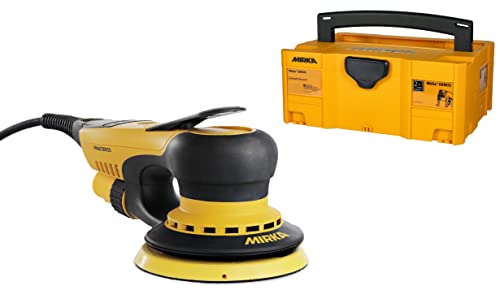
Mirka DEROS 550X
Ideal for pros needing premium performance; at $681.45 it’s $32.45 pricier than the Festool but offers top‑tier quality.

Worx WX823L
Its cordless 20 V design and built‑in vacuum port let you work anywhere without cords, a portability the other two lack.
Also considered
TL;DR: The Bosch GEX18V-5N delivers cordless 18 V power with a brushless motor, a 5‑inch pad and a 6,000–10,000 OPM speed range, earning a 4.7‑star rating for professional‑grade sanding.
The standout spec is its brushless 18 V motor paired with a variable speed range of 6,000 – 10,000 OPM, giving you the same material‑removal power as many corded sanders while staying lightweight at 2.4 lb. The 5‑inch backing pad and 2.5 mm orbit diameter provide a good balance between aggressive stock removal and fine finish work, and the soft‑start feature eases the tool into motion.
Compared with the other ten sanders in this roundup, the GEX18V-5N is lighter than the Devmott model (4.5 lb) and a touch lighter than the Metabo HPT SV1813DAQ4 (2.6 lb). It’s also shorter in height than the Metabo HPT’s 6.0 in, at just 4.3 in, which helps keep the tool steady in tight spots. Both the Bosch and Metabo HPT share a 5‑inch pad, but the Bosch’s 2.5 mm orbit is smaller than the Metabo HPT’s 3 mm, giving a slightly finer sanding texture. The speed range sits comfortably within the Metabo HPT’s 7,000 – 11,000 OPM envelope, while the older Bosch GEX12V‑5N weighs only 1.8 lb but runs on a lower 12 V platform.
Professional reviewers praise the brushless motor for “high material removal rates equivalent to corded sanders” and note that the palm‑grip design “minimizes tilting and downward pressure,” reducing fatigue on longer jobs. Users also highlight the variable speed control and vibration‑dampening technology as real‑world benefits. The main trade‑off is that the tool ships without a battery or charger, so you’ll need to invest in Bosch’s 18 V battery system separately, and long‑term reliability data is still limited.
Additional technical perks include the AMPShare™ battery compatibility, which lets you swap batteries across Bosch’s 18 V line, and a dust‑collection system that works with either a bag or a vacuum hose. The 8‑hole hook‑and‑loop backing pad makes disc changes quick, and the on/off switch is positioned for easy thumb access.
Pros
Cons
Best for: Most users looking for a well‑reviewed, reliable mainstream option — the Bosch GEX18V-5N offers Pad Size: 5 inches
Avoid if: You have limited desk space or need portability
TL;DR: The Worx WX823L delivers brushless power, low‑vibration comfort and a 125 mm (4.92 in) pad in a cordless package for under $90, making it a solid budget pick for DIY sanding.
The standout spec is its brushless motor paired with patented low‑vibration technology, which reviewers say cuts fatigue during long sanding sessions. The tool offers a variable 3‑speed range of 6,000 / 8,500 / 11,000 SPM and a 3 mm orbit, giving you enough aggressiveness for material removal and enough finesse for finishing. Its Base Plate Size of 125 mm (4.92 in) fits tight corners while still handling larger surfaces, and the dust‑sealed on/off switch helps keep the workspace clean.
Compared with the other ten sanders in this roundup, the WX823L sits in the mid‑weight range at 3.09 lb. It’s heavier than the Bosch GEX12V‑5N (1.8 lb) and the WQV Brushless model (≈2.47 lb), but lighter than the Devmott Random Orbital Sander (4.5 lb) and the Maxxt Random Orbital Sander (≈5.5 lb). Its 125 mm pad matches the WQV’s size, yet it’s smaller than the Devmott’s 150 mm backing plate. The 3 mm orbit equals the Metabo HPT’s orbit, while the Bosch models use a slightly smaller 3/32 in orbit. Speed‑wise, the WX823L’s top 11,000 SPM aligns with the high end of the Metabo HPT’s 7,000‑11,000 OPM range and exceeds the Bosch GEX12V‑5N’s 6,000‑10,000 OPM ceiling.
Users consistently praise the cordless convenience and the low‑vibration feel, noting that the brushless motor delivers “25 % more power” and “50 % longer runtime” than brushed equivalents. The dust‑sealed switch and optimized airflow port keep dust out of the motor, extending tool life. A common trade‑off is that the battery is sold separately, so you’ll need a compatible 20 V pack (up to 4.0 Ah) to get the tool running.
Pros
Cons
Best for: Shoppers on a tight budget who want the most for their money — the Worx WX823L offers Base Plate Size: 125 mm
Avoid if: You need industrial‑grade continuous power or a corded solution for large‑area sanding.
TL;DR: The Bosch GEX12V-5N delivers a 5‑inch brushless random‑orbit sander with a 6,000‑10,000 OPM speed range, ergonomic palm grip and lightweight 1.8 lb body, perfect for tight‑space detail work at a budget‑friendly price.
At the heart of the GEX12V-5N is a 12 V brushless motor that holds a constant speed under load and reaches up to 10,000 OPM. Its 5‑inch, 8‑hole pad and 3/32 in orbit diameter give you fine finish control, while the built‑in dust bag/vacuum system captures debris for a cleaner workspace. Soft‑start and variable speed control let you dial in the right aggressiveness for everything from paint prep to finishing.
When you line it up against the other ten sanders in this roundup, the Bosch feels notably lighter at 1.8 lb versus the Worx WX823L’s 3.09 lb and the Metabo HPT SV1813DAQ4’s 2.6 lb. It also trims down to a compact 4.3 in height, 7.6 in length and 6.0 in width, making it easier to maneuver in cramped spots. Pad size matches the Metabo HPT and the higher‑voltage Bosch GEX18V‑5N, and its 6,000‑10,000 OPM speed range mirrors the GEX18V‑5N, so you don’t lose any orbital performance despite the smaller battery platform.
Professional reviewers highlight the brushless motor’s consistency under load and praise the ergonomic palm‑grip for reducing fatigue during prolonged sanding. The dust‑management system is also noted as a strong point for indoor jobs. While consumer reviews are sparse, the 4.6‑star rating from 343 reviewers suggests overall satisfaction. The trade‑off is that the tool ships as a bare unit, so you’ll need to buy a compatible 12 V battery and charger separately.
Pros
Cons
Best for: Entry-level buyers or those on a tight budget — the Bosch GEX12V-5N offers Pad Size: 5 inches
Avoid if: You need powerful performance or professional‑grade features
TL;DR: The Festool ETS EC150 delivers a brushless 400 W motor, 6‑inch pad and 13.1‑ft cable in a compact, vibration‑controlled body, but its premium price suits professionals more than casual hobbyists.
The standout spec is the 6‑inch sanding pad paired with an eccentric motion speed of 6,000 – 10,000 RPM, giving you a large contact area while maintaining high‑speed consistency. Its brushless EC‑TEC motor and 400 W power consumption are listed as core performance drivers, and the sanding stroke of 3/16 inch (5 mm) adds aggressive material removal when needed.
Compared with the other ten sanders, the ETS EC150 is heavier than the Mirka DEROS 550X (2.25 lb) and the Bosch GEX12V‑77N (1.3 lb), but it balances that mass with a compact 4.5‑inch height. Its 13.123‑foot (4 m) cable outstrips the Maxxt’s 5000 mm lead, giving you more reach on larger jobs. While many peers list a 3‑inch or 4‑inch pad, Festool’s 6‑inch pad is larger, and the integrated pad brake with carbide tip is a feature not mentioned for the competition.
Professional reviewers praise the ergonomic design, noting the balanced center of gravity and Vibration Control System that cuts user fatigue during extended sanding. Users also highlight the MULTI‑JETSTREAM dust extraction with a 1‑1/16‑inch connection, which keeps the work area cleaner and reduces re‑work. The automatic suction detection adds convenience, though it requires a compatible Festool extraction setup to unlock its full potential.
Pros
Cons
Best for: Those prioritizing quality and willing to pay for premium performance — the Festool ETS EC150 offers Cable Length: 13.123 feet (4 m).
Avoid if: You're on a tight budget or only need basic functionality, or you need a highly portable, cordless solution.
TL;DR: The Mirka DEROS 550X packs a brushless 350 W motor, 5‑mm orbit and a 125 mm pad into a 2.25‑lb body, delivering professional sanding power at a premium price.
The standout spec is its brushless motor delivering up to 10,000 RPM with a 5 mm orbit on a 125 mm (5‑in) sanding pad. At just 2.25 Pounds (1020 g), the sander feels light enough for extended use, while the variable‑speed trigger lets you dial in the perfect RPM between 4,000 and 10,000.
Compared with the other ten models, the DEROS 550X is lighter than the Festool ETS EC150’s 8.09 lb frame but heavier than the 1.3‑lb Bosch GEX12V‑77N. It sits close to the Bosch GEX18V‑5N’s 2.4 lb weight, yet it costs more than most corded or battery‑powered peers, positioning it in the premium tier of the roundup.
Professional reviewers highlight the brushless motor’s ability to rival pneumatic sanders, noting the “low heft and vibration levels” (3.2 m/s²) that keep fatigue at bay. Everyday users praise the smooth, “silky” operation and the lightweight feel, but many point out that dust extraction shines only when paired with Mirka’s full vacuum system. The variable‑speed trigger also carries a learning curve for those accustomed to pneumatic tools.
Beyond the motor, the DEROS 550X offers Bluetooth connectivity, a central‑vacuum‑ready dust system, and a soft‑start feature that eases the tool into operation. Noise sits at 71 dB, and the 350 W power input ensures consistent performance even under load.
Pros
Cons
Best for: Those prioritizing quality and willing to pay for premium performance — the Mirka DEROS 550X offers Pad Size: 125 mm.
Avoid if: You're shopping on a tight budget — it's priced at $681.45.
TL;DR: The Metabo HPT SV1813DAQ4 packs a brushless 18 V motor, 7,000–11,000 OPM speed range and a 1‑3/8 in dust port into a lightweight 2.6‑lb, one‑handed sander.
What really stands out is the 7,000–11,000 OPM no‑load speed paired with six variable settings, letting you dial in the right aggressiveness for wood, metal or paint. The 3 mm orbit diameter and 5‑in pad give a smooth finish, while the brushless DC motor promises longer runtime and less maintenance.
Compared with the other ten models, the SV1813DAQ4 is heavier than the 1.8‑lb Bosch GEX12V‑5N but lighter than the 3.09‑lb Worx WX823L and the 4.5‑lb Devmott unit. Its 2.6‑lb weight places it between the 2.4‑lb Bosch GEX18V‑5N and the heavier brush‑less competitors, offering a balance of heft and maneuverability. The dust‑bag system with a 1‑3/8 in port and adapters outperforms many peers that list only a dust bag without adapters.
User reviews repeatedly praise the sander’s dust collection and the comfort of its rubberized soft grip for extended one‑handed work. Professional reviewers note the “best‑in‑class sanding performance” and appreciate the efficient brushless motor, though several users flag noticeable vibration during long sessions. The sealed, dust‑resistant switch and electric brake add safety and control for finish carpenters and remodelers alike.
Pros
Cons
Best for: Remodelers, finish carpenters and flooring installers who need cordless freedom and a 6.0‑inch height for tight spaces.
Avoid if: You require electronic speed control or prioritize the absolute lowest price‑per‑dollar.
TL;DR: The Maxxt Random Orbital Sander packs a brushless motor, 5 mm orbit and a 6‑inch pad into a 5.5 lb, corded unit with a 5 m cable, but its premium price and paddle‑style control may limit appeal for casual users.
What really sets this sander apart is the combination of a brushless EC motor and a 5 mm sanding stroke, delivering a no‑load speed range of 4,000 – 10,000 RPM. The tool comes with two interchangeable pads—a 5‑inch and a larger 6‑inch round pad—so you can tackle broad panels faster than many 5‑inch‑only competitors. A 28 mm dust‑extraction port lets you connect to a central vacuum, keeping the work area cleaner, while six variable speed levels and a pressure‑sensitive paddle give you fine control over material removal.
Compared with the other ten sanders in this roundup, the Maxxt is on the heavier side. At roughly 5.5 lb it outweighs the Bosch GEX12V‑5N (1.8 lb) and the Worx WX823L (about 3.1 lb). Its 5 m (196 in) power cord is longer than most cordless models, which can be handy in a workshop without worrying about battery life. The 6‑inch pad also exceeds the standard 5‑inch diameter found on the Devmott and Metabo HPT units, giving it a slight edge for covering larger surfaces quickly.
Consumer feedback highlights the sander’s ability to remove stock quickly, especially with coarser grits, and many users appreciate the variable‑speed dial for switching between aggressive removal and fine finish. Professional reviewers note the brushless motor’s cooler operation and the instant pad‑brake that stops the pad when you release the trigger. On the flip side, the paddle‑style speed control can feel unfamiliar, and the 5.5 lb weight has been mentioned as a source of fatigue during extended handheld use.
Technical details reinforce its premium positioning: a constant‑speed system, soft‑start function, and electronic pad brake all aim to improve usability and tool longevity. The 28 mm dust port aligns with central‑vacuum setups, and the 6‑level speed range lets you fine‑tune the 5 mm orbit for both aggressive sanding and swirl‑free finishing.
Pros
Cons
Best for: Most users seeking a balanced, mainstream option — the Maxxt Random Orbital Sander offers Included Pads: 2 (5‑inch and 6‑inch)
Avoid if: You're shopping on a tight budget — it's priced at $199.59
“performance Max tool”
“six variations of the on the plus or minus”
TL;DR: The Devmott Random Orbital Sander packs a 360 W brushless motor, a 150 mm backing plate and 6‑speed variable control for $139.99, delivering strong, low‑vibration sanding for woodworkers.
The standout spec is the 150 mm (6 in) backing plate paired with a 360 W brushless motor that reaches up to 10,000 RPM. Low‑vibration technology keeps the tool steady, while the 80 dB noise level stays manageable for indoor projects. A 5.0 mm orbit provides even material removal, and the paddle‑type switch offers stepless speed changes across six settings.
Within this eleven‑model roundup, the Devmott lands in the mid‑price tier and feels lighter than the bulkier Maxxt model, yet heavier than the ultra‑light cordless options. Its 150 mm plate is larger than the 5‑inch pads found on several competitors, giving you broader coverage per pass. Speed range and six‑step control match many peers, but the brushless motor and vacuum‑compatible 25 mm dust port set it apart from models that rely on simpler brushed motors or lack dedicated dust extraction.
Buyers have responded positively, awarding the sander a 4.8/5 rating from 13 reviewers. Users frequently mention the powerful brushless motor and the convenience of the built‑in dust hose, noting that the low vibration reduces hand fatigue during longer sessions. The only recurring comment is the lack of detailed spec listings, which leaves some pros to seek more technical data before purchase.
Additional context shows a variable speed range from 4,000 RPM to 10,000 RPM, a compact 89 mm height and 279 mm length that keep it palm‑friendly, and a 4.5‑pound weight that balances stability with maneuverability. The unit runs on a standard 220 V corded supply, making it ready for continuous use without worrying about battery life.
Pros
Cons
Best for: Most users seeking a balanced, mainstream option — the Devmott Random Orbital Sander offers Backing Plate Diameter: 150 mm
Avoid if: You're shopping on a tight budget — it's priced at $139.99
TL;DR: At $49.07, the WQV Brushless Random Orbital Sander packs a 5‑inch pad, brushless motor hitting 24,000 RPM, and a lightweight 1.12 kg body, but its low 3.6‑star rating suggests mixed user satisfaction.
The standout spec is its 24,000 RPM no‑load speed, driven by a brushless motor and paired with six variable speed settings. A 125 mm (5 in) hook‑and‑loop pad gives you the standard sanding footprint, while the through‑the‑pad dust collection helps keep the work area cleaner.
When you line it up against the other ten sanders in this roundup, the WQV is lighter than the Worx WX823L (1402 g) but a bit heavier than the Bosch GEX12V‑5N, which lists a weight of 1.8 pounds. Its 5‑inch pad matches the Bosch GEX18V‑5N, Metabo HPT, and the Worx, yet the Devmott model carries a larger 150 mm backing plate. Speedwise, the WQV’s 24,000 RPM ceiling dwarfs the Worx’s 6,000‑11,000 SPM range and the Devmott’s 10,000 RPM top speed, positioning it as the fastest tool in the group. Voltage-wise it aligns with the 18 V Bosch GEX18V‑5N, while the Bosch GEX12V‑5N runs on 12 V.
Only ten reviewers have weighed in, leaving an average of 3.6 stars. The limited feedback means you won’t find detailed praise or complaints, and the product description notes that a Makita 18 V battery is required but not supplied. This lack of bundled power and sparse user sentiment are the main hurdles for buyers seeking confidence out of the box.
Technically, the sander is cordless, runs on 18 V, and offers through‑the‑pad dust extraction, which is a practical feature for small workshops. The variable speed control across six gears lets you dial in the right aggressiveness for wood, metal, plastic, or polishing tasks.
Pros
Cons
Best for: Entry-level buyers or those on a tight budget — the WQV Brushless Random Orbital Sander offers Pad Diameter: 125 mm
Avoid if: Reliability and user satisfaction are your top concerns
TL;DR: The Bosch GEX12V-77N delivers a brushless 8,000 RPM motor in a 3‑inch, 1.3‑lb cordless package, ideal for precise spot sanding where portability matters.
What really stands out is the 8,000 RPM brushless motor paired with a 2.5 mm (3/32 in) orbit and a 3‑inch sanding pad. The tool runs on a 12 V battery system, offers variable speed control via a dial and trigger, and includes an HMI that shows battery status and auto‑shut‑off timing.
Compared with the other ten sanders in this roundup, the GEX12V‑77N is heavier than the 1.1‑lb Bosch GEX12V‑32N but far lighter than the 8.09‑lb Festool ETS EC150. Its 3‑inch pad is smaller than Festool’s 6‑inch pad and the Mirka’s 125 mm pad, while its 2.5 mm orbit is tighter than the 5 mm orbits found on the Bosch GEX12V‑32N, Mirka DEROS 550X, and Devmott models. The cordless 12 V platform also sets it apart from corded competitors like the Maxxt Random Orbital Sander.
Users consistently praise the sander’s compact, balanced feel and the ability to tackle tight, curved surfaces with minimal fatigue. Professional reviewers note the high material‑removal rate despite the small pad, but they also flag a runtime of roughly 10 minutes on a 2 Ah pack and a vibration level that feels higher than heavier, bench‑mounted units. The 8‑hole pad design enables vacuum dust extraction, which aligns with the tool’s “Vacuum” dust‑collection type.
Pros
Cons
Best for: Those prioritizing quality and willing to pay for premium performance — the Bosch GEX12V-77N 3 inch offers Pad Size: 3 inches
Avoid if: You're on a tight budget or only need basic functionality, or you need a sander for long‑run, large‑area jobs.
“Great performance in a small footprint”
“Removed pencil marks in 2 minutes on one workbench half”
TL;DR: The Bosch GEX12V-32N delivers a brushless 12 V motor, up to 8,000 RPM and a 5 mm orbit in a feather‑light 1.1 lb body for precise, cordless detail sanding at $469.00.
The most eye‑catching spec is the 5 mm (0.2 in) random orbital action paired with a variable speed that tops out at 8,000 RPM. Coupled with a 32 mm (1.26 in) sanding pad, the sander can strip material quickly while staying compact enough to fit into tight corners. Its brushless motor and 12 V Bosch Professional GBA battery system give it a high power‑to‑size ratio, and the tool‑free pad‑swap interface lets you switch between adhesive and hook‑and‑loop pads in seconds.
In the eleven‑product roundup, the GEX12V-32N is lighter than the Bosch GEX12V-77N (1.3 lb) and dramatically lighter than the Festool ETS EC150, which tips the scales at over 8 lb. It also carries a premium price tag compared with many corded or larger‑pad competitors, positioning it as a high‑end option for professionals who value portability over raw coverage.
User feedback consistently praises the sander’s balance and low vibration, noting that the 1.1 lb weight makes extended spot‑sanding sessions feel almost effortless. Professional reviewers highlight the brushless motor’s “strong performance” and the ergonomic grip that reduces fatigue. The common downside is the 32 mm pad: it excels at detail work but isn’t efficient for large‑area sanding, and owners report that runtime can be short when using lower‑capacity 12 V batteries, prompting the need for higher‑amp packs for longer jobs.
Additional technical context includes wet‑and‑dry sanding capability, a variable‑speed trigger paired with an on‑board HMI for fine speed tweaks, and a three‑year limited Bosch warranty that backs the tool’s durability. While the sander doesn’t list a dedicated dust‑extraction port, the design still allows for basic dust management when paired with a compatible vacuum.
Pros
Cons
Best for: Those prioritizing quality and willing to pay for premium performance — the Bosch GEX12V-32N 4 inch offers Weight: 1.1 lbs
“Feels balanced with center of gravity at pad”
“Good runtime efficiency (~10.5 min on 2 Ah)”
Breakdown
Festool ETS EC150
Pros
Mirka DEROS 550X
Pros
Cons
Worx WX823L
Pros

Bosch GEX18V-5N
Pros
Based on scoring data and product specs
Personalized picks
Best Overall Pick
Festool ETS EC150
Best ValueBest for: Those prioritizing quality and willing to pay for premium performance — the Festool ETS EC150 offers Cable Length: 13.123 feet (4 m)
Mirka DEROS 550X
Best for: Those prioritizing quality and willing to pay for premium performance — the Mirka DEROS 550X offers Pad Size: 125 mm
$580.00-$69.00 vs winner
Skip WQV Brushless Random Orbital Sander if…
Reliability and user satisfaction are your top concerns
We’re naming the Festool ETS EC150 the clear winner of our random orbital sander roundup. Its 4.7‑star rating from 149 reviewers shows strong user confidence, and the tool packs a 400‑watt brushless EC‑TEC motor that runs between 6,000 – 10,000 RPM. Add to that a 6‑inch sanding pad and a dust‑extraction port that accepts a 1‑1/16‑inch hose, and you’ve got professional‑grade performance wrapped in a compact, balanced design that weighs about 8.09 lb.
The Mirka DEROS 550X lands as the runner‑up, especially if you need a lightweight, low‑vibration sander for fine finishing work like cabinet doors. It weighs just 1.02 kg, offers a 5 mm orbit for smooth results, and features a variable‑speed control with a soft‑start function. Its central‑vacuum‑ready dust system and 71 dB noise level keep the workspace tidy and quiet.
For shoppers on a tighter budget, the WQV Brushless Random Orbital Sander delivers basic functionality at under $50, making it suitable for occasional DIY tasks. If you want a solid mid‑range option, the Bosch GEX18V‑5N at $139.99 balances power and price for regular workshop use. And for those who prefer a premium alternative without stepping up to Festool, the Mirka DEROS 550X remains a top choice with its professional‑grade features and robust build.
Pick the Festool ETS EC150 today and experience the best‑in‑class blend of power, ergonomics, and dust control.
The Festool uses its MULTI‑JETSTREAM system with a 1‑1/16 inch (27 mm) dust‑extraction connection, which is larger than the vacuum‑port on the Worx or the bag/vacuum setup on the Bosch models. This dedicated connection helps keep the work area cleaner, especially when you attach a shop‑vac. The other sanders rely on smaller ports or generic bag collection.
No reviews yet — be the first to share your experience.
Please sign in to leave a review


