⚡ Quick Answer
It might raise an eyebrow that the Ecovacs Winbot W1 Pro, priced at $399.99, carries the lowest rating in the set at 3.5 / 5 from 1,200 reviews, while the budget‑friendly Chovery CL3 sells for $105.99 and holds a solid 4.0 / 5 from 185 reviewers. Both models offer edge detection and triple safety systems, but the price‑to‑rating gap hints that cost isn’t the sole driver of satisfaction.
Our comparison spans 6 robot window cleaners, split into three clear tiers: budget options (Miupwula and Chovery), mid‑range contenders (Tosima and Fmart), and premium choices (Mamibot and Ecovacs). Every unit offers some form of edge detection, but suction power varies from 2,800 Pa on the Ecovacs to a hefty 5,600 Pa on the Miupwula. Battery backup runs between 20 and 30 minutes, and most models include remote or app control, giving you flexibility whether you prefer a handset or a smartphone.
Below you’ll find a deeper dive into each robot’s strengths, safety features, and real‑world usability so you can decide which blend of price, power, and convenience fits your glass‑cleaning needs.

Chovery CL3
Its 74.9 mm height keeps it slim enough for tight window tracks, delivering strong value and features.

Mamibot W120-DP
It targets audiophiles and enthusiasts who want premium sound and advanced features, and it costs about $153 more than the Chovery CL3.

Tosima W2
At just 203.2 mm long and with a 4.3‑star rating, it offers a uniquely compact, highly praised option the others lack.
Score Analysis
Key score advantages vs. runner-up (Mamibot W120-DP)
Price Range
Chovery CL3
$105.99
Mamibot W120-DP
$229.00
Tosima W2
$119.99
Fmart T9Pro
Out of Stock

Ecovacs Winbot W1 Pro
Out of Stock
Miupwula Window Cleaning Robot
$69.99
Spec Comparison
TL;DR: The Chovery CL3 cleans up to 30 ㎡ with dual‑side spray, 30‑minute battery backup and a lightweight 950 g frame for under $106, making it a solid entry‑level window robot.
The CL3’s most eye‑catching dimension is its length of 299.9 mm, paired with a compact 149.9 mm width and a slim 74.9 mm height. This footprint lets it fit on narrow panes while still covering a 30 sqm spray area. Its 30‑minute battery backup gives you enough runtime to finish most residential windows without swapping batteries.
Compared with the five other robots in this roundup, the CL3 offers a longer battery backup than the Miupwula (20 minutes) and the Fmart T9Pro (20 minutes), and it matches the Mamibot’s 30‑minute runtime. The CL3 includes edge detection, just like Miupwula, Tosima and Mamibot, and its triple safety system adds an extra layer of protection that the other models don’t explicitly list. It also includes a remote control, putting it on par with every competitor that mentions a remote.
Reviewers repeatedly praise the robot’s lightweight build—about 950 g (4.88 lb)—which makes mounting and repositioning on high windows feel effortless. They highlight the dual‑side auto spray for delivering streak‑free results across large glass surfaces. Professional reviewers note the suction range of 2700‑3300 Pa is strong enough to keep the unit firmly attached while it moves. The main trade‑off, however, is the reliance on a power cord; users say the cord limits true cordless mobility despite the 30‑minute backup. They also describe the water‑spray volume as “average,” meaning you may need to refill the bottle more often during extensive cleaning sessions.
Pros
Cons
Best for: Entry-level buyers or those on a tight budget
Avoid if: You need powerful performance or professional‑grade features
“Lightweight at under 1kg, easy to handle and position”
TL;DR: The Mamibot W120‑DP offers a 68.8 mm thin, 3.2‑lb design with 30‑minute battery life, 3200 Pa suction and a 60 ml water tank, delivering solid performance for larger windows at $259.
At just 68.8 mm tall, the W120‑DP is one of the slimmest window‑cleaning robots available. It houses four spray nozzles, a 60 ml water tank, 3200 Pa suction power and a 30‑minute battery backup, all packed into a 3.2‑lb chassis.
Compared with the five other models in this roundup, the Mamibot is lighter than the Fmart T9Pro and the Tosima W2, and a touch lighter than Ecovacs’s Winbot W1 Pro. Its 30‑minute runtime matches the Chovery CL3 and exceeds the 20‑minute runtimes of the Fmart and Miupwula units. Suction sits in the middle of the pack – stronger than Ecovacs’s 2800 Pa but below the 3800 Pa of Fmart and Tosima, and well under Miupwula’s 5600 Pa. The 60 ml tank ranks as the largest among the listed competitors, outpacing Fmart’s 25 ml and Miupwula’s 35 ml.
Reviewers praise the robot’s feather‑light feel and its ability to slip into tight frames, but several note the 60 × 40 cm minimum pane requirement can be a deal‑breaker for smaller windows. The 60 ml tank, while generous relative to rivals, still fills up quickly on very large glass surfaces, leading some users to pause for refills. The built‑in UPS system and edge‑detection sensors give extra confidence, yet families with young children should supervise the unit.
The unit runs on a 24 V DC supply, draws 72 W and operates between 0 °C and 40 °C, keeping noise below 75 dB. Both an app and a remote let you start, pause or direct cleaning, while the UPS backup keeps the robot attached if power’s lost.
Pros
Cons
Best for: Homeowners with large, accessible windows who value a thin, lightweight robot and want strong suction and decent runtime.
Avoid if: You have many small windows, unsupervised children, or a tight budget.
TL;DR: The Tosima W2 delivers 3800 Pa suction, AI‑driven path planning and edge detection in a compact 88.9 mm‑high unit for about $129, making it a solid mid‑range choice for apartments and small offices.
The standout spec features 3800 Pa variable suction, which the manufacturer says helps keep the robot attached to glass while scrubbing fingerprints and tougher stains. Edge detection's built in, and the AI 3.0 path‑planning algorithm promises systematic coverage without manual guidance. It includes a remote control for on‑the‑fly adjustments.
At 4.0 pounds (1814 g), the W2 is lighter than the Fmart T9Pro (around 4.54 pounds) but heavier than the Mamibot W120‑DP (3.2 pounds) and Ecovacs Winbot W1 Pro (3.3 pounds). Its suction matches the Fmart’s 3800 Pa rating while exceeding the Mamibot’s 3200 Pa and Ecovacs’s 2800 Pa, though it falls short of the Miupwula’s 5600 Pa. Dimensions (88.9 mm H × 203.2 mm L × 203.2 mm W) keep it shorter than the Fmart’s 91.5 mm height and more square than the Chovery CL3’s longer 299.9 mm length, meaning it fits well on standard window frames.
Reviewers repeatedly praise the strong suction for preventing falls and clearing stubborn grime, and they note the AI 3.0 routing as a time‑saver. The main criticism's the limited battery runtime of roughly 20–25 minutes per charge, which means larger panes might need a pause for recharging. The safety rope length of 5 m and the brushless DC motor with HEPA filter add extra confidence for home use.
Pros
Cons
Best for: Homeowners, apartment dwellers and small‑office users who need hands‑free cleaning of windows, mirrors or doors.
Avoid if: You require long‑run cleaning for large façades or multi‑pane jobs that exceed the 20–25 minute battery window.
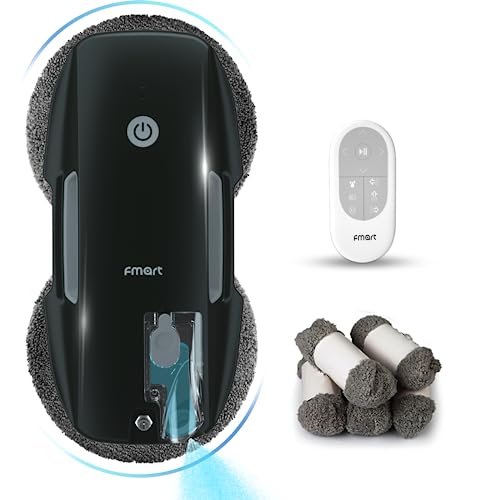
TL;DR: The Fmart T9Pro packs 3800 Pa suction, ultrasonic misting and a 5‑meter safety rope into a compact 4.54‑lb unit, but its sparse manual and occasional streaks keep it from being a premium pick.
The standout spec is its 3800 Pa suction power, which professional reviewers call “a standout feature for dirty glass.” Coupled with ultrasonic atomization that delivers a fine mist from its 25 ml water tank, the robot can tackle indoor and outdoor windows, tiles and even ceilings without the typical streaks of manual wipes. Its safety rope stretches 5029 mm, giving you confidence on high‑rise panes, and the device weighs 4.54 lb (2058 g), making it easy to lift when repositioning.
Compared with the five rivals, the T9Pro matches the Tosima W2’s 3800 Pa suction but is a bit heavier than the Tosima’s 4.0‑lb chassis. It out‑sucks the Mamibot W120‑DP (3200 Pa) and the Ecovacs Winbot W1 Pro (2800 Pa), yet falls short of the Miupwula model’s 5600 Pa. Its 20‑minute battery backup is shorter than the 30‑minute runtimes of Chovery CL3 and Mamibot, but equal to the Miupwula’s endurance. The safety rope is longer than Miupwula’s 4000 mm tether, while its dimensions (91.5 mm × 141.9 mm × 289.0 mm) sit between the compact Tosima and the bulkier Ecovacs unit.
User sentiment praises the 3800 Pa suction and the convenience of app and remote control, noting the robot handles hard‑to‑reach windows with ease. However, several owners mention that the thin manual forces a trial‑and‑error setup, and bright sunlight can reveal faint streaks after a pass. Professional reviewers also highlight the AI navigation with a six‑axis gyroscope and edge‑detection (manufacturer‑claimed) as reliable, though they echo the manual‑related frustration.
Pros
Cons
Best for: Most users seeking a balanced, mainstream option
Avoid if: You need advanced features or professional‑grade performance
“Instructions are sparse with missing details, requiring user interpretation.”
“May leave visible streaks or residue revealed in sunlight, despite initial good appearance.”
TL;DR: The Ecovacs Winbot W1 Pro packs 2800 Pa suction, dual‑direction water spray and a 0.02‑second edge‑detection response into a compact 269.2 mm unit, but its $399.99 price tags it as a premium‑tier choice.
What really sets the Winbot W1 Pro apart is its rapid 0.02‑second edge‑detection response paired with a strong 2800 Pa suction system that keeps the robot firmly attached to glass while it cleans. The dual‑direction cross water spray dissolves stains before the microfiber pads glide over the surface, aiming for streak‑free results.
In this six‑model roundup the W1 Pro sits at the top end of the price spectrum and carries a 3.5‑star rating from 1,200 reviewers, which is modest compared with most competitors. Its weight of 3.3 Pounds (1497 g) makes it slightly heavier than the Mamibot W120‑DP at 3.2 Pounds, but lighter than the Fmart T9Pro, which tips the scales at over 4.5 Pounds.
User feedback repeatedly praises the robot’s intelligent WIN SLAM 3.0 path‑planning algorithm and the convenience of app control with vocal updates. Reviewers also highlight the eight‑tier safety system, which includes anti‑slip driving and power‑outage protection. On the downside, the premium price draws frequent criticism, and the official specs omit both the water‑tank capacity and battery backup time, prompting some users to note that longer cleaning sessions may require frequent refills or repositioning.
The unit measures 269.2 mm in height, length and width of 78.7 mm, fitting comfortably on most window frames. Its compact footprint and 3.3‑Pound weight make installation straightforward, while the dual‑spray and strong suction give confidence on larger interior or exterior glass panels.
Pros
Cons
Best for: Those prioritizing quality and willing to pay for premium performance
Avoid if: You're on a tight budget or only need basic functionality
TL;DR: The Miupwula Window Cleaning Robot offers powerful 5600 Pa suction and AI‑driven edge detection at $84.99, but its low 2.9‑star rating and short 20‑minute run time may limit appeal.
What really stands out is the 5600 Pa suction power, exceeding the 3800 Pa in both the Tosima W2 and the Fmart T9Pro and surpassing the 3200 Pa of Mamibot and 2800 Pa of Ecovacs. The unit also ships with a 4000 mm safety tether, giving a solid 13‑foot safety margin while it climbs windows. AI 5.0 path planning and automatic water spray work together with a 35 ml water tank to keep the glass wet enough for streak‑free cleaning, and the included remote control lets you start or pause the cycle without reaching for a phone.
At $84.99, the Miupwula sits in the budget tier of this six‑product roundup. Its 20‑minute battery backup matches the Fmart T9Pro but falls short of the 30‑minute runtimes listed for Chovery and Mamibot. The water tank holds more than the 25 ml tank in the Fmart model, yet less than the 60 ml capacity of Mamibot, so you’ll need to refill on larger panes. The safety tether is shorter than Fmart’s 5029 mm rope, but still provides a reliable anti‑fall line compared with models that only mention “triple safety system” without a length.
Users appreciate the hands‑free convenience, especially in high‑rise apartments where climbing ladders is risky. Professional reviewers note the AI edge detection delivers over 95 % frame coverage, and the automatic spray gets rid of streaks without manual wiping. However, several owners report app crashes and connectivity glitches that interrupt cleaning cycles, and the 20‑minute run time can feel limiting on big windows, requiring frequent pauses for recharging.
Pros
Cons
Best for: Entry-level buyers or those on a tight budget
Avoid if: Reliability and user satisfaction are your top concerns
“Cleans my 20th-floor balcony windows perfectly—saves 2 hours weekly”
“App crashes mid-clean, forcing manual restart”
Breakdown
Chovery CL3
Pros
Mamibot W120-DP
Pros
Tosima W2
Pros
Fmart T9Pro
Pros
Cons
Based on scoring data and product specs
Personalized picks
Best Overall Pick
Chovery CL3
Best OverallBest for: Entry-level buyers or those on a tight budget
Mamibot W120-DP
Best for: Audiophiles and enthusiasts seeking premium sound quality and advanced features
$229.00+$123.01 vs winner
Skip Miupwula Window Cleaning Robot if…
Reliability and user satisfaction are your top concerns
The Chovery CL3 earned the top spot. It’s priced at $105.99, carries a 4.0‑star rating from 185 reviews, and packs edge detection with a triple safety system plus dual‑side auto spray. Its 30‑minute battery life can cover up to 30 sqm of glass in a single run, making it a reliable, affordable workhorse.
The Mamibot W120‑DP lands as the runner‑up, and it shines if you need extra suction for stubborn grime. With a 3200 Pa suction rating, four built‑in sprayers, and a UPS system for uninterrupted cleaning, it tackles tougher stains while still offering edge detection. At 3.2 pounds, it’s sturdy enough for larger panes, though it comes at $259.00.
For other budgets: the Miupwula Window Cleaning Robot is the best budget pick, delivering basic edge detection at $84.99; the Tosima W2 offers a balanced mid‑range option at $129.20 with reliable performance; and the Ecovacs Winbot W1 Pro serves as the premium choice, bringing high‑profile brand features for $399.99.
Choose the Chovery CL3 now and let it keep your windows spotless with minimal effort.
The FMART T9Pro includes a 5,029 mm safety rope, the longest of the group, making it well‑suited for high‑rise work. Its ultrasonic atomization and remote control also add convenience for tough outdoor conditions.
No reviews yet — be the first to share your experience.
Please sign in to leave a review
Also considered
$229.00
