⚡ Quick Answer
At $79.98 and a 4.7‑star rating from 270 reviewers, the Wyze Bolt v2 packs Wi‑Fi, an AI‑driven fingerprint scanner and BHMA Grade 2 security into a package that installs in about 15 minutes. Its 50‑code capacity and remote access without a hub give it a feature set that rivals many pricier rivals, making it a surprisingly capable choice for anyone who wants keyless entry without breaking the bank.
Our comparison spans 10 smart deadbolts, organized into three price tiers. Budget options range from $49.98 to $79.98 and include the Desloc B200, Kucacci Smart Door Lock, Wyze Bolt v2 and the Philips Smart Lock, each offering basic fingerprint or PIN access and auto‑lock. Mid‑range models like the eufy Smart Lock C33 ($99.99) and Philips Smart Lock with Handle ($115.99) add stronger materials and higher user capacities—20 fingerprints for the Philips handle version. Premium picks sit between $139.97 and $199.99, featuring IP65 ratings, extensive durability cycles and advanced integrations such as the eufy S230 and Ultraloq Bolt.
Next, we break down how each lock stacks up on security, connectivity and everyday usability so you can match the right smart deadbolt to your home.

Wyze Bolt v2
Its 50‑code access capacity lets many family members or guests get in without extra keys, making it a solid entry‑level choice.
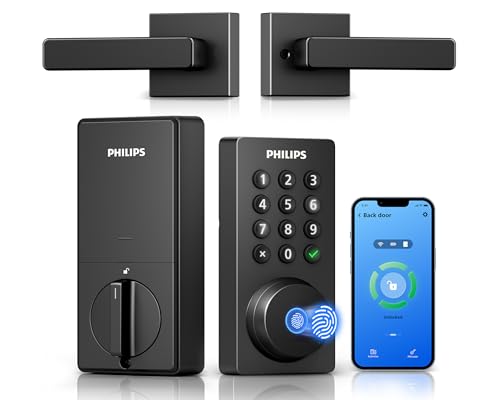
Philips Smart Lock with Handle
Ideal for mid‑range shoppers who want a sturdy metal lock with fingerprint support; at $115.99 it sits about $36 above the Wyze Bolt v2.

eufy Smart Lock S230
Stands out with an emergency power port and IP65 rating, letting you keep the lock functional during power outages or harsh weather—features the Wyze and Philips models lack.
Also considered
TL;DR: The Ultraloq Bolt packs Matter‑over‑Thread, a 360° fingerprint scanner and up to 50 access codes into a satin‑nickel deadbolt that’s IP65‑rated, ANSI/BHMA Grade 1 certified, and priced at $169.99.
What really sets the Ultraloq Bolt apart is its native Matter support over both Wi‑Fi and Thread, letting you control the lock from Apple Home, Google Home or Alexa without a separate hub. The lock also offers a 360° fingerprint sensor and an anti‑peep keypad, and you can store up to 50 access codes plus two mechanical keys for backup.
At 3.4 pounds, the Bolt is heavier than the 1.0‑pound Lockstar Smart Door Lock but lighter than the eufy Smart Lock S230, which tips the scales at about 3.64 pounds. Its 2.96‑inch depth sits between the shallow 30 mm profile of the Lockstar and the deeper 220 mm design of the eufy S230, giving it a solid but not overly bulky presence on the door.
Users consistently praise the seamless Apple Home integration and the convenience of remote lock/unlock via the U‑home app. Professional reviewers highlight the lock’s efficient power management through Thread, which helps the eight AA batteries last for months. The main complaints focus on the lock’s reliance on a 2.4 GHz Wi‑Fi network—some homes with dual‑band routers find the advanced features unavailable on a 5 GHz band—and a slightly more involved installation because the deadbolt and knob are separate components.
Beyond connectivity, the Bolt delivers robust security: ANSI/BHMA Grade 1 certification, 128‑bit AES encryption, and a claim of up to 35× the strength of a standard residential lock with a lifespan up to seven times longer. It’s built from zinc alloy with a satin‑nickel finish and carries an IP65 rating, so it can handle rain or dust without issue. The lock runs on 8 × AA alkaline batteries (12 V) and operates from –4 °F to 149 °F externally, covering most climate needs.
Pros
Cons
Best for: Buyers willing to invest in a proven, high‑quality option — the Ultraloq Bolt offers Access Codes Capacity: Up to 50
Avoid if: You're on a tight budget, need 5 GHz Wi‑Fi compatibility, or prefer a lock with only basic functionality
“Built-in WiFi, app remote control, and door alerts.”
TL;DR: The Lockstar Smart Door Lock packs a 30 mm depth, 1.0‑pound build and five entry methods into a sleek black deadbolt, but you’ll need to buy batteries and a Wi‑Fi gateway for remote use.
What really sets this lock apart is its compact 30 mm depth combined with a 164 mm height, giving it a low‑profile look while still accommodating doors 38‑48 mm thick. The unit weighs just 1.0 pound (454 g), making it lighter than the eufy S230, Ultraloq Bolt, and Kucacci models, which all tip the scales at over 2 pounds.
Compared with the nine other deadbolts in our roundup, the Lockstar sits in the premium‑price tier but offers a richer feature set than the Wyze Bolt v2, which lacks a built‑in gateway. It’s taller than the Philips Smart Lock (1.5 in height) and far shallower than the eufy S230’s 220 mm depth, so it fits tighter door jambs where bulkier units would struggle.
Users consistently applaud the fingerprint scanner for its speed and accuracy, and professional reviewers highlight the immediate auto‑lock triggered by the included door sensor. The lock also supports Alexa and Google Home, and its keypad accepts 6‑9 digit codes. On the downside, the package arrives without batteries and remote app access hinges on purchasing a separate Wi‑Fi gateway, adding both cost and setup steps. The manufacturer lists static power draw under 30 µA and working consumption under 200 mA, while the lock tolerates temperatures from –20 °C to 70 °C and humidity between 20‑80 % RH, with anti‑drill and anti‑pick safeguards built in.
Pros
Cons
Best for: Buyers willing to invest in a proven, high‑quality option — the Lockstar Smart Door Lock offers Depth: 30 mm
Avoid if: You're on a tight budget, need built‑in Wi‑Fi without extra hardware, or prefer a lock with batteries supplied out of the box.
“every time my door closes it automatically locks”
TL;DR: The eufy Smart Lock S230 packs a BHMA‑certified 250,000‑cycle durability, 0.3‑second fingerprint reads and IP65 weatherproofing into a 3.64‑lb unit that installs in about 10‑15 minutes.
What really stands out is the lock’s durability and speed. It’s BHMA certified for 250,000 lock/unlock cycles, and its AI‑learned fingerprint sensor opens the door in just 0.3 seconds, with the whole unlock sequence completing in 1 second. The built‑in 10,000 mAh rechargeable battery is rated for a full year of use, and the device can handle temperatures from –30 °C to 70 °C.
Compared with the other nine contenders, the S230 is on the heavier side – at roughly 3.64 lb it outweighs the Ultraloq Bolt (about 3.4 lb) and is considerably heavier than the Lockstar Smart Door Lock (around 1.0 lb). Its depth of 220 mm also makes it deeper than many of the slimmer alternatives, while its width of 135 mm sits between the compact Philips models and the bulkier eufy Video Smart Lock E330.
Users consistently applaud the lightning‑fast fingerprint response and the intuitive eufy Security app for remote management. Professional reviewers highlight the lock’s solid local security – AES 128‑bit encryption, tamper alarm and offline functionality – as major strengths. The main pain points revolve around the lock’s reliance on 2.4 GHz Wi‑Fi, which some users find flaky in congested networks, and the need to recharge the battery more often than the advertised 12‑month estimate. Vacation‑rental hosts also note the lack of native Airbnb integration.
Beyond speed and durability, the S230 offers auto‑lock, an emergency micro‑USB power port, and full voice‑assistant support for Alexa and Google Assistant. All data, including fingerprint templates, stays on the device rather than in the cloud, giving extra peace of mind for privacy‑focused households.
Pros
Cons
Best for: Buyers willing to invest in a proven, high‑quality option — the eufy Smart Lock S230 offers Operating Temperature: -30°C to 70°C.
Avoid if: You need advanced guest‑code automation or a lock that works seamlessly with Airbnb, or you require a device that avoids any Wi‑Fi band restrictions.
TL;DR: The Philips Smart Lock offers built‑in Wi‑Fi and Bluetooth, fast 0.3‑second fingerprint access, and remote control for $79.98, making it a solid entry‑level smart deadbolt.
The lock’s most distinctive spec is its integrated Wi‑Fi, meaning you never need a separate hub to reach it from your phone. It also pairs with Bluetooth, and the Philips Home Access app lets you lock or unlock remotely, plus you can command it with Alexa or Google Assistant. At 1.4 pounds, the deadbolt feels solid yet is easy to handle during installation.
Compared with the nine other locks in this roundup, the Philips model sits at a similar price point to the Wyze Bolt v2 but offers fewer listed dimensions and a smaller footprint than the eufy Smart Lock C33, which reports a larger height and length. It’s also lighter than the Kucacci Smart Door Lock, which weighs over 2 pounds, and it provides fewer fingerprint slots (20 vs. 200 on Kucacci). While it lacks Z‑Wave support that some rivals include, its built‑in Wi‑Fi gives it a clear connectivity edge over models that require an external bridge.
Reviewers consistently praise the lock’s convenience: the built‑in Wi‑Fi eliminates the need for extra hardware, and the fingerprint sensor delivers a 0.3‑second read with a 99 % recognition rate, which professionals note as “rapid and reliable.” Users do flag the need for eight AA batteries—none are supplied—and the absence of an emergency power backup. The ANSI/BHMA Grade 3 rating is adequate for most homes but isn’t meant for commercial or high‑security settings.
Technical details round out the picture. The lock supports AES‑128 encryption, stores entry logs locally, and can auto‑lock anywhere from 10 to 180 seconds after closing. It operates in humidity from 0 % to 95 % and temperatures between –35 °C and 66 °C, so it can handle most climates. You can program up to 20 fingerprints, 100 user PINs, and an unlimited number of one‑time PINs, plus a master PIN for added flexibility.
Pros
Cons
Best for: Budget‑conscious buyers seeking a reliable entry‑level option — the Philips Smart Lock offers Operating Temperature: -35°C to 66°C
Avoid if: You need advanced features or professional‑grade performance
TL;DR: The Desloc B200 offers sub‑0.3‑second fingerprint unlock, 12‑month battery life, and Bluetooth control within 2 m for just $49.98, making it a solid budget smart deadbolt.
The standout spec is the fingerprint recognition speed of less than 0.3 seconds, letting you swing the door open almost instantly. It stores up to 50 fingerprints and 150 PIN codes, and the auto‑lock timer can be set anywhere from 5 to 900 seconds.
At roughly 2.03 pounds, the B200 is lighter than the Kucacci Smart Door Lock, which tips the scales at about 2.40 pounds. Its price under $50 also puts it below most of the other ten‑product contenders, though the Wyze Bolt v2 and eufy models carry built‑in Wi‑Fi while the B200 needs a separate G2 Gateway for remote access.
Professional reviewers applaud the rapid fingerprint response and the breadth of unlocking methods—including app, eKey, IC card, and mechanical key. Users note the convenience of voice control through Alexa or Google, but they also point out that direct Bluetooth control stops at 2 meters and the required G2 Gateway adds extra cost. The lock’s IP54 rating and operating range of –30 °C to 70 °C make it suitable for most climates.
Pros
Cons
Best for: Budget-conscious buyers seeking a reliable entry-level option — the Desloc B200 offers Fingerprint Capacity: 50
Avoid if: You need integrated Wi‑Fi remote control without extra hardware or require a longer Bluetooth range
TL;DR: The eufy Video Smart Lock E330 3‑in‑1 costs $199.99, packs a 2K camera, 50‑fingerprint slots and a 10000 mAh battery, but its premium price and occasional battery drain may give budget‑focused shoppers pause.
What really sets the E330 apart is its built‑in 2K (2560 × 1440) camera with an f/1.6 aperture and a 5.2 m motion‑detection range, turning the deadbolt into a front‑door surveillance hub. The lock also includes a doorbell function, a touchscreen keypad, and five unlock methods (fingerprint, app, keypad, voice, physical key). Under the hood you get a 10000 mAh rechargeable Li‑ion battery, a durability rating of 100,000 cycles, and a pressure resistance of 2000 N, all housed in a 3.6155810968‑pound body.
At $199.99 the E330 is pricier than the Ultraloq Bolt’s $169.99 list price and also heavier than Ultraloq’s 3.4‑pound unit, while still lighter than the eufy S230’s 3.637627323‑pound chassis. Its fingerprint capacity of 50 matches Ultraloq’s limit and far exceeds the Philips Smart Lock with Handle’s 20‑fingerprint slots. Installation takes about 15 minutes—on par with the Wyze Bolt v2’s 15‑minute claim—and the lock’s 221 mm depth is noticeably deeper than Ultraloq’s 2.96‑inch depth, meaning it may need a thicker door jamb.
Everyday owners praise the all‑in‑one design for eliminating separate cameras and doorbells, and professional reviewers highlight the subscription‑free local storage (up to 128 GB microSD) and the sharp 2K video quality. However, users frequently note that real‑world battery life falls short of the advertised 3‑12 month range, forcing more frequent recharges. The touchscreen keypad and doorbell button are dim at night, and the lack of HomeKit or Matter support limits integration with some smart‑home ecosystems. Connectivity hiccups have also been mentioned in a handful of reviews.
Beyond the camera, the lock is built to withstand the elements: it carries an IP65 rating, endures 144 hours of humidity and 72 hours of salt‑spray exposure, and meets BHMA certification standards. Encryption uses AES128 plus ECC, and the unit operates from –30 °C to 70 °C, making it suitable for most climates.
Pros
Cons
Best for: Those prioritizing quality and willing to pay for premium performance — the eufy Video Smart Lock E330 3‑in‑1 offers Fingerprint Capacity: 50.
Avoid if: You're shopping on a tight budget — it's priced at $199.99.
“battery killer”
“remarkably sleek and compact”
TL;DR: The Philips Smart Lock with Handle costs $115.99, offers 0.3‑second fingerprint entry, 100 PIN codes and hub‑free Wi‑Fi, but its $115 price tags it above many budget rivals.
The lock’s standout spec is its ultra‑fast 0.3‑second fingerprint recognition, paired with a 99% success rate and capacity for 20 users. Combined with 100 programmable PINs and a touchscreen keypad, you can grant access to family, guests, or service workers without handing out physical keys.
In a roundup of ten smart deadbolts, the Philips model sits on the pricier side of the spectrum, outpacing the eufy Smart Lock C33, which is positioned as a lower‑cost option. Physically, the Philips lock is more compact at 6.0 inches long, 1.5 inches high and 2.2 inches wide, whereas the eufy C33 measures 7.24 inches in length, 5.12 inches in height and 6.06 inches in width, making the Philips unit a better fit for tighter door jambs. Its built‑in 2.4 GHz Wi‑Fi eliminates the need for a separate hub, a convenience the Lockstar Smart Door Lock still requires via an optional gateway.
Consumers repeatedly praise the lock’s seamless app experience, voice‑assistant integration with Alexa and Google Assistant, and the peace of mind from auto‑lock and tamper‑alarm features. On the flip side, reviewers note that the Wi‑Fi‑only power scheme can drain the eight AA batteries faster than expected, and the lack of an emergency power port leaves the lock vulnerable during extended outages. Professional reviewers also point out that while ANSI/BHMA Grade 3 certification is solid for residential use, it may fall short for high‑security scenarios.
Technically, the lock stores credentials locally and encrypts traffic with AES‑128, meeting modern security expectations. It works with doors 35‑50 mm thick, tolerates temperatures from –35 °C to 66 °C, and alerts you to low battery or forced entry attempts. The combination of fingerprint speed, Wi‑Fi connectivity, and robust encryption makes it a strong contender for tech‑savvy homeowners who value convenience over a bare‑bones price tag.
Pros
Cons
Best for: Buyers in the mid price range seeking the best quality at that price point — the Philips Smart Lock with Handle offers Fingerprint Capacity: 20
Avoid if: You're shopping on a tight budget — it's priced at $115.99
TL;DR: For $99.99, the eufy Smart Lock C33 offers a 7.24‑inch by 6.06‑inch deadbolt with integrated Wi‑Fi, adaptive fingerprint access and a 15‑minute no‑drill install, making keyless entry easy for families and renters.
The lock’s standout feature is its adaptive fingerprint sensor that learns the way you grip the handle, delivering one‑handed unlocks in seconds. It also ships with integrated Wi‑Fi, so you can control it remotely without a bridge. Physically, the unit measures 5.12 inches in height, 7.24 inches in length and 6.06 inches in width, giving it a solid presence on the door.
Compared with the other nine contenders, the C33 sits at the higher end of the price band—pricier than the Wyze Bolt v2—but it also packs a larger footprint than the Philips Smart Lock with Handle, which is only 1.5 inches tall and 6.0 inches long. Installation time matches the Wyze Bolt v2’s 15‑minute claim, and like many peers it avoids any drilling, which is a boon for renters.
Users consistently praise the effortless family setup and the quick app onboarding that brings real‑time notifications and event history to your phone. Reviewers note the fingerprint sensor works reliably in daily use, though a few mention it can struggle when fingers are wet. The 8‑12‑month battery life on eight AA cells is seen as generous, yet some households report faster drain under heavy traffic. Professional reviewers highlight the back‑lit, anti‑peeping keypad and the privacy mode that blocks exterior access with a red light indicator.
Pros
Cons
Best for: Value‑conscious buyers seeking quality at $99.99 — the eufy Smart Lock C33 offers Height: 5.12 inches and a suite of smart features ideal for families, Airbnb hosts and small businesses.
Avoid if: You need the highest security rating (Grade 1) or integrated video doorbell functionality.
TL;DR: The Wyze Bolt v2 offers Wi‑Fi remote access, AI‑learning fingerprint entry in 0.3‑0.5 seconds, and a 15‑minute DIY install for just $79.98, earning a 4.7‑star rating.
The standout feature is its AI self‑learning fingerprint scanner, which unlocks the door in 0.3‑0.5 seconds and stores up to 50 access codes. Built‑in Wi‑Fi means you can control the lock from anywhere without a hub, and the BHMA Grade 2 certification adds a solid security baseline.
At 1134 g (about 2.5 lb), the Wyze Bolt v2 is lighter than the Philips Smart Lock (1.4 lb) but heavier than the Desloc B200 (921 g). It shares the same backset options (2‑3/8" or 2‑3/4") as the Philips model, while its Bluetooth 5.3 and 16 ft setup range are comparable to other Bluetooth‑enabled locks in the group.
Users consistently praise the lock’s reliable fingerprint entry and the straightforward 15‑minute installation. Reviewers also note the 8‑month battery life from eight AA cells as a plus, though the auto‑lock timer lacks door‑closed detection, and the requirement for eight batteries is seen as less convenient than four‑cell competitors.
Technical details include an external assembly of 6.16 in × 2.83 in × 0.68 in and an internal assembly of 7.09 in × 2.93 in × 1.41 in. The unit is rated IP53, supports hardware encryption, and requires two‑factor app authentication. Bluetooth 5.3 and a 16 ft setup range round out the connectivity options.
Pros
Cons
Best for: Entry-level buyers or those on a tight budget — the Wyze Bolt v2 offers Installation Time: 15 minutes
Avoid if: You want the best value-per-dollar in its price range
TL;DR: At $49.99, the Kucacci Smart Door Lock packs six entry methods, stores up to 200 fingerprints with a 0.3 second read, and auto‑locks, delivering a feature‑rich, budget‑friendly solution for rentals.
The lock’s standout spec is its fingerprint system: it can hold 200 unique prints and returns a match in just 0.3 seconds. Combined with a keypad, Bluetooth, NFC, FOB card and a traditional key, you have six ways to get inside without fumbling for a key. Auto‑lock is built in, and voice assistants like Alexa and Google Assistant work through the optional Tuya gateway.
Price‑wise it sits below the Wyze Bolt v2’s $79.98 tag, while matching the Desloc B200’s $49.98 price point. However, at 2.40 pounds it is a bit heavier than Desloc’s 2.03 pound unit. The required clearance of 100 mm (about 4 inches) is larger than Wyze’s minimum 65 mm, so very tight door frames may need extra space.
Professional reviewers note the lock installs in roughly 5‑10 minutes with just a screwdriver and that the reversible handle suits both left‑ and right‑handed doors. Users appreciate the quick fingerprint response and the ability to grant up to 200 users access, which is handy for Airbnb hosts. The main drawback highlighted is the need for a separate Tuya G2 Gateway for Wi‑Fi features, and the gateway only supports 2.4 GHz networks.
Pros
Cons
Best for: Entry‑level buyers or those on a tight budget — the Kucacci Smart Door Lock offers Fingerprint Capacity: 200
Avoid if: Reliability and user satisfaction are your top concerns
Breakdown
Wyze Bolt v2
Pros
Cons
Philips Smart Lock with Handle
Pros
Cons
eufy Smart Lock S230
Pros

Desloc B200
Pros
Based on scoring data and product specs
Personalized picks
Best Overall Pick
Wyze Bolt v2
Best OverallBest for: Entry-level buyers or those on a tight budget — the Wyze Bolt v2 offers Installation Time: 15 minutes
Philips Smart Lock with Handle
Best for: Buyers in the mid price range seeking the best quality at that price point — the Philips Smart Lock with Handle offers Fingerprint Capacity: 20
$169.99+$90.01 vs winner
Skip Philips Smart Lock if…
You need advanced features or professional-grade performance
We crown the Wyze Bolt v2 as the top smart deadbolt. At $79.98 it offers a 4.7‑star rating from 270 reviewers, a solid 8‑month AA‑battery life, and a fast 0.3‑0.5 second unlock time, all while meeting BHMA Grade 2 security standards and requiring no drilling for most doors.
The Philips Smart Lock with Handle lands as the runner‑up, ideal if you need voice‑assistant control and a metal‑handle design. It supports Alexa and Google Assistant, auto‑locks, and works with doors 35‑50 mm thick, giving you fingerprint, PIN, mechanical key, and app access—all backed by AES‑128 encryption.
For tighter budgets, the Desloc B200 at $49.98 delivers essential smart features at a low cost. If you prefer a balanced mid‑range choice, the Philips Smart Lock with Handle (already highlighted) offers robust integration and a metal exterior for $115.99. For those willing to splurge, the eufy Video Smart Lock E330 3‑in‑1 at $199.99 adds video verification for extra peace of mind.
Choose the Wyze Bolt v2 for the most feature‑rich, secure, and easy‑install smart deadbolt on the market.
At $79.98 it undercuts many rivals while offering hardware encryption, a Bluetooth 5.3 link and built‑in 2.4 GHz Wi‑Fi. It also includes an AI self‑learning fingerprint scanner that unlocks in 0.3–0.5 seconds, an auto‑lock timer and a no‑drill installation that most users find straightforward.
No reviews yet — be the first to share your experience.
Please sign in to leave a review