⚡ Quick Answer
Choosing a smartwatch that won’t quit at the end of the day can feel like hunting for a needle in a haystack. In this roundup we compared 8 models that span a price range from $17.99 for the VTech KidiZoom DX2 up to $587.99 for the Garmin Venu 4 Slate. We split the selection into three tiers – budget options (VTech, Xiaomi Redmi Watch 5 Active Midnight at $39.99, and Tensky Smartwatch), mid‑range (Amazfit Bip 6 at $74.99 and CMF BY Nothing Watch 3 Pro), premium (Amazfit Active 2, Garmin Forerunner 165 at $199.00, and Garmin Venu 4 Slate).
The Amazfit Bip 6 catches the eye with a 1.97‑inch AMOLED screen that can hit 2,000 nits and a claimed 14‑day typical battery life, all for $74.99 and a 4.4‑star rating from 4,977 reviewers. If you crave even longer endurance, the Xiaomi Redmi Watch 5 Active Midnight promises up to 18 days typical use at $39.99, while the Garmin Forerunner 165 balances a 20‑day battery‑saver mode with advanced running metrics for $199.00. For families, the VTech KidiZoom DX2 delivers a 7‑10 day battery span and an IP68 rating at a pocket‑friendly $17.99.
Below we break down each tier’s strengths, so you can match battery life, features and price to your daily routine.

Amazfit Bip 6
Offers up to 14 days of battery life on a single charge, delivering the longest runtime among the contenders.

Xiaomi Redmi Watch 5 Active Midnight
For budget‑conscious buyers, it provides solid features at $39.99—about $35 less than the Amazfit Bip 6.

Tensky Smartwatch
For users needing specific technical compatibility, it offers a 300 mAh battery delivering up to 7 days heavy‑use life.
Also considered
Score Analysis
Key score advantages vs. runner-up (Xiaomi Redmi Watch)
Price Range
Amazfit Bip 6
$76.99
Xiaomi Redmi Watch 5 Active Midnight
$39.45
Tensky Smartwatch
$49.99

Garmin Forerunner 165
$199.99

Amazfit Active 2
$104.99
CMF BY Nothing Watch 3 Pro
$99.00

Garmin Venu 4 Slate
$510.99

VTech KidiZoom DX2
$19.99
Spec Comparison
TL;DR: The Amazfit Bip 6 packs a 1.97‑inch 2,000‑nit AMOLED screen, up to 14 days of typical battery life and a feather‑light 0.09 lb chassis into a budget‑friendly smartwatch.
The standout spec is its peak brightness of up to 2,000 nits, which makes the 1.97‑inch AMOLED panel readable even in bright sunlight. Combined with a 340 mAh battery that delivers up to 14 days of typical use, the watch lets you skip daily charging without sacrificing visibility.
At 0.09 pounds, the Bip 6 is lighter than the CMF BY Nothing Watch 3 Pro (0.1125 lb) and the Tensky Smartwatch (0.20 lb), yet a bit heavier than the Amazfit Active 2 (0.065 lb). Its typical battery life outlasts the CMF’s 13 days and the Tensky’s 12 days, though it falls short of the Xiaomi Redmi Watch 5 Active’s 18 days. Brightness-wise, it eclipses the CMF’s 600 nits and the Xiaomi’s 500 nits, while staying below the Active 2’s 3,000 nits. The 1.97‑inch display is marginally larger than the CMF’s 1.96 inch and the Tensky’s 1.85 inch, but smaller than the Xiaomi’s 2‑inch screen.
Professional reviewers praise the up to 14‑day battery and the 2,000‑nit screen, while everyday users echo the comfort of the aluminum‑alloy frame and liquid‑silicone strap. The Zepp OS offers AI coaching and over 140 workout modes, including HYROX Race and Strength Training, which beginners find useful. However, several users report occasional Bluetooth drops during calls, and the build feels less premium compared with higher‑end models. A minor point of confusion is the differing reported resolutions (380×450 vs 390×450), which some reviewers note.
Pros
Cons
Best for: Budget‑conscious fitness enthusiasts who want a bright, long‑lasting smartwatch with plenty of workout features.
Avoid if: You need a premium‑grade feel, NFC payments or a watch that comfortably fits very large wrists.
TL;DR: The Xiaomi Redmi Watch 5 Active Midnight offers a 2‑inch LCD, 470 mAh battery that lasts up to 18 days, Bluetooth calling with three‑mic noise cancellation, and a lightweight 42.2 g build for under $40.
The standout spec is the 470 mAh battery, which translates to 12 days of heavy use and 18 days in typical daily scenarios. That endurance outpaces every other watch in this eight‑item roundup, where the next longest typical life is 14 days on the Amazfit Bip 6. Coupled with a sub‑2‑hour magnetic charge, you’ll rarely need to think about recharging.
At 2 inches, the screen is the largest among its peers—bigger than the 1.97‑inch Amazfit Bip 6 and the 1.85‑inch Tensky model. Brightness peaks at 500 nits, which is lower than the 2,000‑nit peak on the Amazfit Bip 6, but still bright enough for most outdoor conditions. The watch weighs 0.17857443222 pounds (42.2 g with strap), making it lighter than the Tensky Smartwatch yet heavier than the sub‑0.1‑pound competitors like the Amazfit Bip 6 and Garmin Forerunner 165.
Professional reviewers applaud the 18‑day battery as a “standout feature for budget smartwatches,” and they note the three‑mic ENC system delivers clear Bluetooth call quality within an ~80 cm pickup range. Users echo this sentiment, regularly praising the long‑lasting charge and the variety of over 200 cloud watch faces. Consumer feedback notes the LCD’s lower vibrancy compared with AMOLED panels and the absence of built‑in GPS, NFC, and an always‑on display.
Pros
Cons
Best for: Budget‑conscious buyers seeking a reliable entry‑level option
Avoid if: You need advanced features or professional‑grade performance
“respectable for a budget watch”
TL;DR: The Tensky Smartwatch costs $49.99, offers a 1.85‑inch HD touchscreen, up to 12 days of typical battery life and IP68 water resistance, making it a solid budget pick for everyday fitness tracking.
The standout spec is its battery endurance: Tensky delivers 12 days of typical use, 7 days under heavy use, and a standby time of 30 days, all powered by a 300 mAh cell. Its 1.85‑inch HD display with adjustable brightness keeps interactions clear even in bright conditions.
Compared with the other seven watches, Tensky is a bit heavier at 0.20 lb (90.96 g) versus the Xiaomi Redmi Watch 5 Active’s 0.18 lb and the Amazfit Bip 6’s 0.09 lb. Its 300 mAh battery is smaller than the Xiaomi’s 470 mAh and the Amazfit Bip 6’s 340 mAh, which is why its heavy‑use endurance tops out at 7 days. The screen is also slightly smaller than the Xiaomi’s 2‑inch panel and the Amazfit Bip 6’s 1.97‑inch display, but larger than the VTech KidiZoom DX2’s 1.4‑inch screen.
Reviewers consistently note the watch feels solid and looks sleek enough to pair with any outfit. Professional reviewers praised its smooth syncing and the convenience of built‑in Alexa and call functionality. Everyday users appreciate the comfortable band, reliable fitness tracking, and the surprise of pre‑loaded games like 2048, which add a bit of fun to workouts.
Beyond the battery, Tensky packs a solid sensor suite: it includes heart‑rate, SpO₂, stress, sleep and menstrual cycle tracking. The IP68 rating and a dedicated water mode let you swim or jog in the rain without worry. With over 100 sports modes, customizable watch faces, and music control, it covers most activity needs while staying compatible with both Android and iOS.
Pros
Cons
Best for: Budget‑conscious users who need Android/iOS compatibility, Alexa integration, built‑in calling and a long‑lasting battery for everyday fitness tracking.
Avoid if: You want the best value‑per‑dollar in its price range
“should do it for those seeking an affordable option with rugged military‑grade construction and waterproof capabilities”
“two thumbs up”
TL;DR: The Garmin Forerunner 165 offers a crisp 1.2‑inch AMOLED display, up to 20 days of battery‑saver life, and a lightweight 39 g build, delivering solid GPS running features for beginners and intermediates.
The watch’s standout spec is its battery endurance – up to 20 days in Battery Saver mode and 11 days in regular smartwatch mode, far outlasting most rivals in the lineup. Its 1.2‑inch AMOLED touchscreen (390 × 390 px) stays bright and clear, while the 39 g polymer‑bezel case keeps it comfortable for all‑day wear.
Compared with the other seven watches, the Forerunner 165 sits in the middle of the weight range: heavier than the Amazfit Active 2 (0.065 lb) but lighter than the CMF BY Nothing Watch 3 Pro (0.1125 lb) and the Tensky Smartwatch (0.20 lb). Its 1.2‑inch screen is more compact than most peers – the Amazfit Active 2 (1.32 in), CMF Watch 3 Pro (1.96 in), Amazfit Bip 6 (1.97 in), Tensky (1.85 in), Xiaomi Redmi Watch 5 Active (2 in) and even the Garmin Venu 4 Slate (1.4 in). Battery life also outperforms many rivals, with 20 days in saver mode versus 4 days for the Amazfit Active 2 and 12 days for the Xiaomi model, providing a clear advantage for endurance training.
User feedback repeatedly praises the vibrant AMOLED display and the watch’s feather‑light feel on the wrist. Runners appreciate the reliable built‑in GPS and the long‑lasting battery that lets them train for weeks without recharging. Professional reviewers note the lack of a dedicated triathlon mode and that music storage is optional rather than standard, which may deter athletes needing more advanced multisport features.
Beyond the screen and battery, the Forerunner 165 packs 25+ activity profiles, wrist‑based heart‑rate monitoring, Pulse Ox, HRV status, sleep scoring, and Garmin Coach daily workouts. It also supports NFC‑based Garmin Pay and provides 4 GB of internal storage for music and data, all housed behind chemically strengthened glass and a fiber‑reinforced polymer bezel.
Pros
Cons
Best for: Buyers willing to invest in a proven, high-quality option
Avoid if: You're on a tight budget or only need basic functionality
TL;DR: The Amazfit Active 2 packs a 1.32‑inch sapphire AMOLED screen that can hit up to 3000 nits, lasts 10‑12 days on a typical use cycle, and weighs just 0.065 lb.
The watch’s standout spec is its ultra‑bright 3000‑nit AMOLED display protected by sapphire glass, paired with a lightweight 0.065‑pound stainless‑steel case. Its typical battery endurance of 10‑12 days means you’ll rarely need to charge it during a workweek.
Compared with the seven other smartwatches in this roundup, the Active 2 is the lightest on the list and far brighter than any competitor. Its battery life sits in the upper‑mid range—longer than many but a few peers claim slightly more days. The 1.32‑inch screen is notably smaller than the screens on the other models, which may feel cramped for power users.
Users consistently praise the comfortable fit, the battery life of 10‑12 days, and the vivid outdoor readability. Professional reviewers note the premium feel of the round 44 mm case, the 5 ATM water resistance for swimming, and the handy offline maps with Zepp Flow AI voice control. The watch does omit a USB‑C charging cable and some owners have reported occasional Bluetooth drops.
Pros
Cons
Best for: Buyers willing to invest in a proven, high‑quality option
Avoid if: You're on a tight budget or only need basic functionality
“premium features without the premium price”
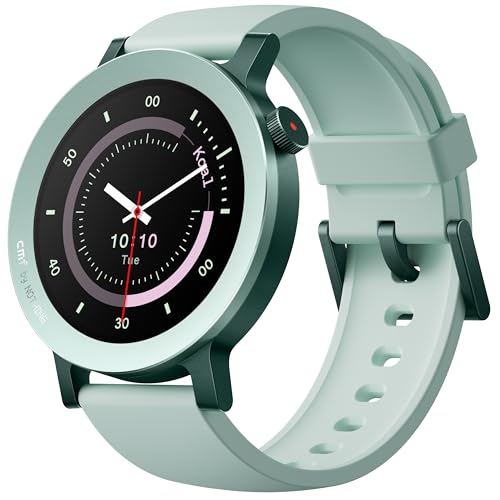
TL;DR: The CMF BY Nothing Watch 3 Pro delivers a 1.96‑inch AMOLED screen, 600‑nit brightness and up to 13 days of typical battery life for $79, wrapped in an aluminum‑alloy case with built‑in GPS.
This smartwatch’s standout spec is its 13‑day typical battery life; its 340 mAh cell powers the battery. Pair that with a 1.96‑inch AMOLED panel that pushes 600 nits of brightness, and you’ll get a device that stays visible on a long hike without daily charging.
At 0.1125 lb, the Watch 3 Pro is heavier than the Amazfit Bip 6 (0.09 lb) but lighter than the Tensky Smartwatch (0.2006 lb). Its 600‑nit display is less bright than the Amazfit Bip 6’s 2,000‑nit screen, yet still brighter than the Xiaomi Redmi Watch 5 Active Midnight’s 500‑nit panel. Battery‑wise, its 13‑day claim sits just below the Amazfit Bip 6’s 14‑day typical life and exceeds the Tensky’s 12‑day typical use, though it doesn’t reach the Xiaomi’s 18‑day figure.
Users praise the long‑lasting battery and the vivid screen, noting that step and heart‑rate tracking feel reliable. Reviewers also like the built‑in multi‑system GPS (GPS, GLONASS, Galileo, QZSS, Beidou) and Bluetooth calling that works with a mic and speaker. Common complaints focus on the lack of auto‑brightness, inconsistent sleep tracking, and a rectangular case that can feel bulky on smaller wrists.
Beyond the basics, the Watch 3 Pro packs 131 sports modes, 150 always‑on watch faces, AI noise reduction for calls, and a 58 Hz refresh rate that keeps animations smooth. Sensors include a 4‑channel heart‑rate monitor, SpO₂, stress and motion recognition, and the CMF Watch app syncs them to Apple Health, Google Fit and Strava.
Pros
Cons
Best for: Budget‑conscious beginners, casual athletes who need reliable GPS, and style‑focused wearers who want a large AMOLED screen.
Avoid if: You're shopping on a tight budget — it's priced at $79.00
“Long battery life (up to 13 days) is a game changer!”
“The bright/colorful display makes it easy to read outdoors.”
TL;DR: The Garmin Venu 4 Slate delivers a 1.4‑inch AMOLED display, 12‑day smartwatch battery life, and robust health sensors, but its $587.99 price and 45 mm case may feel premium and bulky.
The Venu 4’s standout endurance comes from a 12‑day battery life in smartwatch mode and roughly 17 hours when GPS is active, letting you track long hikes or multi‑day events without hunting for a charger. Its 1.4‑inch AMOLED touchscreen packs a bright, crisp view, while the stainless‑steel bezel option adds a premium feel. At 0.08125 pounds (36.86 g), the watch stays relatively light despite the metal case, and 8 GB of internal storage lets you keep music and maps on‑device.
Compared with the other seven watches in this roundup, the Venu 4 is lighter than most – only the Amazfit Active 2 (0.065 pounds) is lighter – and it carries a larger 45 mm case than the Forerunner 165’s 43 mm dimensions. Its 12‑day smartwatch endurance outlasts the Forerunner 165’s 11‑day claim and matches the Tensky’s typical use figure, while surpassing the always‑on display span of the Amazfit Active 2. The storage capacity of 8 GB also exceeds the 4 GB offered by the Forerunner 165.
Users consistently praise the Venu 4 for the long battery life and the accuracy of its wrist‑based ECG and SpO₂ sensors, noting the built‑in LED flashlight as a handy night‑time tool. Professional reviewers highlight the solid GPS performance on trail switchbacks and the bright AMOLED panel that stays readable in direct sunlight. However, several owners mention that the 45 mm case feels bulky on wrists under 135 mm, and many question whether the premium price is justified versus previous Venu generations.
Pros
Cons
Best for: Buyers willing to invest in a proven, high‑quality option
Avoid if: You're on a tight budget or only need basic functionality
TL;DR: The Tykoit KidiZoom DX2 offers a 1.4‑inch screen, IP68 water resistance, and up to 10 days of battery life for just $17.99, making it a solid entry‑level smartwatch for tight budgets.
The watch’s 1.4‑inch display sits behind a lightweight 67.7 g (2.89‑oz) case, and the IP68 rating protects it, so you can wear it while swimming or showering. Its 210 mAh battery delivers 7‑10 days of typical use, and a full charge takes about 2 hours.
Compared with the other seven models, the KidiZoom DX2 weighs more than the Xiaomi Redmi Watch 5 Active (42.2 g with strap) and the Amazfit Bip 6 (40.8 g), but it’s lighter than the Tensky Smartwatch (90.96 g). Its 210 mAh battery capacity is lower than the Xiaomi's 470 mAh and the Tensky's 300 mAh, which translates into a shorter battery‑life window than the Xiaomi’s 18‑day typical claim. The screen also measures smaller than most peers – the Xiaomi sports a 2‑inch panel and the Amazfit Bip 6 uses a 1.97‑inch display – while its Bluetooth 4.1 version trails the 5.3 Bluetooth found in several competitors.
Users consistently applaud the long‑lasting charge and the comfortable, lightweight feel on the wrist. Professional reviewers note the sleek AMOLED/LCD display and the reliable IP68 rating for water activities. However, the limited selection of four watch faces and occasional Bluetooth syncing hiccups generate frequent complaints, and some users report occasional sensor inaccuracies with the SpO₂ monitor.
Beyond the basics, the watch tracks heart rate in real time, offers manual blood‑oxygen detection, and monitors sleep stages (light, deep, REM, awake). It supports ten built‑in sport modes, delivers standard smartwatch tools like a flashlight, find‑phone, stopwatch, timer, music control, and breathing exercises, and pushes notifications for calls, SMS, Facebook, Instagram, and WhatsApp.
Pros
Cons
Best for: Shoppers on a tight budget who want a waterproof smartwatch with solid battery life and basic fitness tracking.
Avoid if: You need advanced health metrics like ECG, a large sport‑mode library, or a high‑end app ecosystem.
“Excellent battery life (7-10 days usage).”
“Comfortable lightweight design (2.89 oz) and IP68/5ATM waterproofing.”
Breakdown
Amazfit Bip 6
Pros
Xiaomi Redmi Watch 5 Active Midnight
Pros
Cons
Tensky Smartwatch
Pros
Cons
Garmin Forerunner 165
Pros
Based on scoring data and product specs
Personalized picks
Best Overall Pick
Amazfit Bip 6
Best OverallBest for: Most users looking for a well-reviewed, reliable mainstream option
Xiaomi Redmi Watch 5 Active Midnight
Best for: Budget-conscious buyers seeking a reliable entry-level option
$39.45-$37.54 vs winner
Skip VTech KidiZoom DX2 if…
You have limited desk space or need portability
The Amazfit Bip 6 takes the top spot thanks to its 14‑day typical battery life, which its 340 mAh cell powers, a bright 2,000‑nit AMOLED screen, and a lightweight 0.09‑lb aluminum‑alloy frame that stays comfortable all day.
The runner‑up, Xiaomi Redmi Watch 5 Active Midnight, shines if you need a wallet‑friendly watch that still lasts long – it delivers up to 18 days of typical use on a 470 mAh battery, includes Bluetooth calling with three microphones, and offers over 140 sport modes for active lifestyles.
For tighter budgets, the VTech KidiZoom DX2 at $17.99 offers great value for casual or kid‑focused wear, while the Garmin Venu 4 Slate at $587.99 stands out as the premium contender with advanced health and navigation features.
Pick the Amazfit Bip 6 today for the longest‑lasting, well‑rounded smartwatch experience.
The Amazfit Bip 6 offers built‑in GPS with free maps and up to 14 days of typical battery life, making it well‑suited for multi‑day treks. In contrast, the Garmin Forerunner 165 provides advanced running metrics but its GPS‑only mode lasts around 17‑19 hours, so its endurance drops when navigation is active.
No reviews yet — be the first to share your experience.
Please sign in to leave a review