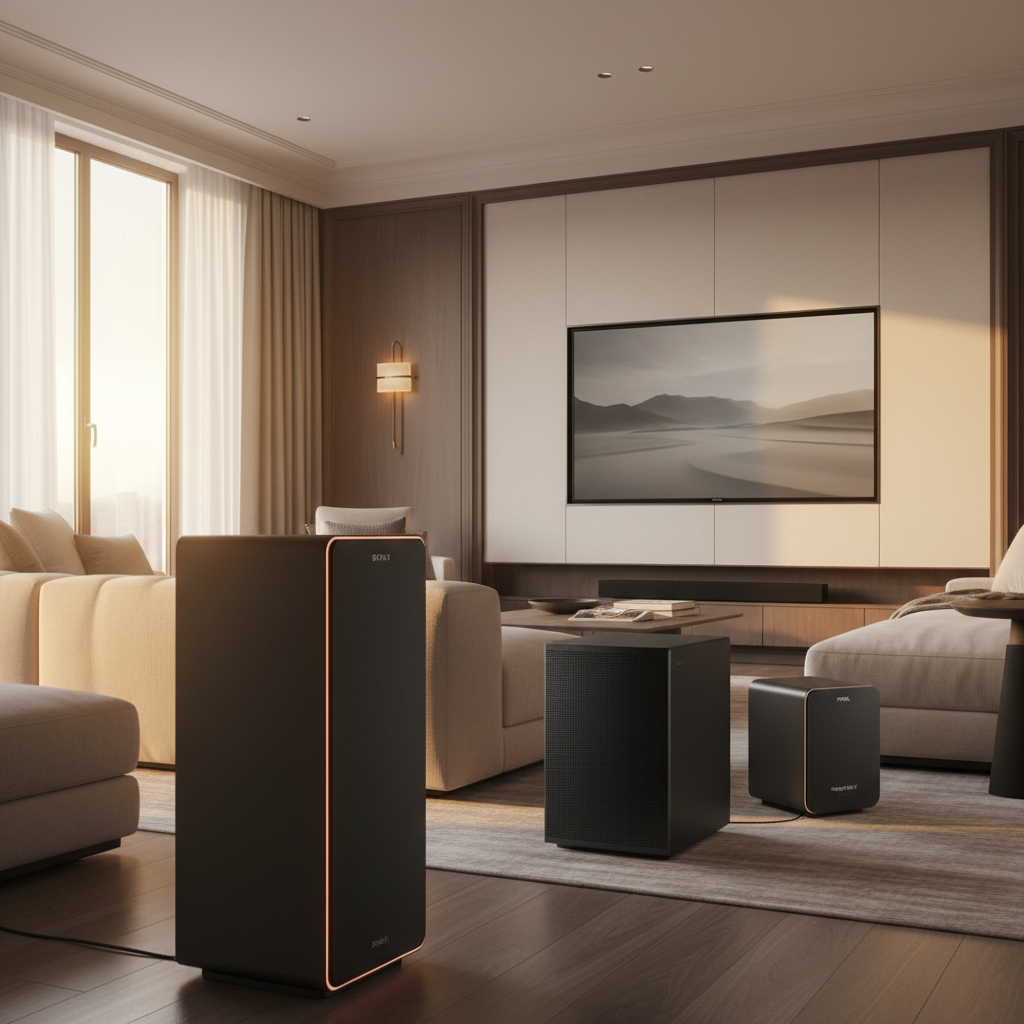
If you want the most immersive DTS:X experience, the Polk Audio MagniFi Max AX SR tops the list. Priced at $899.00, it earns a 4.4‑star rating from 797 reviewers and packs a 1‑HDMI eARC 4K port, three additional HDMI 4K inputs, and a 10‑inch wireless subwoofer, delivering true 7.1.2‑channel surround that fills larger living rooms.
Our roundup compares eight soundbars, spanning three price tiers. On the budget side you’ll find the Vizio SV210Y at $129.99 and the Vizio 5.1 Soundbar SE at $198.00, plus Sony’s compact HT‑G700 for $311.74. Mid‑range options include the Polk MagniFi Mini AX at $499.00 and Sony’s HTS60 at $698.00, both offering solid DTS:X support. Premium picks round out the list with the Sony HTB600 ($698.00), LG’s S95QR ($799.99), and the flagship Polk MagniFi Max AX SR.
Read on to see how each model performs in real‑world setups and which one matches your space, budget, and audio cravings.

Polk Audio MagniFi Max AX SR
Offers 1 HDMI eARC 4K (60Hz) plus three HDMI 4K (60Hz) inputs, providing strong connectivity for DTS:X.

Sony HTS60
Ideal for audiophiles who want premium performance without the top‑tier price—comes in at $698, about $201 less than the Best Overall.

Polk MagniFi Mini AX
Stands out with a dedicated 3.5 mm analog input and a single HDMI eARC port, catering to users who need a compact, well‑reviewed soundbar.
Also considered
Score Analysis
Key score advantages vs. runner-up (Sony HTS60)
Price Range
Polk Audio MagniFi Max AX SR
$769.00
Sony HTS60
$698.00
Polk MagniFi Mini AX
$499.00

Sony HT-G700
$272.33

Sony HTB600
$548.00

LG S95QR
$799.99

Vizio SV210Y
$129.99

Vizio 5.1 Soundbar SE
$198.00
Spec Comparison
TL;DR: The Polk Audio MagniFi Max AX SR delivers true 7.1.2 immersive sound with DTS:X and Dolby Atmos, backed by an 11‑driver soundbar, a 254 mm wireless subwoofer, and a $899 price tag.
What sets this system apart is its 7.1.2 channel layout that includes an 11‑driver soundbar, a wireless 254 mm subwoofer, and two wireless surround speakers. It supports Dolby Atmos, DTS:X, and a full suite of PCM and Dolby formats, while offering 1 HDMI eARC 4K (60 Hz) port plus three additional HDMI 4K (60 Hz) inputs and Bluetooth 5.0 for flexible connectivity.
Compared with the other seven contenders, the MagniFi Max AX SR is considerably lighter than the LG S95QR’s 33.0 pounds and still lighter than the bulkier Sony HT‑G700 at 24.4 pounds, but heavier than the compact Sony HTS60 at 5.75 pounds. Its driver count of 11 surpasses the six drivers listed for Sony HTB600 and the single driver array of the Vizio SV210Y, giving it a richer on‑board sound source. The system also offers more HDMI inputs than the Sony HTB600’s single HDMI port, and it includes a USB port for firmware updates, a feature not mentioned for several peers.
Users consistently praise the crystal‑clear dialogue that the VoiceAdjust technology provides and the deep, room‑filling bass from the 254 mm subwoofer. Reviewers highlight the straightforward wireless setup of the subwoofer and surrounds, but they also note that the IR remote needs a clear line‑of‑sight and that the 45‑inch (1143 mm) soundbar can dominate tighter entertainment centers. Professional reviewers point out the OLED front display for status feedback and the Roku TV Ready integration, which simplifies pairing with compatible TVs.
Additional technical context includes a Bluetooth version of 5.0, dual‑band Wi‑Fi (2.4 GHz & 5 GHz), and a 3‑year driver warranty paired with a 1‑year electronics warranty. The soundbar’s dimensions—116.8 mm deep, 71.1 mm high, and 1143 mm wide—fit most wall‑mount setups, and the included mounting brackets and templates make installation easier.
Pros
Cons
Best for: Buyers willing to invest in a proven, high-quality option
Avoid if: You're shopping on a tight budget — it's priced at $899.00
“Dialogue is crystal clear”
“Bass is powerful and deep”
TL;DR: The Sony HTS60 delivers 5.1‑channel virtualized Dolby Atmos/DTS:X sound with a 1,000 W output, Bluetooth 5.3 and a dedicated center channel, all for $698 and a 4.4‑star rating.
The HTS60’s headline spec is its 1,000 W total power output paired with a 5.1‑channel amplifier. It supports virtualized Dolby Atmos and DTS:X, and the Bluetooth 5.3 codec lets you stream from a phone without lag. A 30 W amplifier and a 60 W subwoofer share the power budget, while the soundbar’s dedicated center driver handles dialogue clarity.
Compared with the Sony HTB600, the HTS60 is noticeably lighter at 5.75 pounds versus the HTB600’s 6.875 pounds, and its total weight of 2,608 g undercuts the HTB600’s 3,119 g. More importantly, the HTS60’s 1,000 W total output dwarfs the HTB600’s 350 W, giving it a stronger punch. It shares the same Bluetooth 5.3 version as the HTB600, but offers a full 5.1 discrete speaker layout, whereas budget options like the Vizio SV210Y provide only a 2.1 system.
Users praise the immersive 5.1 surround, noting that the large subwoofer delivers room‑filling bass and the center channel makes dialogue easy to follow. Professional reviewers echo the “clear dialogue” and “powerful bass” compliments. On the downside, several owners report that they must perform firmware updates via USB drive, and updates sometimes fail, and the rear speakers need nearby power outlets, limiting true wireless placement.
All inputs route through the subwoofer, which acts as a hub for HDMI eARC, optical and analog connections. While it lacks Wi‑Fi, AirPlay or Chromecast, the BRAVIA Connect app provides convenient smartphone control, and the HDMI eARC link ensures seamless integration with compatible Sony TVs.
Pros
Cons
Best for: Home‑theater enthusiasts who want a full 5.1 surround experience without an AV receiver, especially Sony Bravia TV owners.
Avoid if: You’re on a tight budget, need built‑in Wi‑Fi/AirPlay/Chromecast, or prioritize high‑fidelity music playback over cinematic surround.
“Explosions and music have real punch — you feel the bass in your chest.”
“Dialogue is always clear, even during loud scenes.”
TL;DR: Polk’s MagniFi Mini AX is a compact 3.1‑channel soundbar with a 5 × 7‑inch wireless subwoofer, delivering Dolby Atmos and DTS:X via virtual processing for $499, earning 4.4‑star praise from 797 reviewers.
The system’s standout hardware is the 5 × 7‑inch subwoofer, paired with a soundbar that measures just 104 mm deep, 79 mm high and 366 mm wide, and tips the scales at 14.0 pounds. It supports an extensive codec list—including Dolby Atmos, Dolby Atmos TrueHD, DTS‑X and DTS‑Virtual:X—through Polk’s SDA 3D Audio and 3.1.2 virtual channel processing, giving a room‑filling experience despite its modest footprint.
At 14.0 pounds, the MagniFi Mini AX sits heavier than the ultra‑light Sony HT‑S60 (5.75 pounds) and Sony HT‑B600 (6.875 pounds) but is far lighter than Sony’s larger HT‑G700 (24.4 pounds) and LG’s S95QR (33.0 pounds). Its single HDMI eARC port matches the HDMI offerings of Sony HT‑G700 and HT‑B600, while its Bluetooth 5.0 aligns with Sony HT‑G700 but trails the Bluetooth 5.3 found in the Sony HT‑S60 and HT‑B600 models. The MagniFi Mini AX also includes an analog 3.5 mm input, an optical input, and a USB‑A port for firmware updates, giving it a broader connectivity suite than several peers that list fewer input options.
Reviewers consistently praise the bar’s “powerful, thundering audio” and the “deep, room‑shaking bass” from the dedicated subwoofer, noting that the compact lozenge shape fits well on tight TV stands. Professional reviewers highlight the straightforward plug‑and‑play setup via HDMI eARC and the rich wireless streaming lineup (AirPlay 2, Chromecast Audio, Spotify Connect). The main criticism revolves around the simulated height effects—Dolby Atmos and DTS:X render virtually, so they don’t achieve true object‑based positioning, which can disappoint enthusiasts seeking genuine upward‑firing sound.
Pros
Cons
Best for: Most users looking for a well‑reviewed, reliable mainstream option
Avoid if: You have limited desk space or need portability
TL;DR: The Sony HT‑G700 packs 400 W total output, Dolby Atmos and DTS:X support, and a wireless subwoofer into a sleek 3.1‑channel bar for $311.74, delivering strong bass and clear dialogue for home theater setups.
With a claimed 400 W total power output and a 3.1‑channel layout, the HT‑G700 delivers a strong soundstage. It decodes Dolby Atmos and DTS:X via its single HDMI eARC input, offers seven EQ presets, and features Bluetooth 5.0 for wireless playback.
Its 400 W sits above the 180 W of the Vizio 5.1 Soundbar SE and below the 350 W of Sony’s HTB600, while the HT‑G700’s 24.4 lb system weight is heavier than Vizio’s 7.44941983298pounds SV210Y and the 7269 g Vizio SE, yet lighter than LG’s 33.0pounds S95QR. The bar’s Bluetooth 5.0 trails Vizio’s Bluetooth 5.2 and Sony’s Bluetooth 5.3 in the HTS60 and HTB600, so wireless streaming may feel a step older. Compared to Vizio SV210Y’s two full‑range speakers, the HT‑G700’s three full‑range drivers plus a 160 mm subwoofer driver give it a richer bass foundation.
Customers repeatedly praise the powerful, room‑filling sound and the clear dialogue from the dedicated center channel, noting that the wireless subwoofer places easily. However, many point out the lack of Wi‑Fi, AirPlay or Chromecast, and some feel the virtual surround processing can sound artificial after extended listening.
Sony’s digital S‑Master amplifier drives each channel with 100 W, dropping to 60 W at 1 kHz, while the subwoofer consumes 20 W and claims 100 W output. The unit includes IR passthrough, HDMI CEC (BRAVIA Sync) and wall‑mountability, making integration with a TV straightforward.
Pros
Cons
Best for: Buyers in the budget price range seeking the best quality at that price point
Avoid if: You want the best value-per-dollar in its price range
TL;DR: The Sony HTB600, priced at $698.00, earns 4.4/5 stars, offers 350 W of power, 3.1.2 channels and Dolby Atmos/DTS:X support in a sleek, wall‑mountable package.
The HTB600’s core is a 3.1.2‑channel layout powered by six drivers—including a 160 mm driver in the soundbar—delivering a claimed 350 W of total output. It handles Dolby Atmos and DTS:X, giving you object‑based audio without separate height speakers. Bluetooth 5.3 lets you stream music wirelessly, and the included wireless subwoofer rounds out the low end.
Compared with the Sony HTS60, the HTB600 provides far fewer total watts than the HTS60’s 1000 W output, but it adds Dolby Atmos and DTS:X that the HTS60 lacks. It’s heavier than the HTS60’s 5.75‑pound chassis yet lighter than the LG S95QR’s 33.0‑pound build. Its 350 W output also exceeds the Vizio 5.1 Soundbar SE’s 180 W, though it falls short of the HTS60’s power. Bluetooth 5.3 matches the HTS60’s version, outpacing the Sony HT‑G700’s Bluetooth 5.0 and the Vizio SV210Y’s 5.2.
Users praise the bar’s clear dialogue and spacious soundstage, noting that the vertical surround engine and S‑Force Pro Front Surround create a wide, immersive image. Professional reviewers highlight the detailed mids and the ability to place sound objects accurately. However, many describe the wireless subwoofer as under‑powered; it lacks the wall‑shaking impact that bigger subs deliver and can become boomy when turned up. The lack of an HDMI passthrough also limits flexibility for those who want to keep a single cable run to the TV. At 6.875 pounds, the bar is light enough for wall mounting, and the subwoofer’s 7,710 g mass adds solid low‑frequency presence. The system comes with a one‑year warranty.
Pros
Cons
Best for: Movie and TV enthusiasts who want Dolby Atmos immersion without a full surround‑speaker setup
Avoid if: You need deep, wall‑shaking bass, HDMI passthrough, or multi‑room Wi‑Fi streaming
TL;DR: LG’s S95QR delivers a true 9.1.5‑channel, 810 W soundbar system with AI calibration and wireless rear speakers, but its high price and average subwoofer performance make it a premium‑only choice.
The standout spec is the 9.1.5‑channel layout that houses 17 speaker units and pushes 810 W of total output power. Dedicated height drivers and a 220 W subwoofer round out the immersive setup, while AI Room Calibration PRO auto‑tunes each speaker for the room.
At 33.0 pounds, the S95QR is considerably heavier than the Sony HTS60 (5.75 pounds) and the Polk MagniFi Max AX SR (13.0 pounds). It offers two HDMI inputs, fewer than the three HDMI ports the Polk model provides, and its Bluetooth 5.0 lags behind Sony HTS60’s Bluetooth 5.3.
Users love the plug‑and‑play wireless subwoofer and rear speakers, noting the system can fill a large room with loud, immersive sound for movies and gaming. Professional reviewers, however, point out that the subwoofer and surround speakers can sound mediocre and that height immersion feels limited despite the five up‑firing drivers.
Beyond the channel count, the bar supports Dolby Atmos, DTS:X, IMAX Enhanced and Meridian Audio Technology, and it includes Wi‑Fi (2.4 GHz/5 GHz), Chromecast, AirPlay 2, Spotify Connect and Tidal. Power draw stays modest at 78 W for the bar, 40 W for the subwoofer and 33 W for the rear speakers.
Pros
Cons
Best for: Large‑room home‑theater enthusiasts who want a high‑channel count, all‑in‑one solution with minimal cabling.
Avoid if: You need a compact setup for a small apartment, demand audiophile‑level refinement, or prioritize reliability and user satisfaction above all.
TL;DR: The Vizio SV210Y delivers Dolby Atmos and DTS:X in a compact 2.1‑channel bar for $129.99, offering solid bass, ClearDialog dialogue, and easy HDMI eARC setup, but relies on an app instead of a remote.
The SV210Y packs two 3‑inch bass drivers and two full‑range speakers into a 2.1‑channel layout, supporting Dolby Atmos and DTS:X. Its frequency response starts at 50 Hz and the maximum sound level reaches 95 dB, while Bluetooth 5.2 lets you stream wirelessly. The bar measures 121.92 mm deep, 66.04 mm high, and 812.8 mm wide, and it weighs 7.44941983298 pounds.
Compared with the other seven entries, the Vizio sits at the low‑end of the price spectrum and is lighter than the Sony HT‑G700 (24.4 pounds) but it's a bit heavier than the Sony HTS60 (5.75 pounds). Its Bluetooth version (5.2) is newer than the 5.0 in the Sony HT‑G700, yet a step behind the 5.3 in the Sony HTS60. The maximum sound level of 95 dB is just shy of the 96 dB listed for the Vizio 5.1 Soundbar SE, and its 2.1‑channel configuration offers fewer channels than the 5.1 layout of the Sony HTS60.
Users consistently praise the dramatic bass boost down to 50 Hz and the ClearDialog feature that makes dialogue easy to understand. Reviewers also note the minimalist design and QuickFit mounting system, which make wall or TV placement a breeze. The lack of a physical remote forces adjustments through the Vizio mobile app, and the absence of an optical input can limit compatibility with older TVs. Professional reviewers highlight the cinema‑quality sound in such a small form factor, while also pointing out the limited true surround experience despite Atmos support.
Pros
Cons
Best for: Shoppers on a tight budget who want the most for their money
Avoid if: You have limited desk space or need portability
“Having to use an app to adjust the controls is terrible!!”
TL;DR: The Vizio 5.1 Soundbar SE delivers true 5.1 surround with a wireless subwoofer, Dolby Atmos/DTS:X support, and 180 W output for $198, making it a strong budget option despite a missing remote.
The system’s most striking spec is its 180 watts of total output power paired with a 96 dB sound pressure level, giving you room‑filling volume without cranking the TV’s volume. It also includes a wireless subwoofer that reaches down to 50 Hz (45 Hz under load), so bass‑heavy movies feel punchy. The soundbar itself measures 838 mm × 58 mm × 82 mm, and the whole package weighs 7269 g.
Compared with the other seven entries, Vizio’s offering stands out for its full 5.1 channel layout—three front drivers inside the bar, two wired rear satellites, and the wireless subwoofer—while the Vizio SV210Y is limited to a 2.1 configuration. Its Bluetooth 5.2 module is a step up from the Sony HT‑G700’s Bluetooth 5.0, and it matches the Sony HT‑G700’s single HDMI eARC input, keeping the connection setup simple. Unlike higher‑priced models such as the Polk MagniFi Mini AX, this unit stays under $200, positioning it as the most affordable true‑surround option in the set.
Professional reviewers note the “spacious, dynamic sound with good bass” and praise the easy setup via HDMI eARC and Vizio’s QuickFit mounting system. Users consistently highlight crisp dialogue thanks to ClearDialog voice enhancement and the immersive feel of Dolby Atmos and DTS:X, even though Atmos virtualizes the effect. On the downside, owners report occasional Bluetooth drop‑outs, a lack of a dedicated remote (control is via the TV remote or the Vizio mobile app), and the need for visible cabling to the rear speakers.
Additionally, the system supports Dolby Atmos, DTS:X, and DTS Virtual:X, giving you the latest object‑based audio formats without an external AVR. ClearDialog lets you boost dialogue clarity, which many reviewers say makes movies and games easier to follow. The QuickFit tool‑free mounting works with select Vizio TVs, so you'll keep the bar flush against the wall for a clean look.
Pros
Cons
Best for: Movie and TV enthusiasts who want a true 5.1 surround experience on a tight budget.
Breakdown
Polk Audio MagniFi Max AX SR
Pros
Cons
Sony HTS60
Pros
Polk MagniFi Mini AX
Pros
Sony HT-G700
Cons
Based on scoring data and product specs
Personalized picks
Best Overall Pick
Polk Audio MagniFi Max AX SR
Best OverallBest for: Buyers willing to invest in a proven, high-quality option
Sony HTS60
Best for: Those prioritizing quality and willing to pay for premium performance
$698.00-$71.00 vs winner
Skip Vizio SV210Y if…
You have limited desk space or need portability
Polk Audio’s MagniFi Max AX SR takes the top spot thanks to its full‑stack feature set: it supports DTS:X alongside Dolby Atmos, delivers a 7.1.2‑channel layout, and ships with a dedicated subwoofer and two surround speakers. The system’s 4K HDMI eARC port and Bluetooth 5.0 keep it future‑proof, while a 4.4‑star rating from 797 reviewers underscores its real‑world appeal. At 13.0 lb the package feels solid without being unwieldy for wall‑mounting.
The Sony HTS60 lands as the runner‑up, ideal if you need a wireless surround solution for a living‑room setup. It offers virtualized DTS:X and Dolby Atmos, a 5.1‑channel amp delivering 1000 W total power, and Bluetooth 5.3 for seamless music streaming. With a 4.4‑star rating from 443 users and a price of $698.00, it balances performance and price for a connected home.
For tighter budgets, the Vizio SV210Y stands out as the best‑value pick at $129.99, giving you entry‑level DTS:X support without breaking the bank. If you prefer a mid‑range option that still offers wireless rear speakers, the Sony HTS60 (the runner‑up) remains the strongest choice before stepping up to the premium Polk system.
Pick the Polk MagniFi Max AX SR for the most complete DTS:X experience and enjoy cinema‑grade sound today.
The Polk Audio MagniFi Max AX SR leads with a full‑size 7.1.2 speaker layout, one HDMI eARC port plus three additional HDMI 4K inputs, dual‑band Wi‑Fi (2.4 GHz & 5 GHz) with 802.11 a/n/ac, Bluetooth 5.0, Apple AirPlay 2, Google Chromecast for Audio, and built‑in Alexa support, along with a wireless subwoofer and two surround speakers.
Please sign in to leave a review
No reviews yet. Be the first to review!
