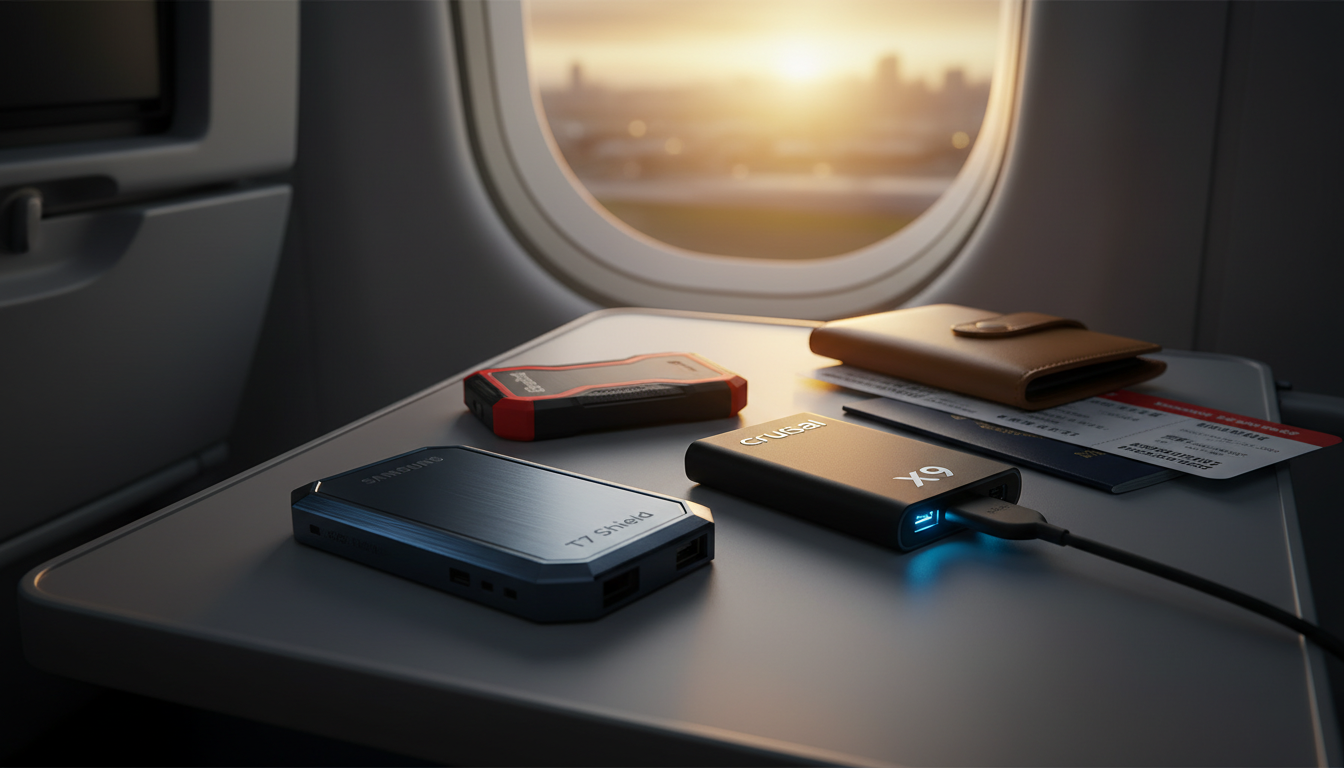
⚡ Quick Answer
When you’re hopping between airports, hotels, or outdoor shoots, a compact SSD that can survive a tumble and still move terabytes in minutes is essential. Seven travel‑friendly portable SSDs were compared, spanning a price range from $121.01 up to $399.99, and each model carries an average rating of 4.4 stars or higher.
The lineup splits into three price tiers. Budget picks – the Crucial X9 ($125.47), Crucial X9 Pro ($121.01) and SSK Portable SSD ($149.99) – all weigh under 40 g and promise up to 1,050 MB/s sequential reads. The mid‑range SanDisk Portable SSD sits at $162.00 with read speeds around 560 MB/s. Premium options include the SanDisk Extreme PRO ($224.99) delivering 2,000 MB/s, the Kingston XS1000R ($268.30) at 1,050 MB/s, and the rugged Samsung T7 Shield ($399.99) offering 1,050 MB/s read, 3 m drop protection and IP65 water resistance.
The breakdown shows how each drive balances speed, durability and pocketability, helping you match the right model to your travel workflow.

Samsung T7 Shield 2TB
Its 3 m drop resistance ensures data stays safe even if the drive hits the floor.

Crucial X9
Ideal for budget‑conscious travelers, it costs $125.47—about $274 less than the Samsung T7 Shield.
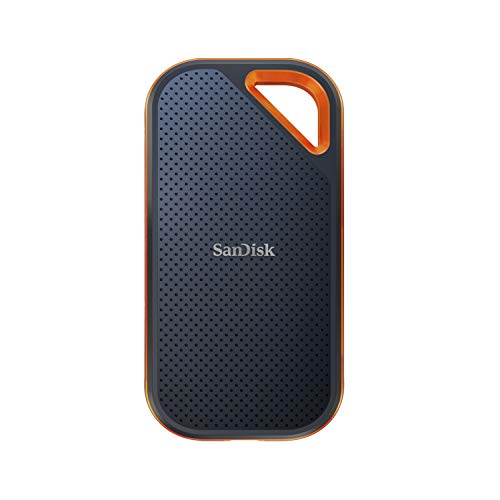
SanDisk Extreme PRO
With a 110.7 mm height, it packs a larger form factor, catering to users who prioritize capacity over ultra‑compact size.
Also considered
Score Analysis
Key score advantages vs. runner-up (Crucial X9)
Price Range
Samsung T7 Shield 2TB
$574.99
Crucial X9
$142.16
SanDisk Extreme PRO
$209.99

Crucial X9 Pro
$132.79

Kingston XS1000R 2TB
$268.79

SanDisk Portable SSD
$154.99

SSK Portable SSD
$159.99
Spec Comparison
TL;DR: The Samsung T7 Shield 2TB packs 2 TB of storage, IP65 water‑dust protection and 3 m drop resistance into a 12.4 mm‑thick, 0.21‑lb SSD that hits roughly 1,050 MB/s reads and 1,000 MB/s writes.
The standout feature is its rugged envelope: an IP65 rating shields it from water and dust, while a 3 m (≈9.8 ft) drop tolerance and 1,500 G shock resistance keep the drive safe in harsh field conditions. Inside, a USB 3.2 Gen 2 (10 Gbps) interface delivers up to 1,050 MB/s sequential reads and 1,000 MB/s writes, all backed by 2 TB of capacity and AES‑256‑bit hardware encryption.
Compared with the six other SSDs in this travel‑friendly roundup, the T7 Shield is noticeably heavier at 0.21 lb (97 g) versus the sub‑0.1 lb weights of Kingston, SanDisk Portable, SSK, and Crucial models. Its 12.4 mm height is a touch thicker than Kingston’s 13.5 mm and SSK’s 12 mm, yet far slimmer than the SanDisk Extreme PRO’s 110.7 mm chassis. Speed‑wise it matches Kingston’s 1,050 / 1,000 MB/s figures, but trails the Extreme PRO’s 2,000 MB/s class. The only device offering a comparable drop rating (3 m) is Kingston; the others list lower protections. Importantly, none of the peers mention an IP rating, making Samsung’s dust‑and‑water resistance a unique advantage.
Reviewers consistently applaud the solid performance and ruggedness, noting that the IP65 seal and drop proofing give peace of mind for outdoor shoots or travel. The trade‑off users highlight is the bulkier footprint and the premium price tag. Professional reviewers also note that both USB‑C‑to‑C and USB‑C‑to‑A cables come included, and Samsung Magician software simplifies encryption setup, adding convenience for on‑the‑go creators.
Pros
Cons
Best for: Buyers willing to invest in a proven, high‑quality option
Avoid if: You're shopping on a tight budget — it's priced at $399.99
“Fast transfers (1,050/1,000 MB/s for large files/videos/games) and rugged IP65 build surviving drops/water make it perfect for field work.”
“Bulkier size and higher price compared to the standard T7, but worth it for durability.”
TL;DR: The Crucial X9 1 TB portable SSD delivers 1050 MB/s read/write speeds in a 65 × 50 × 10 mm, 32 g package, with IP55 protection and a three‑year warranty, making it a lightweight, travel‑ready storage solution.
The standout spec features symmetrical 1050 MB/s sequential read and write performance, paired with a pocket‑sized 65 mm × 50 mm × 10 mm chassis that weighs just 0.07 lb (≈32 g). The drive also carries an IP55 rating and 7.5 ft (2.3 m) drop protection, which is unusual for a unit this thin.
Compared with the six other SSDs in this roundup, the X9 weighs less than the SanDisk Extreme PRO (0.17 lb) and Samsung T7 Shield (0.21 lb), while its 10 mm height stands far shorter than the Extreme PRO’s 110.7 mm. It matches the SSK Portable SSD’s 1050 MB/s read speed but edges it out on write speed (X9 writes at 1050 MB/s versus SSK’s 1000 MB/s). The X9’s 65 mm length is a touch shorter than the SSK’s 68 mm, and its 50 mm width matches the Crucial X9 Pro and exceeds the narrower 37 mm width of the SSK model.
Reviewers consistently praise the drive’s ultra‑small footprint and the “1.34 oz” (32 g) weight that lets users stash multiple drives in a pocket or laptop bag. Professionals point out the plug‑and‑play USB‑C interface and the included USB‑C‑to‑C cable as hassle‑free. Some users mention that while the X9’s 1050 MB/s speeds feel fast, sustained write tasks lag behind premium options like the Samsung T7 Shield, which advertises 2000 MB/s reads. The lack of a metal chassis also makes it feel less rugged than the SanDisk Extreme PRO, which touts a forged‑aluminum body.
Pros
Cons
Best for: Budget-conscious buyers seeking a reliable entry-level option
Avoid if: You need advanced features or professional‑grade performance
TL;DR: The SanDisk Extreme PRO 1TB Portable SSD delivers flagship‑class 2000 MB/s read/write speeds, IP65 dust‑and‑water resistance, and a rugged forged‑aluminum body, but it carries a premium price and is heavier than many rivals.
The standout specification is the advertised 2000 MB/s sequential read and write performance, which sits at the top of the portable‑SSD class. SanDisk built the drive for on‑the‑go creators who need both speed and security, coupling it with a 5‑year limited warranty, 128‑bit AES encryption, and a carabiner loop.
When you line it up against the six other SSDs in this roundup, the Extreme PRO feels noticeably larger and heavier. At 0.17 pounds it outweighs the Kingston XS1000R, SanDisk Portable SSD, SSK Portable SSD, Crucial X9, and Crucial X9 Pro, all of which sit at 0.09 pounds or less, though it’s still lighter than the Samsung T7 Shield’s 0.21 pounds. Its 110.7 mm height and 10.4 mm thickness also exceed the 13.5 mm height of the Kingston or the 10 mm height of the SanDisk Portable SSD, making it the tallest of the group. Speedwise, its 2000 MB/s sequential rates roughly double the up‑to‑1050 MB/s caps reported for Kingston, SSK, Crucial X9, Crucial X9 Pro, and Samsung T7 Shield, giving it a clear performance edge.
Professional reviewers consistently note that the drive lives up to its 2000 MB/s claim and praise its compact, smartphone‑sized footprint for field work. Users also highlight the IP65 rating and the sturdy aluminum chassis as key reasons they trust it in harsh environments. The 4.4/5 star rating from 16,524 reviews feels solid, though a few buyers point out that the higher price tag and the extra heft make it less attractive than lighter, lower‑priced alternatives.
Pros
Cons
Best for: Buyers willing to invest in a proven, high‑quality option
Avoid if: Reliability and user satisfaction are your top concerns
TL;DR: The Crucial X9 Pro packs 1 TB of storage, up to 1,050 MB/s USB‑3.2 Gen 2 speeds, IP55 protection and a feather‑light 38 g (0.08 lb) chassis for $121.01.
The standout spec is its combination of a 1 TB Micron TLC NAND drive with a Silicon Motion SM2320 ASIC that delivers up to 1,050 MB/s sequential read and write speeds, all while fitting inside a 65 mm × 9.91 mm × 50 mm, 38 g (0.08 lb) enclosure with an IP55 rating for dust and water resistance.
Compared with the other six SSDs in this roundup, the X9 Pro is heavier than the 32 g Crucial X9 and the 30 g SSK Portable SSD, but lighter than the 41 g SanDisk Portable SSD and far lighter than the 77.5 g SanDisk Extreme PRO and the 97 g Samsung T7 Shield. Its 1,050 MB/s speed matches the Crucial X9 and SSK models, outpaces the SanDisk Portable SSD’s up to 800 MB/s, and sits below the Extreme PRO’s 2,000 MB/s. The X9 Pro’s 7.5‑ft (2 m) drop resistance compares to the Crucial X9’s 7.5 ft rating and exceeds the SanDisk Portable SSD’s 2‑m rating, while the Samsung T7 Shield offers a 3‑m drop rating.
Reviewers consistently praise the X9 Pro’s ultra‑lightweight chassis—called “credit‑card‑sized” and “ideal for professionals on the move”—and its smooth compatibility with Apple devices thanks to pre‑configured firmware. Professional reviewers note the USB‑3.2 Gen 2 (10 Gbps) interface as a practical sweet‑spot, and users highlight the 256‑bit AES hardware encryption as a solid security bonus for travel. The device draws power directly from the USB port, eliminating the need for an external brick, and it’s backed by a 5‑year limited manufacturer warranty.
Pros
Cons
Best for: Creative professionals and Mac users who need fast, portable storage for 4K/8K video editing, photography and travel.
Avoid if: You need the absolute fastest sequential write performance or the highest dust‑water protection (IP65).
TL;DR: Kingston XS1000R 2TB packs 2 TB of storage into a 28.7 g (0.09 lb) metal‑plastic case, delivering up to 1,050 MB/s reads and 1,000 MB/s writes, making it one of the lightest high‑speed portable SSDs for travelers.
The standout spec is its ultra‑light weight of 28.7 g while still offering a full 2 TB capacity. Its USB 3.2 Gen 2 Type‑C interface can push sequential reads up to 1,050 MB/s and writes up to 1,000 MB/s, which is fast enough for most on‑the‑go editing and backup tasks.
Compared with the six other SSDs in this roundup, the XS1000R is lighter than the SanDisk Extreme PRO (0.17 lb) and Samsung T7 Shield (≈0.21 lb), matches the SanDisk Portable SSD’s 0.09 lb rating but is slimmer at 13.5 mm height versus the Portable’s 10 mm, and it is slightly taller than the SSK (12 mm) and Crucial X9 (10 mm). Speed‑wise, its 1,050 MB/s read matches the SSK, Samsung T7 Shield, Crucial X9 and X9 Pro, but trails the SanDisk Extreme PRO’s 2,000 MB/s claim and outpaces the SanDisk Portable SSD’s 800 MB/s ceiling.
Professional reviewers praise the drive’s “ultra‑light” metal/plastic build and plug‑and‑play simplicity across Windows, macOS, Linux, Chrome OS, Android and iOS/iPadOS. Users consistently highlight the tiny footprint and rapid transfers, while the most common complaints revolve around the lack of an included protective case and the noticeable speed dip when the drive is connected to older USB ports.
Pros
Cons
Best for: Travelers, photographers and mobile professionals who need a high‑capacity, ultra‑light SSD for quick backups on the go.
Avoid if: You’re on a tight budget, require rugged drop protection, or rely on older USB ports that can’t deliver Gen 2 speeds.
TL;DR: The SanDisk Portable SSD packs 1 TB into a 10 mm, 0.09‑lb shell, offers up to 800 MB/s theoretical speeds and 2 m drop protection, making it a rugged travel companion with solid performance.
The drive’s standout spec is its 2‑meter drop protection combined with an IP55 rating, meaning it can survive drops and resist water and dust while weighing only 0.09 pounds. Its compact chassis measures just 10 mm in height and 47 mm on each side, and it runs on USB‑C NVMe with a maximum data‑transfer rate of 10 Gbps. SanDisk lists sequential read speeds up to 800 MB/s and writes up to 452 MB/s, with real‑world read performance measured at 334 MB/s.
Compared with the six other SSDs in this travel roundup, the SanDisk is slightly heavier than the SSK Portable SSD (≈0.07 lb) and the Crucial X9 (≈0.07 lb), but matches the weight of the Kingston XS1000R (0.09 lb). It is slimmer than the SSK’s 12 mm height and far shorter than its 68 mm length, giving it a more pocket‑friendly footprint. In terms of speed, the SanDisk’s “up to 800 MB/s” ceiling trails the SSK and Crucial X9, both advertising up to 1,050 MB/s reads and writes. Its 2‑meter drop protection exceeds the SSK’s 4‑ft rating and aligns with the Crucial X9’s 2.3‑m protection, while the Samsung T7 Shield offers a similar 3‑m drop rating but at a higher price tier.
Users consistently applaud the drive’s portability and ruggedness, noting that the rubber hook and shock‑proof construction make it a go‑to for on‑location shoots. Professional reviewers, including TechRadar, commend the smart design and value, while TheSSDReview highlights the water‑ and dust‑resistant build. However, several reviewers flag heat buildup during long, high‑speed transfers, and the bundled USB‑C cable is described as shorter than many competitors’ offerings. Some users also mention a performance dip when handling many small random files, and the price is seen as higher than faster alternatives.
Beyond the headline speeds, CrystalDiskMark lists the SanDisk at 560 MB/s sequential read and 501 MB/s sequential write, while Atto benchmarks list 562 MB/s read and 526 MB/s write. The drive ships pre‑formatted in exFAT, requires no external power, and includes a rubber hook for easy attachment to bags or belts.
Pros
Cons
Best for: Most users looking for a well‑reviewed, reliable mainstream option
Avoid if: You need advanced features or professional‑grade performance
“hands-down one of the best external SSDs on the market”
“very well-built, compact, water and dust resistant and shock proof”
TL;DR: SSK’s 1 TB Portable SSD delivers up to 1050 MB/s reads, 1000 MB/s writes, a feather‑light 30 g aluminum body, and 4‑ft drop resistance, making it a speedy, travel‑ready companion.
The SD500 crams a full 1 TB of storage into a 12 mm‑high, 68 mm‑long, 37 mm‑wide aluminum shell that weighs just 30 g (0.07 lb). It advertises sequential reads of up to 1050 MB/s and writes of up to 1000 MB/s when paired with a USB 3.2 Gen 2x2 port, and it includes an approximately 24 GB pSLC cache for burst performance. A built‑in 4‑ft drop‑resistance rating adds confidence for travelers.
Compared with the SanDisk Portable SSD, the SSK is lighter (30 g vs 41 g) and offers a higher listed read speed (1050 MB/s versus up to 800 MB/s), though its body is a bit longer. Against the Crucial X9 and X9 Pro, the SSK is the lightest of the three and matches their 1050 MB/s read rating, but its write speed of 1000 MB/s trails the 1050 MB/s seen on those models. The SanDisk Extreme PRO outpaces the SSK with 2000 MB/s reads, but it is considerably heavier (0.21 lb) and bulkier. Kingston’s XS1000R and Samsung’s T7 Shield share the same 1050/1000 MB/s performance, yet both weigh around 0.09 lb or more, making the SSK the most portable option among them.
Everyday users praise the plug‑and‑play experience across Windows, macOS, Android and iOS, and they often highlight the included protective pouch and dual USB‑C cables as a convenient travel bonus. Professional reviewers note the sleek aluminum chassis, a rubber hanging ring for easy attachment, and a blue LED that signals activity, while also pointing out that the drive supports UASP and TRIM for efficient data handling.
The drive runs on less than 5 W of power and uses an exFAT file system with a 256 KB allocation unit, which works well out of the box on most platforms. Its USB 3.2 Gen 2 or Gen 2x2 interface lets you reach the advertised speeds, but sustained write performance can fall once the 24 GB cache is exhausted, and user reports echo this behavior.
Pros
Cons
Best for: Budget‑conscious buyers seeking a reliable entry‑level option
Avoid if: You need advanced features or professional‑grade performance
“hands-down one of the best external SSDs on the market”
“very well-built, compact, water and dust resistant and shock proof”
Breakdown
Samsung T7 Shield 2TB
Pros
Cons
Crucial X9
Pros
SanDisk Extreme PRO
Pros
Cons
Crucial X9 Pro
Pros
Based on scoring data and product specs
Personalized picks
Best Overall Pick
Samsung T7 Shield 2TB
Best ValueBest for: Buyers willing to invest in a proven, high-quality option
Crucial X9
Best for: Budget-conscious buyers seeking a reliable entry-level option
$142.16-$432.83 vs winner
Skip SSK Portable SSD if…
You need advanced features or professional-grade performance
We’re naming the Samsung T7 Shield 2 TB the clear winner. It ships with a 3‑year warranty, a solid 4.7/5 rating from 16,083 reviews, and a rugged design that survives drops of 3 m while keeping an IP65 seal. Its sequential read of 1,050 MB/s and write of 1,000 MB/s give you fast transfers, and at 0.21384839414 pounds (97 g) it’s light enough for any travel bag.
The runner‑up is the Crucial X9, ideal if you need a feather‑light drive that still handles rough handling. Weighing just 0.07054792384 pounds (32 g) and featuring a 7.5‑ft (2.3 m) drop protection rating, it suits backpackers or commuters. It also offers 1050 MB/s read and write speeds, an IP55 rating, and a handy lanyard hole, all for a modest $125.47 price tag.
For other budgets, consider these picks:
Pick the Samsung T7 Shield 2 TB for the best blend of speed, durability, and value on your next trip.
The Samsung T7 Shield offers an IP65 rating and can survive drops from up to 3 m, making it the most rain‑proof and drop‑resistant option, though it weighs 97 g. The SanDisk Extreme PRO also has an IP65 rating and 3 m drop protection but is slightly lighter at 77.5 g, while the Crucial X9 provides IP55 protection and a 2.3 m drop rating at just 32 g.
No reviews yet — be the first to share your experience.
Please sign in to leave a review