⚡ Quick Answer
Choosing a universal flash with a built‑in LCD can feel overwhelming, especially when eight solid contenders vie for attention. The lineup spans a price range from $49.98 for the Altura Photo Camera Flash up to $369.90 for the Westcott FJ80 II M, and each model carries a rating between 3.0/5 and 4.7/5, giving you plenty of data to weigh.
We’ve grouped the options into three clear tiers. The budget camp includes the Altura Photo ($49.98, 4.2/5), Voking VK750II ($59.94, 4.6/5) and Ambitful AF970 ($59.46, 4.4/5), all offering solid guide numbers and wireless ranges for entry‑level shooters. Mid‑range choices feature the Godox iT30Pro at $74.90 with a 2.8‑inch touchscreen, 120 g weight and 1.5 s recycle time, plus the Meike MK430N ($59.99, 4.4/5) with a 275 g body and 360° swivel head. Premium offerings—Godox AD100Pro ($259.00, 4.5/5), Westcott FJ80 II M ($369.90, 4.6/5) and Commander Optics Flash ($115.70, 3.0/5)—bring larger batteries, longer wireless ranges and higher power outputs.
Below we break down each flash’s strengths, quirks and ideal use cases so you can pinpoint the unit that fits your shooting style.

Godox iT30Pro
Offers a 7.4 V, 900 mAh battery, delivering balanced power for most users.

Godox AD100Pro
Designed for audiophiles and enthusiasts who demand premium sound, the AD100Pro costs about $184 more than the iT30Pro, reflecting its advanced features.
Voking VK750II
Its compact 57 mm depth and 200 mm height keep it small enough for tight spaces, a size advantage the other two lack.
Also considered
Score Analysis
Key score advantages vs. runner-up (Godox AD100Pro)
Price Range
Godox iT30Pro
$74.90
Godox AD100Pro
$259.00
Voking VK750II
$59.99

Altura Photo Camera Flash
$49.98

Westcott FJ80 II M
$389.90

Meike MK430N
$59.99
Ambitful AF970
$53.00

Commander Optics Flash
$115.70
Spec Comparison
TL;DR: The Godox iT30Pro packs a 2.8‑inch touchscreen, 15 m guide number and 100 m wireless range into a 120 g pocket flash that recycles in just 1.5 seconds.
The iT30Pro features a 2.8‑inch full‑color touchscreen paired with a 900 mAh lithium‑ion battery, letting you adjust settings on‑the‑fly while staying under 120 g. It delivers a guide number of 15 m (49.2 ft) at ISO 100 and a rapid 1.5 s recycling time, so you can keep shooting without missing a beat. Its built‑in diffuser and multi‑strobe mode add creative flexibility without extra gear.
Compared with the other seven flashes in this roundup, the iT30Pro weighs noticeably less than the Meike MK430N (275 g), Ambitful AF970 (390 g) and Altura Photo flash (280 g). Its 15 m guide number exceeds the Meike’s 36 ft rating, and its 1.5 s recycle beats the Meike’s roughly 4 s and Voking’s ≈3 s cycles. The 100 m indoor wireless range dwarfs the 20‑25 m indoor range of both Meike and Voking, and also exceeds the 20‑30 m range of the Ambitful. While the Westcott FJ80 II M shares the same 2.8‑inch screen, it weighs far more, making the iT30Pro the most portable option with a comparable display.
Users consistently praise the flash’s pocket‑size convenience and the intuitive touchscreen, calling it a “travel‑friendly powerhouse.” Professional reviewers highlight the unique Sony global‑shutter compatibility, which pushes high‑speed sync up to 1/80 000 sec. The most common criticism is the fixed head – without tilt or swivel you’ll need accessories for directional lighting – and the modest 15 m guide number, which can feel limiting in bright or distant scenes.
Pros
Cons
Best for: Most users seeking a balanced, mainstream option
Avoid if: You're shopping on a tight budget — it's priced at $74.90
“first TTL pocket flash for advanced photographers”
“pretty decent output when needed”
TL;DR: The Godox AD100Pro packs 100 Ws of output, a 2600 mAh USB‑C battery, and a 100 m 2.4 GHz wireless range into a 76 mm pocket‑sized monolight with an OLED touchscreen.
At just 76 mm in depth and height, the AD100Pro delivers a solid 100 Ws of power while running on a 2600 mAh rechargeable battery that auto‑shuts off after 30 minutes. An OLED touchscreen lets you tweak TTL, manual or multi‑flash modes without a separate controller, and the unit recycles in 0.01 s at full power.
Compared with the seven other flashes in this roundup, the AD100Pro is heavier than the Meike MK430N (275 g) and Ambitful AF970 (390 g) but lighter than the Westcott FJ80 II M (602 g). Its 2600 mAh battery capacity outstrips Westcott’s 1600 mAh and the iT30Pro’s 900 mAh, giving it the longest listed charge potential. Wireless range hits 100 m, matching Westcott and far surpassing the Commander Optics Flash (30 m) and Ambitful (20‑30 m indoor). The OLED touchscreen is a step up from the LCD panels on the Commander and iT30Pro, and the 0.01 s minimum recycle time is the quickest among the peers, which list recycle times from 1.5 s up to about 4 s.
Professional reviewers praise the ultra‑compact size—comparable to a 24‑70 mm lens—paired with reliable TTL and high‑speed sync up to 1/8000 s. Users love the fast recycle, solid 5800 K color temperature and the stroboscopic mode that can fire up to 90 flashes at 99 Hz. The main trade‑off is the roughly 360 full‑power flashes per charge and the lack of a built‑in hot shoe, which means you’ll need an external trigger for on‑camera mounting.
Pros
Cons
Best for: Run‑and‑gun photographers, event and wedding shooters, travel videographers, and portrait artists who need portable, high‑output off‑camera lighting.
Avoid if: You need on‑camera speedlight mounting, ultra‑high flash counts for studio work, or the lightest possible handheld unit.
“The smallest, lightest... packs a lot more power”
“perfect off‑camera flash”
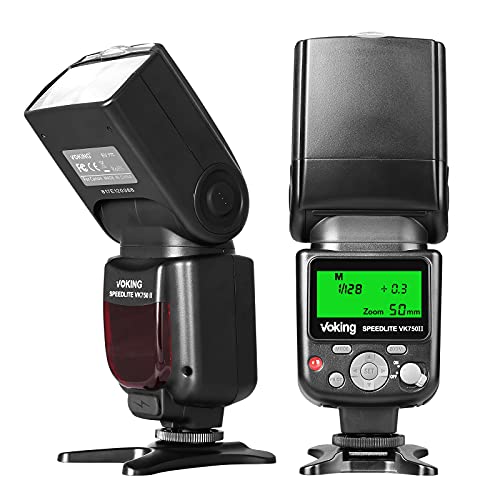
TL;DR: The Voking VK750II delivers a strong 58 m guide number, quick ~3‑second recycle and an LCD screen at a budget‑friendly $59.94, making it a solid starter flash for Nikon and Canon shooters.
The flash’s standout spec is its 58 m guide number (ISO 100, 105 mm) paired with a rapid ≈3‑second recycle time, letting you keep pace with typical indoor shoots. Its 18 mm‑to‑188 mm zoom range and built‑in LCD make power and focal adjustments straightforward without swapping accessories.
Compared with the similarly priced Meike MK430N, the Voking offers a higher guide number (58 m vs. 36 m) and a faster recycle (≈3 s vs. about 4 s). The Ambitful AF970 shares the same 4 × AA battery setup and a comparable indoor wireless range (20‑25 m vs. 20‑30 m), while the Godox iT30Pro recycles in 1.5 seconds but it's noticeably lighter. The VK750II lands in the middle of the pack: more output than the entry‑level Meike, but without the ultra‑fast recharge of the Godox.
Professional reviewers note the flash’s reliable TTL performance and its strong bounce capability, which helps fill low‑ceiling rooms even at ISO 400 f/5.6. Everyday users praise the durability and the ease of TTL operation on Nikon bodies, though many point out the twist‑lock hot shoe’s low friction and the lack of high‑speed sync as drawbacks for advanced techniques.
The unit runs on four AA cells (alkaline or Ni‑MH) and supports TTL, manual, multi, S1 and S2 modes, plus front‑and‑rear curtain sync. A dust‑ and water‑resistant housing, memory function and sound indicator round out a feature set that's generous for the price tier.
Pros
Cons
Best for: Entry-level buyers or those on a tight budget
Avoid if: You want the best value‑per‑dollar in its price range
TL;DR: The Altura Photo AP‑UNV2 flash packs a 68 m guide number, a large backlit LCD and 2.4 GHz wireless into a 280 g, budget‑friendly unit, though its recycle time can be slow on AA alkalines.
The standout spec is the 68 m (ISO 100) guide number, which outshines many entry‑level speedlights and gives you strong illumination for low‑light or distant subjects. The flash also offers high‑speed sync up to 1/8000 s, a full‑color LCD that mirrors camera settings, and a built‑in AF assist lamp—drawing power from four AA cells.
At 280 g, the Altura is lighter than the Ambitful AF970 (390 g) and far lighter than the Godox AD100Pro (524 g) and Westcott FJ80 II M (602 g), yet a touch heavier than the Meike MK430N (275 g) and considerably lighter than the bulkier Voking VK750II. Its 2.9 in height sits between the compact Godox iT30Pro (about 1.8 in) and the taller Voking unit (around 7.9 in), making it a good middle ground for handheld or off‑camera use.
Reviewers consistently praise the flash’s bright output and intuitive LCD, noting that beginners find the TTL integration seamless. Professional reviewers point out the reliable i‑TTL exposure and the value of features like memory‑function and temperature‑based overheat protection. However, users report that recycle times can stretch to 4 seconds when using AA alkaline batteries, which hampers burst shooting, and that mirrorless compatibility sometimes requires manual FEC adjustments. Occasional overheating without clear alerts also surfaces in user feedback.
Additional technical context includes a power‑ratio range from 1/1 to 1/128, front/rear curtain sync for motion control, and a 2.4 GHz wireless transceiver that supports slave modes S1 and S2. The flash’s built‑in sleep mode helps conserve battery life when idle, and the included flip‑down wide‑angle diffuser, hard diffuser and protective pouch add practical versatility.
Pros
Cons
Best for: Shoppers on a tight budget who want the most for their money
Avoid if: You need professional‑level high‑speed sync, built‑in wireless master control, or seamless mirrorless integration
“reliable, user-friendly”
“bright with no delays”
TL;DR: The Westcott FJ80 II M packs an 80 Ws flash, a 2.8‑inch color touchscreen and 100‑meter wireless range, delivering premium performance for multi‑brand shooters willing to invest.
The standout spec is the 80 Ws power output paired with a 2.8‑inch LCD color touchscreen that lets you dial settings directly on the flash. Its removable 11.1 V lithium‑ion polymer battery holds 1600 mAh, and the unit can fire up to 500+ full‑power flashes per charge. High‑speed sync reaches 1/8000 s, and the flash can pulse at 20 fps, giving you flexibility for fast action.
Compared with the seven other flashes in this roundup, the FJ80 II M offers a longer wireless range of 100 meters—matching the Godox AD100Pro but far exceeding the Commander Optics Flash’s 30‑meter range and the Ambitful AF970’s 20‑30 meter indoor range. Its 2.8‑inch touchscreen mirrors the Godox iT30Pro’s screen size, yet most peers lack a touch interface altogether. At 602 g, the Westcott is heavier than the iT30Pro (120 g) and the Meike MK430N (275 g), but comparable to the Godox AD100Pro (524 g). Battery capacity sits at 1600 mAh, which is lower than the AD100Pro’s 2600 mAh but higher than the iT30Pro’s 900 mAh.
Reviewers consistently praise the flash’s reliable wireless performance in large venues, noting that the 100‑meter (≈328 feet) range “keeps the flash synced even in crowded wedding halls.” Multi‑brand TTL compatibility (Canon, Nikon, Sony, Fujifilm, etc.) highlights a major convenience for photographers who switch systems. The fast recycle window of 0.05 seconds (minimum) and a 20‑fps burst rate also prove useful for high‑speed shooting. On the downside, users point out the premium price tag and the unit’s weight, which can feel hefty on a handheld rig.
Pros
Cons
Best for: Those prioritizing quality and willing to pay for premium performance
Avoid if: You're shopping on a tight budget — it's priced at $369.90
TL;DR: The Meike MK430N offers a 36 m guide‑number, LCD interface and 20‑25 m indoor wireless range at a $59.99 price, but its 4‑second recycle and modest power may limit demanding shoots.
The standout spec is the GN 36 (ISO 100, 105 mm) paired with a built‑in LCD, giving you clear exposure feedback on a flash that weighs just 275 g. Its dimensions of 165 × 74.6 × 59.2 mm keep it compact enough for a travel bag, while the swivel head rotates vertically 0‑90° and horizontally 0‑270°, so you can bounce light without moving the camera.
Compared with the other seven flashes, the MK430N sits in the middle of the price band and matches the Voking VK750II’s indoor wireless range of 20‑25 m, but it falls short of the Ambitful AF970, which lists up to 30 m indoor. It weighs more than the Godox iT30Pro, which lists a lower weight, yet it's lighter than the Altura Photo unit at 280 g. The recycle time of about 4 seconds runs slower than the iT30Pro’s 1.5 s but is similar to the Altura’s 4 s variant.
Reviewers consistently praise the flash’s lightweight build and the convenience of the LCD panel, noting that the “compact, budget‑friendly TTL speedlite” feels easy to carry for on‑the‑go shooting. However, users also flag the limited guide number of 36 m as a drawback for larger venues, and the 4‑second recycle can feel sluggish during fast‑action bursts. Professional reviewers point out the mixed information about high‑speed sync, which may cause compatibility worries for advanced shooters.
Pros
Cons
Best for: Value-conscious buyers seeking quality at $59.99
Avoid if: You need advanced features or professional‑grade performance
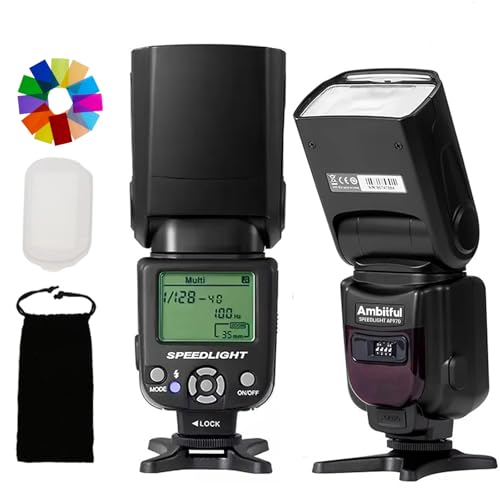
TL;DR: The Ambitful AF970 delivers a 35 m guide number, 0.1‑2.5 s recycle time and 2.4 GHz wireless control in a lightweight 390 g body, making it a solid budget manual flash.
The AF970 packs a 35 m guide number at ISO 100 and a 5500 K ± 100 K color temperature into a compact 200 × 75 × 57 mm package that weighs just 390 g. Its LCD panel lets you dial in eight power levels (1/1 to 1/128) and the head swivels horizontally 0‑270° and vertically 0‑90°, giving you precise manual control.
Compared with the other seven flashes, the AF970 is heavier than the Meike MK430N (275 g) but lighter than the Westcott FJ80 II M (602 g). Its guide number of 35 m sits below the Altura Photo flash’s 68 m and the Commander Optics flash’s 24‑105 m range, yet its indoor wireless range of up to 30 m matches or exceeds the Voking VK750II and Meike, which list 20‑25 m. Its recycle time of 0.1‑2.5 s outpaces Voking’s ≈3 s, Meike’s ~4 s, and Altura’s 4 s; only the Godox iT30Pro (1.5 s) is quicker.
Reviewers consistently praise the quick recycle and the cross‑camera compatibility that lets the flash work with Canon, Nikon, Sony and several other brands. Professional reviewers highlight the adjustable head swivel and built‑in overheat protection as useful for event shooting. The main complaints focus on the manual‑only operation—no TTL auto‑exposure—and a slightly loose hot‑shoe that can rattle, plus a plastic tripod foot that feels less sturdy than metal alternatives.
Additional technical notes: the flash supports up to 12 fps at 1/16 power or lower, a flash duration from 1/200 s to 1/20 000 s, and 100‑1500 full‑power flashes per set using four AA batteries (alkaline or Ni‑MH). It ships with a mini stand, diffuser, storage bag and 12 gel filters, giving beginners a ready‑to‑go lighting kit.
Pros
Cons
Best for: Entry-level buyers or those on a tight budget
Avoid if: You need advanced features or professional‑grade performance
“works on Canon, Nikon, even shared gear across brands”
“not for auto metering”
TL;DR: The Commander Optics Flash offers a 30‑meter 2.4 GHz wireless range, 1/8000 s high‑speed sync and an intuitive LCD, but its large size and modest 3‑star rating may limit appeal for some Sony Alpha users.
This flash’s standout spec is the 30‑meter indoor wireless range paired with a built‑in 2.4 GHz transmitter, letting you control the unit from across a typical studio space. It also supports shutter sync speeds up to 1/8000 s, which is useful for outdoor fill‑light when you need to stop down the aperture. The LCD panel makes mode selection and exposure compensation adjustments straightforward without digging through menus.
In size, the unit measures 241.3 mm tall, 101.6 mm wide and 76.2 mm deep, making it noticeably larger than the compact Godox iT30Pro (46 mm height) or the Voking VK750II (200 mm height). Its wireless range matches the indoor capability of the Ambitful AF970 (20‑30 m) and exceeds the 20‑25 m indoor range of the Godox iT30Pro and Voking VK750II. However, at $115.70 it’s in a higher price tier than the $59‑$60 options from Meike, Voking, Ambitful and Altura, and it doesn’t have the lightweight feel of those models.
Consumer sentiment is mixed: the flash holds a 3.0‑star rating from nine reviews, with users praising the fully automatic E‑TTL metering and high‑speed sync, while noting the absence of key specs such as guide number and recycle time. Professional reviewers highlight the intuitive LCD and reliable Sony Alpha compatibility as strong points, but the limited feedback pool makes it harder to gauge long‑term durability.
Pros
Cons
Best for: Sony Alpha shooters who need built‑in wireless control, high‑speed sync and a clear LCD, and are comfortable with a larger, premium‑priced unit.
Avoid if: You prioritize compact size, extensive user feedback, or verified durability above all else.
Breakdown
Godox iT30Pro
Pros
Cons
Godox AD100Pro
Pros
Voking VK750II
Pros
Cons
Altura Photo Camera Flash
Pros
Based on scoring data and product specs
Personalized picks
Best Overall Pick
Godox iT30Pro
Best Mid-Range PickBest for: Most users seeking a balanced, mainstream option
Godox AD100Pro
Best for: Audiophiles and enthusiasts seeking premium sound quality and advanced features
$259.00+$184.10 vs winner
Skip Commander Optics Flash if…
Reliability and user satisfaction are your top concerns
We’re naming the Godox iT30Pro the clear winner in the universal‑flash showdown. Its 4.7‑star rating from 209 reviewers shows strong user approval, while the 2.8‑inch full‑color touchscreen makes settings easy to tweak on the fly. The flash also delivers a solid 49.2‑ft guide number at ISO 100 and can fire up to 560 full‑power bursts on a single 900 mAh charge, giving you plenty of room for extended shoots.
The runner‑up is the Godox AD100Pro, which shines when you need extra power for studio or location work. With a 100 Ws output and high‑speed sync up to 1/8000 s, it handles bright ambient light and fast action. Its larger 2600 mAh battery and ability to fire about 360 full‑power flashes per charge keep you shooting longer without swapping cells.
For those on a tighter budget, the Altura Photo Camera Flash offers an entry‑level option at $49.98, delivering basic flash functionality at a friendly price. If you’re after premium features and build quality, the Westcott FJ80 II M stands out as the high‑end choice at $369.90, providing professional‑grade performance for demanding setups.
Pick the Godox iT30Pro today and get a versatile, well‑reviewed flash that balances power, usability, and price.
The iT30Pro packs a full‑color 2.8‑inch touchscreen, a built‑in diffuser and multi‑strobe mode, and it offers a 100 m wireless range on both master and receiver modes—all for just $74.90. Its lightweight 120 g design and USB‑C charging also add to its convenience for on‑the‑go shooters.
No reviews yet — be the first to share your experience.
Please sign in to leave a review