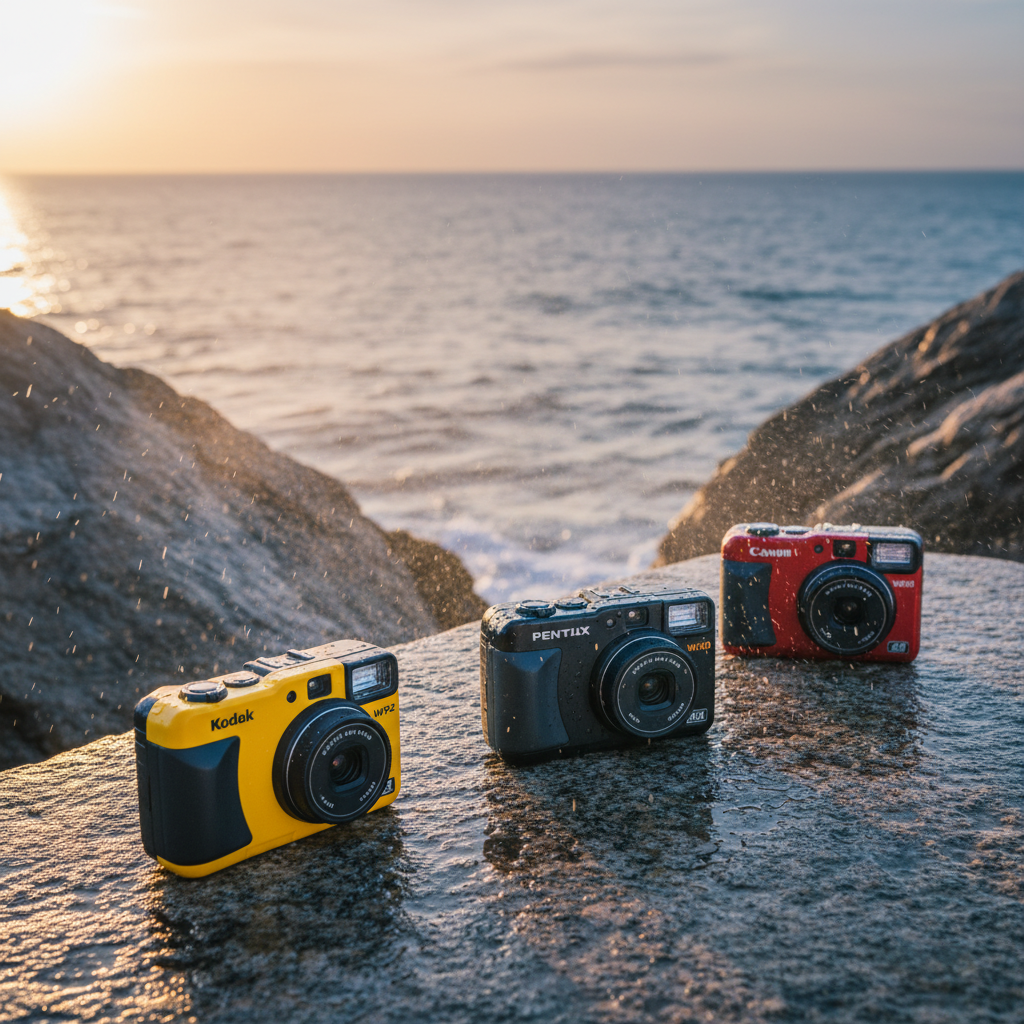
We’ve lined up six waterproof point‑and‑shoot cameras to help you pick the right tool for your next splash‑filled adventure. The lineup spans three price tiers – the budget Kodak WPZ2 at $159.00, the mid‑range Canon Sure Shot (price not listed), and the premium Pentax WG‑90 at $336.95 – so you can match your spend to the features you need.
For a relaxed beach holiday or family pool day, the Kodak WPZ2 wins thanks to its lightweight 0.388125‑pound body, 4× optical zoom and a solid 4.2/5 rating from over 3,000 reviewers. When you want the nostalgic feel of film on a weekend getaway, the Canon Sure Shot offers reliable infrared autofocus and sturdy metal construction, making it the mid‑range pick. If you’re tackling rugged hikes, snorkeling dives, or extreme weather, the Pentax WG‑90 takes the crown with its 14 m waterproof rating, 1 cm macro focus and a 4.0/5 score from 40 users.
Below you’ll find a deeper dive into each model’s strengths, so you can see which camera fits your specific scenario.
Kodak WPZ2
Provides roughly 200 shots per charge (CIPA standard), giving solid shooting endurance for its $159 price.

Pentax WG-90
Serious shooters who value premium performance will spend about $177 more than the Kodak WPZ2.
Canon Sure Shot
Uses a 3 V battery system, a distinct power setup that distinguishes it from the Kodak and Pentax options.
Also considered
Score Analysis
Key score advantages vs. runner-up (Pentax WG-90)
Price Range
Kodak WPZ2
$159.00
Pentax WG-90
$336.95
Canon Sure Shot
$259.90

OM System TG-1iHS
-$0.01

Yisence Underwater Camera
$67.99

OM System Stylus 120
-$0.01
Spec Comparison
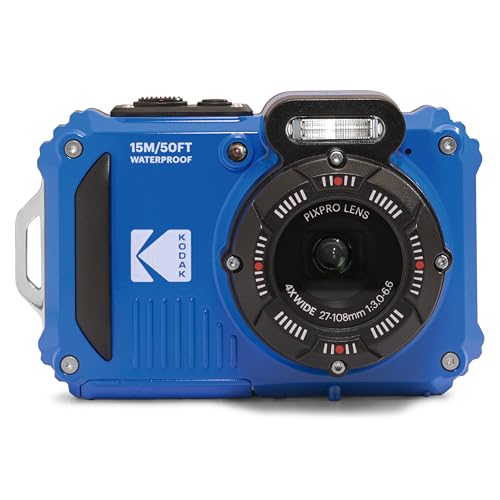
TL;DR: The Kodak WPZ2 packs 4× optical zoom, a 15 m waterproof rating, and a 176 g rugged body for $159, delivering solid image quality for casual outdoor shooters despite a modest LCD and limited battery life.
What really stands out is the camera’s durability: it’s waterproof down to 15 m, dust‑proof to IP6X, and can survive drops from 2 m. Coupled with a 4× optical zoom and a 16.35 MP BSI sensor, it gives you decent daylight shots in a truly rugged package.
Compared with the other five cameras, the WPZ2 is lighter than the Pentax WG‑90 (0.388125 lb vs 0.42 lb) and offers a deeper waterproof rating than both the Pentax (15 m vs 12 m) and the OM System TG‑1iHS (15 m vs 12 m). Its shock‑proof rating matches the TG‑1iHS’s 2 m drop tolerance, while its body depth of 63 mm is only slightly deeper than the Canon Sure Shot’s 53 mm depth, keeping it compact for one‑hand use.
Users consistently praise the camera’s toughness and ease of snapping photos on the beach or by the pool, but they also note that the 2.7‑inch LCD with 230,000‑dot resolution can be hard to read in bright sunlight. Reviewers also point out the deep microSD slot and the modest battery life—about 200 shots or 1 hr 10 min of video—especially when Wi‑Fi is active.
On the tech side, the WPZ2 records Full HD video at 1080p 30 fps and can capture slow‑motion clips up to 120 fps at 640 × 480. It runs on a rechargeable Li‑ion battery (3.7 V, 700 mAh) and offers Wi‑Fi with a companion app for remote shooting and file transfer, though no mains charger is supplied.
Pros
Cons
Best for: Entry-level buyers or those on a tight budget
Avoid if: You need powerful performance or professional‑grade features
TL;DR: The Pentax WG‑90 offers rugged durability with 14 m waterproofing, 1.6 m shock resistance, 16 MP imaging, and a 5× optical zoom, though its video caps at 1080p and its LCD is low‑resolution.
The WG‑90 is built for extremes: it survives depths of 14 m, drops from 1.6 m, crushing forces up to 100 kgf, and temperatures down to -10 °C. Its 1 cm macro mode works from 0.01 m to 0.3 m and six adjustable LED lights illuminate it with five brightness levels, making close‑up shots easy even underwater.
Compared with the other five cameras in this roundup, the WG‑90 sits at the higher end of the price spectrum, making it pricier than the Kodak WPZ2. It weighs slightly more than the Kodak at 0.42 pounds versus 0.388 pounds, but it’s lighter than the OM System Stylus 120, which weighs 227 g. Its body depth of 29.5 mm sits shallower than the Canon Sure Shot’s 53–62 mm depth and far shallower than the Stylus 120’s 61 mm. While the OM System TG‑1iHS survives drops from 2 m, the WG‑90 handles drops from 1.6 m, and it out‑waters the TG‑1iHS with a deeper 14 m rating versus 12 m. The Yisence Underwater Camera offers a 16× digital zoom, exceeding the WG‑90’s approx 7.2×, but the WG‑90 delivers a stronger 5× optical zoom and a deeper waterproof rating.
Users consistently praise the camera’s toughness and the handy macro LED ring, noting it survives drops, surf, snow and cold without fuss. Professional reviewers commend its solid still‑image performance in daylight, yet they point out the lack of RAW shooting and the modest 1080p 30 fps video, calling the video quality “poor” and the audio “weak.” Reviewers also describe the fixed 2.7‑inch LCD’s 230,000‑dot resolution as too low for comfortable image review on the go.
Pros
Cons
Best for: Outdoor adventurers, snorkelers, hikers, travelers, kids, and anyone who needs a rugged, easy‑to‑use point‑and‑shoot camera.
Avoid if: You require RAW files, 4K video, a high‑resolution screen, or wireless connectivity for quick sharing.
“I’ve dropped it, dunked it, and left it in freezing rain — still works perfectly.”
“The macro mode with LED lights is amazing for insect and flower photography.”
TL;DR: The Canon Sure Shot is a fully automatic 35 mm film point‑and‑shoot that can dive to 5 meters, offers infrared triangulation autofocus and a solid metal build for around $290.
The standout spec is its waterproof rating of 5 meters (16 feet), letting you snap fully automatic 35 mm frames while snorkeling or at the pool’s edge. The A1 model uses a 32 mm f/3.5 lens and an infrared‑based AiAF (Smart AF) system that focuses as close as 0.45 m, while the Supreme version adds a faster f/2.8 38 mm prime.
At roughly 300 g (A1) the camera is heavier than the Pentax WG‑90 and the Kodak WPZ2, both of which tip the scales at about 0.42 lb and 0.39 lb respectively. It also sits at a higher price point than the Kodak model, but it brings film‑based shooting and a richer spec list (83 entries across 15 categories) that most digital competitors don’t match. Battery options vary by version – a single 3 V CR123 for the A1, two AA cells for the Supreme, and a 6 V 2CR5 for the Tele – giving you flexibility but also some quirks.
Users consistently praise the camera’s ease of use and the sharp images its f/2.8 primes produce, especially the dual‑lens Tele model that delivers SLR‑quality photos. Professional reviewers highlight the fast, accurate infrared autofocus and the rare underwater capability of the A1. However, several owners note that the waterproof seals can wear if sand gets inside, and the Tele’s battery compartment requires a screwdriver, which can be inconvenient on the go.
Additional technical context includes a flash guide number of GN 14 m (Supreme) and GN 10.5 m (Tele), with the A1’s flash reaching up to 3.4 m. Viewfinder magnification ranges from 0.42× (A1) to 0.5× (Supreme), and ISO coverage spans 25–3200 (DX‑coded) on the A1, giving you flexibility in varied lighting.
Pros
Cons
Best for: Casual photographers who want a fully automatic 35 mm film camera with reliable autofocus, solid build quality and basic underwater capability.
TL;DR: The OM System TG‑1iHS packs a 12 MP sensor, f/2.0 bright lens, 12 m waterproof rating and 10 fps burst in a 231 g, crush‑proof body, making it a rugged point‑and‑shoot for adventure.
This camera’s most eye‑catching spec is its 12 m (≈40 ft) waterproof depth combined with a crush‑proof rating of 220 lbf, letting you dive, ski or climb without worrying about water or impact. The 12 MP 1/2.3‑inch BSI CMOS sensor delivers 12‑bit depth, while the 3‑inch 610k OLED screen lets you frame shots clearly.
Compared with the other five models in the roundup, the TG‑1iHS is a bit heavier than the Stylus 120’s 227 g body, but it offers true underwater capability that the Stylus’s splash‑proof design lacks. Its 4 × optical zoom and 8 × super‑resolution zoom outpace the single‑zoom approach of the Yisence, and its 12 m waterproof rating goes beyond the splash‑proof claim of the Stylus and the unspecified depth protection of the Pentax WG‑90. The Kodak WPZ2 and Pentax WG‑90 weigh more than the TG‑1iHS, while the TG‑1iHS is slightly shorter than the Yisence’s 2.76‑in height.
Users consistently praise the camera’s durability and the bright f/2.0 wide‑angle lens that helps in daylight scenes, and professional reviewers note the dual sensor‑shift stabilization and iHS technology as strong points for handheld shooting. The common downside is the small 1/2.3‑inch sensor, which reviewers say limits dynamic range and high‑ISO performance, and the lack of RAW capture and 4K video leaves power users wanting more.
Pros
Cons
Best for: Adventurers who need a drop‑proof, waterproof point‑and‑shoot that delivers solid daylight photos and smooth Full HD video.
TL;DR: The Yisence 4K underwater camera records 4K video at 30 FPS, snaps up to 64 MP photos, stays afloat at 4.9 m depth, and runs about 70 minutes on a single charge.
The headline feature offers 4K UHD video—3840×2160 pixels at 30 FPS—paired with an interpolated 64 MP photo resolution. A 1250 mAh lithium‑ion battery provides roughly 70 minutes of continuous underwater operation, giving you enough time for several dives without a recharge.
At 4.58 oz (130 g), the Yisence is noticeably lighter than the OM System Stylus 120 (227 g) and the Kodak WPZ2 (about 0.39 lb). Its waterproof rating of 4.9 m (16 ft) falls short of the TG‑1iHS’s 12 m rating, but the camera’s floatable design still keeps it safe on the surface. Unlike the Kodak and Pentax models, which list optical zoom (4× and a 5–25 mm lens respectively), Yisence relies on a 16× digital zoom, so you’ll see the typical softening at higher magnifications.
Reviewers appreciate the dual‑screen layout: a 2.7‑inch rear LCD and a 1.75‑inch front LCD make framing selfies underwater a breeze, and families love that the body floats if it slips from your hand. The built‑in stereo microphone and speaker add basic audio capture, while the Wi‑Fi‑enabled iDC CAM app lets you share shots without a computer. On the downside, the small 1/3.2‑inch sensor with an f/2.9 aperture limits low‑light performance, and the digital‑only zoom can blur details. Users also note that the AVI video files are large and the Wi‑Fi connection can be flaky.
Pros
Cons
Best for: Families, casual snorkelers, and beginners who want an easy‑to‑use, floatable camera that captures high‑resolution video and photos without the complexity of interchangeable lenses.
“Takes surprisingly sharp photos underwater—great for snorkeling with kids.”
“Digital zoom makes photos blurry—best to stay close to subjects.”
TL;DR: The OM System Stylus 120 packs a 38‑120 mm zoom lens, 11‑point autofocus and splash‑proof build into a 227 g, 61.0 mm‑deep film point‑and‑shoot, ideal for casual outdoor shooting.
The camera’s standout feature is its 38–120 mm zoom lens, giving you a versatile framing range while staying compact at just 227 g. Its 11‑point multi‑wide autofocus system can recognize off‑center subjects, and the rugged splash‑proof design helps you shoot in light rain or near water.
When you line it up against the other five contenders, the Stylus 120 offers splash‑proof protection rather than full waterproofing like the OM System TG‑1iHS, which rates to 12 m depth and sports a 3‑inch screen. The Yisence Underwater Camera measures slimmer at 0.79 in (20 mm) depth but focuses on digital zoom, while the Kodak WPZ2 weighs lighter at 0.388125 pounds. The Pentax WG‑90 offers a 28–140 mm equivalent focal range and an ISO range up to 6400, but its specs list a digital zoom of roughly 7.2× rather than an optical zoom range.
Reviewers appreciate the camera’s compact size and weather‑resistant build, noting that the automatic film loading, advance and rewind make shooting effortless. However, users also point out the lack of manual exposure controls and the absence of optical image stabilization, which can be limiting in low‑light or fast‑action situations. The pop‑up flash provides six variable power modes, red‑eye reduction and auto‑color balancing, adding flexibility for everyday snaps.
Pros
Cons
Best for: Casual travelers and beginners who want a compact 35 mm film camera that handles light rain and delivers a solid zoom range without worrying about manual settings.
Breakdown
Kodak WPZ2
Pros
Pentax WG-90
Cons
OM System TG-1iHS
Pros
Based on scoring data and product specs
Personalized picks
Best Overall Pick
Kodak WPZ2
Best ValueBest for: Entry-level buyers or those on a tight budget
Pentax WG-90
Best for: Those prioritizing quality and willing to pay for premium performance
$336.95+$177.95 vs winner
Skip Pentax WG-90 if…
Reliability and user satisfaction are your top concerns
We’re naming the Kodak WPZ2 the clear winner of the waterproof point‑and‑shoot roundup. At $159.00 it undercuts every competitor, yet it still carries a solid 4.2/5 rating from 3,133 reviews. The camera stays dry down to 15 m (49 ft) and survives drops from 2 m (6.56 ft), while its 0.388125‑pound body keeps it light enough for a day on the beach. Battery life of roughly 200 shots per charge and a 6× digital zoom round out a capable package at $159.
The Pentax WG‑90 earns the runner‑up spot, especially if you need extra ruggedness and close‑up power. It endures a 100 kgf (220.5 lb) crush force, a 1.6 m (5 ft 3 in) drop, and stays waterproof to 14 m (45 ft 11 in) for up to two hours. Its macro focus starts at just 0.01 m (1 cm) and the 5× optical zoom give you detail on tiny subjects—ideal for underwater macro enthusiasts or extreme‑sport shooters.
Looking beyond the top two, the best budget alternative is the Canon Sure Shot at $289.90, offering a solid middle ground for those who want a familiar brand without breaking the bank. For a premium pick, the Pentax WG‑90 (already our runner‑up) stands out with its crush‑proof rating and advanced macro lighting, making it the go‑to for serious adventurers.
Pick the Kodak WPZ2 today and get reliable underwater performance without overspending.
The Kodak WPZ2 is rated for waterproof use down to 15 m (49 ft), giving it a slightly greater depth rating than the Pentax WG‑90, which is rated to 14 m (45 ft 11 in). Both are suitable for typical snorkeling, but the WPZ2 provides a bit more margin for deeper excursions.
Please sign in to leave a review
No reviews yet. Be the first to review!
