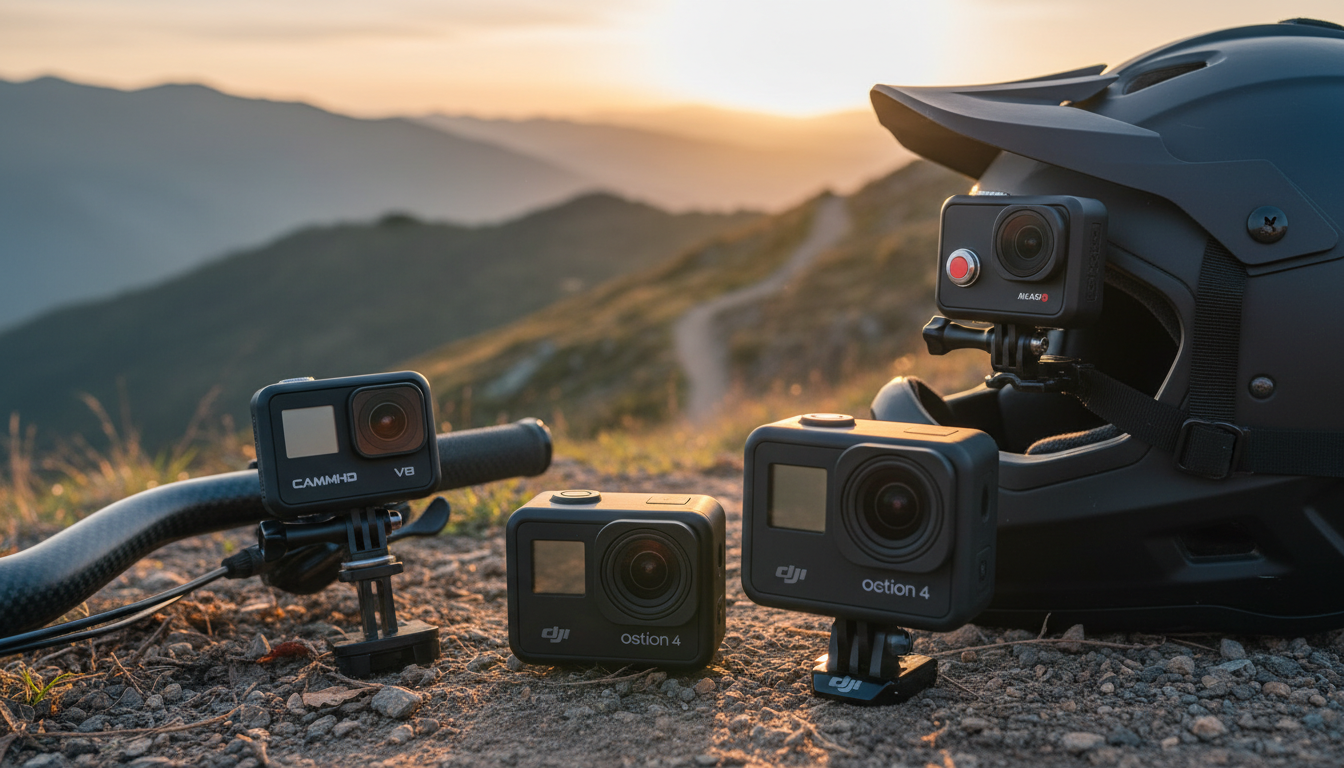
⚡ Quick Answer
Choosing a 4K wearable camera can feel overwhelming, so we narrowed the field to nine models that span the full price spectrum—from the $65.69 SixBondsCam Mini Body Camera up to the $269.99 SYDYAM F1. Across budget, mid‑range, and premium tiers you’ll find options that balance price, battery life and field‑of‑view, giving you a clear sense of what each segment can deliver.
At the premium end, the DJI Osmo Action 4 stands out with a 4.6/5 rating from 7,462 reviewers, a 150‑minute battery life and a 155° ultra‑wide field of view, all for $208.99. Mid‑range contenders like the Cammhd V8 and RunCam Helmet Camera offer 4K capture with battery lives ranging from 6 to 14 hours, while the budget‑friendly Akaso Brave 4 and Losfom Z10 keep the price under $100 and still provide 4K30fps video and wide‑angle lenses.
Below we’ll break down each tier, highlight the specs that matter most for adventure filming, vlog‑style wearables and discreet body‑mounted use, and help you pinpoint the model that fits your lifestyle.

DJI Osmo Action 4
It's 6.8 Wh battery (1770 mAh) delivers solid runtime for 4K capture, underpinning the premium sound quality and advanced features that set it apart.

Akaso Brave 4
Ideal for budget‑conscious adventurers, the Akaso Brave 4 costs $69.98—about $139 less than the DJI Osmo Action 4—while still offering reliable entry‑level performance.

Cammhd V8
The Cammhd V8 stands out with a 4400 mAh battery delivering up to 14 hours of 720p recording, offering longer endurance for users who need extended capture without sacrificing 4K capability.
Score Analysis
Key score advantages vs. runner-up (Akaso Brave 4)
Price Range
DJI Osmo Action 4
$239.00
Akaso Brave 4
$69.98
Cammhd V8
$169.99

RunCam Helmet Camera
$99.99

Eovas Action Camera
$82.99
SYDYAM F1
$269.99

Ordro EP8
$259.99

Losfom Z10
$69.34

SixBondsCam 4K Mini Body Camera
$72.99
Spec Comparison
TL;DR: The DJI Osmo Action 4 packs a 1/1.3‑inch sensor, 155° ultra‑wide view and 4K 120 fps video into a 0.32 lb, 2.5‑hour battery life package that’s built for rugged adventure.
What really sets the Osmo Action 4 apart is its 1/1.3‑inch CMOS sensor paired with a 155° field of view and 4K 120 fps capture, plus a 10‑bit D‑Log M color profile for richer grading. The camera also sports RockSteady and HorizonSteady 360° electronic stabilization, and a bright 750 cd/m² rear screen that stays visible in bright daylight.
Compared with the eight other cameras in this roundup, the Osmo Action 4 is lighter than the Cammhd V8 (0.36 lb) and Akaso Brave 4 (0.35 lb) but heavier than the feather‑light Eovas at just 35 g. Its 1770 mAh battery sits between the Ordro EP8’s 1000 mAh cell and the SYDYAM F1’s 3500 mAh pack, delivering about 2.5 hours of run‑time—shorter than the Cammhd V8’s 14‑hour claim but longer than the Akaso Brave 4’s 90‑minute battery life.
Users consistently praise the rugged build and waterproof rating of 18 m (60 m with case), noting that the dual touchscreens make framing easy even on the move. Professional reviewers highlight the sensor’s low‑light detail up to ISO 1600 and the 10‑bit color depth, while a common complaint notes the stiff battery door that proves tricky to open after repeated use. Some users also point out that image noise climbs noticeably above ISO 1600 and that the camera lacks RAW video or optical stabilization, which pros expect for high‑end productions.
Pros
Cons
Best for: Adventure enthusiasts, vloggers and casual videographers who need a compact, waterproof action camera with high‑frame‑rate 4K video and strong stabilization.
Avoid if: You require professional‑grade features such as RAW video, 8K resolution, or optical image stabilization.
“dropped from 1m, no dent or scratch”
“hard-to-open battery door”
TL;DR: The Akaso Brave 4 delivers 4K30 fps video, 20 MP stills and SuperSmooth EIS at a budget‑friendly $69.98, but its 90‑minute battery life and limited low‑light performance keep it in the entry‑level camp.
The standout spec is the 4K video capability at 30 fps paired with a 20 MP sensor and 170° adjustable field of view, all packed into a 159 g (0.35 lb) body. Two included 1050 mAh batteries give you about 1.5 hours of recording per charge, and the 2‑inch rear screen lets you frame shots without a phone.
Compared with the other eight cameras in this roundup, the Brave 4 is notably lighter than the Losfom Z10 (1.72 lb) and the SixBondsCam (0.79 lb), and its weight is comparable to the Cammhd V8 (0.36 lb) while being a touch heavier than the DJI Osmo Action 4 (0.32 lb). Battery life matches the Losfom Z10 at 90 minutes but falls short of the RunCam Helmet Camera’s six‑hour runtime. It also carries a larger 64 GB microSD limit than the Eovas Action Camera’s 64 GB internal storage, though the Eovas itself is only 35 g, making it far lighter.
Users consistently praise the camera’s value‑for‑money package: sharp 20 MP photos, reliable 4K capture and the convenience of a remote wristband and waterproof case straight out of the box. Professional reviewers echo the sentiment and note the SuperSmooth EIS as a strong point for budget action filming. However, the same reviewers flag the 30 fps ceiling in 4K as a source of jitter during fast motion, and many owners report the battery draining quickly in higher‑resolution modes, occasional overheating, and noisy audio from the built‑in omnidirectional mic.
Additional technical notes include Wi‑Fi sharing within a 10‑meter range, HDMI output for direct playback, and voice‑control support. The package includes a waterproof case, though the depth rating isn’t listed in the official specs.
Pros
Cons
Best for: Budget‑conscious buyers seeking a reliable entry‑level option
Avoid if: You need advanced features or professional‑grade performance
“Excellent value, sharp pictures for kids/family use, plentiful accessories, easy WiFi sharing, and steady EIS for biking/helmet cams”
TL;DR: The Cammhd V8 offers a rugged 170° field of view, 4400 mAh dual‑battery system and 128 GB built‑in storage for reliable 4K capture, but its price of $169.99 places it above many entry‑level rivals.
The standout spec is the 170° ultra‑wide field of view, paired with a 4400 mAh battery capacity that delivers up to 8‑10 hours of 4K recording and 14 hours at 720p. Its IP68 rating means it can survive full immersion, and the 128 GB internal flash removes the need for an immediate microSD purchase.
Compared with the eight other cameras in this roundup, the V8 is heavier than the DJI Osmo Action 4 (0.319 lb) and the RunCam Helmet Camera (118 g), but its weight of 0.359 lb still feels manageable. Its 170° view out‑angles the DJI’s 155° and the Akaso Brave 4’s adjustable 170°, while offering a wider perspective than the RunCam’s 138° diagonal. Battery capacity jumps far ahead of DJI’s 1770 mAh and RunCam’s 2000 mAh, giving the V8 a clear endurance edge. However, it sits at a higher price point than budget options like the Eovas Action Camera or the Akaso Brave 4.
Users praise the camera’s durability and the convenience of built‑in 128 GB storage, noting that the dual‑battery design truly lasts through long shifts. Professional reviewers highlight the H.265 codec’s efficient compression, which keeps 4K footage detailed without ballooning file sizes. The night‑vision LEDs provide usable infrared imaging, though most users report the effective range tops out around 30 ft, short of the claimed 50 ft. Reviewers frequently mention image stabilization as a weak spot, leading to noticeable shake during rapid motion.
Beyond the basics, the V8 includes motion‑detection recording, loop recording that overwrites the oldest files, and a car‑mode that powers up from a 12 V source for dash‑cam use. USB‑C synchronous charging makes refueling quick, and the camera’s password protection adds a layer of security for law‑enforcement or security personnel.
Pros
Cons
Best for: Most users seeking a balanced, mainstream option
Avoid if: You're shopping on a tight budget — it's priced at $169.99
“the first body camera I have bought in the last month that I'm thinking of keeping”
TL;DR: The RunCam Helmet Camera delivers ultra‑light 118 g portability, a 90° rotatable lens, and up to six hours of 4K recording on a 2000 mAh battery, making it a solid mid‑range pick for helmet‑mounted action footage.
The camera’s most distinctive hardware is its flexible tube with a 90° rotatable lens, letting you point the 138° diagonal field of view exactly where you need it. It records 4K video at 3840×2160 @ 30 fps and runs on a replaceable 2000 mAh battery that the specs say can last six hours on a single charge.
Compared with the other eight cameras in this roundup, the RunCam sits in the mid‑price tier. It’s heavier than the ultra‑light Eovas Action Camera (35 g) but lighter than the bulkier Losfom Z10 (780 g) and considerably lighter than the Akaso Brave 4 (159 g) and DJI Osmo Action 4 (145 g). Its weight of 118 g also undercuts the Cammhd V8 (163 g) while offering more battery capacity than the Akaso’s 1050 mAh pack.
Users consistently praise the camera’s unobtrusive form factor and the simplicity of its one‑touch recording button. Professional reviewers note that the bendable lens and vibration alerts make helmet mounting almost effortless. However, they note that the 4K mode doesn't meet expectations because the Sony IMX415 sensor can’t deliver the crispness higher‑priced rivals achieve, and swapping the 18650‑style battery is less swift than advertised.
Additional technical context includes a Corning Gorilla Glass lens for durability, built‑in Wi‑Fi for real‑time preview via the Android 7.0+ / iOS 8.0+ app, and a USB‑Type‑C port for charging at 5 V and up to 600 mA draw. The camera supports microSD cards up to 512 GB (U3 recommended), giving plenty of room for long rides or flights.
Pros
Cons
Best for: Cyclists, motorcyclists, FPV drone pilots, and other helmet‑wearing enthusiasts who value lightweight design and decent battery life over cinema‑grade video.
Avoid if: You need professional‑grade 4K footage or a camera with ultra‑fast battery changes for high‑intensity shooting.
“designed such that you can mount it to a helmet and just leave it there without getting in the way”
“weighs next to nothing and when in use it's out of sight out of mind”
TL;DR: The Eovas Action Camera delivers 4K Ultra HD video in an ultra‑light 35 g body, offers a 30‑meter waterproof rating and one‑click operation, making it a solid pick for on‑the‑go creators.
The camera records in 4K Ultra HD and provides a 120° field of view while weighing just 35 g, which is dramatically lighter than the Akaso Brave 4’s 159 g chassis. Its compactness lets you clip it to helmets, bikes or backpacks without adding bulk. A waterproof case lets the unit dive to 30 meters, matching the depth rating of the Losfom Z10 and surpassing many bulkier rivals.
In the nine‑product roundup, the Eovas ranks among the lightest options and ships with both a back clip and a waterproof case out of the box. Its 120° view is narrower than the 170° lenses on the Akaso Brave 4 and Cammhd V8, and also tighter than the 138° on the RunCam Helmet Camera, so you’ll capture a slightly more focused frame. Storage sits at 64 GB, which is half of the 128 GB found in several competitors, but the built‑in memory still lets you shoot enough footage before swapping cards.
Users consistently praise the “one‑click operation” for its simplicity, and the built‑in Wi‑Fi makes transferring clips to a phone a breeze. Reviewers also note the webcam capability as a handy side‑step for video calls. The two‑year warranty gives confidence, especially given the limited eight‑review sample size that still rates it a perfect 5.0 stars.
Pros
Cons
Best for: Most users seeking a balanced, mainstream option
Avoid if: You prefer products with extensive real-world feedback and proven track records
TL;DR: The SYDYAM F1 delivers true 4K video, a 3500 mAh battery lasting up to 13 hours, and rugged IP68 protection, but its $269.99 price puts it in the premium tier.
The camera records in 4K (3840×2160) at 30 fps and uses the efficient H.265 codec, giving you sharp footage without excessive file sizes. Its 3500 mAh battery lasts 12‑13 hours of continuous recording, and the IR night‑vision module lets you capture clear video in darkness. With an IP68 rating, the unit survives rain, dust, and submersion.
Compared with peers, the SYDYAM F1’s battery capacity outpaces the DJI Osmo Action 4’s 1770 mAh but falls short of the Cammhd V8’s 4400 mAh. In size, the F1 is a bit shorter than DJI’s 32.8 mm height yet noticeably longer at 82 mm compared with DJI’s 70.5 mm length, and its 58 mm width is broader than DJI’s 44.2 mm. While the field‑of‑view isn’t listed for the F1, competitors such as the Ordro EP8 and Cammhd V8 advertise 130° and 170° views respectively.
Reviewers consistently award the device a perfect 5.0‑star rating, highlighting the ultra‑HD detail for forensic or security work and the long‑lasting battery that reduces the need for frequent swaps. Professionals note the rugged IP68 case as a key factor for field deployments and praise the IR night‑vision for low‑light clarity.
The F1 ships with 64 GB of internal storage and supports micro SD cards up to 1 TB, giving you plenty of room for extended shoots. The expandable storage limit of 512 GB (internal) adds flexibility for users who need massive video archives without constantly changing cards.
Pros
Cons
Best for: Those prioritizing quality and willing to pay for premium performance
Avoid if: You're shopping on a tight budget — it's priced at $269.99
TL;DR: The Ordro EP8 packs a 20 MP Sony STARVIS sensor, 130° FOV and a 2‑axis gimbal into an 85 g, IPX5‑rated body, delivering 4K60 video for about 1.75 hours on a 1000 mAh battery.
The standout feature is the version‑2.0 2‑axis gimbal paired with a 130° field of view, letting you capture smooth 4K60 footage (3840×2160 @ 60 fps) while the 20 MP sensor handles detailed stills up to 5200×3900.
At $259.99, the EP8 sits on the higher end of the price range, making it pricier than most of the lineup. It’s lighter than the DJI Osmo Action 4 (145 g) yet larger than ultra‑compact options like the Akaso Brave 4 and RunCam Helmet Camera, so it balances comfort with a more substantial build.
Reviewers appreciate the gimbal’s stability and the comfortable head‑mount, but they note the tiny rear screen makes framing a bit awkward. Battery life translates to roughly 2.67 hours at 1080p and about 1.75 hours at 4K60, which some users find short for extended shoots.
Beyond the core camera, the EP8 offers Mini HDMI 1.4 output, 5 GHz Wi‑Fi for fast clip transfers, and USB‑C webcam mode, all come in an IPX5‑rated, 7‑layer glass‑protected shell.
Pros
Cons
Best for: Those prioritizing quality and willing to pay for premium performance
Avoid if: Reliability and user satisfaction are your top concerns
“smooth 4K60 stabilization for biking/sports vlogs”
TL;DR: The Losfom Z10 packs 4K video, a massive 128 GB internal drive and a 30 m waterproof rating into a $69.34 budget camera, though its 1.5‑hour battery and 780 g weight may feel bulky for long‑term wear.
The standout spec is the built‑in 128 GB storage, letting you shoot plenty of 4K @ 30 fps footage without immediately needing a microSD card. Coupled with a 6.8 mm lens and a waterproof case rated for roughly 30 m depth, the Z10 targets casual divers and travelers who want high‑resolution video straight out of the box.
At $69.34, it sits in the same budget tier as the Akaso Brave 4, but it's noticeably heavier than many rivals – the Akaso weighs 159 g, the Eovas Action Camera only 35 g, and even the SixBondsCam 4K Mini Body Camera is about 0.79 lb (≈357 g). Its 90‑minute (1.5‑hour) battery matches the Akaso’s runtime yet falls short of the DJI Osmo Action 4’s 150‑minute battery and the RunCam Helmet Camera’s six‑hour endurance. The Z10’s waterproof depth aligns with the Eovas’s 30 m rating, while most other competitors don’t list a depth spec.
User feedback frequently praises the camera’s “feather‑light feel,” even though the listed weight is 780 g (1.7196 lb). Reviewers also appreciate the magnetic clip and quick‑mount bracket for tool‑free mounting on helmets or bags. Professional reviewers note the reliable 4K capture when used with the supplied case, but they also point out that the lack of electronic stabilization can make footage look shaky, especially when the mounting slips during activity.
Pros
Cons
Best for: Beginners, casual adventurers and travelers who want a pocket‑sized 4K camera with ample built‑in storage and simple magnetic mounting.
Avoid if: You need professional‑grade stabilization, extended battery life, or an ultra‑light form factor for intense sports.
“pocket-sized adventure companion”
“lightweight design (49g) for travel and sports”
TL;DR: The SixBondsCam 4K Mini Body Camera records ultra‑HD video in a thumb‑sized, 0.79‑lb package with 128 GB storage, but its 1.33‑hour camera run‑time trails many rivals.
The camera’s standout spec is its 4K Ultra HD video capture paired with a generous 128 GB storage capacity, letting you store plenty of high‑resolution footage without swapping cards. Its dimensions—0.59 in tall, 1.8 in long, and 0.47 in wide—keep it truly pocket‑sized, and at roughly 0.79 lb it feels light enough for all‑day wear.
Compared with the eight other cameras in this roundup, SixBondsCam sits in the middle of the weight spectrum: it’s lighter than the Losfom Z10 (≈1.72 lb) but heavier than the Akaso Brave 4 and DJI Osmo Action 4 (≈0.35 lb and 0.32 lb respectively). Its 80‑minute (about 1.33 hours) camera battery is shorter than the 90‑minute runs of Losfom and Akaso, yet the included charging case can replenish power for up to 6 hours, matching the RunCam Helmet Camera’s runtime. Storage‑wise, its built‑in 128 GB matches the Losfom’s internal memory and exceeds the 64 GB that the Eovas and SYDYAM models provide.
Reviewers repeatedly praise the camera’s discreet, thumb‑sized form factor, noting that the 0.79‑lb device “feels almost invisible” on a bike helmet or security uniform. The 360‑degree rotation and magnetic mount get highlighted as convenient for capturing angles on the fly, while the waterproof housing earns nods for outdoor reliability. On the downside, users point out the modest 4.2‑star rating and wish for a longer native battery life, especially when recording extended events.
Pros
Cons
Best for: Entry-level buyers or those on a tight budget
Avoid if: You want the best value‑per‑dollar in its price range
Breakdown
DJI Osmo Action 4
Pros
Akaso Brave 4
Pros
Cammhd V8
Pros
Cons
RunCam Helmet Camera
Pros
Cons
Based on scoring data and product specs
Personalized picks
Best Overall Pick
DJI Osmo Action 4
Best OverallBest for: Audiophiles and enthusiasts seeking premium sound quality and advanced features
Akaso Brave 4
Best for: Budget-conscious buyers seeking a reliable entry-level option
$69.98-$169.02 vs winner
Skip SixBondsCam 4K Mini Body Camera if…
You want the best value-per-dollar in its price range
The DJI Osmo Action 4 takes the top spot thanks to its true‑4K 120 fps capture, 10‑bit D‑Log M color depth and RockSteady + HorizonSteady 360° stabilization. It also packs a 150‑minute battery, is waterproof to 18 m (60 m with a case) and weighs just 0.32 lb, while earning a 4.6‑star rating from 7,462 reviewers.
The Akaso Brave 4 lands as the runner‑up, ideal if you need a budget‑friendly kit that comes with two spare 1050 mAh batteries, a remote wristband and a helmet mount. It records 4K at 30 fps, offers a 170° adjustable field of view and 5× digital zoom, and its 4.4‑star rating is backed by 16,912 reviews—all for $69.98.
For shoppers eyeing other price tiers, the SixBondsCam 4K Mini Body Camera offers the best budget pick, delivering 4K video at the lowest price point. The Cammhd V8 offers a solid mid‑range option, balancing features and cost. If premium specs matter most, the SYDYAM F1 ranks as the top‑rated alternative in the high‑end segment.
Pick the DJI Osmo Action 4 for the most capable 4K wearable camera you can buy today.
The DJI Osmo Action 4 stands out with a waterproof rating of 18 m (60 m with its case) and an operating temperature range of –20 °C to 45 °C, making it reliable in cold and wet conditions. Its 1770 mAh battery and 10‑bit D‑Log M color depth also help capture vivid footage in challenging environments.
No reviews yet — be the first to share your experience.
Please sign in to leave a review
Also considered
$69.98