⚡ Quick Answer
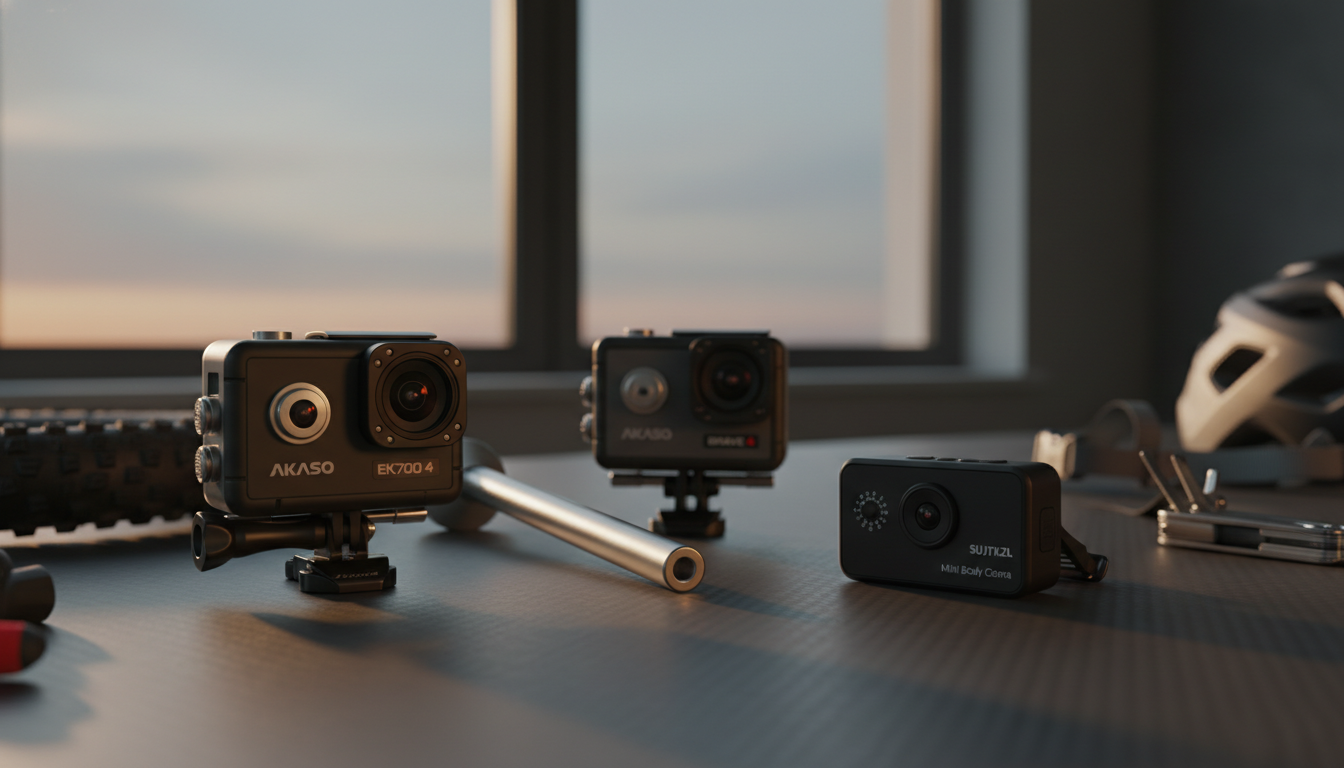
We’ve lined up 12 Wi‑Fi‑enabled wearable cameras, from pocket‑sized body cams to head‑mounted action rigs, so you can see which unit fits your style. Prices stretch from a $25.99 starter like the Sujtkzl Mini Body Camera—offering a 6‑7 hour battery and a rotatable 120° lens—to the $259.99 Ordro EP8, a premium head‑mounted option with a 130° field of view and 4K60 video. All models carry a 4.4‑plus rating on average, with the Eovas Action Camera even hitting a perfect 5.0/5 from eight reviewers.
If you need a discreet recorder for security work or casual cycling, the budget tier (Sujtkzl, Foukwakc H7, Vauvinmaic, SixBondsCam) keeps weight under 40 g and battery life up to 7 hours, while staying under $70. For family outings or vlog‑friendly trips, the mid‑range picks—Akaso Brave 4 at $69.98 and Eovas at $72.89—balance a 170° view and 4K capture. The premium camp (Akaso EK7000, Action Camera Action Camera, Ordro EP6, Ordro EP8) delivers larger screens, longer Wi‑Fi ranges (10 m) and higher‑resolution sensors, but with price tags from $94.99 up to $259.99.
Next, we’ll break down each camera’s strengths, so you can match the right device to your adventure.

Akaso EK7000
Offers 90 minutes of continuous recording thanks to its 1050 mAh battery, at a $94.99 price.

Akaso Brave 4
Best for everyday explorers who want a reliable camera; at $69.98 it’s roughly $25 cheaper than the EK7000.

Sujtkzl Mini Body Camera
Features a larger 1800 mAh battery and loop recording that overwrites when storage drops below 400 MB, all for $25.99.
Also considered
Score Analysis
Key score advantages vs. runner-up (Akaso Brave 4)
Price Range
Akaso EK7000
$94.99
Akaso Brave 4
$69.98
Sujtkzl Mini Body Camera
$25.99

Ordro EP8
$259.99

Vauvinmaic Mini Body Camera
$62.04

Foukwakc H7
$50.53

Ordro EP6
$139.99

Action Camera Action Camera
$102.99

SixBondsCam 4K Mini Body Camera
$72.99

Eovas Action Camera
$82.99

Jeto Mini Body Camera 4K
$66.99
Yoidesu Mini Body Camera
$45.89
Spec Comparison
TL;DR: The Akaso EK7000 delivers 4K video, 20 MP photos, and 90 minutes of runtime in a feather‑light 57 g body with Wi‑Fi and a 30 m waterproof housing, all for $94.99.
The camera records up to 4K at 30 fps and snaps 20 MP photos, giving you high‑resolution capture without breaking the bank. Its 1050 mAh battery powers about 90 minutes of shooting, while the built‑in Wi‑Fi reaches roughly 10 m, letting you transfer clips straight to a phone.
At 57 g, the EK7000 is lighter than the Action Camera (≈0.077 lb) and only a bit heavier than the 35 g Eovas model, making helmet or bike mounts a breeze. Its battery capacity matches the Akaso Brave 4 (1050 mAh) but falls short of the Action Camera’s 1255 mAh, and its waterproof rating of 30 m is modest compared with the Action Camera’s 40 m depth.
Reviewers love the camera’s portability and the included wrist remote, but they note that the camera upscales the 4K output, which can appear grainy in low light. Professionals point out the lack of electronic image stabilization and the absence of an external mic input, which limits smoothness and audio fidelity.
Technical details include a fixed 170° field of view, an ISO range of 100‑6400, loop recording for continuous overwrite, and a 2.0‑in TN LCD screen for framing shots. The device also supports burst mode at 30 fps, timelapse intervals of 3‑10 seconds, and offers micro HDMI, mini USB, and a microSD slot for flexible connectivity.
Pros
Cons
Best for: Budget‑conscious beginners, casual adventurers, snorkelers, and helmet‑mounted activities.
Avoid if: You need advanced stabilization, low‑light performance, or professional‑grade video quality.
“I love the lightweight portability; it barely adds any weight to my helmet.”
TL;DR: The Akaso Brave 4 delivers 4K @ 30fps video, 20 MP photos and 90‑minute battery life for $69.98, making it a solid entry‑level action cam with Wi‑Fi sharing.
The camera’s standout spec is its 4K @ 30fps video capture paired with a 20 MP sensor, plus an adjustable 170° lens that can be set to 140°, 110° or 70°. It also packs a 1050 mAh battery that provides up to 90 minutes of recording per charge, and the unit weighs 159 g.
Compared with the other eleven contenders, the Brave 4 is heavier than the feather‑light Eovas Action Camera (35 g) and Vauvinmaic Mini Body Camera (35.7 g), yet sits close to SixBondsCam’s 0.79 lb build. Its 90‑minute runtime matches the Jeto Mini Body Camera’s battery life but it's shorter than Foukwakc’s 150‑minute claim. In terms of storage, the Brave 4 supports up to 64 GB microSD cards, which is on par with most peers that also list 64 GB as the maximum.
Users consistently praise the camera’s value: they cite the 4K footage and sharp 20 MP stills as “solid image quality for budget‑conscious creators,” and the included remote wristband, helmet mount kit and waterproof case add convenience. Professional reviewers note the reliable SuperSmooth EIS, while many owners mention the 4K frame‑rate ceiling can feel jittery during fast action, and the battery drains quickly when shooting at the highest resolution. Low‑light noise and a tinny built‑in microphone also generate frequent complaints, and some report overheating during extended sessions.
Pros
Cons
Best for: Most users looking for a well‑reviewed, reliable mainstream option
Avoid if: You need advanced features or professional‑grade performance
“Excellent value, sharp pictures for kids/family use, plentiful accessories, easy WiFi sharing, and steady EIS for biking/helmet cams”
TL;DR: The Sujtkzl Mini Body Camera delivers 1080p video, 6‑7 hours of battery life and dual‑band Wi‑Fi for just $25.99, making it the most affordable, lightweight option in the lineup.
This camera’s standout spec is its 1800 mAh battery, which powers up to 6‑7 hours of continuous recording—far more endurance than the 250 mAh cell in the Yoidesu Mini Body Camera or the 800 mAh pack in the Foukwakc H7. Coupled with a 120° wide‑angle lens that rotates 180°, it captures a broad field of view while staying compact at only 4.5 g.
When you line it up against the other eleven contenders, the Sujtkzl is dramatically lighter than the 36 g Foukwakc H7 and the 86 g Jeto Mini Body Camera, and its battery capacity eclipses the Vauvinmaic model’s 750 mAh. Its $25.99 price tag also places it at the bottom of the price range, so you’re getting more storage (up to 128 GB microSD) and Wi‑Fi connectivity for less money than most peers.
Reviewers consistently praise the camera’s unobtrusive size and the motion‑triggered recording that starts automatically when it detects movement. Professional testers call the price‑to‑performance ratio “insane” and note the on‑screen menu that includes stealth mode and photo capture with a date stamp. The downside that appears in both expert and user feedback is the variable night‑vision range—6 ft in standard mode and up to 15 ft with the four IR LEDs—so low‑light performance isn’t guaranteed beyond that distance. Also, the lack of 4K recording may disappoint users who need ultra‑high‑definition footage.
Pros
Cons
Best for: Budget‑conscious users who need a discreet, Wi‑Fi‑enabled body cam with solid battery life.
Avoid if: You require 4K video, guaranteed night‑vision beyond 15 ft, or built‑in high‑capacity storage.
TL;DR: The Ordro EP8 delivers 4K @ 60 fps video with a 130° lens, 2‑axis gimbal stabilization and a 1000 mAh battery, but its small rear screen and premium $259.99 price may limit appeal.
What really sets the EP8 apart is its ability to capture 4K video at 60 fps through a 130° field of view while a 2‑axis gimbal (version 2.0) smooths out motion. The 20 MP Sony STARVIS sensor pairs with a 4.88 mm focal length lens to give sharp, low‑light footage, and the camera can store up to 256 GB on a microSD card.
Compared with the other eleven cameras in this roundup, the EP8 sits at the higher end of the price spectrum and offers more advanced video specs than the budget‑focused Action Camera Action Camera or the Akaso EK7000. It's heavier than the ultra‑light Action Camera (35 g) but noticeably lighter than the Akaso Brave 4 (159 g), giving it a comfortable balance for head‑mount use. Its feature set also outstrips the Ordro EP6, which lacks the 130° lens and 2‑axis gimbal.
Reviewers consistently praise the smooth 4K60 stabilization and the fast Wi‑Fi 5 transfer that can move a clip in under a minute. Users also like the IPX5 rating for light rain protection and the convenient USB‑C webcam mode. The tiny rear screen makes framing shots harder, and the 4K60 battery life caps at 105 minutes, while 1080p recording stretches to 160 minutes. Charging takes 70 minutes at 2 A, and the battery capacity is 1000 mAh.
Pros
Cons
Best for: Vloggers, cyclists, motorcyclists, FPV drone pilots and action‑sports enthusiasts who need hands‑free 4K capture with solid stabilization.
Avoid if: You're shopping on a tight budget — it's priced at $259.99, and the limited rear screen may frustrate precise framing.
“smooth 4K60 stabilization for biking/sports vlogs”
TL;DR: The Vauvinmaic Mini Body Camera packs true 4K @ 30fps, a 1.47‑inch LCD and 150‑minute battery life into a 0.08‑lb, thumb‑sized unit for just $62.99.
The standout spec is its 4K video at 30 fps combined with a 750 mAh battery that delivers up to 150 minutes of recording at 1080p (120 minutes at 2K and 90 minutes at 4K). A 1.47‑inch LCD lets you frame shots and playback footage directly on the cam, while the included 64 GB microSD card gives you plenty of storage out of the box and you can expand to 256 GB.
At $62.99, the Vauvinmaic sits in the budget tier. It weighs about 0.08 lb (35.7 g), making it lighter than the SixBondsCam (around 0.79 lb) but a touch heavier than the Jeto model (around 0.07 lb). Its maximum supported storage of 256 GB tops the SixBondsCam’s 128 GB limit, and its 120° field of view is broader than many competitors that list narrower lenses. The camera’s IP65 rating and an optional IPX7 waterproof case let you handle splashes, though it isn’t rated for deep submersion.
Reviewers love the discreet, thumb‑sized form factor and the surprisingly crisp 4K footage for a sub‑$100 cam. Professionals note the LCD screen as a rare and useful feature in this size class, and users praise the long battery life and Wi‑Fi app sharing. The common downside is the lack of any optical or strong electronic stabilization, which results in noticeably shaky video during motion, and the built‑in microphone often records low‑quality audio, requiring post‑production tweaks.
Technically, the camera uses a CMOS sensor with an f/2.79 aperture and a 5 mm focal length, delivering a 120° field of view. The camera handles connectivity via built‑in Wi‑Fi and a USB‑C port for charging and file transfers. Six magnetic mounting kits—including bike, helmet, side, back clip, magnetic lanyard and waterproof case—make it easy to attach the cam wherever you need it.
Pros
Cons
Best for: Buyers in the budget price range seeking the best quality at that price point
Avoid if: You want the best value‑per‑dollar in its price range
TL;DR: The Foukwakc H7 packs a 128 GB built‑in drive, 150‑minute battery life and a feather‑light 36 g body into a thumb‑sized 1080P camera that connects via WiFi for easy sharing.
The standout spec is the massive 128 GB of internal storage, which eliminates the need for a separate microSD card and lets you capture hours of footage straight out of the box. Coupled with an 800 mAh battery that delivers up to 150 minutes of recording, the H7 offers more endurance than the Yoidesu Mini Body Camera’s 250 mAh cell and rivals the Vauvinmaic’s 750 mAh pack.
When you line it up against the other eleven entries, the H7 sits in the same weight class as the Vauvinmaic Mini Body Camera (around 35.7 g) and is noticeably lighter than the SixBondsCam 4K Mini Body Camera, which tips the scales at roughly 0.79 lb. Its dimensions—64.5 mm tall, 20.1 mm long and 27.9 mm wide—make it one of the most compact options, out‑sizing only the ultra‑tiny Akaso Brave 4’s 22.99 mm height. While it lacks a 4K sensor, its 1080P video resolution matches the baseline of most budget wearables and the built‑in WiFi keeps it on par with the Yoidesu and Vauvinmaic for app‑based control.
Reviewers consistently highlight the camera’s “extremely lightweight” feel, noting that the 36 g chassis lets it sit comfortably on a hat or helmet for a full day of activity. However, users also point out that the spec sheet omits details on low‑light performance and waterproof rating, which raises doubts for anyone planning to use it in rain or dim environments. Professional reviewers echo this sentiment, calling the H7 a solid entry‑level choice but cautioning that it doesn't handle demanding shoots.
Pros
Cons
Best for: Entry-level buyers or those on a tight budget
Avoid if: You need powerful performance or professional‑grade features
TL;DR: The Ordro EP6 delivers 4K video, a 120°‑130° wide‑angle lens, and a lightweight 70 g design, but its modest ~2‑hour battery and lack of stabilization keep it in the budget‑friendly, entry‑level niche.
The EP6 packs a 4K UHD (3840×2160) sensor that records at 30 fps, paired with a 120°‑130° field of view and a fixed‑focus lens that can focus as close as 50 cm. At just 70 g (≈0.15 lb), it feels almost weightless on a headband, and the 1000 mAh battery gives you roughly 2 hours of continuous shooting. The built‑in mono microphone and 5 V charging voltage round out a compact, all‑in‑one package.
Compared with the other eleven cameras in this roundup, the EP6 sits on the heavier side of the ultra‑light contenders – the Action Camera weighs about 0.08 lb and the Akaso EK7000 is listed at 57 g – but it’s still lighter than the Akaso Brave 4’s 159 g chassis. Its battery capacity of 1000 mAh is a notch below the Action Camera’s 1255 mAh and a little under the EK7000’s 1050 mAh, which translates to a shorter runtime than those models’ 60‑minute and 90‑minute claims. While the EP6’s price tag of $139.99 places it above many budget options, the feature set—including Wi‑Fi app control and a 32 GB microSD card in the box—offers more than the bare‑bones alternatives.
Users consistently praise the comfortable headband and the ease of sharing clips via the OD Cam app’s live preview. Professional reviewers note that the 4K 30 fps capture works well for entry‑level POV vlogging, and the built‑in gyroscope helps with orientation data. The most common complaints focus on the absence of any optical or electronic stabilization, which makes footage noticeably shaky during active movement, and the fixed‑focus lens that can’t get closer than 50 cm, limiting close‑up creativity. The mono microphone also leaves audio feeling thin, and a few owners report occasional hiccups with the Wi‑Fi connection.
Under the hood, the EP6 uses a 1/2.8‑inch CMOS sensor rated at 4‑5 MP high‑sensitivity, an F/2.8 aperture, and supports a range of video modes from 4K 30 fps down to VGA 120 fps. Wi‑Fi operates on the 2.4 GHz band, allowing a remote control range of up to 9 ft (2.7 m). The camera can double as a USB webcam, and the 1/4‑inch tripod thread adds mounting flexibility beyond the headband.
Pros
Cons
Best for: Beginners and budget‑conscious creators who need a lightweight, hands‑free camera for POV vlogging and casual action recording.
Avoid if: You require professional‑grade stabilization, low‑light performance, or a tighter budget — the $139.99 price and limited stabilization make it less suitable for those needs.
“captures where hands are most of the time”
“budget-friendly 1080p60 performance”
TL;DR: The Generic 4K Action Camera delivers 170° wide‑angle 4K video at up to 60 fps, includes a 64 GB card, and survives 40 m underwater, but its 60‑minute battery may feel short for long outings.
This camera’s standout spec is its 170° field of view paired with 4K resolution at 30‑60 fps, plus 8× digital zoom and 10‑bit HDR for vivid detail. Six‑axis electronic image stabilization helps keep footage steady, while the 12‑20 MP photo range adds flexibility for stills.
Compared with the other eleven models, its 1255 mAh battery capacity tops the Akaso EK7000’s 1050 mAh and the Akaso Brave 4’s 1050 mAh, yet the 60‑minute runtime is shorter than the 90‑minute lives of those two and the Jeto Mini Body Camera. At 35 g, it’s lighter than the EK7000’s 57 g and far lighter than the Brave 4’s 159 g, making it easy to mount on a helmet or bike. The 40 m waterproof rating matches the Jeto Mini and exceeds the 30 m depth of the EK7000, Eovas Action Camera, and Eovas’s 30 m rating. Storage-wise, its 128 GB capacity doubles the internal 64 GB that the Eovas model offers.
Professional reviewers praise the budget‑friendly 4K/60 fps capability and the effective six‑axis EIS, noting the camera’s wide‑angle lens captures immersive action scenes. Everyday users appreciate the clear 4K footage and the included 64 GB microSD card, but many flag the 60‑minute battery life, the cheap‑feel plastic housing, and occasional Wi‑Fi instability that drains power quickly. The lack of true optical stabilization also shows up in high‑speed shots.
Pros
Cons
Best for: Budget‑conscious beginners and casual adventurers who need a lightweight, waterproof, hands‑free cam.
Avoid if: You need professional‑grade performance, longer battery life, optical stabilization, or ultra‑reliable Wi‑Fi.
“Clean, detailed 4K clips”
“Surprisingly good stabilization for a budget cam”
TL;DR: The SixBondsCam 4K Mini Body Camera offers 4K Ultra HD video, 128 GB storage and Wi‑Fi in a thumb‑sized, waterproof package for $65.69, though its battery lasts just 80 minutes.
This camera records in 4K Ultra HD and stores footage on a 128 GB microSD slot, providing plenty of room for high‑resolution clips. At only 0.59 in tall, 1.8 in long and 0.47 in wide, it's truly thumb‑sized, and it weighs 0.7893 lbs, so it's easy to wear discreetly. The built‑in Wi‑Fi lets you transfer files without removing the card, and the 360‑degree rotation lets you point the lens exactly where you need it.
While the Jeto Mini Body Camera sits in the same price range, the SixBondsCam weighs significantly more than Jeto’s 0.072 lb unit. Its 80‑minute battery is a bit shorter than Jeto’s 90‑minute runtime, but the charging case still provides up to 6 hours of power. The 128 GB storage dwarfs Jeto’s 64 GB limit, and it also exceeds the storage listed for Vauvinmaic’s model.
Users frequently mention the camera’s “thumb‑sized design” and “discreet recording” as major positives, especially for cyclists and security staff. Reviewers also praise the 360‑degree rotation and the included magnetic lanyard, clip, and frame for flexible mounting. Some users criticize the relatively short 80‑minute recording window, saying it limits longer sessions. Professional reviewers highlight the clear 4K video and the convenience of Wi‑Fi transfer.
Pros
Cons
Best for: Most users seeking a balanced, mainstream option
Avoid if: You need advanced features or professional‑grade performance
TL;DR: The Eovas Action Camera delivers 4K video, 30 m waterproof rating, and Wi‑Fi in a feather‑light 35 g body for $72.89, earning a 5‑star rating from eight reviewers.
The standout spec is its 4K Ultra HD video paired with a 30‑meter waterproof depth, letting you capture crisp footage even underwater. At just 35 g, it’s one of the lightest options in the lineup, making it easy to clip onto helmets or clothing without adding bulk.
Compared with the other cameras, the Eovas is significantly lighter than the Akaso Brave 4 (which tips the scales at 159 g) and the Jeto Mini Body Camera (86 g). Its weight is roughly on par with the Foukwakc H7 (36 g). The 120° field of view is narrower than Akaso’s adjustable 170° and Jeto’s 150°, so you’ll capture a tighter scene. Its 30‑meter waterproof rating sits below Jeto’s 40 m depth but still exceeds many entry‑level models that lack a listed depth rating. Price‑wise, it sits above the most budget‑friendly options, reflecting its premium build and features.
User feedback highlights the one‑click operation as a major convenience, especially when you need to start recording on the fly. Reviewers also appreciate the included waterproof case and back‑clip, noting that the camera doubles as a webcam without extra adapters. The five‑year warranty (actually two‑year) adds confidence, though the limited eight‑review sample means you’ll want to weigh the rating against the modest amount of feedback.
Additional technical points include built‑in Wi‑Fi for easy file transfer, 64 GB of internal storage for ample footage, and a two‑year warranty from the manufacturer. The package comes with a back clip and waterproof case, so you’re ready to mount and submerge right out of the box.
Pros
Cons
Best for: Most users seeking a balanced, mainstream option
Avoid if: You prefer products with extensive real-world feedback and proven track records
“Clean, detailed 4K clips”
“Surprisingly good stabilization for a budget cam”
TL;DR: The Jeto Mini Body Camera 4K delivers ultra‑compact 4K video, 150° lens, 90‑minute battery and 40 m waterproof rating for $66.94, but its case and magnetic mount feel fragile.
The camera’s standout spec is its 150° lens angle, letting you capture a wide field of view while staying under 5 inches long (108 × 41.5 × 17.5 mm). Combined with 4K video at 30 fps and night‑vision infrared, it handles bright daylight and low‑light scenes without extra gear.
Compared with the other eleven options, Jeto is the lightest on the list—its 0.072 lb (86 g) body undercuts SixBondsCam’s 0.789 lb and Akaso Brave 4’s 0.351 lb, and it’s only slightly lighter than Vauvinmaic’s 0.079 lb. Its 90‑minute battery outlasts SixBondsCam’s 80‑minute run time, matching Vauvinmaic and Akaso, yet falls short of Foukwakc H7’s 150‑minute endurance. Storage tops out at 64 GB, which is half of SixBondsCam’s 128 GB capacity, so power users may need to swap cards more often.
Reviewers appreciate the tiny form factor for travel vlogs and the bundled accessories—waterproof case, magnetic pendant, 360° clip, helmet and bike mounts, plus a 64 GB microSD card. Professional reviewers note the sub‑$100 price as an affordable option for 4K capture, while everyday users praise the night‑vision and Wi‑Fi app control for quick file transfers. The same reviews repeatedly call out the protective case as flimsy and the magnetic clip as unreliable during motion, and some question whether the advertised 4K resolution meets true 4K quality.
Pros
Cons
Best for: Budget‑conscious casual creators who need an ultra‑portable POV camera for travel vlogs, light biking, or night‑time recording.
Avoid if: You need professional‑grade durability, longer battery endurance, or higher storage capacity for extensive footage.
TL;DR: The Yoidesu Mini Body Camera records up to 2.7K video with a 110° lens, offers a 0.96‑inch screen and Wi‑Fi app control, but its 250 mAh battery limits recording to about 90 minutes at max resolution.
Yoidesu’s standout spec is its ability to capture video up to 2.7K HD while keeping a modest 110° field of view and 12 MP photo resolution. The camera sports a 0.96‑inch IPS color screen for on‑the‑fly framing, and a USB‑C port paired with Wi‑Fi lets you control settings through the RoadCam app. Battery capacity sits at 250 mAh, giving up to 120 minutes of recording at 1080p and up to 90 minutes when you push the 2.7K setting.
In the broader lineup, Yoidesu is heavier than the 36 g Foukwakc H7 and carries a smaller 250 mAh battery compared with the 800 mAh pack in the same model and the 750 mAh cell found in the Vauvinmaic Mini Body Camera. While it shares Wi‑Fi connectivity with several peers, it lacks the adjustable lens angles of the Akaso Brave 4 and the built‑in storage of the Foukwakc H7, making its feature set a bit slimmer than some higher‑priced alternatives.
Reviewers appreciate the camera’s lightweight design—under 9.2 ounces—for comfortable head‑mount use during cycling or short hikes. Reviewers repeatedly praise two‑axis rotational stabilization and intelligent noise cancellation for smoothing footage and cutting background chatter. Voice prompts also help hands‑free operation. On the downside, users note the limited battery life at the top resolution and the low 2.8‑star rating, suggesting reliability concerns for longer sessions.
Beyond the basics, Yoidesu includes remote operation, editing, and saving through its dedicated app, plus the ability to record while the unit is charging. Two‑axis stabilization and intelligent noise cancellation work together to deliver steadier, clearer FPV video without the need for extra gimbals.
Pros
Cons
Best for: Entry-level buyers or those on a tight budget
Avoid if: Reliability and user satisfaction are your top concerns
Breakdown
Akaso EK7000
Pros
Akaso Brave 4
Pros
Sujtkzl Mini Body Camera
Pros
Ordro EP8
Pros
Cons
Based on scoring data and product specs
Personalized picks
Best Overall Pick
Akaso EK7000
Best ValueBest for: Buyers willing to invest in a proven, high-quality option
Akaso Brave 4
Best for: Most users looking for a well-reviewed, reliable mainstream option
$69.98-$25.01 vs winner
Skip Yoidesu Mini Body Camera if…
Reliability and user satisfaction are your top concerns
We’re naming the Akaso EK7000 the clear winner of our wearable‑camera roundup. It ships at $94.99, carries a 4.4‑star rating from 31,954 reviewers, and offers 4K video at 30 fps plus a 170° field of view, so you get crisp, wide‑angle footage without breaking the bank. Its 1050 mAh battery delivers about 90 minutes of recording, and the built‑in Wi‑Fi reaches roughly 10 m, making file transfers quick and easy.
The runner‑up is the Akaso Brave 4, which shines if you need extra flexibility on the go. It comes with two 1050 mAh batteries (each giving about 90 minutes of runtime), a wrist‑mounted remote, and voice‑control support, so you can capture hands‑free during sports or bike rides. The adjustable 170°‑to‑70° lens and 4K @ 30 fps video keep image quality solid, while a 0.96‑in front screen and 2‑in rear screen let you frame shots precisely.
Looking at the broader price spectrum, the Sujtkzl Mini Body Camera at $25.99 offers a budget‑friendly starter for casual users, the Akaso Brave 4 at $69.98 remains a solid mid‑range choice with its dual batteries and remote, and the Ordro EP8 at $259.99 delivers premium features for those who want the most advanced specs.
Pick the Akaso EK7000 now and start capturing your world with reliable Wi‑Fi connectivity.
The Akaso EK7000 packs a built‑in microphone, speaker, 2.0‑inch TN LCD, 4K 30 fps video, 170° field of view and a waterproof rating to 30 m, all for $94.99. The Akaso Brave 4 adds voice control and a second battery but its front screen is only 0.96 in and it lacks a speaker, making the EK7000 the more feature‑dense option.
No reviews yet — be the first to share your experience.
Please sign in to leave a review