⚡ Quick Answer

🏆 Best Overall
Culligan WH-HD200-C
$61.37
Finding a whole‑house water filter that fits your home’s water quality and your wallet can feel like a maze. We compared 10 systems, spanning three price tiers that Pricepect defines as budget, mid‑range, and premium. The budget lane includes the GE FXUSC at $10.94, the Culligan RFC‑BBSA and Pentair OMNIFilter U25. Mid‑range options feature the Culligan WH‑HD200‑C at $61.37, the Aquaboon filter and the A. O. Smith single‑stage unit. Premium offerings round out the list with Waterdrop, APEC and Express Water models.
What makes the Culligan WH‑HD200‑C compelling is its professional‑grade construction for just $61.37. It carries a 4.4‑star rating from 3,762 reviewers, a clear‑sump housing for visual monitoring, and stainless‑steel reinforcements that handle up to 10 GPM flow. Competing strengths appear elsewhere: iSpring’s three‑stage system boasts a 4.7‑star rating and a 99 % PFAS removal claim, while Waterdrop delivers 97.72 % chlorine reduction and passes a 100,000‑plus water‑hammer test.
Below we’ll walk through each tier, weigh flow rates, filter media and installation ease, and help you pinpoint the system that aligns with your home’s needs.
Culligan WH-HD200-C
Its compact depth of 8.26 inches delivers strong value and brand confidence, making it a reliable mainstream choice.

iSpring WGB32B-PFKDS
Buyers who prioritize top user satisfaction benefit from its 4.7‑star rating and 15 GPM flow, though its price isn’t listed compared with the $61.37 Culligan.

Waterdrop WD-WHF21-PG
Its larger 15.55‑inch height and 14.37‑inch length set it apart, offering premium build at $113.03 for users willing to invest.
Also considered
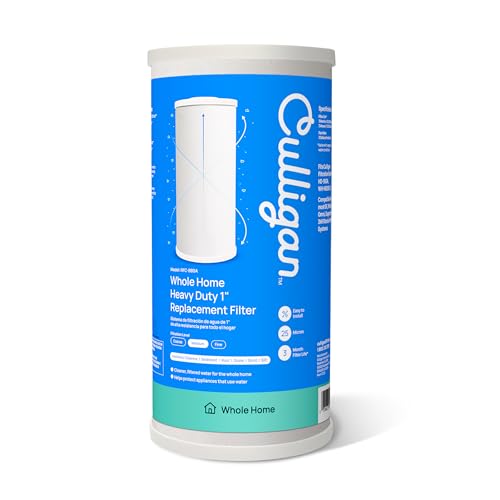
TL;DR: The Culligan RFC‑BBSA delivers 25‑micron sediment filtration and chlorine taste/odor reduction at a modest $23.08 price, with a compact 1.9‑lb design and a 3 GPM flow rate.
This cartridge’s standout feature is its radial‑flow design, which professional reviewers note minimizes pressure drop and limits carbon fines compared with standard axial‑flow cartridges. It carries a 25‑micron rating, a 10,000‑gallon capacity, and a flow rating of 3 GPM at 60 PSI, all packed into a 4.5‑inch diameter, 9.75‑inch tall housing that weighs just 1.9 lb.
When you line it up against the other nine entries, the RFC‑BBSA is heavier than the ultra‑light GE FXUSC (0.53 lb) but considerably lighter than the iSpring WGB32B‑PFKDS (51.4 lb) and the Pentair OMNIFilter U25 (4.0 lb). Its 3 GPM flow rate sits below the 5 GPM of Pentair, the 7 GPM of A. O. Smith, and the 15 GPM offered by iSpring, Waterdrop, and APEC, making it a modest‑flow option for typical residential demand.
Customers consistently praise the filter for softening chlorine taste and odor while cutting visible rust and sand stains on fixtures. Installation is described as straightforward, and the 4.7‑star rating from 2,155 reviewers reflects broad satisfaction. The main complaints revolve around the 3 GPM flow limit, which some users notice during peak usage, and a service life of 3–6 months that can shorten in iron‑rich or very sandy well water.
Technical notes add that the media is coconut‑shell granular activated carbon, the unit meets NSF/ANSI Standard 42 for chlorine reduction, and it fits 10‑inch Big Blue style housings such as the Culligan WH‑HD200‑C and several GE models. The radial‑flow construction also helps protect downstream components by handling higher sediment loads.
Pros
Cons
Best for: Budget‑conscious buyers seeking a reliable entry‑level option — the Culligan RFC‑BBSA offers Flow Rate: 3 GPM at 60 PSI.
“the water tastes cleaner and has less bleach odor”
“fewer rusty stains on fixtures and less accumulated sediment in appliances”
TL;DR: For just $10.94, the GE FXUSC gives whole‑house sediment filtration at 30‑micron, lasts 3 months, and packs into a compact 9.875‑inch unit with a 4.7‑star rating.
The GE FXUSC is a whole‑house sediment filter that removes particles down to 30 microns and carries an NSF Class V particulate‑reduction certification. Each cartridge is rated for 3 months or 16,000 gallons, so you’ll get consistent protection without frequent swaps.
At 0.585 lb and only 9.875 inches tall, it’s dramatically lighter than the iSpring WGB32B‑PFKDS (51.4 pounds) and far shorter than the Culligan WH‑HD200‑C (16.33 inches tall). Even the Culligan RFC‑BBSA, which weighs 1.9 pounds, is noticeably heavier than this GE filter. The compact depth of 2.5 inches also makes it easier to fit into tight under‑sink spaces compared with bulkier peers.
Reviewers appreciate that the filter supplies clean water to every tap and helps keep appliances free of sediment buildup. The high 4.7‑star rating from over 6,039 reviewers underscores its reliability. However, users note the 30‑micron rating won’t catch finer contaminants, and the cartridge must be swapped every three months, which some find a bit frequent. Compatibility is limited to GE GXWH20T‑type housings and similar 10 × 4.5 inches filters.
Pros
Cons
Best for: Budget-conscious buyers seeking a reliable entry‑level option — the GE FXUSC offers Filter Life: 3 months or 16,000 gallons.
TL;DR: The iSpring WGB32B-PFKDS delivers 99% PFAS removal, a robust 15 GPM flow, and a 12‑month, 100,000‑gallon filter life, but its large footprint may limit placement options.
What really sets this unit apart is its certified ability to strip out up to 99% of PFOA and PFOS, thanks to SGS‑tested media that combines KDF, GAC, a high‑performance carbon block, and an anti‑scale filter. At 711.2 mm tall (about 28 in) and weighing 51.4 lb, the system is built for serious whole‑house protection rather than a compact countertop solution.
When you line it up against the nine other filters in our roundup, the iSpring is the heaviest and tallest option. It dwarfs the GE FXUSC (under 1 lb and under 10 in tall) and the Culligan RFC‑BBSA (under 2 lb, roughly 10 in tall) while also out‑flowing them—its 15 GPM rate beats the 3 GPM of the Culligan RFC‑BBSA and the 5 GPM of the Pentair OMNIFilter U25. Even the Waterdrop WD‑WHF21‑PG matches the 15 GPM flow, but it weighs less at 37.1 lb. Capacity-wise, iSpring’s 100,000‑gallon lifespan sits between the high‑capacity A. O. Smith (600,000 gal) and the modest 10,000‑gal limit of the Culligan RFC‑BBSA.
Reviewers consistently praise the system’s PFAS performance and the scale‑inhibiting feature that helps keep pipes clear. Professional reviewers note the “comprehensive PFAS protection” and the “long filter life lasting up to 12 months.” On the downside, users point out that the unit does not lower total dissolved solids, so households needing TDS reduction will still require a reverse‑osmosis add‑on. The sizable dimensions (approximately 24.5 in L × 8 in W × 28 in H) can also be a fit challenge in tighter utility closets.
Pros
Cons
Best for: Buyers who prioritize user satisfaction — rated 4.7/5 with 3,692 reviews — the iSpring WGB32B-PFKDS offers Flow Rate: 15 GPM
Avoid if: You have limited installation space or need a system that also reduces TDS without a separate RO unit
TL;DR: The APEC CB1-CAB20-BB delivers 15 GPM flow and over 100,000 gallons of chlorine‑removing capacity in a sturdy 20‑inch housing, but it lacks sediment filtration.
What really sets this unit apart is its 25 micron nominal rating combined with a radial flow design that keeps pressure drops low while preventing carbon fines from escaping the Granular Activated Carbon media. At 14.0 pounds, the reinforced polypropylene housing feels solid enough for light‑industrial use, and the 12‑month filter life means you won’t be swapping cartridges every few weeks.
Compared with the other nine filters in the roundup, the APEC sits toward the heavier end—Culligan’s WH‑HD200‑C weighs just 3.0 pounds—yet it matches Waterdrop’s 15 GPM flow rate. Its 20‑inch filter housing is longer than the 10‑inch housing of the Pentair OMNIFilter U25, giving it a larger media volume and the capacity to treat more than 100,000 gallons before replacement.
Professional reviewers praise the radial flow design for its pressure‑friendly operation and commend the high treatment capacity, noting that the system handles chlorine, taste, odor, and VOCs without a noticeable drop in water pressure. The downside highlighted by experts is the absence of any sediment‑blocking stage, so a pre‑filter is advisable if your supply is gritty. Users also point out that the unit doesn’t address iron, lead, or microbial contaminants, limiting its scope to chemical and organic issues.
Pros
Cons
Best for: Buyers willing to invest in a proven, high‑quality option — the APEC CB1-CAB20‑BB offers Flow Rate: 15 GPM
Avoid if: You need sediment filtration or a lightweight, portable system
TL;DR: The Culligan WH‑HD200‑C delivers a robust 10 GPM whole‑house sediment filter in a lightweight 3.0 Pounds housing, backed by NSF certifications and a 2‑year warranty for under $61.37.
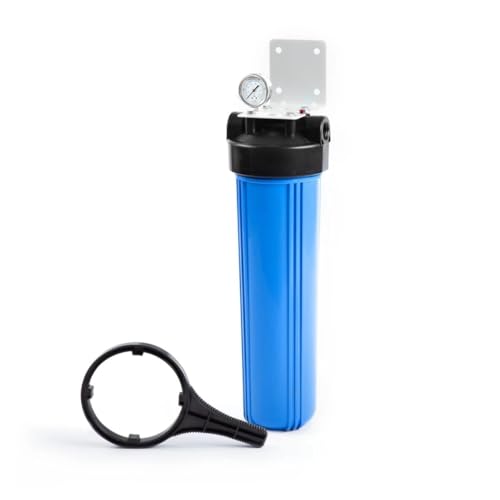
This unit’s standout spec is its 10 GPM maximum flow rate, which keeps pressure steady even when multiple fixtures run at once. The housing sits at a depth of 8.26 inches and weighs just 3.0 Pounds, making it easy to mount on a 1 inch NPT water main. A clear styrene acrylonitrile sump lets you glance at filter condition without disassembly.
Compared with the other nine filters in the roundup, the Culligan is significantly lighter than the Aquaboon whole‑house filter and more compact than the APEC CB1‑CAB20‑BB’s large housing. Its 10 GPM flow outpaces the Pentair OMNIFilter U25’s 5 GPM, while still fitting comfortably in a standard utility closet thanks to its modest 16.33‑inch height.
Reviewers consistently praise the durable stainless‑steel reinforcement and the transparent housing for quick visual checks. Professional reviewers note its suitability for high‑sediment sources and commend the straightforward DIY installation kit. The only downside mentioned is that filter cartridges are sold separately, so you’ll need to select the right R50‑BBSA or compatible media for your water quality.
Technical credentials include NSF/ANSI 42, NSF/ANSI 372, CSA B483.1, and WQA/IAPMO certifications, a 2‑year warranty, and a filter capacity of up to 24,000 gallons with an estimated 6‑month cartridge life. The system accepts a range of Culligan cartridges (R50‑BBSA, CW5‑BBS, etc.) and operates between 40°F and 100°F, handling pressures from 30 psi up to 125 psi.
Pros
Cons
Best for: Most users looking for a well‑reviewed, reliable mainstream option — the Culligan WH‑HD200‑C offers Depth: 8.26 inches.
Avoid if: You need built‑in chemical reduction such as chlorine removal without adding separate cartridges.
TL;DR: A. O. Smith’s single‑stage whole‑house filter strips up to 97% of chlorine, handles 7 GPM, lasts 600 k gal, all for $76.99, making it a solid mid‑range choice.
The standout spec is its chlorine reduction claim of up to 97%, backed by a 7 GPM flow rate that easily serves a family of four or more. The filter housing measures 4.5 in, while the unit itself stands 7.64 in tall, 14.96 in long, and 7.76 in wide, weighing 7.98 lb. Its cartridge is rated for 6 years or 600,000 gallons, so you won’t be swapping media often.
Compared with the other nine filters in this roundup, the A. O. Smith sits between the extremes. It’s lighter than the Aquaboon’s 10.41‑lb unit but noticeably heavier than Culligan’s 3‑lb model. Its height of 7.64 in is shorter than Waterdrop’s 15.55‑in profile, yet taller than the compact GE FXUSC. In terms of flow, 7 GPM outpaces the Pentair U25’s 5 GPM but falls short of Waterdrop’s 15 GPM.
Professional reviewers praise its ability to improve skin and hair softness by cutting chlorine exposure, and many users note a noticeable taste improvement after installation. However, the single‑stage design means it won’t tackle sediment, mercury, bacteria, or PFAS, so households with well water or high sediment loads often pair it with a pre‑filter. The system requires no electricity and operates up to 100 psi, fitting comfortably within typical home pressure ranges.
Pros
Cons
Best for: Most users looking for a well‑reviewed, reliable mainstream option — the A. O. Smith Single‑Stage offers Flow Rate: 7 GPM
TL;DR: The Waterdrop WD‑WHF21‑PG filters 97.72% of chlorine, delivers 15 GPM flow, and passes a 100,000+ water‑hammer test, all for $113.03.
What really sets this filter apart is its chlorine‑reduction claim of 97.72%, which many users say makes tap water taste and smell noticeably better. The system also boasts a 15 GPM flow rate, so you won’t notice a slowdown when multiple showers run at once. Its 100,000+ water‑hammer test rating adds confidence that the unit can handle the pressure spikes common in busy homes.
At 37.1 lb, the Waterdrop is heavier than the ultra‑light Culligan WH‑HD200‑C (3 lb) and Pentair OMNIFilter (4 lb), but it’s lighter than the iSpring WGB32B‑PFKDS (51.4 lb). In terms of flow, it matches the APEC CB1‑CAB20‑BB’s 15 GPM and outperforms the Pentair and GE models, which sit at 5 GPM. Compared with the A. O. Smith single‑stage unit’s 7 GPM, the Waterdrop moves water faster while staying within the same 90 psi maximum pressure limit.
Reviewers consistently praise the dual chlorine‑removal process that combines KDF composite and natural coconut‑shell carbon, noting fewer “chlorine taste” complaints after installation. Professional reviewers also highlight the pure‑copper connectors, which help prevent leaks over time. On the flip side, owners mention that the standard three‑stage setup doesn’t tackle iron or manganese as aggressively as the pricier five‑stage version, and they point out the recurring cost of swapping cartridges every 6‑12 months.
Pros
Cons
Best for: Buyers willing to invest in a proven, high‑quality option — the Waterdrop WD‑WHF21‑PG offers Flow Rate: 15 GPM
Avoid if: You're on a tight budget, need only basic filtration, or have well water with high iron or manganese levels
TL;DR: The Aquaboon Whole House Filter costs $61.42, weighs 10.41 lb, stands 22.0 in tall, and offers high‑flow, certified filtration, but its bulk and empty‑canister design may require extra planning.
At 22.0 in high and 10.41 lb, this Aquaboon unit is one of the taller and heavier options in the lineup. It features a 1 in inlet/outlet port, a high‑flow rating, and a reinforced polypropylene housing that resists chemicals. The price tag of $61.42 places it in the same price band as the Culligan WH‑HD200‑C, while still delivering a larger physical footprint.
Compared with peers, the Aquaboon is noticeably bulkier: the Culligan WH‑HD200‑C weighs just 3.0 lb and measures 16.33 in tall, and the Pentair OMNIFilter U25 is 4.0 lb and 12.0 in tall. Even the A. O. Smith Single‑Stage model is lighter at roughly 7.98 lb. On the opposite end, the iSpring WGB32B‑PFKDS tops the scale at 51.4 lb, so Aquaboon sits in the middle‑weight range but remains taller than most. Its price aligns closely with Culligan’s offering, yet it provides a larger housing (20 in × 4.5 in) for whole‑house well water.
Customer feedback shows a solid 4.4 / 5 rating from 893 reviews, indicating general satisfaction. Review themes often mention the ease of mounting thanks to the included bracket and the convenience of a high‑flow design that reaches every faucet. However, the product ships as an empty canister, so users must source compatible filters separately, a point that some reviewers flag as an extra step.
Technically, the filter is a single‑stage, empty‑canister system built from reinforced polypropylene, offering chemical resistance and certification. It’s compatible with Pentek 150233, 150235, and Geekpure BB‑20B cartridges, giving you flexibility in filter choice. Warranty, micron rating, and filter life are not listed in the available specs, so you’ll need to check the manufacturer’s details for those aspects.
Pros
Cons
Best for: Most users looking for a well‑reviewed, reliable mainstream option — the Aquaboon Whole House Filter offers Height: 22.0 inches.
Avoid if: Reliability and user satisfaction are your top concerns.
TL;DR: The Express Water Ultimate Protection offers three‑stage, 100,000‑gallon capacity filtration with a 0.25 gal/s flow rate, but its 63‑lb weight and $547.99 price make it a premium‑grade choice.
This system packs three filter stages—polyphosphate, KDF and an activated carbon block—into a housing that measures 30.0 inches tall, 29.0 inches long and 8.5 inches wide. With a rated flow of 0.25 gallons per second and a filter capacity of 100,000 gallons, it’s built to keep water pressure steady while handling a full‑home supply.
Compared with the other nine units in our roundup, the Express Water model is substantially heavier than the APEC CB1‑CAB20‑BB (14 pounds) and the Waterdrop WD‑WHF21‑PG (37.1 pounds). It also stands taller than the APEC’s 26.0‑inch height and the Culligan WH‑HD200‑C’s 16.33‑inch profile. While its flow rate of 0.25 gal/s aligns with the 15 GPM rating of the Waterdrop unit, its 100,000‑gallon capacity matches the APEC’s >100,000‑gallon claim, placing it among the higher‑capacity options.
Everyday users highlight the noticeable improvement in water taste and the elimination of odors, echoing professional reviewers who note strong chlorine and heavy‑metal reduction. The system’s three pressure‑release buttons and gauges earn praise for easy monitoring. However, reviewers also point out that the larger footprint and 63‑pound mass demand a dedicated, dry space, and the ongoing filter replacement costs are higher than many alternatives.
Beyond the core filtration, the housing combines stainless‑steel framing with 100 % food‑grade ABS and PCE plastic, and the unit can be mounted on the ground or a wall. Connections are a standard 1‑inch size, and the design is intended for dry, level areas protected from freezing temperatures and direct sunlight.
Pros
Cons
Best for: Those prioritizing quality and willing to pay for premium performance — the Express Water Ultimate Protection offers Flow Rate: 0.25 gallons per second
Avoid if: You need a compact system, operate in temperatures below 40 °F or above 100 °F, or have limited installation space
TL;DR: The Pentair OMNIFilter U25 delivers 5 gpm flow, a 15,000‑gallon capacity and a clear housing for visual monitoring, all for $49.10, making it a solid budget whole‑house filter.
What sets the U25 apart is its built‑in valve‑in‑head design, letting you swap cartridges without shutting off the main water supply. The clear housing lets you see when the cartridge is exhausted, and the system handles up to 5 gpm while treating up to 15,000 gallons before the typical 3‑month cartridge life ends.
In size, the U25 is more compact than the Culligan WH‑HD200‑C, which sits at 8.26 inches deep and 16.33 inches tall, yet it offers a larger footprint than the ultra‑light Culligan RFC‑BSA that weighs just 1.9 pounds. Compared with the Aquaboon Whole House Filter’s 10.41 pounds, the U25’s 4.0‑pound weight makes it easier to handle during DIY installation.
Reviewers consistently praise the valve‑in‑head mechanism and the ability to monitor filter condition through the clear housing. The main complaint is the need to purchase separate galvanized fittings, pipe and plumber’s tape, which adds a small extra step to the install. The system works with standard 3/4″ inlet/outlet ports and accepts polyspun (10‑20 micron), pleated cellulose (5‑10 micron) or activated‑carbon (5 micron) cartridges, giving you flexibility for sediment and chlorine reduction.
Pros
Cons
Best for: Entry-level buyers or those on a tight budget — the Pentair OMNIFilter U25 offers Flow Rate: 5 gpm
Avoid if: You want the best value‑per‑dollar in its price range
Breakdown
Culligan WH-HD200-C
Pros
Cons
iSpring WGB32B-PFKDS
Pros
Waterdrop WD-WHF21-PG
Pros

APEC CB1-CAB20-BB
Pros
Based on scoring data and product specs
Personalized picks
Best Overall Pick
Culligan WH-HD200-C
Best OverallBest for: Most users looking for a well-reviewed, reliable mainstream option — the Culligan WH-HD200-C offers Depth: 8.26 inches
iSpring WGB32B-PFKDS
Best for: Buyers who prioritize user satisfaction — rated 4.7/5 with 3,692 reviews — the iSpring WGB32B-PFKDS offers Flow Rate: 15 GPM
$901.99+$840.62 vs winner
Skip Express Water Ultimate Protection if…
You need advanced features or professional-grade performance
We’re naming the Culligan WH‑HD200‑C the clear winner. It carries NSF/ANSI 42 and 372 certifications, offers up to 24,000 gallons of filtration capacity, and delivers a solid 10 GPM flow rate—all for a list price of $61.37. The package even includes a mounting bracket, housing wrench, filter‑life indicator and a 2‑year warranty, making DIY installation straightforward.
The iSpring WGB32B‑PFKDS takes the runner‑up spot, especially if you need higher flow and robust PFAS protection. It pushes 15 GPM, removes 99% of PFAS (PFOA and PFOS), and handles 100,000 gallons over a 12‑month filter life, all within a three‑stage system that tackles chlorine, heavy metals and scale.
Looking beyond the top two, the GE FXUSC shines as the best budget choice at just $10.94, while the Aquaboon Whole House Filter offers a solid mid‑range option for $61.42. For those willing to invest heavily, the Express Water Ultimate Protection stands out as the premium alternative at $547.99.
Choose the Culligan WH‑HD200‑C today and enjoy reliable whole‑house protection without breaking the bank.
The Culligan WH‑HD200‑C is rated for a maximum flow rate of 10 GPM. The iSpring WGB32B‑PFKDS lists a flow rate of 15 GPM, so iSpring moves more water per minute while both meet typical household demand.
No reviews yet — be the first to share your experience.
Please sign in to leave a review