⚡ Quick Answer
Touchscreen smart locks promise the convenience of keyless entry without sacrificing security. In this roundup we evaluated six models that span the market’s three price tiers – budget options like the eufy C210 ($89.99) and Philips Smart Lock ($113.99), mid‑range choices such as the Yale Approach Black Suede ($134.00) and Ultraloq Latch 5 ($159.99), and premium contenders Kwikset Halo ($160.96) and Schlage Encode ($271.34).
The Ultraloq Latch 5 stands out with an IP65 rating, 99.8% fingerprint accuracy and a 0.3‑second unlock speed, all wrapped in a lever that replaces the knob instead of the deadbolt – a rare fit for rentals and apartments. By contrast, the Kwikset Halo offers a capacitive touchscreen and 250 programmable user codes, while the Schlage Encode pushes the premium envelope with Wi‑Fi, Bluetooth and 100 access codes at $271.34. Budget‑friendly picks still hold their own: the eufy C210 delivers 100,000 lock cycles for $89.99, and Philips scores a 4.5/5 rating with multiple unlock methods.
Next we’ll break down each model’s strengths, connectivity options, and installation quirks so you can match the lock that fits your door, budget, and smart‑home ecosystem.

Ultraloq Latch 5
Its shallow 3.5‑inch depth lets it fit most standard doors while keeping a sleek profile, delivering strong value and feature set for everyday users.
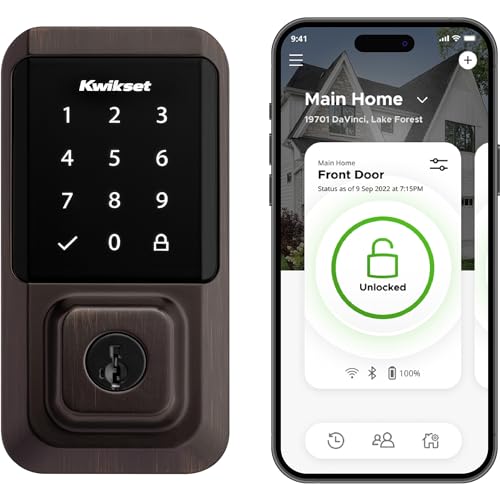
Kwikset Halo
Ideal for homeowners who want premium performance and a robust code capacity, it adds just $0.97 to the Ultraloq price while offering 250 user codes.

Schlage Encode
Stands out with a 4.3‑star rating and a 22.9‑unit exterior depth, catering to buyers who value proven performance and can accommodate thicker door setups.
Also considered
TL;DR: The eufy C210 packs Wi‑Fi, five unlock options and BHMA Grade 3 durability into a 1.48 lb, $89.99 lock that’s easy to install and ideal for budget‑focused homes.
The standout spec is its built‑in Wi‑Fi, meaning you won’t need a separate bridge to control the lock from the eufy Security app. It also offers five unlock methods—app, keypad, physical key, Apple Watch and voice—plus bank‑grade encryption and a lockdown after five failed attempts. With a rated 100,000 lock/unlock cycles, 2000 N pressure resistance and a 6‑month battery life on four AA alkaline cells, the C210 promises long‑term reliability at a $89.99 price point.
Compared with the other five contenders, the C210 is noticeably lighter than the Philips Smart Lock (which weighs 3411 g) and the Yale Approach Black Suede (about 2.3 lb). It’s also lighter than the Schlage Encode’s 4.25 lb, while sitting close to the Kwikset Halo’s 454 g. In terms of cost, it lands well below the Ultraloq Latch 5 and the Kwikset Halo, making it the most affordable option in the group. However, it lacks a fingerprint scanner that the Ultraloq and Yale models provide, and it doesn’t include a door sensor that some higher‑priced rivals feature.
Users consistently praise the sleek black design and the quick 15‑minute installation. Reviewers highlight the reliable remote control via the app, especially the ability to lock or unlock from anywhere without range limits. On the downside, owners note that the app doesn’t log which family member used a shared account, and the battery can drain faster than expected, often needing replacement at the six‑month mark. Professional reviewers also point out the lighter build feels less premium than the bulkier, higher‑priced alternatives.
Additional technical context includes a humidity resistance of 144 hours and salt‑spray resistance of 72 hours, which help protect the lock in tougher environments. The lock’s backset range of 60 to 70 mm and cross‑bore hole of 38 to 54 mm make it compatible with most standard US deadbolts, and the BHMA Grade 3 certification backs up its durability claims.
Pros
Cons
Best for: Shoppers on a tight budget who want the most for their money — the eufy C210 offers Backset: 60 to 70 mm
Avoid if: You have limited desk space or need portability
“compact & capable”
TL;DR: The Kwikset Halo Wi‑Fi deadbolt packs a hub‑free, 1‑inch bolt throw, 250‑code capacity and ANSI/BHMA Grade AAA security into a lightweight 1.0‑lb, antimicrobial‑coated unit for $160.96.
What sets the Halo apart is its built‑in Wi‑Fi that talks directly to the Kwikset app—no bridge or hub required. The lock throws a solid 25.4 mm (1 inch) steel bolt and lets you store up to 250 user codes, while the backset is adjustable from 60.3 mm to 69.8 mm to fit most doors. Its 10.1 cm depth and 14.2 cm height give it a sleek profile without compromising the UL 437 and 20‑minute fire‑rating certifications.
Compared with the other five locks in this roundup, the Halo is lighter than the Yale Approach Black Suede (2.3 lb) and far lighter than the Schlage Encode (4.25 lb), yet it isn’t the lightest—eufy C210 tips the scales at about 1.48 lb. Its depth of 10.1 cm sits between the compact Ultraloq Latch 5 (3.5 in) and the deeper eufy C210 (220 mm), while its adjustable backset outmatches the fixed 60 mm‑70 mm range of the Philips Smart Lock. The Halo also offers more user codes (250) than the Philips (100) and Schlage (100) models, though it lacks a fingerprint sensor that the Ultraloq and Yale units provide.
Professional reviewers praise the hub‑free Wi‑Fi setup for instant remote access and note the ANSI/BHMA Grade AAA rating as a top‑tier security credential. Users also appreciate the Microban antimicrobial coating that helps keep the keypad cleaner. However, the reliance on a strong Wi‑Fi signal can be a pain point in homes with spotty coverage, and the lock runs on four AA batteries, which some owners find require periodic replacement. The lock is also listed as ADA non‑compliant, which may matter for accessibility‑focused households.
Beyond the basics, the Halo packs SmartKey rekeying, SecureScreen touchscreen protection, activity notifications, geofencing, and an auto‑relock timer. The capacitive touchscreen backlights for easy night‑time entry, and the included two physical keys give you a fallback if the batteries die. With a lifetime mechanical‑finish warranty and a one‑year electronics guarantee, the lock balances premium features with a solid warranty.
Pros
Cons
Best for: Those prioritizing quality and willing to pay for premium performance — the Kwikset Halo offers Backset: Adjustable 60.3 mm - 69.8 mm (2‑3/8" x 2‑3/4")
Avoid if: You're on a tight budget or only need basic functionality
TL;DR: The Ultraloq Latch 5 packs 99.8% fingerprint accuracy, 0.3‑second unlocks and a rugged IP65 rating into a lever‑style lock for $159.99, making it a strong all‑rounder for renters and smart‑home fans.
The standout spec is its fingerprint system: 99.8% accuracy and a 0.3‑second unlock speed, which users repeatedly praise as “instant” and “reliable.” Its IP65 rating also means it can handle rain or dust, a rare claim among lever‑type smart locks.
At $159.99, it sits in the same price tier as the Kwikset Halo, yet it offers more entry options—fingerprint, app, PIN, mechanical key, Apple Watch and auto‑unlock—whereas the Halo lists fewer methods. Compared with the Yale Approach’s 99% fingerprint accuracy and the Philips Smart Lock’s limited PIN capacity, Ultraloq’s 99.8% and broader user management give it a clear edge. Its 3.5‑inch depth is shallower than Kwikset Halo’s 10.1 cm depth and the Schlage Encode’s 22.9‑unit exterior depth, making it a compact fit for many doors.
Reviewers love the quick, tool‑free installation (“no wiring, no drilling”) and the real‑time activity logs in the U‑Home app. Professional reviewers note the lever design avoids deadbolt modifications, a boon for apartments where the deadbolt can’t be altered. The main gripe is the built‑in Wi‑Fi works only on the 2.4 GHz band, which can frustrate users with 5 GHz‑only routers, and some renters miss the traditional deadbolt look.
Beyond the front‑line features, the lock carries ANSI A156.36 Grade 1 certification, 128‑bit AES encryption with a dynamic key, Z‑Wave and IFTTT compatibility, and Alexa/Google Assistant voice support. Power comes from four AA batteries with an external backup, and the anti‑peep touchscreen keypad adds privacy for PIN entry.
Pros
Cons
Best for: Most users seeking a balanced, mainstream option — the Ultraloq Latch 5 offers Depth: 3.5 inches
Avoid if: You need a traditional deadbolt look or rely on 5 GHz‑only Wi‑Fi networks
TL;DR: The Schlage Encode lever lock packs BHMA Grade 1 security, Wi‑Fi/Bluetooth connectivity, a 100‑code touchscreen, and a six‑month AA‑battery life, but its $271.34 price tags it as a premium choice.
What really stands out is the combination of a BHMA Grade 1 certification with built‑in Wi‑Fi and Bluetooth, letting you lock or unlock from the Schlage Home app without a hub. The fingerprint‑resistant touchscreen can store up to 100 access codes, and the lock’s bolt throws 25.4 mm for solid deadlatch engagement. At 4.25 pounds, the unit feels substantial, and its exterior dimensions—22.9 mm depth, 149.2 mm height, and 76.2 mm width—fit standard lever doors.
Compared with the other five contenders, the Encode is pricier than the Kwikset Halo, which weighs just 1.0 pound, and noticeably heavier than the eufy C210 at 1.48 pounds. It also out‑weighs the Yale Approach Black Suede at 2.3 pounds. While the Ultraloq Latch 5 lists no weight, its feature set leans toward IP65 protection and Z‑Wave integration, whereas the Encode focuses on Wi‑Fi/Bluetooth and a professional finish. None of the peers combine the same level of ANSI/BHMA Grade 1 rating with a built‑in Wi‑Fi module.
Reviewers consistently praise the lock’s “highest residential security” rating and the convenience of remote notifications and a built‑in alarm that signals forced entry. Professional notes highlight the straightforward screwdriver‑only installation and the sleek Century trim with Latitude lever style. On the downside, users mention the reliance on four AA batteries—requiring a six‑month replacement cycle—and note that remote features can falter if the home Wi‑Fi drops.
Technical details round out the picture: the lock operates from –35 °C to 66 °C outdoors and –10 °C to 49 °C indoors, and a low‑battery indicator flashes on both the touchscreen and in the app. Voice assistants like Amazon Alexa and Google Assistant can lock or unlock on command, and the secure encrypted connection keeps data safe.
Pros
Cons
Best for: Buyers willing to invest in a proven, high-quality option — the Schlage Encode offers Access Codes Capacity: 100
Avoid if: You're shopping on a tight budget — it's priced at $271.34
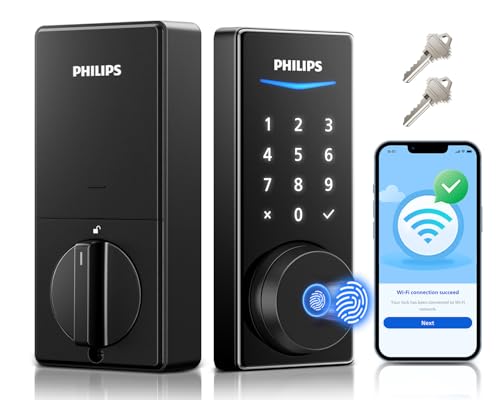
TL;DR: The Philips Smart Lock packs built‑in Wi‑Fi, 0.3‑second fingerprint access and AES‑128 encryption into a matte‑black deadbolt for $113.99, delivering keyless convenience on standard doors without a separate hub.
The lock’s standout feature is its integrated Wi‑Fi, letting you control the deadbolt from the Philips Home Access app wherever you are—no extra bridge required on most models. Inside, a fingerprint sensor reads a finger in just 0.3 seconds, and the lock stores up to 100 user PINs plus unlimited one‑time codes, all protected by AES‑128 encryption and local data storage.
Compared with the five other locks in this roundup, the Philips unit is heavier than the eufy C210 (about 671 g) and the Yale Approach Black Suede (≈1 043 g), but it still fits standard doors with a backset of 60/70 mm and a cross‑bore of 38/54 mm. It’s priced below the Ultraloq Latch 5 and Kwikset Halo, yet sits above the entry‑level eufy C210, giving it a middle‑ground value proposition.
Professional reviewers highlight the convenience of built‑in Wi‑Fi and the variety of unlock methods—fingerprint, PIN, app, mechanical key, voice and proximity auto‑unlock. Users appreciate the anti‑peeping PIN entry and the 10‑180 second auto‑lock timer, though some note that certain models still need a separate Wi‑Fi bridge for full remote access and that the fingerprint capacity is limited to 50 profiles.
Pros
Cons
Best for: Entry-level buyers or those on a tight budget — the Philips Smart Lock offers Backset: 60/70 mm
Avoid if: You want the best value‑per‑dollar in its price range
TL;DR: The Yale Approach Black Suede retrofit lock adds Wi‑Fi, 99% fingerprint accuracy and unlimited virtual keys for $134, but its 15‑foot bridge range and AA‑battery design limit flexibility.
The lock’s standout spec is its 15‑foot Bluetooth bridge range, letting you control the deadbolt from most rooms without a wired hub. It also packs bank‑grade AES encryption, two‑factor authentication and a 99% fingerprint accuracy rating, all inside a matte black housing that measures 40.64 mm deep, 142.24 mm high and 66.04 mm wide. At 2.3 pounds (1043.26 g) it’s solid enough to feel secure while still being manageable for DIY installation.
Compared with the five peers, Yale sits in the middle of the weight spectrum: it’s lighter than the Philips Smart Lock’s 3411 g body but heavier than the Kwikset Halo’s 454 g and eufy C210’s 671 g. Its height of 142.24 mm matches Kwikset Halo’s 14.2 cm profile, while the Schlage Encode stands slightly taller at 149.2 mm. Fingerprint accuracy trails the Ultraloq Latch 5’s 99.8% but still beats the average for this class. The bridge‑range limitation is tighter than the Ultraloq’s NFC option and the Philips model’s broader auto‑lock timer range.
User feedback praises the lock’s straightforward retrofit – most renters report a setup under 10 minutes and appreciate keeping their original keys as a fallback. Professional reviewers note the DoorSense auto‑lock feature and the convenience of sharing unlimited virtual keys via the iOS/Android app. Common complaints focus on the need to place the Wi‑Fi bridge within 15 feet and the restriction to 2.4 GHz Wi‑Fi, which can complicate placement in larger homes. The lock runs on four AA alkaline cells, so you’ll need to replace them periodically.
Technical specs show the lock operates comfortably between 0 °C and 40 °C and tolerates humidity from 10 % to 85 % (non‑condensing). It also supports Google Assistant and Amazon Alexa, and works with Apple Watch for wearable unlocking. These environmental ranges make it suitable for most residential climates.
Pros
Cons
Best for: Most users seeking a balanced, mainstream option — the Yale Approach Black Suede offers Bridge Range: 15 feet
Avoid if: Reliability and user satisfaction are your top concerns
“Straightforward setup... great smart lock towards renters as you keep the deadbolt and keys”
Breakdown
Ultraloq Latch 5
Pros
Kwikset Halo
Pros
Schlage Encode
Pros
Cons
Philips Smart Lock
Pros
Cons
Based on scoring data and product specs
Personalized picks
Best Overall Pick
Ultraloq Latch 5
Best OverallBest for: Most users seeking a balanced, mainstream option — the Ultraloq Latch 5 offers Depth: 3.5 inches
Kwikset Halo
Best for: Those prioritizing quality and willing to pay for premium performance — the Kwikset Halo offers Backset: Adjustable 60.3 mm - 69.8 mm (2-3/8" x 2-3/4")
$160.96+$0.97 vs winner
Skip Yale Approach Black Suede if…
Reliability and user satisfaction are your top concerns
Ultraloq Latch 5 takes the top spot thanks to its military‑grade security and versatile access options. It carries an ANSI A156.36 Grade 1 certification, a 99.8 % fingerprint accuracy rating, and an unlock speed of just 0.3 seconds. On top of that, you can get in via fingerprint, app, PIN code, mechanical key, Apple Watch or auto‑unlock, all managed through the U‑Home app, and it’s priced at $159.99.
The runner‑up, Kwikset Halo, shines when you need a solid deadbolt with smart features. Its 25.4 mm (1 inch) steel bolt throw gives strong physical security, while geofencing and SmartKey Security let you lock or unlock based on your phone’s location. With capacity for 250 user codes and a capacitive touchscreen keypad, it’s a reliable choice for families or shared homes.
Looking at other price points, the eufy C210 offers the best budget entry at $89.99, delivering a straightforward touchscreen lock without the extra bells and whistles. For those willing to spend more, the Schlage Encode stands out as the premium pick at $271.34, featuring built‑in Wi‑Fi and a high‑end finish that fits upscale interiors.
Pick the Ultraloq Latch 5 for the most secure, flexible touchscreen lock experience today.
The Ultraloq Latch 5 bundles military‑grade 128‑bit AES encryption, 99.8 % fingerprint accuracy and a 0.3‑second unlock speed into a single unit that also supports Bluetooth, Z‑Wave, Apple Watch and auto‑unlock. At $159.99 it offers more entry methods and a higher IP65 rating than pricier rivals, giving you more security and convenience for less money.
No reviews yet — be the first to share your experience.
Please sign in to leave a review