⚡ Quick Answer
If you’re hunting for a doorbell that feels premium without draining your wallet, the Tapo D210 is hard to ignore. At $49.99 it carries a 4.4‑star rating from over 3,200 reviewers, a 6,400 mAh battery that the specs say can last up to 180 days, and a 160° diagonal field of view that eliminates blind spots. Its 2K‑class video and AI person detection come without a monthly subscription, giving you high‑resolution coverage at a modest cost.
We evaluated eight wireless doorbells, spanning the full price spectrum from the $34.99 Arlo Video Doorbell HD (2nd Gen) up to the $149.99 Abode Wireless Video Doorbell. The budget tier features Arlo, Tapo D210 and Boifun, the mid‑range tier includes the Tapo D230S1 and Botslab, while the premium tier is represented by eufy, Reolink and Abode. Ratings range from 3.0 to 4.4 stars, and battery capacities vary from 6,400 mAh to 7,000 mAh.
Below we break down each model’s key specs, strengths and drawbacks so you can match the right doorbell to your home’s needs and budget.

Tapo D210
Its 6,400 mAh battery capacity gives long runtime, supporting the value and reliability that earned it the top budget spot.

Botslab Wireless Video Doorbell
Ideal for buyers who want a proven doorbell with up to 210 days of battery life, and they're willing to spend about $50 more than the Tapo D210.
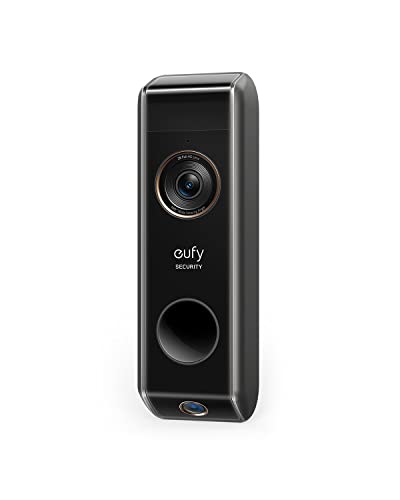
eufy Security Video Doorbell S330
Stands out with a 160° front camera field of view, delivering a wider visual coverage that the budget picks don’t provide.
Also considered
TL;DR: The Tapo D210 delivers 2K video, a 160° ultra‑wide view and a 6,400 mAh battery that lasts up to six months, all for a modest $49.99 price tag.
The standout spec is its 2K 3MP resolution (2304 × 1296) paired with a 160° diagonal field of view, which captures head‑to‑toe coverage without blind spots. Its 6,400 mAh lithium‑ion battery promises up to 180 days of operation, reducing the need for frequent recharges. The doorbell also offers 10x digital zoom and a 15 fps frame rate, ensuring clear footage even when you need to zoom in on a visitor’s face or a passing car.
When you line it up against the seven other doorbells in this roundup, the Tapo D210 sits comfortably in the middle of the pack. Boifun’s model provides a slightly wider 180° view but carries a larger 6,700 mAh battery, while Arlo also uses a 180° lens yet lacks the 2K resolution that Tapo offers. The Tapo D230S1 matches the 160° diagonal view but is half the weight at 0.55 lb, whereas the eufy S330 shares the same 160° view and a lighter 0.77 lb chassis. Botslab’s unit reaches 24 ft in night vision, just shy of Tapo’s 25 ft range, and Reolink’s battery capacity tops out at 7,000 mAh but comes with a heavier 1.32 lb body. Across the board, the Tapo D210 remains competitively sized at 1.97 in W × 1.52 in H × 2.13 in D and weighs 1.26 lb, making it easy to mount on most doorframes.
Users consistently applaud the 160° view for eliminating blind spots and the long‑lasting battery that truly lasts months between charges. Reviewers also note the crisp 2K video that captures facial details and license plates clearly, and they appreciate the subscription‑free AI person detection that reduces false alerts. The downside that pops up in feedback is the fixed camera orientation – there’s no pan or tilt to adjust the angle after installation. Night vision is limited to black‑and‑white, and the 15 fps frame rate feels modest compared with higher‑speed rivals. Professional reviewers highlight the on‑device machine‑learning for person detection and the robust 128‑bit AES encryption with SSL/TLS, underscoring the doorbell’s solid security posture.
Pros
Cons
Best for: Budget‑conscious buyers seeking a reliable entry‑level option — the Tapo D210 offers Battery Capacity: 6,400 mAh
Avoid if: You need advanced features like pan/tilt adjustment or color night vision capabilities
TL;DR: The eufy Security Video Doorbell S330 packs a dual‑camera system with 2K front view, 95% false‑alarm reduction and local storage, all in a lightweight, IP65‑rated housing for $99.99.
What really sets the S330 apart is its dual‑camera design: a 2K front‑facing camera (2560 × 1920) with a 160° field of view works together with a downward‑pointing 1080p package camera (1600 × 1200) that covers deliveries. The unit also boasts 95% false‑alarm reduction, an IP65 rating for weather resistance, and a compact weight of 0.77 lb, making it easy to mount on most doorframes.
Compared with the other seven doorbells in this roundup, the S330 sits at the higher end of the price spectrum but remains lighter than the Tapo D210 and Boifun models, which weigh over a pound each. Its battery‑powered option gives it more flexibility than wired‑only rivals, while the requirement for a HomeBase hub makes it a bit more involved than plug‑and‑play units like the Arlo HD. The dual‑camera approach also makes it bulkier than single‑camera competitors such as the Tapo D210, a trade‑off many users find worth it for the extra coverage.
Reviewers consistently praise the no‑subscription model; the built‑in 8 GB storage (plus up to 16 GB on the HomeBase) lets you record without recurring fees. Users also like the 3–6 month battery life, though several note that recharging the battery can cause short periods of downtime, especially in high‑traffic homes. Professional reviewers highlight the combination of PIR and radar motion sensors, which helps keep false alerts low, and the inclusion of facial recognition and package detection adds a layer of convenience for everyday doorstep activity.
Pros
Cons
Best for: Buyers willing to invest in a proven, high‑quality option — the eufy Security Video Doorbell S330 offers Front Camera Field of View: 160° and robust false‑alarm handling.
Avoid if: You need Apple HomeKit support or a slimmer design that fits ultra‑compact doorframes.
TL;DR: The Botslab Wireless Video Doorbell offers a 180° fisheye view, 5 MP video, and up to 210 days of battery life for $99.99, making it a solid, weather‑proof choice for thorough home security.
What really stands out is the 180° dual‑plane field of view paired with a 5 MP sensor (2880 × 1620) that captures head‑to‑toe coverage and ground‑level packages in a single frame. The unit runs on a 6400 mAh battery that the manufacturer claims can last up to 210 days, and its IP66 rating means it can handle rain, dust, and extreme temperatures without a hiccup. At 1.23 pounds, it feels sturdy yet manageable for most doorframes.
Compared with the other seven doorbells in this roundup, Botslab is heavier than the eufy Security Video Doorbell S330 (0.77 lb) and the Tapo D210 (1.26 lb), but lighter than Reolink’s battery model (1.32 lb). Its 180° view matches Reolink and Boifun’s 180° angles, while the eufy and Tapo units top out at 160°. Night‑vision reaches 24 feet, a step beyond Boifun’s 16‑foot claim but shy of Arlo’s 20‑foot range. Battery capacity ties with the Tapo D210 (6400 mAh) and exceeds the eufy’s unspecified capacity, though Reolink lists a larger 7000 mAh pack.
Users consistently praise the doorbell for actually delivering on its wide‑angle promise and for the long battery life that reduces maintenance trips. The AI suite—human/person detection, lingering alerts, and prowler detection—cuts down false alarms, a point highlighted by both everyday owners and professional reviewers. On the flip side, several reviewers note that the mobile app feels dated and that occasional connectivity lag can make answering calls feel sluggish, especially when the 5 MP feed is stretched across the full 180° view.
Beyond the basics, the device includes a fisheye lens with panoramic, VR, and correction view modes, and it combines PIR and radar motion sensors for reliable detection. Voice modulation and a silent recording mode give you privacy options, while the included base station doubles as a Wi‑Fi extender and indoor chime. Integration with Amazon Alexa and Google Assistant means you can link it into existing smart‑home routines without extra hubs.
Pros
Cons
Best for: Buyers willing to invest in a proven, high‑quality option — the Botslab Wireless Video Doorbell offers Battery Life: Up to 210 days
Avoid if: You're on a tight budget, prioritize a slick app experience, or need only basic functionality
“Actually delivers on the 180° claim”
“Battery lasts for months”
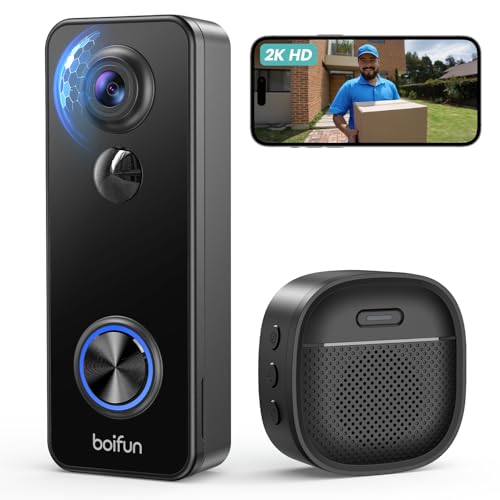
TL;DR: The Boifun Wireless Video Doorbell packs a 2K sensor, 180° view and a 6700 mAh battery that can last up to 90 days, all for $49.99, making it a solid budget entry.
What really stands out is the 6700 mAh battery that Boifun claims can keep the unit running for up to 90 days on a single charge. Coupled with a 2K FHD (3MP / 2304×1296) sensor and a full 180° viewing angle, the doorbell captures wide‑angle footage with enough detail to recognise faces and packages. The device also offers AI‑driven motion detection that distinguishes people, cars and packages, and it supports local storage on a microSD card up to 128 GB.
In the context of the eight‑product roundup, Boifun sits at a similar price point to the Tapo D210, yet the two differ in several ways. Boifun’s battery capacity (6700 mAh) is a touch higher than the Tapo’s 6,400 mAh, while its viewing angle (180°) exceeds the Tapo’s 160° diagonal field of view. On the flip side, Boifun’s night‑vision range of 5 m (16 ft) is considerably shorter than the Tapo’s 25‑foot reach, and the Boifun unit is physically larger (5.79 in × 2.22 in × 1.65 in) than the compact Tapo model (1.52 in high, 1.97 in wide). These trade‑offs help explain why the Tapo D210 tops the rankings despite a modest price.
User sentiment frequently praises the wireless convenience, long battery life and the subscription‑free local storage option. Reviewers also note the clear 2K video and the handy pre‑recorded 30‑second voice messages. However, several owners report that the 2.4 GHz‑only Wi‑Fi can be finicky in congested networks, and a handful of users have experienced occasional false alarms or app glitches. Professional reviewers highlight the AI detection as a strength but point out that motion‑detection accuracy can lag behind premium rivals.
Pros
Cons
Best for: Budget‑conscious buyers seeking a reliable entry‑level option — the Boifun Wireless Video Doorbell offers Battery Capacity: 6700 mAh.
Avoid if: You want the best value‑per‑dollar in its price range.
TL;DR: The Reolink Video Doorbell Battery costs $119.99, offers 2K (4MP) video with a 150° × 150° square view, and can run up to five months on its 7,000 mAh battery.
The standout spec is its 2K (4MP, 2048x2048) sensor paired with a 150° horizontal and 150° vertical field of view, giving a full head‑to‑toe capture that many rivals miss. Its 180° diagonal view and 15 FPS frame rate ensure smooth footage, while the 1.16‑inch height and 6.3‑inch length keep the unit compact enough for most door frames.
At $119.99, the Reolink sits in the premium tier, making it pricier than the budget‑friendly Tapo D210 but still lighter than the eufy Security Video Doorbell S330, which weighs 0.77 pounds compared to Reolink’s 1.32 pounds. Its dual‑band Wi‑Fi (2.4 GHz/5 GHz) offers more stable connectivity than some single‑band competitors, though a few users note occasional reconnection hiccups on the 5 GHz band.
Customers love the subscription‑free model and the expansive 150° × 150° view that reliably captures packages and visitors. Professional reviewers praise the HDR‑enhanced 2K video and the ability to store up to 256 GB on a microSD card. The downside is that the 7,000 mAh battery can drain noticeably faster when you enable the maximum 15 FPS setting or experience frequent motion, and the trickle‑charge option only tops up the battery slowly. Compared with the Botslab Wireless Video Doorbell’s 5MP sensor, Reolink’s resolution is a step down.
Pros
Cons
Best for: Those prioritizing quality and willing to pay for premium performance — the Reolink Video Doorbell Battery offers Video Resolution: 2K (4MP, 2048x2048)
“Perfect head-to-toe view catches packages thieves couldn't hide”
“Battery lasts weeks/months with light use; no monthly fees is huge.”
TL;DR: The Tapo D230S1 packs a 5 MP (2K) camera, 160° diagonal view and up‑to‑8‑month battery life in a lightweight 0.55‑lb housing, all for a modest price.
At 1.4 inches tall, 5.75 inches long and 2.15 inches wide, the D230S1 feels compact enough to sit neatly on most door frames. Its 5 MP (2K) sensor pairs with a 160° diagonal field of view, so you get a full‑length portrait of anyone at your doorstep. Weighing just 0.55 pounds, the unit is easy to mount and won’t add noticeable strain to a surface.
When you line it up against the other seven doorbells in this roundup, the Tapo is noticeably lighter than the eufy Security Video Doorbell S330 (0.77 pounds) and far lighter than the Botslab Wireless Video Doorbell (1.23 pounds). Its 160° view matches eufy’s but is narrower than Botslab’s 180°, giving it a solid middle ground. The D230S1 also comes in at a lower price point than many of its peers, making it a budget‑friendly choice without sacrificing core features.
Reviewers consistently praise the sharp 2K video and the AI‑driven detection of people and cars, noting that the built‑in spotlight and color night vision keep images clear after dark. Users also like the ability to store footage locally on a microSD card up to 512 GB, which eliminates the need for a subscription. On the flip side, the doorbell only supports 2.4 GHz Wi‑Fi, and some owners have reported occasional disconnects on congested networks. Battery life can shrink quickly if motion alerts fire frequently or when temperatures dip.
Pros
Cons
Best for: Most users seeking a balanced, mainstream option — the Tapo D230S1 offers Field of View: 160° Diagonal
TL;DR: The Arlo Video Doorbell HD (2nd Gen) delivers 2K HDR video and a 180° view for $34.99, but its black‑and‑white night vision only reaches 20 feet.
The standout spec is its 2K HDR video resolution (1944 × 1944) paired with a 180° field of view, giving you crisp, wide‑angle footage of anyone at your door. The camera is fixed‑position, but digital zoom lets you focus on details without moving parts.
Compared with the other seven doorbells, Arlo sits at the low‑end of the price spectrum while offering a wider housing at 5.63 inches wide—significantly broader than the Tapo D210’s 1.97‑inch width and the Boifun’s 1.65‑inch width. Its 180° view matches the Boifun and Botslab units, and exceeds the Tapo D210’s 160° diagonal view. Night‑vision range is 20 feet, a few feet shorter than the Tapo D210’s 25‑foot claim and the Botslab’s 24‑foot range.
Professional reviewers praise the daytime video for its sharpness and vibrant HDR contrast, noting that the 180° lens “covers most of the front porch” without blind spots. Users also appreciate the built‑in siren and two‑way audio, which make it easy to warn off unwanted visitors. On the downside, the night‑vision mode is black‑and‑white only and limited to 20 feet, which some users find insufficient for darker streets. The fixed camera also means you can’t pan or tilt to track motion.
Technical details round out the package: an 8‑volt rechargeable lithium‑ion battery that lasts 4‑6 months on a single charge, and a USB‑C port that refills the battery in about 4 hours. The doorbell supports direct 2.4 GHz Wi‑Fi and integrates with Alexa, Google Home, SmartThings, and IFTTT, giving you flexible smart‑home options. A built‑in siren, noise‑cancelling microphone, and 60‑day video history round out the feature set.
Pros
Cons
Best for: Entry‑level buyers or those on a tight budget — the Arlo Video Doorbell HD (2nd Gen) offers Microphone Count: Yes
Avoid if: You need powerful performance or professional‑grade features, such as color night vision, longer night‑vision range, or movable camera optics.
TL;DR: The Abode Wireless Video Doorbell offers a 160° view, 20 FPS video and a 3‑6 month battery, but its $149.99 price and required cloud subscription may deter budget‑focused renters.
The doorbell’s standout spec is its 160° field of view paired with a smooth 20 FPS video stream, delivering clear 1080p‑to‑2K footage even in daylight. Its IP65 rating means rain and dust won’t stop it, and the sealed rechargeable battery promises three to six months between charges, making true wire‑free installation possible.
Compared with the other seven doorbells in this roundup, Abode sits at the higher end of the price spectrum and carries a lower user rating. While its 160° view matches the eufy S330 and Tapo D210, it is narrower than the 180° views listed for Reolink, Botslab and Boifun. On the flip side, its 20 FPS frame rate outpaces the 15 FPS offered by Reolink and Tapo D210, giving it a smoother motion capture.
Reviewers consistently praise the quick battery‑only setup, the reliable two‑way audio, and the full‑color night vision that switches to infrared when needed. However, the mandatory indoor chime and the fact that video storage lives only in a paid Abode Standard Plan are frequent complaints, along with occasional hiccups when the chime’s placement affects connectivity.
Technical extras include a dedicated wireless link between doorbell and chime, an Ethernet port on the chime for initial charging, and a 30° wedge mount that lets you angle the camera precisely. Smart detection identifies people, packages and pets, and the unit works with Amazon Alexa and Google Assistant for voice‑controlled alerts.
Pros
Cons
Best for: Those prioritizing quality and willing to pay for premium performance — the Abode Wireless Video Doorbell offers Field of View: 160 degrees
Avoid if: You want to avoid subscription fees, need local storage, or are highly sensitive to price and user ratings
Breakdown
Tapo D210
Pros
Botslab Wireless Video Doorbell
Pros
eufy Security Video Doorbell S330
Pros
Boifun Wireless Video Doorbell
Pros
Cons
Based on scoring data and product specs
Personalized picks
Best Overall Pick
Tapo D210
Best Budget PickBest for: Budget-conscious buyers seeking a reliable entry-level option — the Tapo D210 offers Battery Capacity: 6,400 mAh
Botslab Wireless Video Doorbell
Best for: Buyers willing to invest in a proven, high-quality option — the Botslab Wireless Video Doorbell offers Battery Life: Up to 210 days
$99.99+$40.00 vs winner
Skip Abode Wireless Video Doorbell if…
Reliability and user satisfaction are your top concerns
We’re naming the Tapo D210 the clear winner of our wireless doorbell roundup. At just $49.99 it packs a 2K 3MP camera (2304 × 1296) with a 160° diagonal field of view, 10x digital zoom and night vision out to 25 feet, while offering AI‑powered person detection for free. Its 6,400 mAh lithium‑ion battery promises up to 180 days of operation, and the built‑in chime and noise‑cancelling two‑way audio round out a feature set that rivals far pricier models.
The Botslab Wireless Video Doorbell lands as the runner‑up, especially if you need a super‑wide view and robust smart detection. Its 180° fisheye lens captures a 5MP (2880 × 1620) image with HDR support, and the dual‑band 2.4 GHz/5 GHz Wi‑Fi keeps the feed stable. AI detection covers people, visitors, lingering alerts and prowlers, and the included base station doubles as a Wi‑Fi extender and indoor chime, all backed by a battery life of up to 210 days.
For shoppers looking beyond the top pick, the eufy Security Video Doorbell S330 remains a solid mid‑range choice at $99.99, delivering a dependable feature set without breaking the bank. If premium build and integration are your priority, the Abode Wireless Video Doorbell stands out as the high‑end alternative at $149.99.
Grab the Tapo D210 now and upgrade your home’s first line of defense.
At $49.99, the Tapo D210 bundles AI‑powered person detection, two‑way audio, built‑in chime and 2K video in a compact white unit. Those features match or exceed many higher‑priced rivals, making it a strong value proposition for budget‑focused shoppers.
No reviews yet — be the first to share your experience.
Please sign in to leave a review


