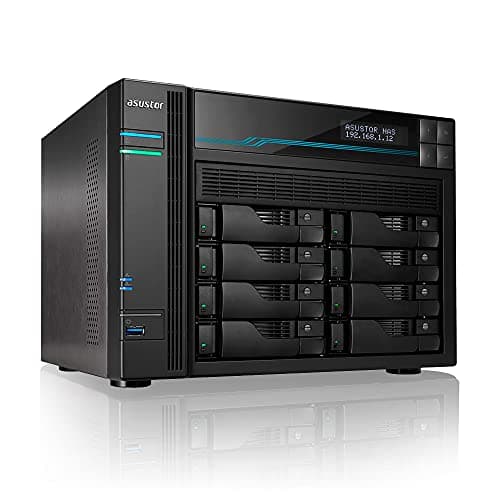
Asustor AS6508T
Score: 86/100Buffalo TeraStation TS3430RN
Score: 81/100Rankings
The Asustor AS6508T is an enterprise-grade 8-bay NAS featuring dual 10 GbE, optional NVMe caching and extensive RAID support, targeting SMBs and power users.
A 1U rack-mountable 4-bay NAS with up to 32 TB capacity, quad-core CPU, dual 2.5 GbE ports and strong security features, suited for SMBs, but limited by modest memory and lack of SSD cache or snapshots.
| Attribute | | Buffalo TeraStation TS3430RN |
|---|---|---|
128 TBbest | 32 TB | |
8best | 4 | |
10 Gbpsbest | 2.5 Gbps | |
4best | 4best | |
8 GBbest | 2 GB | |
| ↓ lower better | 66.9 Wbest | — |
| ↓ lower better | 22 dBbest | — |
2 years | 3 yearsbest |
Click an attribute name to sort · Green = best, red = worst (relative to this comparison)
| Attribute | | Buffalo TeraStation TS3430RN |
|---|---|---|
Performance(3) | ||
CPU Model | Intel Atom C3538 | Annapurna Labs Alpine AL524 Quad-core CPU |
System Memory (GB) | 8 GB | 2 GB |
Ethernet Speed (Gbps) | 10 Gbps | 2.5 Gbps |
Build & Design(2) | ||
Weight (kg) | 6.2 kg | 12.61 kg |
Warranty Period (years) | 2 years | 3 years |
Connectivity(1) | ||
USB Ports | 2 | 3 |
Storage & Capacity(4) | ||
Maximum Raw Capacity (TB) | 128 TB | 32 TB |
Drive Bays | 8 | 4 |
RAID Support | RAID 0,1,5,6,10, JBOD, Single, hot spare, online capacity expansion | RAID 0,1,5,6,10,JBOD |
Supported Drive Types | SATA III | 3.5" SATA III |
Products in the top-left offer the best value (high score, low price).
Reviewers praise its forward-looking networking, solid internal design and quiet operation, while noting UI sluggishness and lack of HDMI.
Users love the 10 GbE speed and NVMe caching but complain about the slow web UI and screw-mounted trays.
Professional reviewers praise the TeraStation 3430RN for its rock-solid reliability, robust security suite and straightforward deployment, highlighting the pre-configured RAID, rail kit and 2.5 GbE networking as key strengths. They note, however, that the modest 2 GB of non-ECC RAM, lack of SSD cache and absence of snapshot capabilities make it less suitable for high-performance or mission-critical scenarios.
Everyday users consistently commend the NAS for its easy setup, dependable day-to-day performance and strong security features, especially the ransomware detection and two-factor authentication. Recurring complaints focus on slower-than-advertised transfer speeds, limited memory causing performance hiccups, and the desire for snapshot functionality and lighter hardware.
“"Dual native 10 GbE and 2.5 GbE ports for high-bandwidth connectivity"”
“"Web UI can be sluggish, especially during initial configuration"”
“"Quiet operation at 22 dBA with smart fan control"”
