Rankings
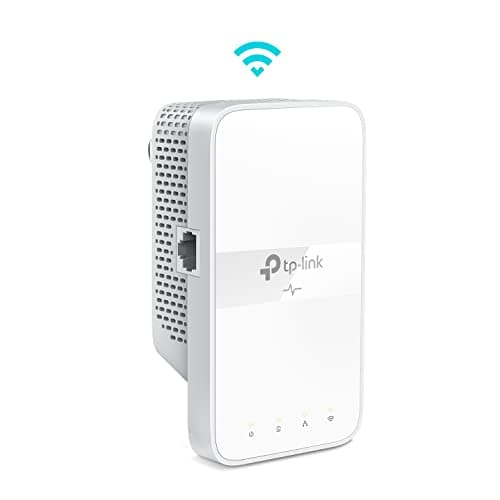
The TL-WPA7617 combines AV2 powerline up to 1000 Mbps with AC1200 dual-band Wi-Fi and a gigabit Ethernet port, offering a versatile networking hub. Its higher power draw, brief warranty, and bulkier form factor are notable trade-offs. Suited for users who need both wired and wireless extensions in a single device.
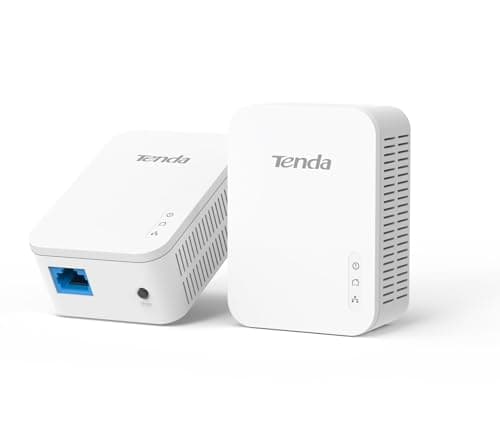
The Tenda PH3 AV1000 kit delivers up to 1000 Mbps theoretical speed with ultra-low power consumption and MIMO support. In practice speeds are lower and the lack of a passthrough socket limits outlet availability. Ideal for users who need a simple wired extension and value energy efficiency.
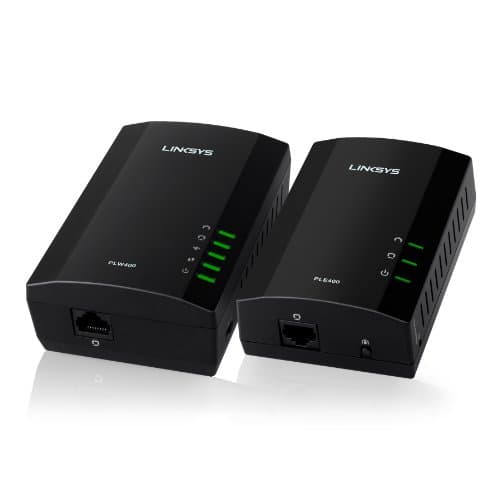
The Linksys PLWK400 merges powerline networking with a Wi-Fi extender, delivering up to 200 Mbps over the electrical wiring and 300 Mbps Wi-Fi. Its main trade-off is the limited Fast Ethernet port speed and the absence of detailed power or range data. It is best for users who need both wired and wireless coverage in hard-to-reach areas without running new cables.
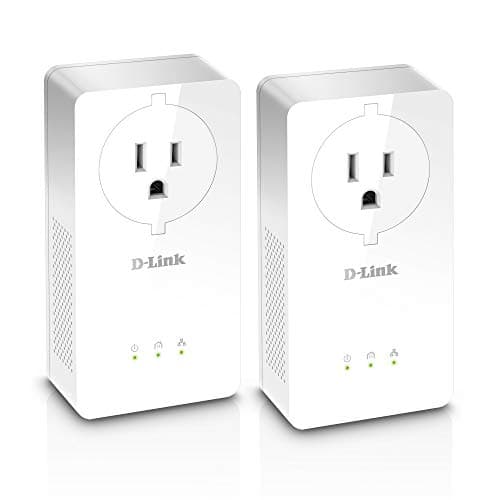
The D-Link DHP-P701AV is a HomePlug AV2 powerline adapter with dual Gigabit ports and a passthrough socket, offering up to 2000 Mbps PHY speed. Its real-world performance varies with wiring quality and it lacks Wi-Fi. Suited for users who need multiple wired connections while preserving outlet space.
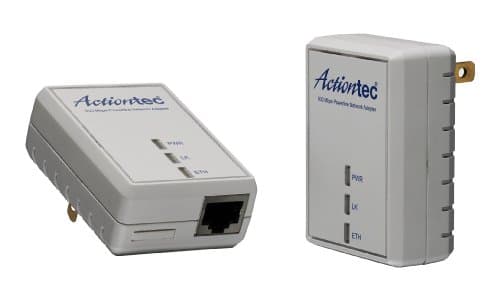
The Actiontec PWR511K01 provides a compact 500 Mbps HomePlug HD solution with easy plug-and-play setup and 128-bit AES security. Its 10/100 Mbps Ethernet port limits true gigabit performance and it lacks a pass-through outlet. Suitable for modest internet connections and devices that don't require gigabit speeds.
| Attribute | | | | | |
|---|---|---|---|---|---|
1,000 Mbps | 2,000 Mbpsbest | 200 Mbps | 1,000 Mbps | 500 Mbps | |
1,000 Mbps | 2,000 Mbpsbest | 200 Mbps | 1,000 Mbps | 500 Mbps | |
1 | 2best | 2best | 1 | 1 | |
| ↓ lower better | 3.2 Wbest | — | — | 11 W | — |
300 mbest | — | — | 300 mbest | — | |
| ↓ lower better | 0.36 Wbest | — | — | — | — |
3 yearsbest | 1 years | — | 0.25 years | — | |
| ↓ lower better | 0.1 kgbest | 0.327 kg | 0.25 kg | 0.2 kg | 0.181 kg |
Click an attribute name to sort · Green = best, red = worst (relative to this comparison)
| Attribute | | | | | |
|---|---|---|---|---|---|
Connectivity(2) | |||||
Ethernet Ports | 1 | 2 | 2 | 1 | 1 |
Network Standards | HomePlug AV, HomePlug AV2, IEEE 1901 | HomePlug AV2, IEEE 802.3 | HomePlug AV, HomePlug AV2, HomePlug AV500 | HomePlug AV2, HomePlug AV, IEEE 1901 | HomePlug HD |
Security(1) | |||||
Encryption | — | AES-128 | — | 128-bit AES | 128-bit AES |
Performance(3) | |||||
Powerline Speed (Mbps) | 1000 Mbps | 2000 Mbps | 200 Mbps | 1000 Mbps | 500 Mbps |
Maximum Data Rate (Mbps) | 1000 Mbps | 2000 Mbps | 200 Mbps | 1000 Mbps | 500 Mbps |
Modulation Technology | MIMO | MIMO | — | OFDM | — |
Power & Energy(2) | |||||
Active Power Consumption (W) | 3.2 W | — | — | 11 W | — |
Power Source | — | — | AC mains | Mains | — |
General(1) | |||||
Warranty Period (years) | 3 years | 1 years | — | 0.25 years | — |
Design(1) | |||||
Device Weight (kg) | 0.1 kg | 0.327 kg | 0.2495 kg | 0.2 kg | 0.181 kg |
Products in the top-left offer the best value (high score, low price).
Professional reviewers acknowledge the PH3's reliable gigabit Ethernet performance and ultra-low power draw, praising its straightforward plug-and-play setup. However, they caution that real-world speeds settle around 250 Mbps and note the lack of Wi-Fi or a passthrough socket limits its flexibility compared with higher-end Tenda models.
Everyday users love the ease of installation and the stable wired connection for gaming and 4K streaming, often highlighting the low energy consumption. Recurring complaints focus on slower-than-advertised speeds, especially in homes with older wiring, and the inconvenience of losing an outlet due to the missing passthrough socket.
“plug-and-play saves time”
“Easy install - just plug it into the router/device and the lights confirm the link.”
“Easy setup with simple instructions and software.”
Professional reviewers and editors commend the DHP-P621AV for its effortless plug-and-play setup, compact form factor, and energy-saving features, while noting that the AV2-based 1000 Mbps PHY rate is a theoretical maximum that depends on wiring quality. The inclusion of a passthrough socket and dual Gigabit ports is seen as a practical advantage over single-port models.
Everyday users generally praise the kit for its easy installation, included cables, and the ability to keep the outlet functional thanks to the passthrough socket. Recurring concerns focus on variable real-world speeds, the need for direct wall outlets, and the requirement that both units share the same electrical circuit.
Professional reviewers highlight the PLWK400's straightforward installation, its suitability for extending coverage into basements and garages, and its ability to deliver up to 500 Mbps across both powerline and Wi-Fi while maintaining WPA2 security and QoS.
Everyday users consistently praise the kit's plug-and-play setup, easy security key management, and the noticeable reduction in lag and connection instability.
Technical specifications from TP-Link's official sources stress that the TL-WPA7617-KIT provides reliable, high-speed connectivity for demanding applications such as HD video streaming and online gaming. Review-type commentary points to its stable performance, extensive 300-meter powerline range, and modern EasyMesh support as key strengths, while noting that the solution eliminates the need for new Ethernet cabling.
Professional reviewers consider the PWR511K01 a solid, compact solution for extending basic Internet connectivity, highlighting its simplicity and reliability for streaming up to 20 Mbps. However, they criticize the misleading 500 Mbps advertising given the 100 Mbps Ethernet limitation and note that performance varies with home wiring, making it unsuitable for high-speed LAN tasks.
Everyday users appreciate the easy setup, stable performance for streaming and gaming, and the compact design that leaves room for other plugs. Common complaints focus on the gap between advertised and actual speeds, the lack of a pass-through outlet, and occasional premature failures of the units.
