Rankings
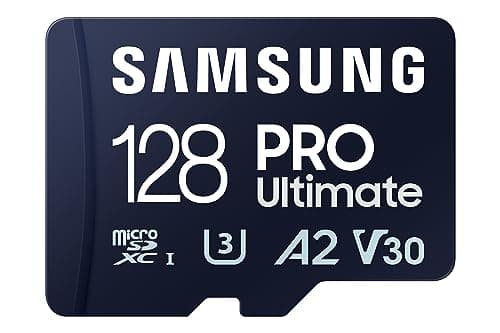
The Samsung PRO Ultimate 128 GB microSDXC provides industry-leading read/write speeds and rugged waterproof/shock protection, making it perfect for demanding 4K video and high-performance mobile gaming. Its trade-off is a premium price and limited capacity relative to larger-capacity cards. Best for content creators, videographers and gamers who need the fastest storage available.
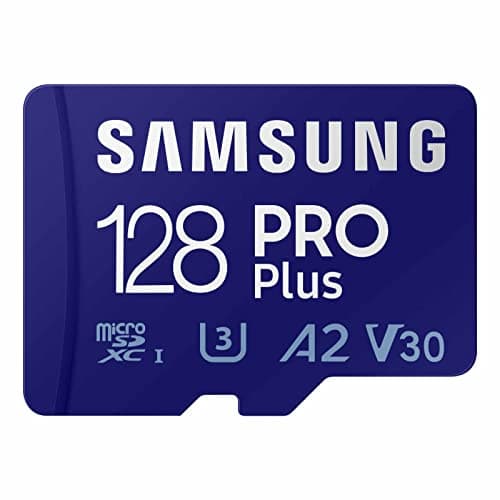
The Samsung PRO Plus 128 GB microSDXC delivers top-tier read/write speeds and strong durability, ideal for 4K video creators and mobile gamers. Its main limitation is reduced performance on older, non-UHS-I devices and a warranty that does not cover continuous-write scenarios. Best suited for photographers, drone pilots and gamers who need speed and ruggedness.
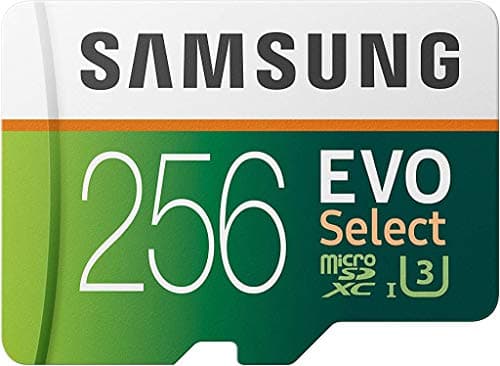
The Samsung EVO Select 256 GB microSDXC offers high capacity and fast UHS-I performance, backed by six-proof durability and an IPX7 waterproof rating. Its main trade-off is a modest warranty period and potential speed drops on older devices. Ideal for Android phones, tablets and cameras where large storage and ruggedness are needed.
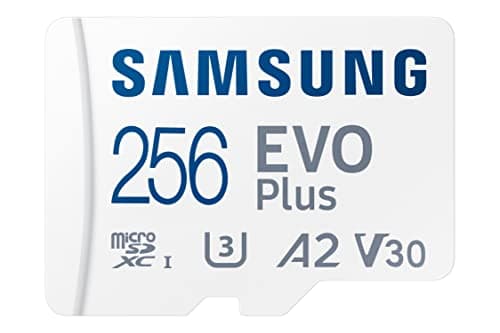
Samsung EVO Plus 256GB combines fast 160 MB/s reads with 90 MB/s writes and four-proof ruggedness, suitable for 4K UHD recording on mobile devices. Its performance depends on UHS-I hosts and sustained writes may not reach peak speeds. Perfect for users wanting a balance of speed, durability, and capacity.
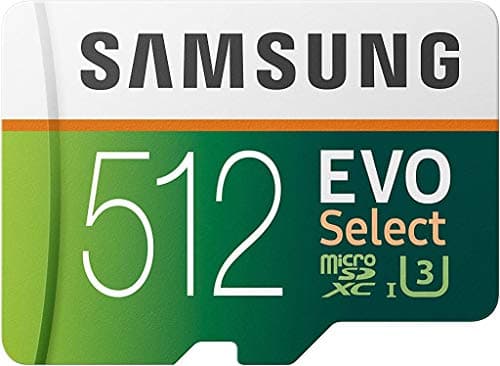
Samsung EVO Select 512GB provides ample high-capacity storage with solid UHS-I performance up to 100 MB/s read and 90 MB/s write, plus robust durability features. However, write speeds can fluctuate and the warranty excludes intensive write-heavy uses. It's a good fit for casual users seeking large capacity at a value price.
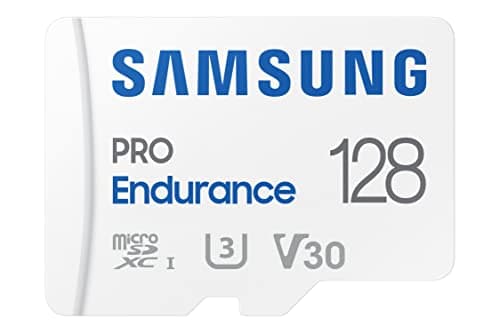
The Samsung PRO Endurance 128 GB microSDXC offers industry-leading endurance and rugged 6-proof durability, making it ideal for continuous surveillance. Its trade-off is modest read/write speeds that lag behind premium performance cards. Best for dash cams, body cams and security systems where reliability outweighs speed.
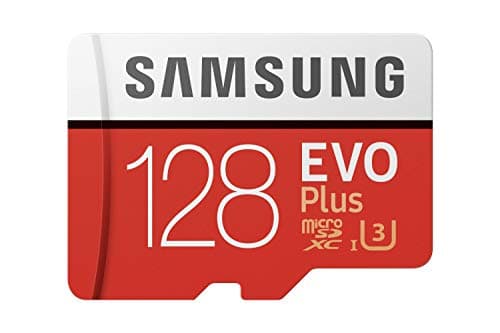
The Samsung EVO Plus 128GB microSDXC offers high read speeds up to 160 MB/s and rugged four-proof durability, making it ideal for 4K video and app storage. Its write speed is limited to a minimum 30 MB/s and performance is capped by UHS-I, which may lag behind newer UHS-II cards. Best suited for mobile users needing reliable, durable storage on UHS-I devices.
| Attribute | | | | | | | |
|---|---|---|---|---|---|---|---|
256 GB | 512 GBbest | 128 GB | 128 GB | 256 GB | 128 GB | 128 GB | |
160 MB/s | 100 MB/s | 200 MB/sbest | 160 MB/s | 160 MB/s | 100 MB/s | 180 MB/s | |
90 MB/s | 90 MB/s | 130 MB/sbest | 30 MB/s | 90 MB/s | 40 MB/s | 130 MB/sbest | |
| ↓ lower better | 13.6 g | 0.25 gbest | 0.25 gbest | 20 g | 0.25 gbest | 0.25 gbest | — |
1 years | 1 years | 10 yearsbest | — | 1 years | 5 years | 10 yearsbest | |
| ↓ lower better | — | 1 mmbest | 1 mmbest | 1 mmbest | 1 mmbest | 1 mmbest | — |
Click an attribute name to sort · Green = best, red = worst (relative to this comparison)
| Attribute | | | | | | | |
|---|---|---|---|---|---|---|---|
Storage(1) | |||||||
Capacity (GB) | 256 GB | 512 GB | 128 GB | 128 GB | 256 GB | 128 GB | 128 GB |
Performance(4) | |||||||
Read Speed (MB/s) | 160 MB/s | 100 MB/s | 200 MB/s | 160 MB/s | 160 MB/s | 100 MB/s | 180 MB/s |
Write Speed (MB/s) | 90 MB/s | 90 MB/s | 130 MB/s | 30 MB/s | 90 MB/s | 40 MB/s | 130 MB/s |
Speed Class | Class 10 | U3 | Class 10 | U3 | U3 | Class 10 | Class 10 |
UHS Speed Class | U3 | UHS-I | U3 | UHS-I | UHS-I | U3 | U3 |
Design(2) | |||||||
Form Factor | microSD | microSDXC | microSD | microSDXC | microSDXC | microSD | microSD |
Weight (g) | 13.6 g | 0.25 g | 0.25 g | 20 g | 0.25 g | 0.25 g | — |
General(3) | |||||||
Warranty (years) | 1 years | 1 years | 10 years | — | 1 years | 5 years | 10 years |
Certifications | FCC, CE, VCCI, RCM | FCC, CE (UKCA), VCCI, RCM | CE (UKCA), FCC, VCCI, RCM | CE, FCC, VCCI, RCM | FCC, CE, VCCI, RCM | CE, FCC, RCM, VCCI | — |
Compatibility | Android smartphones, tablets, cameras, drones | — | GoPRO Action Cam, DJI Drone, Gaming, Phones, Tablets | — | — | Dash Cam, Body Cam, Security Camera | Android Smartphones, Tablets, GoPRO, DJI Drone |
Products in the top-left offer the best value (high score, low price).
Professional reviewers commend the EVO Select for its large capacity, solid real-world read/write speeds, and comprehensive durability, positioning it as a value-focused alternative to premium cards, though they caution that performance can be device-dependent and note its absence from Samsung's PRO lineup.
Everyday consumers consistently highlight the card's reliable speed for 4K video and photo storage, its rugged six-proof design, and the convenience of the included SD adapter, while occasional complaints focus on speed variability across different devices.
“huge capacity and impressive speed”
“gobs of storage”
“the first fastest microSD card”
EVO Plus is ideal when maximum write performance is critical; EVO Select provides a more budget-friendly option with comparable durability.
Professional reviewers commend the EVO Select for delivering reliable UHS-I performance and solid value, especially for 4K video and app storage, while noting that its write speeds fall short of premium alternatives and can vary with the host device.
Everyday users generally praise the card's large capacity, fast reads, and included adapter, highlighting smooth 4K recording and quick transfers, though some express disappointment with slower writes on older devices and the warranty's write-intensive exclusions.
Professional reviewers note the card's industry-leading read/write speeds and its classification as Samsung's 'world's No.1 flash memory', emphasizing its suitability for demanding 4K video and high-performance mobile applications.
Professional reviewers describe the Samsung EVO Plus as a solid, high-performance microSD line with robust four-proof durability, U3/V30/A2 ratings and read speeds up to 160 MB/s, making it ideal for 4K recording. However, they note that its performance scales with capacity and that it is limited to UHS-I, so it cannot match the write speeds of UHS-II cards.
Everyday users consistently praise the card for seamless 4K video capture, fast file transfers and its rugged, reliable construction, while occasional complaints focus on reduced speeds when paired with non-UHS-I devices or slower write performance during large data transfers.
Professional reviewers consider the EVO Plus a solid, reliable microSDXC for mobile and consumer-grade video work, praising its 130 MB/s read capability, U3/V30/A2 ratings and robust build, while noting that its peak speeds fall short of flagship cards like the SanDisk Extreme Pro.
Everyday users consistently highlight the large 256GB capacity, fast 90 MB/s writes for lag-free transfers, and the convenience of the included SD adapter, with few complaints beyond occasional speed drops on older devices.
Professional reviewers praise the PRO Endurance for its enterprise-grade NAND, unmatched 128 GB endurance capacity, and rugged 6-proof construction, positioning it as the go-to solution for always-on recording. However, they acknowledge the intentional speed trade-off, noting it is slower than performance-oriented cards and thus less suited for high-speed tasks.
User feedback is sparse; the only specific comment found was a negative fulfillment experience where the buyer never received the product.
Professional reviewers praise the PRO Plus for its supercharged read/write performance that makes 4K video recording and raw photo bursts seamless, while also noting its robust construction and broad device compatibility. However, they warn that the advertised speeds are contingent on using a UHS-I capable host, so older devices may not experience the full benefit.
Consumers consistently highlight the card's speed and durability as major strengths, especially for mobile photography, drone footage, and handheld gaming. The most common complaints revolve around reduced performance on non-UHS-I devices and the warranty's exclusion of high-write use cases.
