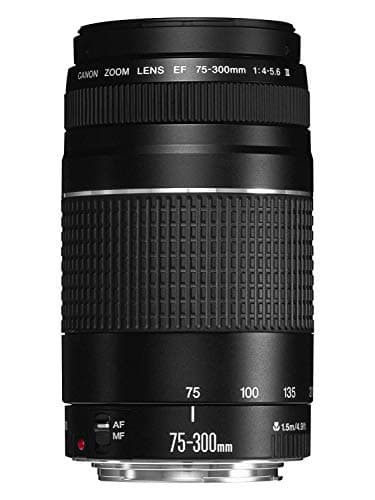
Canon EF 75-300mm f-5.6 III
Score: 58/100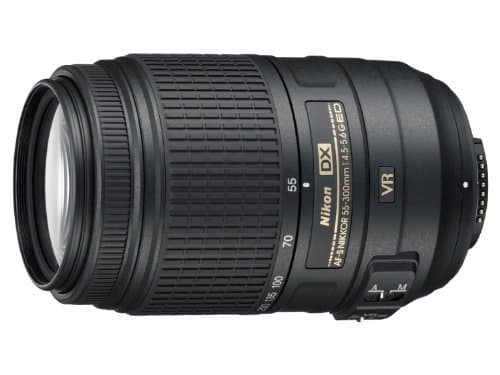
Nikon 55-300mm Zoom Lens
Score: 78/100Rankings
The Nikon 55-300mm f/4.5-5.6G ED VR provides a broad 5.5× zoom and solid VR II for DX-format cameras. Zoom creep and slower AF can hinder fast-action shooting, and edge softness remains at the long end. Best suited for entry-level DX users seeking affordable telephoto versatility.
The Canon EF 75-300mm f/4-5.6 III is a lightweight, budget-friendly telephoto zoom offering solid reach. Its trade-offs include a sluggish micro-motor AF, lack of stabilization, and softer optics at the long end. Best suited for beginners and casual shooters needing portable telephoto capability.
| Attribute | | |
|---|---|---|
| ↓ lower better | 1.5 m | 1.4 mbest |
| ↓ lower better | 480 gbest | 580 g |
4 | 5.5best | |
7 | 9best | |
0.3 | 0.3best | |
13 | 17best | |
9 | 11best | |
58 mmbest | 58 mmbest |
Click an attribute name to sort · Green = best, red = worst (relative to this comparison)
| Attribute | | |
|---|---|---|
Compatibility(2) | ||
Lens Mount | Canon EF | Nikon F-Bayonet |
Mount Compatibility | Full-Frame | DX |
Features(3) | ||
Image Stabilization | false | true |
Autofocus Type | Micro motor | AF-S |
Focus Type | AF | Auto |
Optics(8) | ||
Focal Length (mm) | 75-300 mm | 55-300 mm |
Maximum Aperture (f‑stop) | 4-5.6 | 4.5-5.6 |
Minimum Focus Distance (m) | 1.5 m | 1.4 m |
Zoom Ratio | 4 | 5.5 |
Macro Ratio | 0.25 | 0.28 |
Number of Optical Elements | 13 | 17 |
Number of Optical Groups | 9 | 11 |
Diaphragm Blades | 7 | 9 |
Build & Design(3) | ||
Weight (g) | 480 g | 580 g |
Length (mm) | 122 mm | 123 mm |
Maximum Diameter (mm) | 71 mm | 77 mm |
Products in the top-left offer the best value (high score, low price).
Professional reviewers describe the EF 75-300mm f/4-5.6 III as Canon's basic, budget-friendly long zoom. They commend its ultra-light weight and compact form factor, but repeatedly note the sluggish micro-motor autofocus, modest build quality, and average optical performance, especially the softness and reduced contrast at the 300 mm end.
Everyday users love the lens for its portability and inexpensive telephoto reach, often mentioning how easy it is to pack for travel and wildlife outings. However, they commonly complain about the slow, noisy autofocus, the absence of stabilization, plastic feel, and noticeable softness at the long end, which detracts from image quality in low-light or high-magnification scenarios.
“Users praise sharp distant shots for sports/wildlife, effective VR for handheld telephoto, compact size/weight for travel, and close focus for insects (e.g., 3-inch field at 300mm).”
“Common complaints include zoom creep/wiggle, slow AF for action, soft 300mm corners, filter rotation, and VR less effective on tripod without sensing.”
Professional reviewers commend the Nikon 55-300mm for its generous reach, quiet Silent Wave Motor, and effective VR II stabilization, noting that the ED and HRI elements keep chromatic aberration low. However, they criticize the soft corner performance at 300mm, slower autofocus compared to higher-end telephotos, and diffraction limits when stopping down beyond f/16.
Everyday users love the lens for its lightweight, travel-friendly design, solid VR performance, and ability to get close-up shots of insects, but they repeatedly mention zoom creep, slower AF for action, and noticeable softness in the telephoto corners as recurring pain points.
