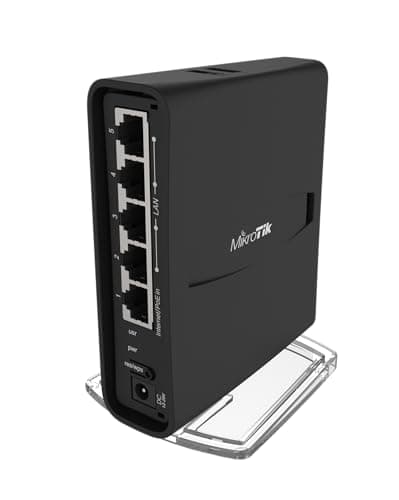
MikroTik hAP ac2
Score: 72/100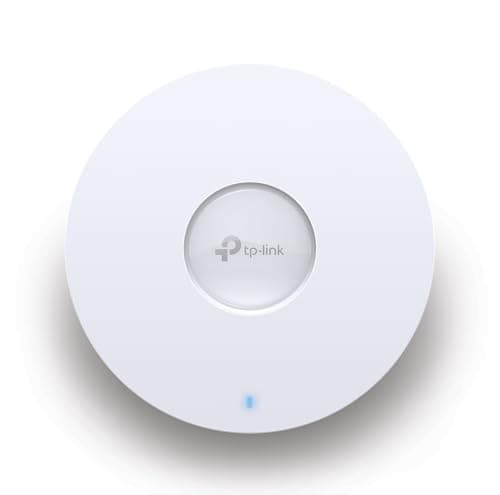
TP-Link EAP650 Ultra-Slim
Score: 76/100Rankings
The TP-Link EAP650 is an ultra-slim Wi-Fi 6 access point delivering up to 3 Gbps dual-band throughput and supporting over 100 devices. Its main trade-off is the lack of explicit beamforming and a single LAN port, which may limit advanced performance tuning. Ideal for high-density indoor environments needing centralized Omada management.
The MikroTik hAP ac² combines dual-band AC1200 Wi-Fi with five Gigabit Ethernet ports and USB support, providing a versatile router/AP solution. Its lack of Wi-Fi 6, low antenna gain, and modest hardware can restrict performance in demanding environments. Perfect for tech-savvy home or small-office setups requiring extensive wired connectivity.
| Attribute | | |
|---|---|---|
1,200 Mbps | 2,402 Mbpsbest | |
300 Mbps | 574 Mbpsbest | |
5best | 1 | |
2best | — | |
| ↓ lower better | 16 W | 13.7 Wbest |
| ↓ lower better | 21 Wbest | — |
| ↓ lower better | 300 gbest | 380 g |
Click an attribute name to sort · Green = best, red = worst (relative to this comparison)
| Attribute | | |
|---|---|---|
Network(2) | ||
Wi‑Fi Standard | 802.11ac | Wi-Fi 6 (802.11ax) |
Frequency Bands | 2.4/5 GHz | Dual-band (2.4 GHz & 5 GHz) |
Performance(2) | ||
Max Data Rate (5 GHz) (Mbps) | 1200 Mbps | 2402 Mbps |
Max Data Rate (2.4 GHz) (Mbps) | 300 Mbps | 574 Mbps |
Power & Power Supply(2) | ||
PoE Standard | Passive | 802.3at, 802.3af |
Power Consumption (W) | 16 W | 13.7 W |
Design & Build(4) | ||
Ethernet Ports | 5 | 1 |
Mounting Options | Horizontal, vertical | Ceiling, wall, junction box, or T-bar (kits included) |
Dimensions (L×W×H) (mm) | 34x119x98 mm | 33.6 x 160 x 160 mm mm |
Weight (g) | 300 g | 380 g |
Products in the top-left offer the best value (high score, low price).
Professional reviewers and editors commend the hAP ac² for its robust feature set at a low price, especially the hardware-accelerated IPsec engine and the flexibility of RouterOS Level 4. They also note its compact design, PoE capability, and USB modem support as strong points for small-office deployments, while calling out the modest CPU/RAM and lack of Wi-Fi 6 or SFP as limitations for more demanding scenarios.
Everyday users value the device's configurability, Ethernet richness, and ability to add a 3G/4G backup via USB, but many express frustration with the limited Wi-Fi range, the steep learning curve of RouterOS, and performance drops in congested wireless environments.
