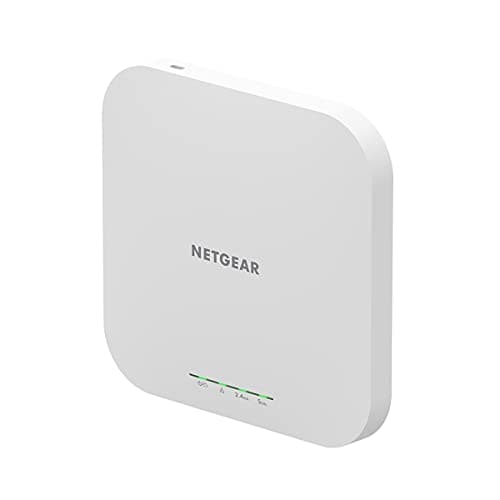
Netgear Wireless Access Point
Score: 81/100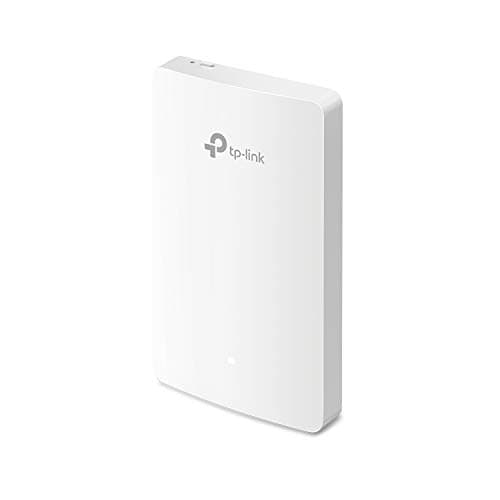
TP-Link EAP235-Wall White
Score: 68/100Rankings
The NETGEAR WAX610 is a dual-band Wi-Fi 6 access point delivering up to 1.8 Gbps with four spatial streams and PoE+ connectivity. Its single Ethernet port and 30-user concurrent limit may affect very busy venues. Suitable for indoor SMBs seeking cloud-managed Wi-Fi 6 with mesh capability.
The TP-Link EAP235-Wall is an in-wall AC1200 AP offering MU-MIMO, beamforming and four Gigabit ports with PoE pass-through for small-room deployments. Its Wi-Fi 5 performance and limited coverage make it less suitable for larger or high-density environments. Ideal for hotels, offices or dorm rooms needing per-room wired connectivity and modest wireless speeds.
| Attribute | | |
|---|---|---|
866 Mbps | 867 Mbpsbest | |
232.3 sqmbest | 25 sqm | |
300 Mbpsbest | 300 Mbpsbest | |
1 | 4best | |
4best | 2 | |
| ↓ lower better | — | 9.8 Wbest |
| ↓ lower better | — | 24.4 Wbest |
| ↓ lower better | 635 g | 222 gbest |
Click an attribute name to sort · Green = best, red = worst (relative to this comparison)
| Attribute | | |
|---|---|---|
Network(2) | ||
Wi‑Fi Standard | 802.11ax | Wi‑Fi 5 (802.11ac) |
Frequency Bands | 2.4 GHz,5 GHz | 2.4 GHz, 5 GHz |
Performance(3) | ||
Max Data Rate (5 GHz) (Mbps) | 866 Mbps | 867 Mbps |
Coverage Area (sqm) | 232.3 sqm | 25 sqm |
Spatial Streams | 4 | 2 |
Power & Power Supply(1) | ||
PoE Standard | 802.3at | 802.3af/at |
Design & Build(4) | ||
Ethernet Ports | 1 | 4 |
Mounting Options | Ceiling,Wall | Wall-plate |
Dimensions (L×W×H) (mm) | 76.2x203.2x203.2 mm | 19.7×156.7×143.0 mm mm |
Weight (g) | 635 g | 222 g |
Products in the top-left offer the best value (high score, low price).
Professional reviewers consider the WAX610 a solid enterprise-grade Wi-Fi 6 solution, emphasizing its advanced OFDMA and MU-MIMO capabilities, a four-fold boost in client capacity, and a 40 % increase in per-device throughput. They also appreciate the cloud-managed Insight platform and the straightforward DIY installation process, positioning it as a balanced choice for SMBs that need modern performance without the complexity of higher-end tri-band models.
No specific consumer reviews were provided in the source data, so user sentiment cannot be directly assessed. The lack of user‑generated feedback suggests limited publicly available commentary on real‑world performance or pain points.
