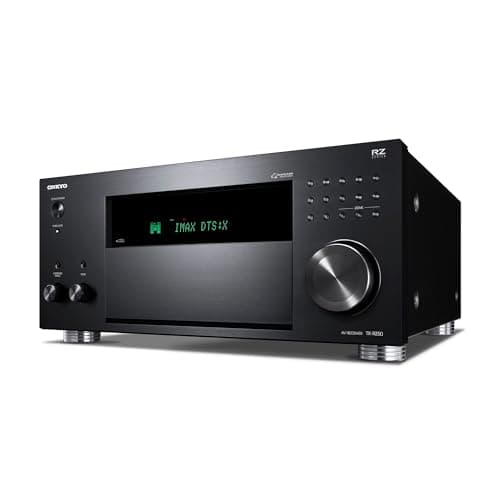
Onkyo TX-RZ50
Score: 81/100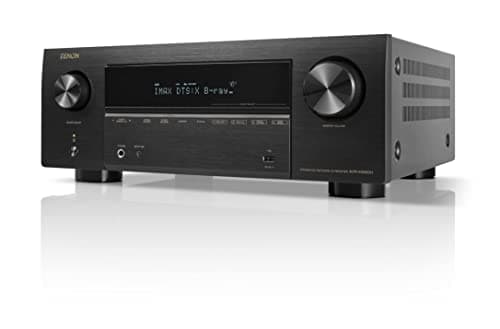
Denon AVR-X3800H
Score: 81/100Rankings
The Onkyo TX-RZ50 is a 9.2-channel receiver offering 120 W per channel, Dirac Live calibration, and THX Certified Select for high-performance audio. Its high idle power consumption and fan noise can be drawbacks for energy-sensitive or quiet-environment users. It excels in medium-size home theaters and gaming setups requiring powerful, calibrated sound.
The Denon AVR-X3800H is a high-power 9.4-channel receiver featuring 105 W per channel, HDMI 2.1 8K video and a built-in tuner. Its elevated DAC noise and heavy weight are notable trade-offs for the premium feature set. Best for enthusiasts building medium-large home-theater systems who value extensive audio/video capabilities.
| Attribute | | |
|---|---|---|
7best | 6 | |
2 | 3best | |
120 Wbest | 105 W | |
| ↓ lower better | 850 W | 660 Wbest |
| ↓ lower better | 0.1 Wbest | — |
3 yearsbest | 3 yearsbest | |
| ↓ lower better | 435.1 mm | 434.34 mmbest |
| ↓ lower better | 201.68 mm | 167.64 mmbest |
Click an attribute name to sort · Green = best, red = worst (relative to this comparison)
| Attribute | | |
|---|---|---|
Ports(2) | ||
HDMI Inputs | 7 | 6 |
HDMI Outputs | 2 | 3 |
Audio(2) | ||
Supported Audio Formats | PCM, DSD, Dolby Digital, DTS, DTS‑ES, DTS 96/24 | AAC; FLAC; WAV; DSD; MP3 |
Channel Configuration | 9.2 | 9.4 |
Power(2) | ||
Power Output (per channel, 8 Ω) (W) | 120 W | 105 W |
Power Consumption (Operating) (W) | 850 W | 660 W |
Connectivity(2) | ||
HDMI Version | HDMI 2.1 | 2.1 |
Bluetooth Version | Bluetooth | 4.0 |
Features(1) | ||
Video Support (e.g., 4K/8K) | 8K/60, 4K/120 | 8K/60Hz; 4K/120Hz; HDR10+; Dolby Vision; HLG |
Build & Design(4) | ||
Width (mm) | 435.1 mm | 434.34 mm |
Height (mm) | 201.68 mm | 167.64 mm |
Depth (mm) | 398.27 mm | 378.46 mm |
Weight (kg) | 14.01 kg | 12.518 kg |
Products in the top-left offer the best value (high score, low price).
Professional reviewers commend the TX-RZ50 for its distortion-free output, expansive frequency response, and low-jitter processing, highlighting the value of built-in Dirac Live and THX certification. They also note minor drawbacks such as measurable multitone jitter, a relatively high idle power draw, and some fan-related noise under heavy use.
Everyday users appreciate the receiver's punchy, detailed sound, the ease of setting up Atmos and gaming, and the reliable multi-room streaming. Recurring complaints focus on occasional HDMI handshake glitches, app control hiccups, and audible fan noise during prolonged high-power sessions.
Professional reviewers commend the AVR-X3800H for its robust analog amplification, flexible channel configuration, and strong 8K video handling, while consistently pointing out the DAC's elevated noise and jitter as the primary drawback. ASR recommends using pure mode to mitigate DAC issues, and overall the unit is seen as a solid step forward despite minor regressions in measurement scores.
Everyday users generally praise the ease of HEOS multi-room streaming, the inclusion of a phono input for vinyl enthusiasts, and the quick Audyssey room-calibration. Recurring complaints focus on DAC-related noise in digital playback and the unit's substantial weight making installation harder.
