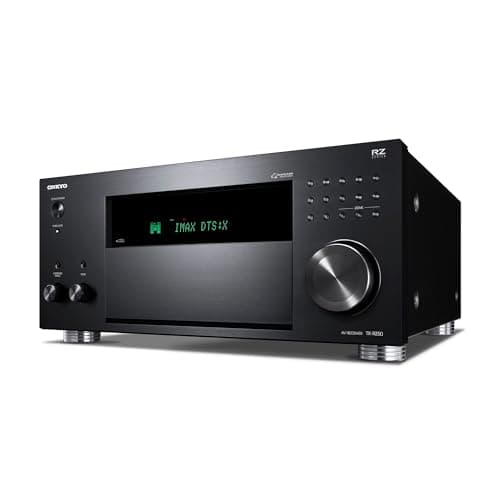
Onkyo TX-RZ50
Score: 81/100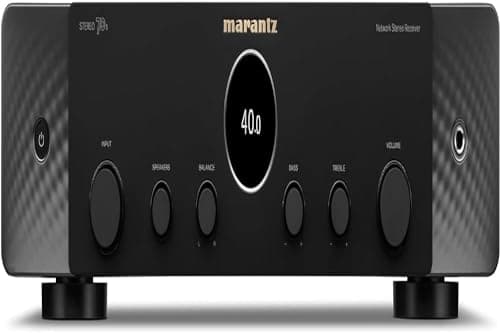
Marantz STEREO 70s
Score: 83/100Rankings
The Marantz STEREO 70s is a compact 2-channel receiver delivering 75 W per channel with modern 8K-ready HDMI connectivity and HEOS streaming. Its limited surround-sound capability and lack of advanced room-calibration features may deter home-theater enthusiasts. Ideal for listeners seeking high-quality stereo performance in tight spaces.
The Onkyo TX-RZ50 is a 9.2-channel receiver offering 120 W per channel, Dirac Live calibration, and THX Certified Select for high-performance audio. Its high idle power consumption and fan noise can be drawbacks for energy-sensitive or quiet-environment users. It excels in medium-size home theaters and gaming setups requiring powerful, calibrated sound.
| Attribute | | |
|---|---|---|
7best | 6 | |
2best | 1 | |
120 Wbest | 75 W | |
| ↓ lower better | 850 W | 210 Wbest |
| ↓ lower better | 0.1 Wbest | 0.2 W |
3 years | 5 yearsbest | |
| ↓ lower better | 435.1 mmbest | 441.96 mm |
| ↓ lower better | 201.68 mm | 109.22 mmbest |
Click an attribute name to sort · Green = best, red = worst (relative to this comparison)
| Attribute | | |
|---|---|---|
Ports(2) | ||
HDMI Inputs | 7 | 6 |
HDMI Outputs | 2 | 1 |
Audio(2) | ||
Supported Audio Formats | PCM, DSD, Dolby Digital, DTS, DTS‑ES, DTS 96/24 | FLAC, WAV, ALAC, DSD |
Channel Configuration | 9.2 | 2 |
Power(3) | ||
Power Output (per channel, 8 Ω) (W) | 120 W | 75 W |
Power Consumption (Operating) (W) | 850 W | 210 W |
Standby Power Consumption (W) | 0.1 W | 0.2 W |
Connectivity(1) | ||
HDMI Version | HDMI 2.1 | 2.1 |
Features(1) | ||
Video Support (e.g., 4K/8K) | 8K/60, 4K/120 | 4K/120,8K |
General(1) | ||
Warranty (years) | 3 years | 5 years |
Build & Design(4) | ||
Width (mm) | 435.1 mm | 441.96 mm |
Height (mm) | 201.68 mm | 109.22 mm |
Depth (mm) | 398.27 mm | 386.08 mm |
Weight (kg) | 14.01 kg | 10.89 kg |
Products in the top-left offer the best value (high score, low price).
Professional reviewers commend the TX-RZ50 for its distortion-free output, expansive frequency response, and low-jitter processing, highlighting the value of built-in Dirac Live and THX certification. They also note minor drawbacks such as measurable multitone jitter, a relatively high idle power draw, and some fan-related noise under heavy use.
Everyday users appreciate the receiver's punchy, detailed sound, the ease of setting up Atmos and gaming, and the reliable multi-room streaming. Recurring complaints focus on occasional HDMI handshake glitches, app control hiccups, and audible fan noise during prolonged high-power sessions.
The Absolute Sound commends the STEREO 70s for its solid stereo power, compact footprint, and a connectivity package that rivals larger AV receivers. Reviewers appreciate the discrete Class A/B amplification, HEOS integration, and the ability to handle high-resolution audio, positioning it as a high-quality music-first component that still accommodates modern video sources.
