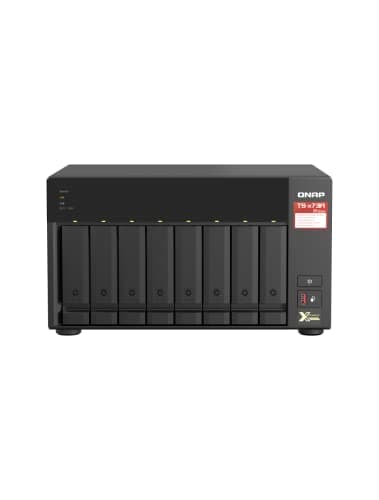
Qnap TS-873A-8G
Score: 82/100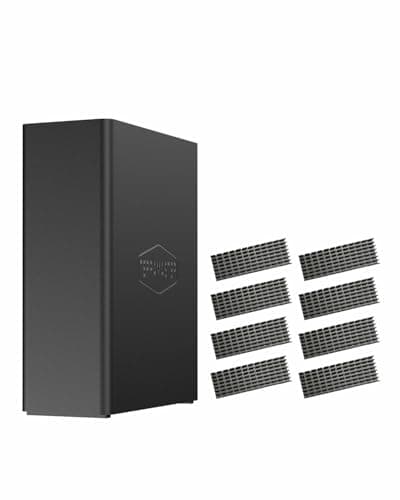
Terramaster F8
Score: 76/100Rankings
The QNAP TS-873A-8G is an 8-bay NAS with an AMD Ryzen quad-core processor, expandable up to 64 GB RAM and dual 2.5 GbE ports, delivering strong performance for demanding workloads. It lacks built-in 10 GbE and has a relatively high active power draw. Suited for small-business labs and media servers requiring large capacity and virtualization.
The TerraMaster F8 SSD is an ultra-compact 8-bay all-flash NAS delivering up to 64 TB raw capacity and fast 10 GbE transfers. Its trade-offs include relatively high power draw, a single network port and OS space consumption. It suits small businesses and creators needing portable high-performance storage.
| Attribute | | |
|---|---|---|
— | 64 TBbest | |
8best | 8best | |
4best | 4best | |
2.2 GHz | 3.4 GHzbest | |
8 GBbest | 8 GBbest | |
— | 1,020 MB/sbest | |
4best | 3 | |
2best | 1 |
Click an attribute name to sort · Green = best, red = worst (relative to this comparison)
| Attribute | | |
|---|---|---|
Performance(2) | ||
CPU Model | AMD Ryzen V1500B | Intel N95 |
CPU Clock Speed (GHz) | 2.2 GHz | 3.4 GHz |
Connectivity(3) | ||
USB Ports | 4 | 3 |
Ethernet Ports | 2 | 1 |
Ethernet Speed (Gbps) | 2.5 Gbps | 10 Gbps |
Power(2) | ||
Power Consumption (Idle) (W) | 25.7 W | 9 W |
Power Consumption (Active) (W) | 54.1 W | 45 W |
Build & Design(3) | ||
Weight (kg) | 8 kg | 0.6 kg |
Dimensions (H×W×D) (cm) | 28.1×29.5×18.8 cm cm | 4 x 10 x 15 cm cm |
Noise Level (dB) | 23 dB | 19 dB |
Professional reviewers consider the TS-873A a solid high-performance NAS that delivers high compute performance for virtualization and media transcoding; eight hot-swappable bays provide up to 64 TB of raw storage; dual 2.5 GbE ports enable faster network transfers; expandable DDR4 memory up to 64 GB with ECC support ensures data integrity; multiple USB 3.2 ports for high-speed peripheral connectivity; optional PCIe slots allow adding 5 GbE/10 GbE adapters for future network upgrades.
Direct consumer reviews are scarce, but the specifications suggest users would likely appreciate the high-speed connectivity, transcoding performance and flexibility for multiple workloads. Potential concerns that surface in discussions revolve around the limited two-bay design and the non-expandable 8 GB RAM, which may restrict future growth.
Professional reviewers commend the F8 SSD series for delivering desktop-class performance in a palm-sized chassis, with the Plus model's i3-N305 and 16 GB DDR5 providing a clear boost for virtualization and 4K media tasks. However, they caution that the OS's 40 GB footprint and the 45 W power draw under load diminish its efficiency, and the single 10 GbE port may be a limitation for enterprise-grade redundancy.
Everyday users love the silent, portable nature of the device and its lightning-fast 10 GbE transfers, noting the ease of tool-free SSD swaps and upgradable memory. Recurring frustrations focus on the OS consuming significant space, higher power usage, limited Ethernet options, and occasional heat under sustained workloads.
“Super quiet and portable-like two phones”
“Fast 1024MB/s transfers”
“OS eating 40GB per SSD”
