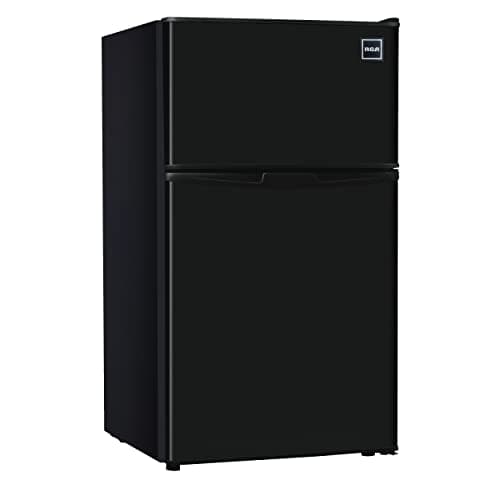
RCA Compact Refrigerator
Score: 79/100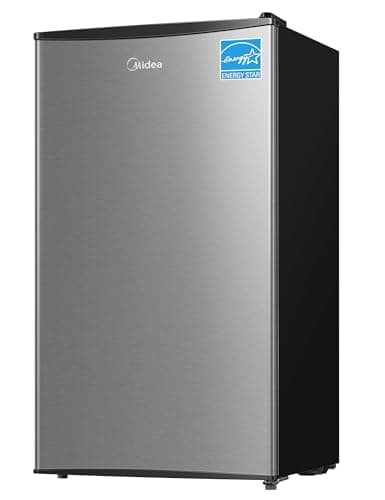
Midea MERM33S1AST
Score: 81/100Rankings
The Midea MERM33S1AST is a 3.3 cu ft stainless-steel-look compact fridge featuring LED lighting, a reversible door, and dedicated door bins for cans and bottles. It lacks a freezer and uses manual defrost, which can be less convenient for continuous use. Suitable for dorm rooms, home offices, or workshops needing efficient fresh-food cooling.
The RCA RFR835 is a compact 3.2 cu ft two-door fridge with ENERGY STAR efficiency, a reversible door, and a separate freezer compartment. Its modest capacity and lack of advanced features like LED lighting limit its appeal for larger households. Suitable for students or office spaces needing an energy-saving mini-fridge.
| Attribute | | |
|---|---|---|
3.2 cu ft | 3.3 cu ftbest | |
| ↓ lower better | 25 dBbest | 42 dB |
1 yearsbest | 1 yearsbest | |
| ↓ lower better | 86.36 cm | 86.1 cmbest |
| ↓ lower better | 50.8 cm | 47.2 cmbest |
| ↓ lower better | 55.88 cm | 44.7 cmbest |
| ↓ lower better | 23.52 kg | 19.504 kgbest |
Click an attribute name to sort · Green = best, red = worst (relative to this comparison)
| Attribute | | |
|---|---|---|
Warranty & Reliability(1) | ||
Warranty (years) | 1 years | 1.0 years |
Noise & Operation(1) | ||
Noise Level (dB) | 25 dB | 42 dB |
Energy & Power(1) | ||
Compressor Type | Compressor | compressor cooled |
Capacity & Dimensions(5) | ||
Capacity (cu ft) | 3.2 cu ft | 3.3 cu ft |
Height (cm) | 86.36 cm | 86.1 cm |
Width (cm) | 50.80 cm | 47.2 cm |
Depth (cm) | 55.88 cm | 44.7 cm |
Weight (kg) | 23.52 kg | 19.504 kg |
Products in the top-left offer the best value (high score, low price).
Professional reviewers emphasize the unit’s ENERGY STAR rating and low annual energy consumption of 323 kWh as standout efficiency points. They also commend the automatic defrost system and the flexibility of a reversible door combined with a separate freezer compartment, noting these features set it apart from many basic mini‑fridges. However, reviewers point out the limited capacity and absence of ice‑making or smart controls as trade‑offs.
There is little publicly available user feedback in the sources, so consumer sentiment cannot be fully assessed. The limited data suggests that users who prioritize space-saving and energy efficiency appreciate the model, while the lack of ice-maker and small capacity are common concerns.
