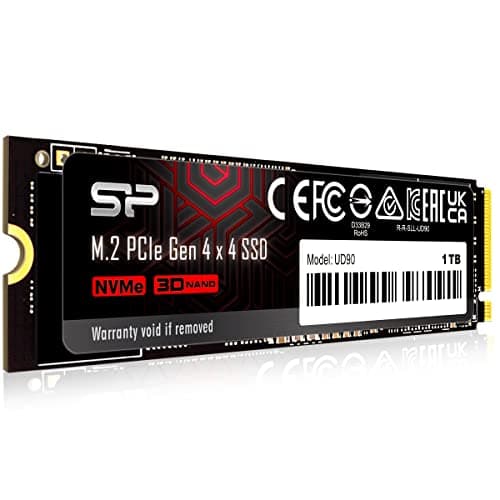
Silicon Power UD90 1TB
Score: 80/100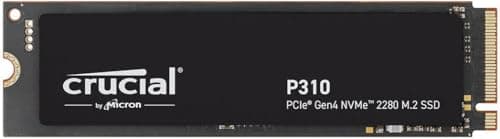
Crucial P310 1TB
Score: 48/100Rankings
The Silicon Power UD90 1TB PCIe 4.0 SSD delivers flagship-class sequential speeds at a budget price, but its DRAM-less design and lack of a heatsink lead to thermal concerns and mixed reliability reports.
The Crucial P310 1TB PCIe Gen4 NVMe SSD delivers flagship-class sequential speeds and strong random IOPS in a compact single-sided M.2 2280 form factor, but its modest endurance and lack of hardware encryption limit its appeal for heavy-write or security-focused scenarios.
| Attribute | | |
|---|---|---|
1,000 GBbest | 1,000 GBbest | |
5,000 MB/s | 7,100 MB/sbest | |
4,800 MB/s | 6,000 MB/sbest | |
570,000 IOPS | 1,000,000 IOPSbest | |
600,000 IOPS | 1,200,000 IOPSbest | |
600 TBWbest | 220 TBW | |
5 yearsbest | 5 yearsbest | |
1,500,000 hoursbest | — |
Click an attribute name to sort · Green = best, red = worst (relative to this comparison)
| Attribute | | |
|---|---|---|
Performance(4) | ||
Sequential Read Speed (MB/s) | 5000 MB/s | 7100 MB/s |
Sequential Write Speed (MB/s) | 4800 MB/s | 6000 MB/s |
Random Read IOPS (IOPS) | 570000 IOPS | 1000000 IOPS |
Random Write IOPS (IOPS) | 600000 IOPS | 1200000 IOPS |
Storage(2) | ||
NAND Type | TLC | QLC |
Endurance (TBW) (TBW) | 600 TBW | 220 TBW |
Design & Build(2) | ||
Weight (g) | 8 g | 10 g |
Thickness (mm) | 3.5 mm | 2.3 mm |
Products in the top-left offer the best value (high score, low price).
Professional reviewers praise the UD90 as a value champion with strong sequential performance, but caution about heat and the absence of an included heatsink.
Everyday users love the fast boot and gaming responsiveness, yet many complain about overheating, premature failures, and occasional data corruption.
“"new Value Champion" - Tom's Hardware”
“"great deal" for 1TB of PCIe 4.0 storage”
“"sudden drive death within months"”
Professional reviewers praise the P310 for its flagship-class sequential speeds, impressive random write IOPS, and cool operation without a heatsink, noting its compact design and 5-year warranty, but consistently flag its modest 220 TBW endurance, DRAM-less architecture, and lack of hardware encryption as drawbacks.
Everyday users are overwhelmingly positive, highlighting the instant boost in system responsiveness, easy installation, and noticeable load-time reductions, with only minor mentions of the missing heatsink.
