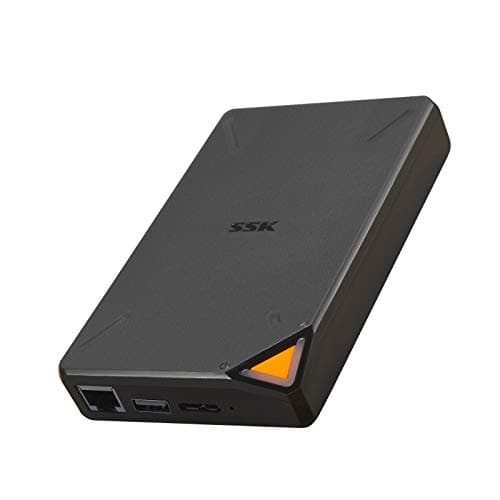
SSK Portable NAS
Score: 55/100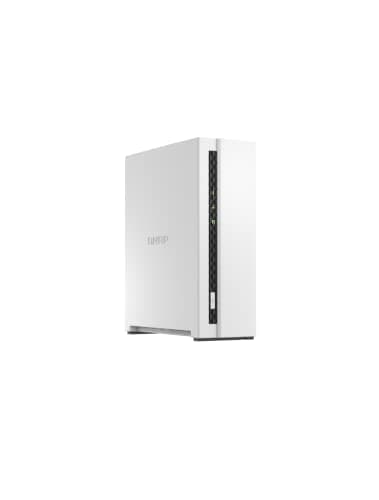
Qnap TS-133-US 2GB
Score: 66/100Rankings
The QNAP TS-133-US is a compact 1-bay desktop NAS with a quad-core ARM processor and 2 GB RAM, aimed at entry-level home and small-office users. Its limited RAM, lack of RAID and only 1 GbE networking restrict scalability and performance for demanding tasks. Best suited for beginners needing simple backups and basic media streaming.
The SSK SSM-F200 is a compact 2 TB portable NAS that runs on a built-in battery and creates its own Wi-Fi hotspot for wireless file access. Its modest wireless speeds and lack of RAID limit it to light backup and sharing tasks. Best suited for mobile professionals who need occasional on-the-go storage and power-bank capability.
| Attribute | | |
|---|---|---|
2 TBbest | — | |
1best | 1best | |
— | 4best | |
— | 1.8 GHzbest | |
— | 2 GBbest | |
7.5 MB/sbest | — | |
7.5 MB/sbest | — | |
1 | 2best |
Click an attribute name to sort · Green = best, red = worst (relative to this comparison)
| Attribute | | |
|---|---|---|
Connectivity(1) | ||
USB Ports | 1 | 2 |
Build & Design(1) | ||
Dimensions (H×W×D) (cm) | 2×8×13 cm cm | 15.75×18.80×15.75 cm cm |
Professional reviewer commentary is absent; manufacturer claims emphasize portability, battery life, and app features, but independent verification of performance and reliability is lacking.
Everyday users highlight the convenience of a wireless, battery-powered personal cloud and the ability to power other devices, while recurring concerns focus on modest transfer speeds and occasional stock shortages.
Professional reviewers commend the TS-133 as the best-value 1-bay NAS, highlighting its powerful ARM quad-core CPU, generous 2 GB RAM for a budget unit, extensive app support and fast USB 3.0 connectivity.
Everyday users love the straightforward entry into the QNAP ecosystem, the quiet operation and the solid single-drive performance for backups and media streaming. Recurring frustrations revolve around a confusing initial setup, limited RAM/CPU when running multiple services, the single-bay design's lack of redundancy, and the perceived slowness of the 1 GbE network.
