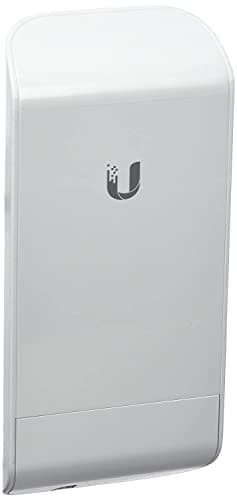
Ubiquiti NanoStation locoM2
Score: 75/100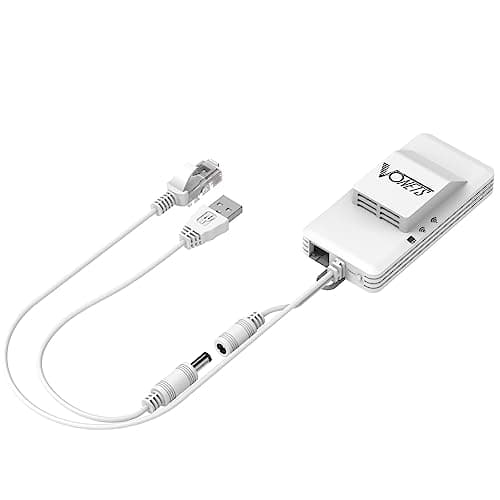
Vonets VAP11AC
Score: 81/100Rankings
The Vonets VAP11AC is a dual-band Wi-Fi bridge/repeater offering up to 1.2 Gbps throughput and 300 m range, built for industrial-grade deployments. Its small form factor restricts antenna options and heat management, and the lack of extensive reviews adds uncertainty. Best suited for surveillance or point-to-point links where rugged power input and long range are critical.
The Ubiquiti NanoStation locoM2 delivers up to 150 Mbps on the 2.4 GHz band with a compact 8-dBi antenna and remote reset capability. Its single-band design and limited Ethernet speed can be drawbacks in high-traffic scenarios. Ideal for small-to-medium WISPs or rural sites needing an affordable, low-power backhaul over a few kilometres.
| Attribute | | |
|---|---|---|
150 Mbps | 1,200 Mbpsbest | |
1best | 1best | |
| ↓ lower better | 180 g | 141 gbest |
5,000 mbest | 300 m | |
| ↓ lower better | 6 Wbest | — |
8.5 dBibest | — | |
24 Vbest | — |
Click an attribute name to sort · Green = best, red = worst (relative to this comparison)
| Attribute | | |
|---|---|---|
Connectivity(2) | ||
Supported Wi‑Fi Standards | 802.11n | 802.11ac, 802.11a, 802.11n, 802.11g, 802.11b |
Frequency Bands (GHz) | 2.4 | 2.4,5 |
Ports(1) | ||
Ethernet Port Speed | 100 | 100 Mbps |
Performance(2) | ||
Maximum Data Rate (Mbps) | 150 Mbps | 1200 Mbps |
Effective Range (m) | 5000 m | 300 m |
Battery & Power(1) | ||
Input Voltage (V) | 24 V | 5-24 V |
Build & Design(2) | ||
Weight (g) | 180 g | 141 g |
Dimensions (L×W×H) (mm) | 30 x 80 x 180 mm | 94x45x15 mm |
Products in the top-left offer the best value (high score, low price).
Professional reviewers emphasize the locoM2's low-latency AirMAX TDMA protocol, carrier-class scalability, and its integrated dual-polarized antenna that delivers solid gain and isolation. They also note the device's rugged outdoor enclosure and intelligent passive PoE with remote reset as strong points, while calling out the limitation to the 2.4 GHz band and the older processor/memory as potential drawbacks for future-proofing.
Everyday users generally praise the device's easy plug-and-play installation, lightweight form factor, and low power draw, especially for remote or solar-powered sites. Recurring concerns revolve around 2.4 GHz interference in crowded areas, the lack of Gigabit Ethernet, and occasional performance limits due to the older hardware.
