⚡ Quick Answer
Choosing a 2.1 speaker system can feel like navigating a maze of power ratings, Bluetooth ranges and price tags. In our comparison of 10 options, the cheapest model sits at $34.99 while the most premium tops out at $319.99. User sentiment varies, with the Klipsch ProMedia 2.1 holding a 4.5/5 rating from 11,706 reviews, and the Creative Pebble Plus pulling a solid 4.3/5 from 7,378 reviewers.
We’ve split the ten speakers into three price tiers. Budget options – the Cyber Acoustics CA‑3090 ($34.99), CA‑3610 ($49.99), Creative Pebble Plus 2.1 ($52.24) and Fifine ($72.99) – keep costs low while delivering clear desktop sound. Mid‑range includes the Logitech Z407 at $109.99, which features a 177.8 mm subwoofer driver and 20 m Bluetooth range, and Creative’s Pebble X Plus for $119.99 with a 30 W peak output. Premium picks such as the Edifier G1500 MAX, Klipsch ProMedia 2.1, SteelSeries Arena 7 and Klipsch ProMedia Lumina 2.1 push power and feature sets higher for demanding setups.
Below we’ll break down each model’s connectivity, driver sizes and real‑world listening scenarios so you can match the system to your space, budget and bass preferences.
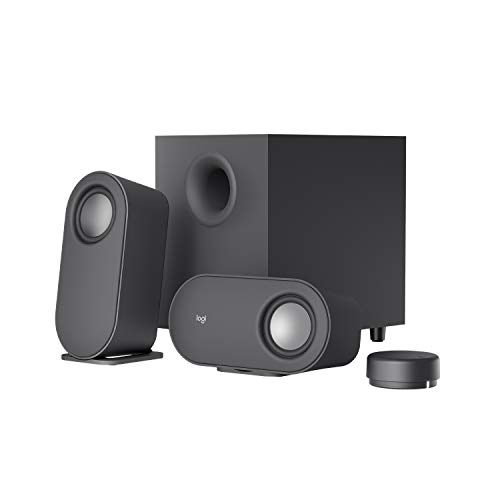
Logitech Z407
Its 63.5 mm satellite drivers deliver fuller mids, giving balanced sound for home and office use.
Creative Pebble Plus 2.1
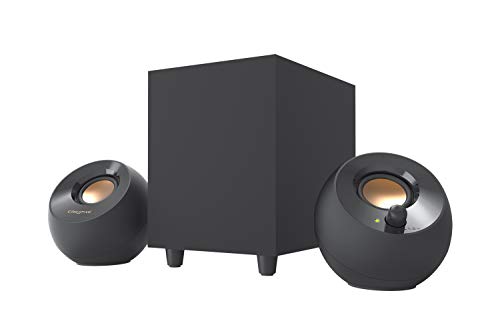
Ideal for budget‑conscious home office setups, it costs $52.24—about $58 less than the Logitech Z407.

Klipsch ProMedia 2.1
It offers a 110 dB SPL ceiling, delivering louder peaks that the other two models don’t reach.
Also considered
Score Analysis
Key score advantages vs. runner-up (Creative Pebble Plus)
Price Range
Logitech Z407
$108.99
Creative Pebble Plus 2.1
$52.24
Klipsch ProMedia 2.1
$159.99

Cyber Acoustics CA-3090
$37.99

Cyber Acoustics CA-3610
$57.99

SteelSeries Arena 7
$299.00

Klipsch ProMedia Lumina 2.1
$379.99

Creative Pebble X Plus
$119.99

Fifine A22
$72.99
Edifier G1500 MAX
$99.99
Spec Comparison
TL;DR: The Logitech Z407 packs 40 W RMS output, a 177.8 mm subwoofer and a 20‑metre Bluetooth dial control into a compact 8.8 lb 2.1‑speaker system ideal for desktop gaming and movies.
At the heart of the Z407 is an 80 W peak (40 W RMS) audio engine with a 177.8 mm subwoofer driver and a 63.5 mm satellite driver paired with a 25.4 mm tweeter. Digital signal processing tunes the 20 W RMS subwoofer for punchy bass while the wireless control dial—69.9 mm in diameter, 29.4 mm tall and weighing just 52 g—lets you adjust volume, bass and tracks from up to 20 m away.
Compared with its peers, the Z407 delivers considerably more RMS power than the Creative Pebble Plus 2.1, which lists 2 W per satellite and a 4 W subwoofer. Its satellite driver (63.5 mm) is also larger than the 50 mm drivers found on the Creative Pebble X Plus, and the subwoofer’s 177.8 mm diaphragm dwarfs the 2‑inch driver in the Cyber Acoustics CA‑3610. In terms of heft, the system’s 8.8 lb weight sits between the lighter Cyber Acoustics CA‑3090 at 5.0 lb and the heavyweight SteelSeries Arena 7 at roughly 23.95 lb, making it portable enough for a desk yet stable on a shelf.
Users consistently praise the “wall of sound” the subwoofer creates in a compact footprint, and professional reviewers note the detailed treble and balanced mids thanks to the DSP‑tuned drivers. Reviewers highlight the wireless dial for its convenience, letting you tweak settings without reaching the PC. However, several owners report occasional Bluetooth pairing glitches and note that the subwoofer can vibrate against hard surfaces, a trade‑off of its powerful bass output.
Pros
Cons
Best for: Home and office users seeking a balance of features and value
Avoid if: You have limited desk space or need portability
“one of the most detailed 2.1 speaker systems”
“immersive, lifelike sound”
TL;DR: For about $52 you get a compact 2.1 USB‑powered set with 50 mm angled satellites, a 100 mm down‑firing subwoofer, 8 W RMS total output and front‑facing volume knobs.
The Creative Pebble Plus 2.1 stands out thanks to its 45° driver angle and a 100 mm down‑firing subwoofer that delivers the “thumping” bass many reviewers praise.
Compared with the nine other speakers in this roundup, the Pebble Plus is lighter than the Cyber Acoustics CA‑3610 (9.1 lb) and Logitech Z407 (8.8 lb) but a bit heavier than the Cyber Acoustics CA‑3090 (5.0 lb) and the Klipsch ProMedia 2.1 (2.1 lb). Its satellite driver size of 50 mm sits between the 2‑in drivers of the CA‑3610 and the 63.5 mm drivers of the Logitech Z407, while the subwoofer’s 100 mm cone matches the 101.6 mm driver of the CA‑3090 and is smaller than the 177.8 mm driver found in the Z407.
User feedback repeatedly mentions the clear mids and the surprisingly punchy bass for a USB‑only system, echoing professional reviewers who highlighted the “crystal‑clear clarity” and the benefit of a minimalist power setup that avoids a wall adapter. The downside most users note is the tangle of 1.2 m satellite, line‑in and DC cables plus a 1.8 m RCA subwoofer cable, which looks cluttered on a small desk. The instruction sheet also leaves some newcomers guessing about optimal USB power adapters.
Pros
Cons
Best for: Budget‑conscious buyers seeking a reliable entry‑level option
Avoid if: You have limited desk space or need portability
“Strong bass and sound quality for size, especially in High Gain mode.”
TL;DR: The Klipsch ProMedia 2.1 delivers THX‑certified, 110 dB SPL sound with a powerful 6.5‑inch subwoofer and 200 W peak output, but its 17‑lb subwoofer is bulky for tight desks.
The system is THX Certified and can reach a maximum SPL of 110 dB, which puts it in the “concert‑level” category for a desktop speaker. Its crossover sits at 3.5 kHz, sending mids and highs to the 3‑inch (76 mm) satellite drivers and low frequencies to the 6.5‑inch (165 mm) side‑firing subwoofer. With a total system peak power of 200 W, the ProMedia 2.1 pushes far more volume than many entry‑level 2.1 kits.
Compared with the Creative Pebble X Plus, which lists a peak power of 30 W (standard) or 60 W (USB‑PD), the Klipsch’s 200 W peak is substantially higher. The Edifier G1500 MAX tops out at 60 W peak, and the Logitech Z407’s satellite driver measures 63.5 mm, smaller than Klipsch’s 3‑inch (76 mm) mids. Even though the ProMedia 2.1 carries a $159.99 price tag—making it pricier than those three competitors—it also offers larger drivers and far greater power, positioning it at the premium end of the roundup.
Users rave about the “room‑shaking” bass and the ability to crank the volume without distortion, echoing professional reviewers who call it a benchmark 2.1 system. Reviewers note the bright, forward‑leaning sound signature as a downside for close‑range listening, and the 17‑lb subwoofer can feel cumbersome on a small desk. Buyers frequently complain about the lack of Bluetooth or wireless inputs.
Beyond raw power, the ProMedia 2.1 benefits from Klipsch’s MicroTractrix horn‑loaded tweeters and a sealed ABS enclosure for the satellites, while the subwoofer uses a bass‑reflex MDF cabinet. Setup is plug‑and‑play via a 3.5 mm miniplug, and the detachable control pod lets you adjust main volume and subwoofer gain without reaching for the PC.
Pros
Cons
Best for: Buyers willing to invest in a proven, high‑quality option
Avoid if: You're on a tight budget or only need basic functionality
“Powerful bass that "shakes" indoors”
“Perfect for the demanding listener”
TL;DR: The Cyber Acoustics CA‑3090 delivers clear desktop sound with a 9 W RMS output, compact 120 mm width, and an adjustable bass knob for just $34.99.
The system’s most distinctive spec is its RMS power of 9 W, paired with a 50.8 mm satellite driver and a 101.6 mm ported subwoofer. At only 5.0 lb (2268 g) and a footprint of 120 mm × 100 mm × 90 mm, it fits easily on a clutter‑free desk while still offering a dedicated bass control on the subwoofer.
Compared with the other nine speakers in this roundup, the CA‑3090 is the most budget‑friendly and one of the lightest options. It weighs less than the 9.1‑lb Cyber Acoustics CA‑3610 and the 5.6‑lb Creative Pebble Plus, and its overall dimensions are far smaller than the Creative Pebble Plus’s listed height of 9.8 in and length of 13.2 in. While the CA‑3610 sports a 2‑in satellite driver (matching our 50.8 mm driver) and a larger 5.25‑in subwoofer, the CA‑3090’s 4‑in subwoofer keeps the system slim without sacrificing the “deep, impactful bass” professional reviewers praise.
Users consistently highlight the clear, low‑distortion sound from the flat‑panel satellites and the punchy bass that feels big for a 4‑in driver. The desktop control pod with a volume knob and bass knob earns frequent compliments for convenience. On the downside, the 9 W RMS rating means the speakers can struggle to fill larger rooms, and users often complain about the lack of Bluetooth or other wireless options. Professional reviewers note that magnetic shielding prevents interference with nearby monitors, adding a subtle but useful benefit for office setups.
Pros
Cons
Best for: Shoppers on a tight budget who want the most for their money
Avoid if: Reliability and user satisfaction are your top concerns
“amazing clarity”
TL;DR: The Cyber Acoustics CA‑3610 delivers 30 W RMS power with a 5.25‑in subwoofer and dual 2‑in titanium satellites, offering strong bass for a budget‑friendly $49.99 desktop setup.
The system’s standout spec is its 30 W RMS output paired with a 5.25‑in down‑firing subwoofer driver, backed by dual 2‑in titanium satellite drivers. At 9.1 lbs, the speakers sit on a compact 13.2 in × 10.6 in × 9.8 in footprint, making them suitable for most desks.
Compared with the other nine entries, the CA‑3610 is heavier than the Creative Pebble Plus 2.1 (≈5.6 lbs) and the Cyber Acoustics CA‑3090 (5.0 lbs), but it supplies far more power—30 W RMS versus the 2 W RMS per satellite of the Pebble Plus and the 9 W RMS of the CA‑3090. Its 5.25‑in subwoofer driver outsizes the 50 mm driver in the Pebble Plus and the 101.6 mm driver in the CA‑3090, though it’s smaller than the 177.8 mm driver in the Logitech Z407 and the 6.5‑in driver in the SteelSeries Arena 7.
Users praise the pronounced bass and the straightforward plug‑and‑play experience, noting the control pod’s power, volume, and bass dials plus a 3.5 mm aux and headphone jack. Professional reviewers highlight the deep, powerful bass as a key strength, while also pointing out that the high‑frequency response feels weak and the plastic chassis looks cheap. Many note the lack of Bluetooth or wireless connectivity.
The system runs from an internal AC adapter and includes a 120 V power brick and user guide. The control pod’s LED indicator provides clear power status, and the 3.5 mm chrome plug ensures easy connection to most computers or laptops.
Pros
Cons
Best for: Budget‑conscious buyers seeking a reliable entry‑level option
Avoid if: You need advanced features or professional‑grade performance
“amazing clarity”
TL;DR: The SteelSeries Arena 7 is a $299.00 2.1 gaming speaker set with a 6.5‑in down‑firing subwoofer, 4‑zone RGB lighting, and a solid 23.95 lb build for immersive desktop audio.
At the heart of the Arena 7 sits a 6.5‑in down‑firing subwoofer paired with silk‑dome tweeters and organic‑fiber woofers, delivering the bass punch that gamers rave about. The system measures 13.07 in tall, 18.9 in long and 15.43 in wide, and tips the scales at 23.95 lb, giving it a sturdy desktop presence. Four LED zones powered by PrismSync let you sync colors with your game or music.
Compared with other speakers in this roundup, the Arena 7 is noticeably heavier than the Klipsch ProMedia Lumina (13.1 lb) and the Logitech Z407 (8.82 lb). Its footprint also exceeds the Lumina’s 9.75 in height and 4.0 in width, meaning it needs more desk real‑estate but offers a more commanding presence. While many rivals only list Bluetooth or aux inputs, the Arena 7 adds optical and USB connections, giving you more hookup options without extra adapters.
Reviewers consistently praise the “punchy bass” and “clear sound” that the 6.5‑in subwoofer and silk tweeters provide, noting the sleek black chassis fits well on a gaming desk. Users also love the straightforward Bluetooth and aux pairing and the ability to tweak RGB colors and EQ through SteelSeries GG Sonar. On the downside, the software flags limited platform support, and it describes the maximum volume as modest for larger rooms. The large subwoofer and the 23.95 lb weight can feel cumbersome on cramped setups.
Pros
Cons
Best for: Those prioritizing quality and willing to pay for premium performance
Avoid if: You're shopping on a tight budget — it's priced at $299.00
“these little desktop speakers pack a punch... sub packs a punch”
TL;DR: The Klipsch ProMedia Lumina 2.1 delivers 12‑hour Bluetooth playback, IP67 waterproof protection, and a 1.5‑inch driver in a compact 4 × 9.75 × 6.5‑inch chassis, but its premium $319.99 price and 13.1‑lb weight may deter budget‑focused buyers.
The standout feature of the Lumina 2.1 is its IP67 rating, meaning it’s dust‑tight and can be submerged up to 1 m for 30 minutes. Coupled with a 1.5‑inch full‑range driver and dual passive radiators, the system delivers clear mids and punchy lows while staying portable enough for poolside or backyard use. A 12‑hour battery life, powered via USB‑C, lets you stream all day without hunting for an outlet.
When you line it up against the other nine speakers in this roundup, the Lumina is noticeably heavier at 13.1 pounds. The Logitech Z407 sits at about 8.8 pounds and the Cyber Acoustics CA‑3610 at roughly 9.1 pounds, while the SteelSeries Arena 7 tops out at a hefty 23.95 pounds. Most of the competitors are wired‑only, so the Lumina’s battery and Bluetooth 5.3 connectivity give it a functional edge that the majority of the list can’t match.
User feedback highlights the rugged IP67 rating and the convenience of a built‑in carry strap as major pluses for outdoor enthusiasts. Reviewers also appreciate the adjustable gain knob for fine‑tuning volume. On the downside, the lack of disclosed power output or SPL figures leaves some audiophiles wishing for more technical transparency, and the premium price tag is a recurring comment.
Pros
Cons
Best for: Those prioritizing ruggedness, wireless freedom, and premium brand reputation and who are willing to invest in a higher‑priced 2.1 system.
Avoid if: You need a lightweight, budget‑friendly speaker set or require detailed power and SPL data for professional‑grade use.
“Powerful bass that "shakes" indoors”
“Perfect for the demanding listener”
TL;DR: The Creative Pebble X Plus packs a 4‑inch down‑firing subwoofer, 2.75‑inch angled satellites and up to 30 W USB‑PD power into a compact USB‑only desktop system for $119.99.
The standout spec is the 4 inch subwoofer paired with 2.75 inch angled satellite drivers, delivering a frequency response of 50 Hz – 20 kHz and a peak power of 30 W in USB‑PD mode, which translates to 30 W RMS total. Front‑facing volume knobs and a high‑gain switch let you dial in the full 8 W RMS output, while the 1.2 m AUX and 1.8 m RCA cables give you flexible placement on a small desk.
Compared with the other nine speakers, the Pebble X Plus is lighter than the Edifier G1500 MAX (2.62 kg) and far lighter than the Logitech Z407 (over 8 lb). Its satellite driver is slightly larger than Edifier’s 2.5 in units, and its 4 inch subwoofer matches Edifier’s sub size, though Edifier’s peak power is 60 W versus the Pebble’s 30 W standard (30 W USB‑PD). The Klipsch ProMedia 2.1 is lighter and sports larger drivers (3 in satellites, 6.5 in sub), but the Pebble’s compact dimensions (overall 179 mm × 464 mm × 178 mm) make it better suited for cramped workspaces. It also carries a higher user rating than Logitech’s 4.2/5, positioning it near the top of the rating curve in this set.
Reviewers love the deep, room‑filling bass from the 4 inch subwoofer and the crystal‑clear highs from the 45° angled drivers. The USB‑only design keeps the desktop tidy, and the RGB lighting offers 16.8 million color combos for a bit of flair. Professional reviewers note that the bass performance doubles that of the original Pebble, but they also point out that the system reaches its full 8 W RMS only with a dedicated 2 A USB adapter; on standard ports the volume tops out early and the bass can become distorted at the highest gain.
Pros
Cons
Best for: Buyers willing to invest in a proven, high‑quality option
Avoid if: You need advanced features or professional‑grade performance
“Strong bass and sound quality for size, especially in High Gain mode.”
TL;DR: The Fifine A22 offers a compact 2.1 setup with Bluetooth, optical and AUX inputs, dynamic RGB lighting, and adjustable EQ, all packed into a 5.07 lb, 11.30 in‑wide system for $72.99.
What really stands out is the breadth of connectivity: a 3.5 mm aux jack, Bluetooth support, an optical input, and OTG capability let you hook up a PC, console, TV or phone without extra adapters. The subwoofer doubles as the control hub, housing function‑key EQ presets, a volume knob and RGB lighting that pulses to the beat. At 5.35 in deep, 10.20 in tall and 11.30 in wide, the system fits comfortably on a desk while weighing 5.07 lb.
Compared with the other nine speakers, the A22 is lighter than the Logitech Z407 (8.82 lb) and Cyber Acoustics CA‑3610 (9.1 lb), but a bit heavier than the Klipsch ProMedia 2.1 (2.1 lb). Its weight is close to the Creative Pebble Plus (5.60 lb) and the Cyber Acoustics CA‑3090 (5.0 lb). While many peers list only basic analog inputs, the A22’s Bluetooth and optical ports are not mentioned for most of the competition, giving it a richer connectivity profile.
Reviewers note the clear treble and the fun RGB lighting that adds a gaming vibe to a room. The adjustable EQ modes for game, music and movie are highlighted as useful for tailoring the sound. On the downside, users note that the subwoofer’s bass can feel shallow compared with larger‑woofer models, and the optical input doesn’t respond to TV remote volume changes. The lack of wireless satellite speakers also limits placement flexibility.
Technical extras include top‑mounted function keys for power, input selection, EQ cycling and volume control, plus a headphone‑output passthrough on the subwoofer rear panel. These controls let you switch sources or tweak sound without reaching for your computer.
Pros
Cons
Best for: Entry-level buyers or those on a tight budget
Avoid if: You want the best value‑per‑dollar in its price range
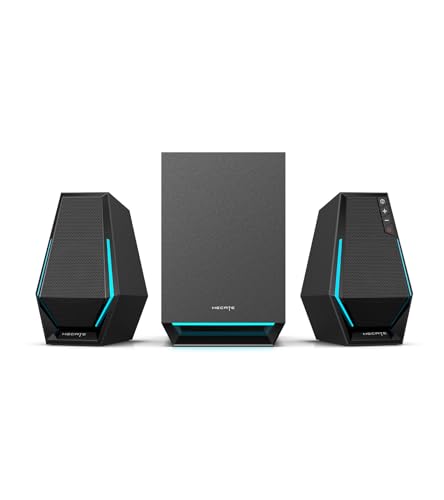
TL;DR: The Edifier G1500 MAX delivers 30 W RMS power, Bluetooth 5.3, and 16.8 million‑color RGB lighting in a compact 2.62 kg desktop 2.1 system for $119.99.
The system’s standout spec is its 30 W RMS output backed by a 60 W peak rating, which channels the output through unusually large drivers – 6 350 mm satellite drivers and a 10 160 mm subwoofer driver – plus a DSP‑controlled electronic crossover. Bluetooth 5.3 adds low‑latency wireless play, while the 16.8 million RGB presets let you match any gaming rig.
Compared with the other nine speakers, the G1500 MAX is heavier than the Creative Pebble X Plus (1.7 kg) and the Logitech Z407 (≈4 kg) but lighter than the SteelSeries Arena 7 (≈10.9 kg). Its RMS power outstrips the Pebble X Plus’s 2 W per satellite and 4 W subwoofer, and it tops the Cyber Acoustics CA‑3610’s 30 W RMS only by offering a DSP and Bluetooth link that the latter lacks. The unit’s dimensions (11.4 in H × 16.7 in L × 9.8 in W) keep it desk‑friendly, yet its 2.62 kg weight is higher than the ultra‑light Klipsch ProMedia 2.1 (≈0.95 kg).
Reviewers consistently praise the low‑latency Bluetooth 5.3 connection for gaming and the vibrant RGB lighting for mood setting. The 4.1‑star rating from 26 reviews hints at solid performance, though some users note the $119.99 price is steeper than many budget 2.1 sets. Technical specs such as a 60 Hz–20 kHz frequency response, ≥80 dB satellite SNR, ≥85 dB subwoofer SNR, ≤25 dB(A) noise level, and <7 % THD round out the picture.
Pros
Cons
Best for: Those prioritizing quality and willing to pay for premium performance
Avoid if: You're on a tight budget or only need basic functionality
Breakdown
Logitech Z407
Pros
Creative Pebble Plus 2.1
Pros
Klipsch ProMedia 2.1
Pros
Cyber Acoustics CA-3090
Pros
Cons
Based on scoring data and product specs
Personalized picks
Best Overall Pick
Logitech Z407
Best OverallBest for: Home and office users seeking a balance of features and value
Creative Pebble Plus 2.1
Best for: Budget-conscious buyers seeking a reliable entry-level option
$52.24-$56.75 vs winner
Skip Edifier G1500 MAX if…
You're on a tight budget or only need basic functionality
Logitech’s Z407 takes the top spot with 80 W peak power (40 W RMS) and a dedicated 20 W subwoofer powered by DSP, delivering strong bass that outpaces most 2.1 sets. It also offers Bluetooth 5.0 with a 20 m wireless range and the ability to connect three devices at once, making it a versatile, wireless‑first solution. At roughly 8.82 lb the system feels solid without being overly heavy.
The Creative Pebble Plus 2.1 lands as the runner‑up, ideal if you need a compact desktop audio kit on a tight budget. Its total output of 8 W RMS (4 W subwoofer, 2 W per satellite) fits well on small desks, and the 45° angled 50 mm drivers help spread sound evenly. Priced at $52.24 and backed by a 4.3‑star rating from 7,378 reviewers, it offers solid value for everyday PC or laptop use.
For shoppers looking beyond the top two, the Cyber Acoustics CA‑3090 offers the best budget entry at $34.99, delivering basic 2.1 sound without breaking the bank. If premium performance is the goal, the Klipsch ProMedia Lumina 2.1 stands out as the high‑end choice at $319.99, delivering the upscale audio experience audiophiles expect.
Pick the Logitech Z407 now for the most balanced, feature‑rich 2.1 system available.
The Logitech Z407 is compact enough for tight spaces, with a subwoofer that measures 180 mm × 240 mm × 234 mm and satellite speakers under 200 mm tall, and its wireless Bluetooth connection eliminates cable clutter. Its battery‑powered operation also means you can place it wherever you like without needing a nearby outlet.
No reviews yet — be the first to share your experience.
Please sign in to leave a review