Rankings
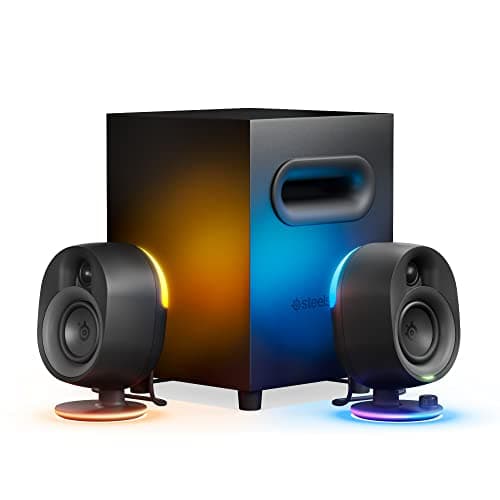
The SteelSeries Arena 7 is a 2.1 gaming speaker system delivering 150 W RMS power and vibrant RGB lighting. Its software limitations and modest maximum volume may hinder large-room use. Ideal for desktop gamers seeking powerful, customizable audio in a compact setup.
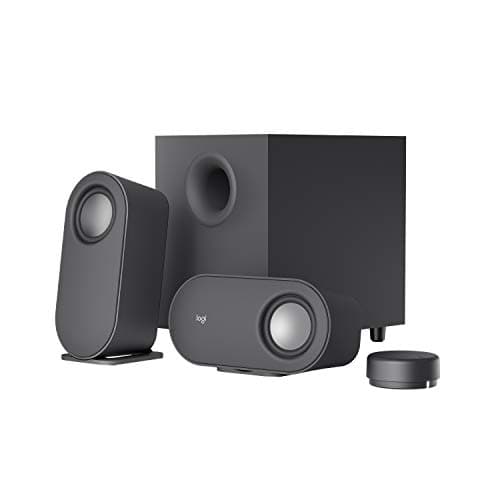
The Logitech Z407 is a compact 2.1 Bluetooth speaker system featuring a down-firing subwoofer, dual satellites and a wireless control dial, delivering 80 W peak power with balanced sound. Its subwoofer size and occasional Bluetooth pairing issues can be drawbacks for tight desk setups. Ideal for PC gamers and media enthusiasts who want strong bass, Bluetooth connectivity and remote control without a bulky traditional system.
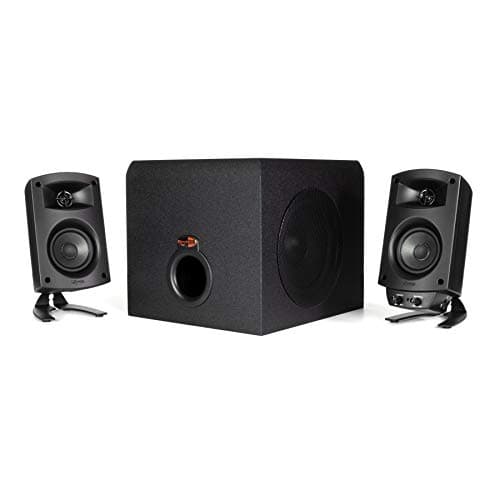
The Klipsch ProMedia 2.1 delivers concert-level loudness and deep bass thanks to its THX-certified design and powerful subwoofer. Its drawbacks are the heavy subwoofer and lack of wireless features. Best for gamers and movie enthusiasts who prioritize loud, immersive sound.
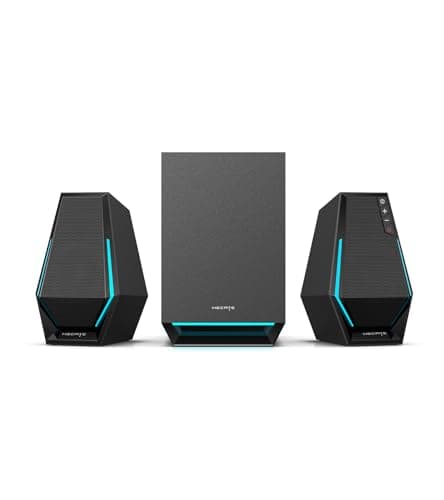
The Edifier G1500 MAX is a 2.1 gaming speaker system with a 4" subwoofer, 30 W RMS power, DSP processing, and customizable RGB lighting. While it offers strong bass and many features, it requires AC power and lacks certain high-end inputs. Suited for gamers who want powerful sound and visual effects on a desktop.
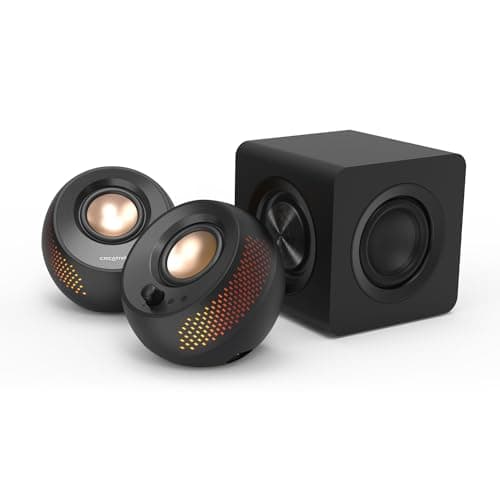
The Creative Pebble X Plus is a compact 2.1 USB-C speaker system with a strong subwoofer and RGB lighting. Its audio performance is limited without a high-current USB adapter and it lacks advanced input options. Best suited for small-desk users who want a sub-bass boost without a wall-wart power supply.
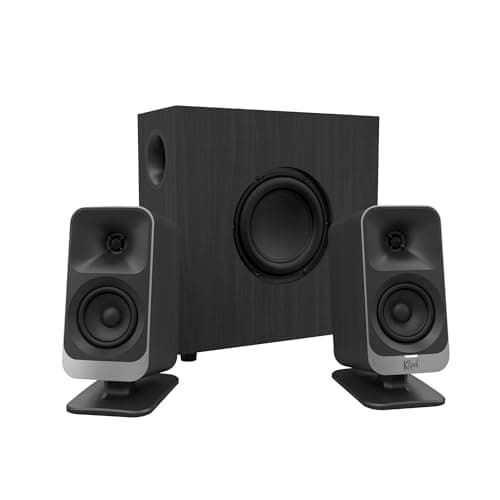
The Klipsch ProMedia Lumina 2.1 is a rugged Bluetooth speaker system with IP67 protection, RGB lighting, and a 12-hour battery. Its main limitation is the absence of detailed power and frequency specifications, making sound performance unclear. Best suited for travelers and outdoor listeners who prioritize durability and wireless convenience.
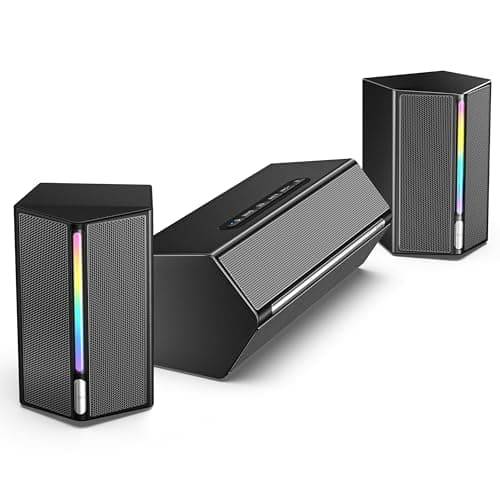
The Fifine AmpliGame A22 provides a 2.1 speaker system with 10 W RMS output, RGB lighting, and versatile Bluetooth, AUX, and optical inputs. Its limited bass depth and reliance on source-device Bluetooth volume control are trade-offs. Suited for gamers and media enthusiasts wanting flexible connectivity on a budget.
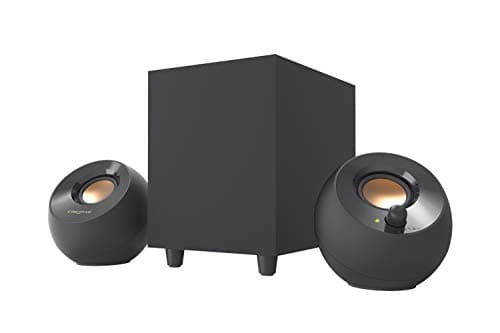
The Creative Pebble Plus is a 2.1 USB-powered speaker set featuring a down-firing 4-inch subwoofer and 8 W RMS total output. It offers solid bass punch and front-mounted volume controls, yet lacks Bluetooth and its overall power is modest, with cable clutter and reliance on a robust USB adapter. Best suited for budget-conscious users needing a compact subwoofer-enhanced desktop audio solution.
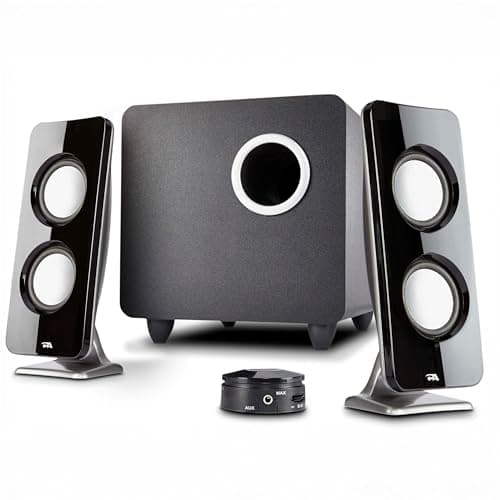
The Cyber Acoustics CA-3610 is a 2.1 desktop speaker system featuring a dedicated subwoofer and dual titanium satellite drivers for strong bass and clear mids. Its weak treble response, cheap plastic build, and lack of Bluetooth reduce its appeal for audiophiles or wireless setups. Ideal for users who prioritize powerful bass in a compact desk footprint.
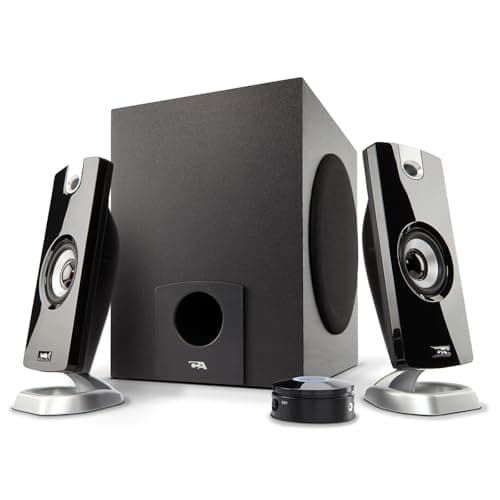
The Cyber Acoustics CA-3090 offers a compact 2.1 desktop speaker set with clear sound and adjustable bass at an affordable price. Its low RMS power and lack of wireless connectivity limit its suitability for larger spaces or modern devices. Best for budget-conscious users needing basic wired audio.
| Attribute | | | | | | | | | | |
|---|---|---|---|---|---|---|---|---|---|---|
63.5 mm | 50 mm | 76.2 mm | 101.6 mm | 50.8 mm | 165 mmbest | 38.1 mm | 70 mm | — | 63.5 mm | |
2 | 2.1 | 2 | 3best | 3best | 3best | 2 | 2.1 | 3best | 3best | |
40 W | 8 W | 100 W | 9 W | 30 W | 150 Wbest | — | 15 W | 10 W | 30 W | |
20 mbest | — | — | — | — | — | — | — | — | — | |
— | — | — | — | — | — | 12 hoursbest | — | — | — | |
1 years | — | 1 years | 1 years | 1 years | 1 years | 1 years | — | — | 2 yearsbest | |
| ↓ lower better | 4 kg | 2.54 kg | 9.61 kg | 2.268 kg | 4.12 kg | 10.86 kg | 5.94 kg | 1.7 kgbest | 2.3 kg | 2.62 kg |
— | 5 | 3 | 5 | 5 | 6 | — | 8best | 3 | 8best |
Click an attribute name to sort · Green = best, red = worst (relative to this comparison)
| Attribute | | | | | | | | | | |
|---|---|---|---|---|---|---|---|---|---|---|
Audio(4) | ||||||||||
Frequency Response (Hz) | — | 50-20000 Hz | 35-22000 Hz | — | — | — | — | 50-20000 Hz | — | 60-20000 Hz |
Driver Size (mm) | 63.5 mm | 50 mm | 76.2 mm | 101.6 mm | 50.8 mm | 165 mm | 38.1 mm | 70 mm (satellite), 102 mm (subwoofer) mm | — | 63.5 mm |
Channels | 2 | 2.1 | 2 | 3 | 3 | 3 | 2 | 2.1 | 3 | 3 |
RMS Power (W) | 40 W | 8 W | 100 W | 9 W | 30 W | 150 W | — | 15 W | 10 W | 30 W |
Battery & Power(1) | ||||||||||
Power Source | ac_adapter | USB-A | AC | AC Powered | AC adapter | — | Battery | USB | AC Powered | Plug-in |
Connectivity(1) | ||||||||||
Bluetooth Version | 5.0 | — | — | — | — | — | 5.3 | 5.3 | — | 5.3 |
Warranty(1) | ||||||||||
Warranty (years) | 1 years | — | 1 years | 1 years | 1 years | 1 years | 1 years | — | — | 2 years |
Controls(1) | ||||||||||
Volume Control Type | dial | Front | control pod | knob | dial | integrated | knob | front_facing | function key | — |
Build & Design(3) | ||||||||||
Weight (kg) | 4 kg | 2.54 kg | 9.61 kg | 2.268 kg | 4.12 kg | 10.86 kg | 5.94 kg | 1.7 kg | 2.30 kg | 2.62 kg |
Dimensions (H×W×D) (cm) | 18.5 x 24.4 x 31.5 cm | 20.32×10.16×5.08 cm | 21.6×10.7×14.4 cm cm | 12.0×9.0×10.0 cm cm | 24.9×26.9×33.5 cm cm | 39.2×33.2×48.0 cm cm | 24.8×10.2×16.5 cm cm | 17.9×46.4×17.8 cm cm | 28.7×25.9×13.6 cm cm | 28.96×24.89×42.42 cm cm |
Enclosure Material | — | — | ABS | — | — | — | — | — | — | Wood |
Features(2) | ||||||||||
RGB Lighting | false | — | — | — | — | true | true | true | true | true |
Number of Included Accessories | — | 5 | 3 | 5 | 5 | 6 | — | 8 | 3 | 8 |
Products in the top-left offer the best value (high score, low price).
Professional reviewers commend the Z407 for its detailed, balanced sound and the convenience of a wireless control dial, noting the DSP-tuned subwoofer delivers impressive bass for its size. However, they criticize the lack of detailed driver specifications and the subwoofer's footprint, which can be a drawback for audiophiles and tight desk spaces.
Everyday users consistently praise the punchy bass, clear mids, and the ability to control the system remotely without reaching the PC. Common complaints revolve around occasional Bluetooth pairing issues, subwoofer vibrations on desks, and reduced range in cluttered environments.
“one of the most detailed 2.1 speaker systems”
“immersive, lifelike sound”
“punchy bass, clear sound for desk gaming/movies/music”
Choose Z407 for compact desks and remote control; choose Arena 7 if you prefer a more traditional wired setup
Choose the X Plus if you want more power, Bluetooth, and visual flair; stick with Pebble Plus for the cheapest, most compact USB-only solution.
Select Z407 when wireless flexibility and enhanced DSP sound are priorities; opt for Pebble Plus for a tighter, budget-friendly desktop setup.
Pick Klipsch when you need high SPL and deep bass; pick Pebble Plus for a minimalist, portable solution.
Professional reviewers commend the Pebble Plus for its clean, minimalist aesthetic and the surprising bass punch provided by the down-firing subwoofer, especially when High Gain mode is engaged. However, they also point out that the modest 8 W RMS output and lack of wireless connectivity place it behind newer competitors that offer higher power and Bluetooth features.
Everyday users love the clear sound, strong bass, and hassle-free USB setup, noting that the speakers fit well on cramped desks. Recurring frustrations revolve around messy cables, vague setup instructions, and the need for a robust USB power source to achieve satisfactory volume levels.
Professional reviewers view the Klipsch ProMedia 2.1 as a benchmark in desktop audio, lauding its THX certification, horn-loaded tweeters, and concert-level SPL that deliver dynamic, crystal-clear sound. While praised for build quality and easy control, critics point out its bright forward signature, heavy subwoofer, and lack of wireless connectivity, making it less suitable for studio or audiophile applications.
Everyday users celebrate the system's thunderous bass, high volume capability, and plug-and-play simplicity, often describing the bass as "shaking" a room. Recurring complaints focus on a bright or harsh tonal balance up close, the subwoofer's weight and placement challenges, and the missing Bluetooth option.
Professional reviewers praise the CA-3090 for its stylish flat-panel design, deep bass from the ported subwoofer, and low-distortion amplification that delivers clear, detailed sound for music, movies and gaming. They highlight its excellent value, noting that it offers stellar performance at a budget price, though they note the lower RMS power and lack of Bluetooth compared to higher-end models.
Everyday users consistently commend the speakers for clear audio, punchy bass for their size, and the convenience of the desktop control pod with aux and headphone options. Common complaints revolve around limited loudness in bigger spaces, occasional loose cables, and the absence of wireless connectivity, with some users experiencing distortion at max volume.
Professional reviewers commend the CA-3610 for its strong, adjustable bass and clear mids/highs thanks to dual titanium drivers, while praising the convenient control pod. However, they consistently note the treble is under-whelming and the plastic build feels inexpensive, and they lament the absence of Bluetooth connectivity.
Everyday users love the pronounced bass, easy plug-and-play setup, and overall value, but they frequently complain about weak treble, cheap-looking plastic, and the subwoofer's footprint.
Professional reviewers praise the Arena 7 for its solid 16-lb build, impressive audio from the compact satellite speakers, and a subwoofer that perfectly complements the mains with adjustable bass. They highlight the easy setup, extensive connectivity, and the deep customization offered by RGB lighting and Sonar software, while noting the software's limited platform support and the system's modest peak volume for larger spaces.
Everyday users rave about the punchy bass, clear sound and sleek desktop footprint, appreciating the straightforward Bluetooth and aux pairing and the ability to customize RGB and EQ. Common complaints focus on the Sonar software's limitations and the fact that the maximum volume isn't loud enough for very large rooms, with a few noting the subwoofer's size as a drawback on cramped desks.
No professional reviews or editor comments were found; the manufacturer highlights the Austin as a "mini-but-mighty" speaker with rugged durability and strong bass for its size.
Professional reviewers, including PC Mag, commend the Pebble Plus for its substantial bass upgrade, crystal-clear 45° drivers, and minimalist USB-only design that keeps workspaces tidy. However, they note that the overall audio is only "acceptable" and that full power output depends on a high-current USB adapter, limiting its appeal to audiophiles seeking higher fidelity.
Everyday users generally praise the Pebble Plus for its deep bass, clear mids, easy plug-and-play setup, and compact size that fits small desks. Recurring complaints focus on limited maximum loudness without a 2 A adapter, occasional distortion at high volumes, and the lack of Bluetooth or advanced input options.
Professional reviewers commend the A22 for its value, versatile connectivity, clear treble and solid bass handling, and useful EQ presets, but they caution that the onboard processing can over-emphasize bass in intricate audio and that the optical input lacks TV remote volume control. Overall, they view it as a strong budget option for gamers and media enthusiasts who prioritize flexibility and compactness over deep bass performance.
Everyday users love the clear vocals, adequate bass thump, solid build quality, and the fun RGB lighting, while repeatedly noting the convenience of multiple input options. Common complaints focus on the limited bass depth, the need to adjust Bluetooth volume on the source device, and the restriction of wired satellite placement.
Select Pebble Plus for a minimalist, USB-powered desktop solution; select Z407 for high-power, Bluetooth-enabled home-theater use.
