⚡ Quick Answer
Finding a Sony E‑mount lens that delivers solid image quality without breaking the $300 ceiling can feel like hunting for a needle in a haystack. We compared 10 lenses that sit between $67.99 and $298.00, spanning everything from ultra‑compact primes to a modest telephoto zoom. Across the board the ratings hover around 4.3–4.7 stars, showing strong user approval.
The lineup splits into three price tiers. Budget‑focused options include the Benoison 420‑800mm telephoto at $67.99 and the Meike 35mm manual focus at $69.99, both earn praise for their low price tags. Mid‑range choices such as the Viltrox 25mm and the Viltrox 35mm sit around $176–$179 and weigh roughly 170 g, offering fast f/1.7 apertures. Premium contenders like Sony’s FE 50mm f/1.8 ($278, 4.7/5, 186 g) and Rokinon’s 35mm f/1.8 ($298, 4.6/5, 210 g) push the upper end of the budget spectrum.
Next we’ll walk through each model’s key strengths, so you can match a lens to your shooting style and pocket without guessing.

Viltrox 35mm
Its 35 mm focal length offers a versatile perspective for everyday shooting, balancing wide and tight framing.

Sony FE 50mm F1.8
Ideal for portrait enthusiasts who value Sony’s proven optics, it costs $99 more than the Viltrox 35mm, reflecting its brand confidence and high‑quality pedigree.

Viltrox 20mm
Stands out with a 20 mm ultra‑wide view and a 52 mm filter thread, catering to tight‑space interiors where the longer 35 mm and 50 mm lenses feel restrictive.
Also considered
Score Analysis
Key score advantages vs. runner-up (Sony FE 50mm)
Price Range
Viltrox 35mm
$179.00
Sony FE 50mm F1.8
$198.00
Viltrox 20mm
$176.00

Meike 33mm Wide Angle Lens
$189.99

Rokinon AF 35mm F1.8
Out of Stock

Meike 50mm Portrait Lens
$159.99
Sony SELP1650 16-50mm OSS
$199.96

Meike 35mm Manual Focus Lens
$69.99
Viltrox 25mm
$176.00

Benoison Telephoto Lens
$67.99
Spec Comparison
TL;DR: The Viltrox 35mm f/1.7 delivers a fast aperture and ultra‑compact build for under $200, making it a solid budget choice for Sony E‑mount APS‑C shooters.
The lens’s standout spec features a f/1.7 maximum aperture, paired with a 0.33 m minimum focus distance, which lets you capture bright subjects close‑up. At just 0.37 lb (170 g) and 54.7 mm long, it’s one of the lightest options in this list, and the 9‑blade diaphragm helps produce smooth bokeh.
Compared with its peers, the Viltrox 35mm is a bit heavier than the Viltrox 20mm (≈0.35 lb) but matches the Viltrox 25mm’s 170 g weight. It’s shorter than the Meike 33mm (82 mm length) and uses a 52 mm filter thread, which is smaller than Meike’s 55 mm. Unlike the manual‑focus Meike 35mm, this model offers STM autofocus with eye/face detection, and its f/1.7 aperture outpaces the Sony 16‑50mm’s f/3.5‑5.6 range while edging out the Sony 50mm f/1.8’s slightly narrower maximum aperture.
Everyday users love the pocket‑size design and quiet AF, noting attractive bokeh for street and travel shots. Professional reviewers note the lack of an aperture ring and a plastic body that feels less premium than metal‑mounted rivals. Some also mention a touch of softness when shooting wide open, and the lens isn’t weather‑sealed.
Technical extras include a USB‑C firmware port for easy updates, nano multi‑layer coating to curb flare, and an internal focus mechanism that keeps the lens length constant during focusing. The lens does not offer built‑in image stabilization.
Pros
Cons
Best for: APS‑C mirrorless shooters who want a fast, pocket‑sized prime under $300.
Avoid if: You need an aperture ring, weather sealing, or the absolute sharpest performance at f/1.7.
“fits in pocket”
TL;DR: The Sony FE 50mm F1.8 delivers a fast f/1.8 aperture in a feather‑light 186 g body, offering solid central sharpness for under‑$300 full‑frame shooters.
The lens’s standout spec is its 186 g plastic‑body‑plus‑metal‑mount construction, making it one of the lightest 50 mm primes on the market. Its maximum aperture of f/1.8 and 0.45 m minimum focus distance let you capture low‑light scenes and modest close‑ups without lugging extra gear.
Compared with the nine other lenses in this roundup, the Sony sits in the middle of the weight range: it’s lighter than the Rokinon 35 mm F1.8 (210 g) and the Meike 50 mm portrait lens (382 g), but heavier than the Viltrox 35 mm (170 g) and the Sony 16‑50 mm OSS (116 g). Its 49 mm filter thread is smaller than the 58 mm thread on the Rokinon and Meike 50 mm, yet larger than the 40.5 mm thread on the Sony zoom. The 50 mm focal length gives a tighter field of view than the 35 mm, 33 mm, 25 mm and 20 mm options, while its 0.45 m closest‑focus distance is longer than the Viltrox 20 mm (0.19 m) and Rokinon 35 mm (0.29 m) but shorter than the Meike 50 mm (0.63 m).
User sentiment highlights the lens’s portability and the pleasing 7‑blade circular aperture that produces smooth bokeh. Professional reviewers praise the sharp centre performance at f/1.8 and note that the image becomes very clean from f/2.8 onward. The double‑Gauss optical design and a single aspherical element help keep spherical aberration low, while the inner barrel extension of about 1 cm when focusing is a known quirk.
Technical notes: the lens offers a 0.14× maximum magnification, a 47° angle of view on full‑frame bodies, and a 7‑blade diaphragm. It ships with a round bayonet hood (ALC‑SH146) and both front and rear caps, giving you immediate protection out of the box.
Pros
Cons
Best for: Budget‑conscious full‑frame Sony E‑mount shooters, street photographers and portraitists who value a fast aperture in a compact package.
Avoid if: You need weather sealing, macro‑level close‑up capability, or edge‑to‑edge sharpness at the widest aperture.
“Image quality is very good... almost that of a 600 euro lens”
TL;DR: The Viltrox 20mm f/2.8 delivers ultra‑compact, lightweight full‑frame wide‑angle performance for $176, but its vignetting and edge softness limit high‑end use.
The lens packs a 20 mm focal length with a bright f/2.8 maximum aperture into a barrel that measures just 59.5 mm long and 65 mm in diameter. At only 0.35 lb (157 g), it’s one of the lightest full‑frame primes you can carry in a pocket.
Compared with its Viltrox siblings, the 20mm is lighter than the 25 mm and 35 mm models, both weigh 170 g. Its minimum focus distance of 190 mm also beats the 300 mm distance of the 25 mm and the 0.33 m (330 mm) distance of the 35 mm, letting you get closer to subjects. The filter thread stays consistent at 52 mm, while the overall length is a touch longer than the 35 mm’s 54.7 mm.
Reviewers repeatedly praise the pocket‑size build and the fast STM autofocus with Eye‑AF support, noting it works well for both stills and video. Professional testers call it “the cheapest full‑frame 20 mm prime on the market” and appreciate the low distortion and minimal focus breathing. However, many users point out strong vignetting at f/2.8 and a wavy distortion pattern that often requires correction in post‑processing, while edge sharpness can be soft when shooting wide open.
The construction mixes plastic with an aluminum alloy mount, and the lens features seven mostly straight aperture blades, HD nano multi‑layer coating, two ED elements, two aspherical elements, and an internal focus mechanism driven by an STM stepping motor plus lead screw. A USB‑C port lets you update firmware, and electronic aperture control means you can adjust the aperture from the camera body.
Pros
Cons
Best for: Beginners, hikers, vloggers and travel photographers who need a pocket‑size full‑frame wide‑angle lens.
Avoid if: You want the best value‑per‑dollar in its price range or need top‑tier edge sharpness for professional work.
“remarkable budget wide-angle”
“super‑cheap”
TL;DR: The Meike 33mm f/1.4 delivers sharp, low‑light APS‑C performance with a 50mm full‑frame equivalent view, quiet STM AF and solid build for $189.99.
At its core, the lens offers a 33 mm focal length with a bright f/1.4‑f/16 aperture range and a diagonal angle of view of 46.3°, giving you a 50 mm full‑frame equivalent field of view on Sony APS‑C bodies. Its 9‑blade diaphragm and 12‑element, 9‑group optical formula include an extra‑low dispersion element and multi‑coating, helping to keep chromatic aberration in check. The minimum focus distance of 400 mm lets you get fairly close to subjects while still maintaining that wide‑open look.
Compared with the other lenses in this $300‑and‑under roundup, the Meike is noticeably heavier than the Sony SELP1650 (116 g) and the Viltrox 35mm (approximately 0.37 lb), but lighter than Meike’s own 50mm portrait offering (382 g). Its 55 mm filter thread is larger than the Sony’s 40.5 mm thread, while its angle of view sits between the Sony’s 83°‑32° range and the Viltrox 35mm’s 45° view. The f/1.4 maximum aperture outpaces the Sony’s f/3.5‑5.6 range and gives you a brighter start than the Viltrox 20mm’s f/2.8‑f/16, which can be a real advantage in low‑light or shallow‑depth‑of‑field scenarios.
Users consistently praise the lens’s centre‑to‑corner sharpness even at f/1.4, noting that it rivals pricier primes. The STM stepping motor delivers quiet, eye‑tracking autofocus that reviewers say “hunts very little,” making it a solid choice for both stills and video. Filmmakers highlight minimal focus breathing as a benefit when they need consistent framing. On the flip side, several reviewers flag noticeable flare and ghosting when pointing at the sun, and a 1‑1/3 stop vignetting at the widest aperture. The clicked, stiff aperture ring, while designed to prevent accidental changes, can be unintentionally bumped during video work.
Additional technical touches include a USB‑C port for firmware upgrades on select mounts, an AF/MF switch for manual control, and a built‑in lens hood. The 66.5 mm diameter and 82 mm (E‑mount) / 84 mm (Z‑mount) length keep the package compact enough for travel, while the 341.5 g weight feels solid without being unwieldy.
Pros
Cons
Best for: Budget‑conscious APS‑C photographers who want a versatile 50 mm‑equivalent prime for portraits, street, and low‑light shooting.
Avoid if: You need minimal flare for sunrise/sunset work, ultra‑low distortion for architecture, or a fully professional‑grade lens.
“Excellent”
“Great”
TL;DR: The Rokinon AF 35mm f/1.8 delivers a bright aperture and weather‑sealed, lightweight design for Sony E‑mount users, but its $298 price and lack of optical stabilization keep it in the premium‑budget niche.
The lens’s standout spec is its fast f/1.8 maximum aperture paired with a linear STM autofocus motor, giving quiet and quick focus while keeping the optical package compact at 210 g. It also sports a 58 mm filter thread and nine rounded aperture blades, which help produce smooth bokeh and good edge‑to‑edge sharpness.
Compared with the nine other lenses in this roundup, the Rokinon is heavier than the Viltrox 35mm (170 g) and Viltrox 20mm (157 g) but lighter than the Meike 50mm portrait lens (382 g). Its 58 mm filter size is larger than the Viltrox 35mm’s 52 mm and the Meike 33mm’s 55 mm, giving you more flexibility with filters. While the price tag sits above the Sony FE 50mm and the Viltrox options, it remains in the same premium‑budget tier as the Sony FE 50mm.
Users consistently praise the lens’s compactness and the vivid colors it renders straight out of the camera. Professional reviewers note the “high sharpness and detail retention even at the maximum f/1.8 aperture,” and many creators appreciate the quiet autofocus for video work. The most common complaints revolve around the absence of built‑in optical image stabilization and the need to flip a custom switch when moving between autofocus and manual focus.
Additional technical details include Ultra MultiCoating (UMC) on all elements, two aspherical and two high‑refractive‑index elements, and full weather sealing—features that help maintain image quality in challenging conditions.
Pros
Cons
Best for: Travel and street photographers, as well as hybrid still‑and‑video creators who value a compact, weather‑sealed prime with a bright f/1.8 aperture.
Avoid if: You need built‑in optical stabilization or are shopping on a very tight budget, as the lens is priced at $298.00.
“great colors and sharp images with impressive detail retention”
TL;DR: The Meike 50mm f/1.8 AF lens gives you a fast aperture, solid build and USB‑C firmware upgrades for $159.99, making it a capable portrait option for budget‑focused Sony‑E shooters.
At the heart of this lens is a 50 mm focal length paired with a bright f/1.8 maximum aperture, delivering strong low‑light performance and shallow depth‑of‑field. It focuses down to 630 mm and offers a 0.1x maximum magnification, while nine rounded aperture blades help render smooth bokeh. The optical formula includes 11 elements in 7 groups, with one ED element and one high‑refraction element, and a double‑sided multilayer coating protects them.
Compared with the other nine lenses in the roundup, the Meike 50mm is heavier than the ultra‑compact Viltrox 20mm (≈0.35 lb) and Viltrox 35mm (≈0.37 lb) but lighter than the Sony FE 50mm (≈0.41 lb). Its 58 mm filter thread is larger than the 52 mm threads found on the Viltrox primes, giving you more flexibility with filters. While many peers, such as the Meike 35mm manual focus lens, rely on manual focus, this model provides autofocus with an AF/MF switch, and several competitors don’t list this feature.
Reviewers consistently praise the lens’s fast f/1.8 aperture for producing “creamy bokeh” and “excellent background separation” in portrait work. Professional testers note that sharpness holds up well from f/2.8 onward, and users appreciate the solid, non‑cheap feel despite the modest price. The included hood and a USB‑C firmware upgrade port add practical value, letting you keep the lens up‑to‑date without extra tools.
Pros
Cons
Best for: Entry-level buyers or those on a tight budget
Avoid if: You want the best value‑per‑dollar in its price range
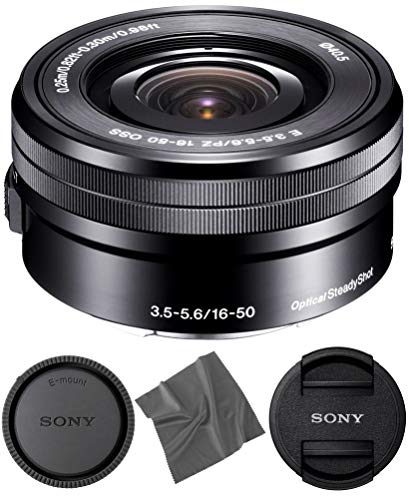
TL;DR: The Sony SELP1650 16‑50mm OSS packs a retractable 29.9 mm profile, 116 g weight and optical SteadyShot into a motorized power‑zoom, making it a ultra‑portable kit lens for travel and vloggers.
The most eye‑catching feature is its collapsible design that folds down to just 29.9 mm when powered off, and at only 116 g it’s one of the lightest zooms in this lineup. It also offers a motorized power‑zoom and Optical SteadyShot, which professional reviewers note delivers smooth, silent zooming ideal for video work. The lens accepts 40.5 mm filters, a relatively small thread that keeps accessory costs low.
Compared with the other nine lenses, the SELP1650 is noticeably lighter than the Viltrox 35 mm (170 g) and the Viltrox 25 mm (170 g), and considerably lighter than the Meike 50 mm portrait lens (382 g). Its filter thread of 40.5 mm is smaller than the 55 mm thread on the Meike 33 mm and the 52 mm threads on the Viltrox primes, meaning you’ll need fewer or cheaper filters. While many of the peers are prime lenses with fixed focal lengths, this zoom covers a 16‑50 mm range (24‑75 mm equivalent) that rivals the versatility of several stand‑alone primes in a single package.
Everyday users rave about how the lens slips into a coat pocket and balances well on APS‑C bodies, calling it a reliable travel companion. Professional reviewers highlight the ED glass and four aspherical elements for keeping distortion low and contrast high. On the downside, the variable maximum aperture of f/3.5‑f/5.6 reduces light‑gathering at the tele end, a point owners who shoot in dim venues frequently mention. The maximum magnification of 0.215× also falls short for macro enthusiasts, and several consumer comments echo this limitation.
Pros
Cons
Best for: Travel photographers, vloggers and casual shooters who value a compact, versatile zoom with built‑in stabilization.
Avoid if: You need a constant fast aperture for low‑light events or a high magnification ratio for macro photography.
TL;DR: The Meike 35mm f/1.7 manual lens offers a bright aperture, all‑metal build and 0.4 lb weight for just $69.99, making it a solid entry‑level option for APS‑C Sony users.
The lens’s 35 mm focal length paired with a maximum aperture of f/1.7 gives you plenty of light for low‑light shooting and shallow depth of field. Its all‑metal construction keeps the body sturdy while the 49 mm filter thread lets you add protective filters. At only 0.4 lb (181 g) it’s light enough to carry all day, and the manual aperture ring plus focus distance scale let you fine‑tune exposure without hunting.
Compared with the other nine lenses in this roundup, the Meike is the most affordable option and far lighter than the Benoison Telephoto (770 g) and shorter than its 240 mm length. It’s a bit heavier than the Viltrox 20mm (0.35 lb) but still lighter than the Viltrox 35mm (0.37 lb). Its 49 mm filter diameter is smaller than the Benoison’s 62 mm thread, and its 41 mm length makes it more compact than the Viltrox 35mm (54.7 mm) and the Meike 33mm Wide Angle (82 mm).
Reviewers appreciate the lens’s bright f/1.7 aperture and the tactile feel of its metal body, noting that the multi‑layer nano coating reduces flare in back‑lit scenes. Users love the manual focus ring and depth‑of‑field scale for precise pre‑focusing, especially on street and travel subjects. The main criticisms focus on soft corners that only improve after stopping down to around f/8, noticeable vignetting and pincushion distortion at wide apertures, and the lack of autofocus, which can hinder fast‑moving subjects or video focus pulls.
Pros
Cons
Best for: Budget‑conscious buyers seeking a reliable entry‑level option
Avoid if: You need advanced features or professional‑grade performance
“excellent budget standard prime”
“metal construction, 172g weight, and low‑light utility for beginners”
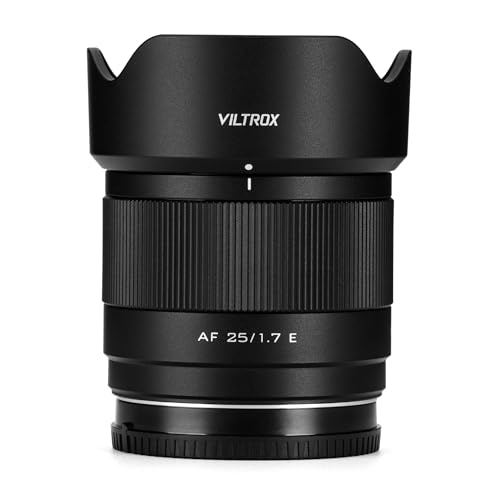
TL;DR: The Viltrox 25mm f/1.7 delivers a fast aperture and compact 170 g build for under $200, offering sharp center performance but shows some edge softness and limited weather protection.
This lens packs a 25 mm focal length with a bright f/1.7 maximum aperture and a 9‑blade diaphragm, giving you shallow depth‑of‑field control in a tiny 170 g package.
Compared with the Viltrox 20mm, the 25mm is heavier than the 157 g 20mm and has a slower minimum focus distance of 300 mm versus the 190 mm of the 20mm, but it wins on aperture speed (f/1.7 vs f/2.8). It shares the same 52 mm filter thread as the 20mm and the Viltrox 35mm, while the Sony 16‑50mm is lighter at 116 g. The Meike 33mm and Meike 50mm lenses are considerably bulkier, and the Meike 35mm manual focus model tips the scales at 181 g, making the Viltrox 25mm one of the lighter options in the lineup.
Everyday users praise the lens’s portability and the crisp center rendering at f/1.7, noting that the quiet STM stepper motor makes focusing smooth for video. Professional reviewers highlight the sharpness that peaks around f/4‑f/5.6 and the pleasing bokeh from the 9‑blade design. Common complaints mention vignetting and chromatic aberration when shooting wide open, plus the lack of weather sealing for demanding outdoor shoots.
Additional technical touches include a waterproof/anti‑fouling front coating, a lotus‑shaped hood, and a USB‑C port for firmware updates; a metal mount holds them, feeling solid despite the lens’s feather‑light weight.
Pros
Cons
Best for: Entry-level buyers or those on a tight budget
Avoid if: You want the best value-per-dollar in its price range
TL;DR: The Benoison 420‑800 mm Telephoto Lens gives Sony E‑mount users super‑telephoto reach for just $67.99, but its manual focus, heavy build and slow f/8.3‑16 aperture demand a tripod and patience.
This lens packs a 420‑800 mm zoom range and a fixed aperture of f/8.3‑16, letting you chase distant subjects without breaking the bank. Its 62 mm filter thread lets you add polarizers or ND filters, while the 770 g weight and 240 mm length keep the optics solid enough for stable mounting.
Compared with the other nine lenses in this roundup, the Benoison is markedly longer than the Meike 35 mm Manual Focus Lens (41 mm) and heavier than the Meike 35 mm (about 0.4 lb). Its filter thread also exceeds the Meike’s 49 mm and the Sony SELP1650’s 40.5 mm, giving you more accessory options. Unlike the Viltrox and Sony kits that offer autofocus, this model is manual‑focus only and lacks any built‑in image stabilization.
Users consistently praise the budget‑friendly price and the ability to reach true super‑telephoto distances that would otherwise cost hundreds of dollars. Reviewers note that the lens delivers acceptable sharpness at the 420 mm end, especially when paired with a camera’s IBIS and focus‑peaking. However, the community also flags blur from camera shake at the long end, the need to keep shutter speeds at 1/500 s or faster, and the difficulty of manual focusing on moving subjects.
Pros
Cons
Best for: Entry‑level buyers or those on a tight budget who want to experiment with super‑telephoto photography.
Avoid if: You need fast autofocus, built‑in stabilization, or professional‑grade low‑light capability.
“Suitable only for hobbyists due to blurriness without stabilization, manual focus hassle, low‑light struggles, weight, and mediocre quality at 800mm—recommending upgrades for pros.”
“Sharpest on 3D subjects via field curvature's bokeh but poor for landscapes/flat scenes; resolution drops off‑center and faster at 800mm, with visible vignetting; advises mirrorless IBIS but fast shutters (1/500s).”
Breakdown
Viltrox 35mm
Pros
Sony FE 50mm F1.8
Pros
Viltrox 20mm
Pros
Cons
Meike 33mm Wide Angle Lens
Pros
Based on scoring data and product specs
Personalized picks
Best Overall Pick
Viltrox 35mm
Best OverallBest for: Home and office users seeking a balance of features and value
Sony FE 50mm F1.8
Best for: Buyers willing to invest in a proven, high-quality option
$198.00+$19.00 vs winner
Skip Benoison Telephoto Lens if…
Reliability and user satisfaction are your top concerns
The Viltrox 35mm f/1.7 takes the top spot with its $179.00 price, a 4.7‑star rating from 393 reviewers, and a fast f/1.7 maximum aperture. It packs nine aperture blades, an 11‑element/9‑group optical design and an STM motor that supports eye/face detection and IBIS, plus a petal‑shaped hood for flare control.
The Sony FE 50mm f/1.8 lands as runner‑up, ideal if you need a classic portrait focal length on an APS‑C body (75 mm equivalent) for shallow‑depth‑of‑field shots. At $278.00 it earns a 4.7‑star rating from 1,557 reviews, offers seven aperture blades, a solid f/1.8 maximum aperture and includes a round bayonet hood.
For tighter budgets, the Benoison Telephoto Lens at $67.99 delivers surprising reach without breaking the bank. If you prefer a premium feel, the Rokinon AF 35mm f/1.8 at $298.00 provides a sturdier build and a bright aperture for enthusiasts willing to spend a bit more.
Choose the Viltrox 35mm f/1.7 today for the best value on a Sony E‑mount lens under $300.
The Viltrox 35mm f/1.7 offers a fast f/1.7 aperture, a lightweight 170 g body, internal STM autofocus and a petal‑shaped hood, making it ideal for dimly lit street scenes; the Sony FE 50mm f/1.8 also works in low light but is heavier at 186 g and costs more.
No reviews yet — be the first to share your experience.
Please sign in to leave a review