Rankings
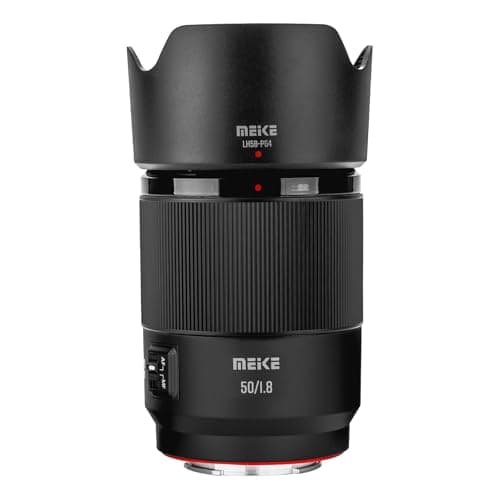
The Meike 50mm f/1.8 is an affordable full-frame prime lens offering a fast aperture and compact build. Its lack of weather sealing and image stabilization limit use in harsh conditions. Ideal for budget-conscious portrait and street shooters.
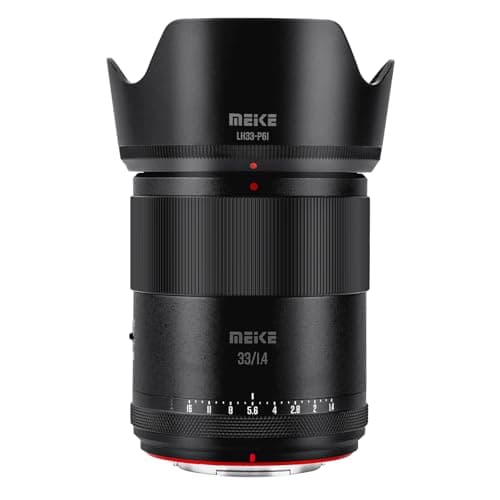
The Meike 33mm f/1.4 (E-mount) delivers sharp 50mm-equivalent performance with quiet STM autofocus and eye-tracking. Flare, vignetting and a stiff aperture ring are notable compromises. Great for APS-C users seeking a versatile, video-friendly prime.
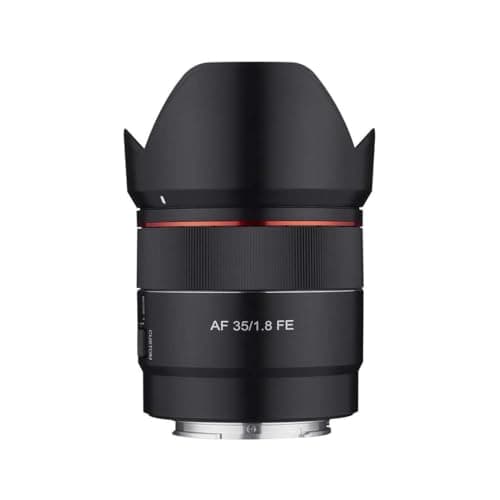
The Rokinon AF 35mm f/1.8 is a compact, lightweight prime lens for Sony E-mount full-frame cameras, offering a bright f/1.8 aperture and weather-sealed construction. Its main trade-off is the lack of built-in image stabilization and a manual focus-switch mechanism. Ideal for travel and street photographers seeking high image quality in a portable package.
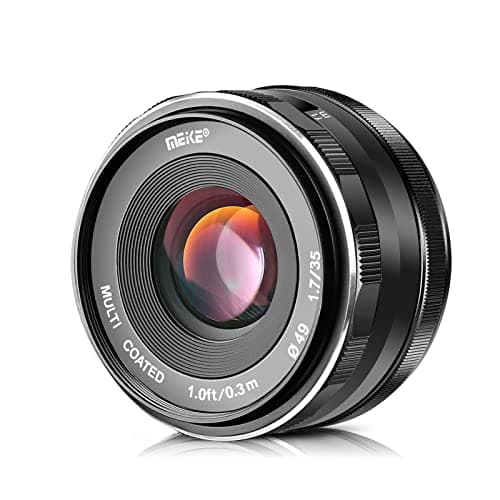
The Meike 35 mm f/1.7 is an all-metal manual-focus prime designed for APS-C mirrorless cameras, delivering a bright aperture and compact size. Soft corners and the absence of autofocus restrict its use for fast or edge-critical work. It's perfect for street and travel photographers who value manual control and low-light capability.
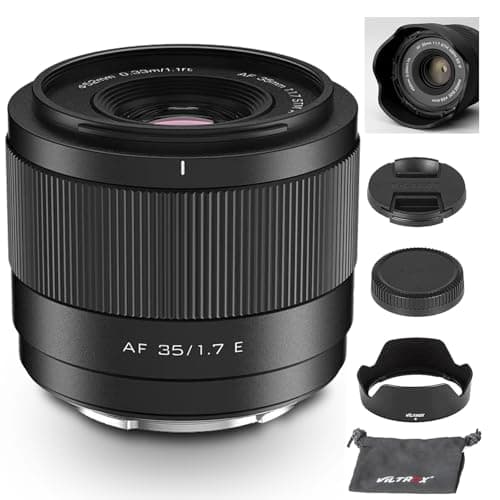
The Viltrox 35mm f/1.7 is an ultra-compact, fast-aperture prime ideal for street and portrait work on Sony APS-C bodies. Its trade-offs are the lack of weather sealing, no aperture ring, and a plastic-heavy build. Best suited for travelers and vloggers who prioritize size and speed over ruggedness.
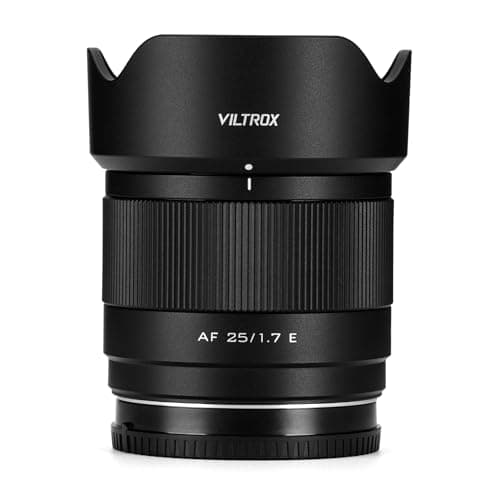
The Viltrox 25mm f/1.7 Air is a lightweight, fast APS-C prime delivering strong centre sharpness and quiet STM autofocus. Its limitations include vignetting, some chromatic aberration and the lack of weather sealing. It is ideal for street, portrait and low-light shooters who value speed and portability over ruggedness.
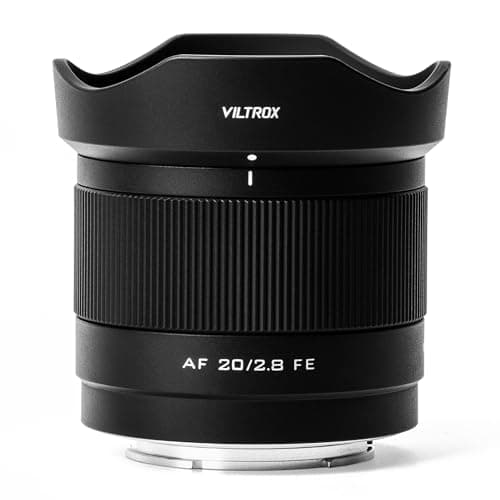
The Viltrox 20mm f/2.8 is a pocket-sized, budget-friendly full-frame wide-angle lens offering fast STM autofocus and close-focus capability. Its main drawbacks are noticeable vignetting, edge softness and a plastic-heavy construction. It is best for beginners, travelers and vloggers who value size and price over top-tier image quality.
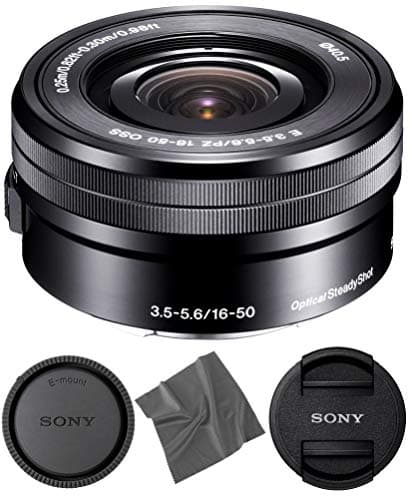
The Sony E PZ 16-50mm f/3.5-5.6 OSS is an ultra-compact, retractable zoom with power-zoom and Optical SteadyShot, covering a versatile 24-75mm equivalent range. Its variable slow aperture and lack of weather sealing restrict low-light and rugged use. Perfect for travel photographers and vloggers needing a lightweight kit lens.
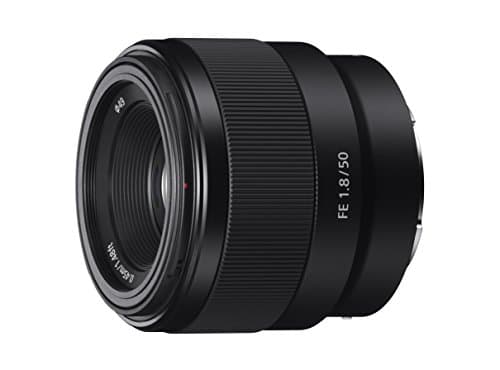
The Sony FE 50mm f/1.8 is a compact, lightweight prime delivering fast f/1.8 aperture and sharp central performance at an affordable price. It suffers from soft corners, vignetting, and lacks weather sealing or stabilization. Best suited for budget-conscious portrait and low-light shooters.
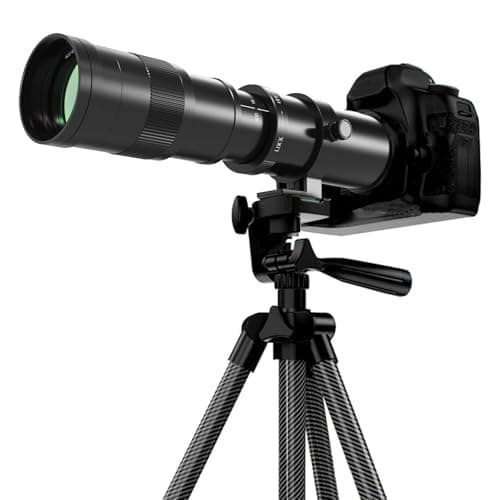
The Benoison 420-800mm manual-focus telephoto lens offers super-telephoto reach at a budget price, compatible with Sony E-mount cameras and usable with IBIS for stabilization. Lack of autofocus, image stabilization, and a slow aperture limit its practicality, especially handheld. Suited for hobbyist wildlife photographers willing to use a tripod and accept lower image quality.
| Attribute | | | | | | | | | | |
|---|---|---|---|---|---|---|---|---|---|---|
35 mm | 50 mmbest | 20 mm | 33 mm | 35 mm | 50 mmbest | — | 35 mm | 25 mm | — | |
1.7 | 1.8 | 2.8best | 1.4 | 1.8 | 1.8 | — | 1.7 | 1.7 | — | |
| ↓ lower better | 0.33 m | 0.45 m | 0.19 mbest | 0.4 m | 0.29 m | 0.63 m | — | 0.3 m | 0.3 m | — |
| ↓ lower better | 170 g | 186 g | 157 g | 341.5 g | 210 g | 382 g | 116 gbest | 181 g | 170 g | 770 g |
— | 1 | — | — | 1 | — | 3.1best | — | — | 1.9 | |
9best | 7 | 7 | 9best | 9best | 9best | 7 | — | 9best | — | |
— | 0.1 | 0.2 | — | 0.2 | 0.1 | 0.2best | — | 0.1 | — | |
11 | 6 | 10 | 12best | 10 | 11 | 9 | 6 | 12best | — |
Click an attribute name to sort · Green = best, red = worst (relative to this comparison)
| Attribute | | | | | | | | | | |
|---|---|---|---|---|---|---|---|---|---|---|
Compatibility(2) | ||||||||||
Lens Mount | Sony E | Sony E-mount | Sony E | Sony E | Sony E | Sony E | Sony E-mount | Sony E | Sony E | Sony E |
Mount Compatibility | Sony E-mount APS-C cameras | Sony E-mount full-frame | Sony E (full-frame), Nikon Z, Fuji X | FUJIFILM X, Nikon Z, Sony E (APS-C) | Sony E | Sony E, Nikon Z, L-mount/Leica-SL | Sony E-mount APS-C | Sony E (APS-C), Fujifilm X (APS-C), Nikon Z | Sony E, Fujifilm X, Nikon Z | Sony A7C, A7R, A7S, A7, A9, a6700, a6600, a6500, a6400, a6300, a6100, a6000, a5100, a5000, NEX-7, NEX-6, NEX-5, ZV-E10, etc. |
Features(3) | ||||||||||
Image Stabilization | false | false | false | — | false | — | true | — | false | false |
Autofocus Type | STM | Auto | STM | STM | Linear STM | STM | Auto | Manual | STM | Manual |
Focus Type | Internal autofocus | Auto | Internal focus | autofocus | Autofocus | Autofocus with AF/MF switch | Internal | Manual | Internal focus | Manual |
Optics(9) | ||||||||||
Focal Length (mm) | 35 mm | 50 mm | 20 mm | 33 mm | 35 mm | 50 mm | 16-50 mm | 35 mm | 25 mm | 420-800 mm |
Maximum Aperture (f‑stop) | 1.7 | 1.8 | 2.8 | 1.4 | 1.8 | 1.8 | 3.5-5.6 | 1.7 | 1.7 | 8.3-16 |
Minimum Focus Distance (m) | 0.33 m | 0.45 m | 0.19 m | 0.4 m | 0.29 m | 0.63 m | 0.25-0.30 m | 0.3 m | 0.30 m | — |
Zoom Ratio | — | 1 | — | — | 1 | — | 3.125 | — | — | 1.9 |
Macro Ratio | — | 0.14 | 0.17 | — | 0.17 | 0.1 | 0.215 | — | 0.11 | — |
Number of Optical Elements | 11 | 6 | 10 | 12 | 10 | 11 | 9 | 6 | 12 | — |
Number of Optical Groups | 9 | 5 | 8 | 9 | 8 | 7 | 8 | 5 | 10 | — |
Diaphragm Blades | 9 | 7 | 7 | 9 | 9 | 9 | 7 | 8-10 | 9 | — |
Coating | Nano multi-layer | — | HD nano multi-layer | Multilayer | Ultra MultiCoating | Double-sided multilayer coating | — | Multi-layer nano coating | Waterproof/anti-fouling | — |
Build & Design(6) | ||||||||||
Weather Sealing | false | false | false | — | true | — | false | — | false | — |
Filter Thread Size (mm) | 52 mm | 49 mm | 52 mm | 55 mm | 58 mm | 58 mm | 40.5 mm | 49 mm | 52 mm | 62 mm |
Weight (g) | 170 g | 186 g | 157 g | 341.5 g | 210 g | 382 g | 116 g | 181 g | 170 g | 770 g |
Length (mm) | 54.7 mm | 103.9 mm | 59.5 mm | 82 mm | 65 mm | 103.1 mm | 29.9 mm | 41 mm | 55 mm | 240 mm |
Maximum Diameter (mm) | 64 mm | 68.6 mm | 65 mm | 66.5 mm | 63.5 mm | 73 mm | 64.7 mm | — | 64 mm | 67 mm |
Construction Material | Metal | Plastic with metal mount | Mixed plastic/aluminum | — | — | — | — | All-metal | Metal | — |
Products in the top-left offer the best value (high score, low price).
Professional reviewers commend the Viltrox 35mm f/1.7 for its ultra-compact footprint, fast aperture and quiet STM AF with eye/face detection, noting it as a solid budget alternative to Fuji's 35mm f/2 lenses. However, they criticize the lack of an aperture ring, weather sealing and the slightly softer wide-open sharpness compared with Viltrox's own 56mm counterpart.
Everyday users consistently praise the lens's pocketable size, light weight, quiet autofocus and attractive bokeh, especially for travel, street and video work. Recurring complaints focus on the missing aperture ring for Fuji users, the plastic feel of the body, and occasional softness at the widest aperture.
“fits in pocket”
“compact and lightweight”
“Image quality is very good... almost that of a 600 euro lens”
Professional reviewers commend the Sony FE 50mm F1.8 for its excellent value, lightweight construction, sharp center performance and pleasing bokeh, while noting soft corners wide open, noticeable vignetting and the absence of weather sealing and OSS as trade-offs compared to higher-priced alternatives.
Everyday users love the lens's portability, low-light capability and sharpness when stopped down, but repeatedly mention soft corners at the widest aperture, occasional autofocus hiccups and the lack of weather resistance as the main pain points.
Professional reviewers commend the Viltrox 20mm f/2.8 for its unbeatable price, pocketable size, fast STM autofocus with Eye-AF, and solid center sharpness, making it a practical choice for travel and video. However, they consistently point out optical compromises such as strong vignetting, wavy distortion, soft edges, and a plastic-heavy build that keep it from matching the performance of higher-priced rivals.
Everyday users echo the professional praise for portability and value, highlighting how the lens fits easily into daily kits and delivers decent images for the price. The most common criticisms mirror the pros/cons lists: noticeable vignetting, edge softness, and a less premium feel due to the plastic construction.
Professional reviewers praise the Meike 33mm f/1.4 for delivering sharpness that rivals higher-priced lenses, a quiet STM motor with eye-tracking, and minimal focus breathing, making it a strong value proposition for APS-C shooters. They also note its good contrast and chromatic aberration control, while flagging flare, vignetting, distortion, and a stiff aperture ring as areas needing improvement.
Everyday users consistently highlight the lens's excellent sharpness and reliable autofocus, calling it "excellent" and "great" for its price. Common praise centers on its compactness, bokeh quality, and ease of use, while recurring complaints focus on the stiff aperture ring, flare/ghosting in bright light, and the need to correct vignetting and distortion in post.
Professional reviewers consistently commend the Rokinon AF 35mm f/1.8 for its excellent sharpness, color fidelity, and quiet, fast autofocus, calling it a "Goldilocks lens" that balances portability with near-professional image quality. While they appreciate its weather-sealed build and versatile focal length, they note the lack of optical stabilization and the manual focus-switch ergonomics as minor drawbacks.
Everyday users love the lens's compactness, lightweight feel, and the high-quality images it produces, especially the vivid colors and edge-to-edge sharpness at f/1.8. Common praise centers on its suitability for travel, street, and low-light shooting, while the most frequent complaints involve the missing image stabilization and the need to manually toggle focus modes.
Professional reviewers praise the Meike 50mm f/1.8 for its tack-sharp resolution, excellent contrast, and beautiful bokeh, noting that its image quality rivals much pricier lenses such as Nikon's 50mm f/1.8G. They also commend its solid build and the value it offers, describing it as an absolute steal for budget-conscious shooters.
Everyday users echo the professional sentiment, highlighting consistent sharpness, pleasing creamy bokeh, solid build feel, and an outstanding price-to-performance ratio. The lens is repeatedly called a "steal" and praised for portrait and low-light capabilities.
Professional reviewers commend the SELP1650 for its ultra-compact, retractable build and the smooth, silent power-zoom that makes it a strong choice for travel videography. The inclusion of ED glass and aspherical elements earns praise for good contrast and low chromatic aberration, while the built-in Optical SteadyShot adds handheld stability. However, experts criticize the variable f/3.5-5.6 aperture for limiting low-light performance and note the modest 0.215× magnification as insufficient for macro work.
Everyday users consistently highlight the lens's portability, lightweight feel, and balanced handling on Sony APS-C bodies, describing it as an ideal travel companion and reliable kit lens. Common praise centers on the convenient power-zoom for video and the overall image quality for general shooting. Recurring complaints focus on the limited low-light capability due to the variable aperture and the lack of macro-level close-focus ability.
Professional reviewers praise the Meike 35mm f/1.7 for its solid metal build, bright f/1.7 aperture and sharp central rendering, calling it an excellent value for beginners and street shooters. They also note its limitations-soft corners, vignetting and the absence of autofocus-making it less suitable for fast action or demanding landscape work.
Everyday users celebrate the lens's low price, lightweight feel and characterful bokeh, often highlighting the enjoyable manual rings and filter compatibility. Common complaints revolve around the learning curve of manual focus, edge softness, vignetting and occasional weight inconsistencies when caps are attached.
Professional reviewers praise the Viltrox 25mm f/1.7 for its excellent sharpness, especially when stopped down, and its compact, lightweight construction that suits travel and street work. They note the fast STM motor, 9-blade aperture and exotic glass elements as strong points, while calling out edge softness, some residual chromatic aberration at f/1.7 and the lack of weather sealing as the main drawbacks.
Everyday users consistently highlight the lens's portability, sharp image quality and smooth bokeh, describing it as a great value for low-light and portrait work. Common complaints revolve around vignetting and chromatic aberration when shooting wide open, the absence of weather sealing and an aperture ring, and occasional AF hunting in very dim conditions.
Professional reviewers describe the Benoison as a budget manual zoom that offers an affordable entry into the 420-800mm range but falls short for serious work. They note that while it can produce acceptable results on the short end and with IBIS assistance, the lack of stabilization, slow fixed aperture, and significant loss of sharpness at 800mm limit its usefulness to hobbyists. Reviewers recommend faster lenses for pros and suggest using a tripod and fast shutter speeds when using this lens.
Everyday users appreciate the lens for its low cost and ability to reach super-telephoto distances, especially for casual wildlife and bokeh-focused shots. However, they commonly complain about the heavy weight, the difficulty of manual focusing, poor low-light performance, and noticeable softness and vignetting at the long end, making it less suitable for demanding situations.
