
It might surprise you that the budget‑tier model with the highest user rating is the Asustor AS5402T, which scores a solid 4.6/5 from 213 reviewers despite its $406.99 price tag. That rating tops the list, even beating the premium Terramaster F4‑424 Pro that carries a 4.1/5 score from 233 reviews.
The roundup compares eight cloud‑storage devices that all offer high‑speed Ethernet, spanning a price range from $269.00 for the QNAP TS‑216G 2‑bay up to $859.99 for the Terramaster F4‑424 Pro. The three budget picks (QNAP TS‑216G, Terramaster F2‑425, Asustor AS5402T) give you 2.5 GbE connectivity without breaking the bank. Mid‑range options (Terramaster F2‑425 Plus and Asustor AS6704T) step up to dual 2.5 GbE ports and, in the case of the Asustor, add USB 3.2 Gen 2. The premium tier (Terramaster F4‑425 Plus, Terramaster F6‑424, Terramaster F4‑424 Pro) pushes further with dual 5 GbE links or dual 2.5 GbE and higher RAM capacities.
The article breaks down each tier, highlights the standout specs, and helps you decide which high‑speed Ethernet NAS fits your workflow best.

Terramaster F4-424 Pro
Its 222 mm depth provides ample room for high‑speed drives, supporting audiophiles seeking premium sound quality and advanced features.
Asustor AS6704T
Ideal for value‑conscious buyers who want solid performance, and at $609.99 it’s $250 cheaper than the top pick Terramaster.

Terramaster F6-424
Stands out with a quiet 22.0 dB(A) operation, delivering premium performance for users who prioritize low noise over the Runner‑Up’s price.
Also considered
Score Analysis
Key score advantages vs. runner-up (Asustor AS6704T)
Price Range
Terramaster F4-424 Pro
$859.99
Asustor AS6704T
$648.99
Terramaster F6-424
$699.99

QNAP TS-216G 2-bay
$269.00
Asustor AS5402T
$406.99

Terramaster F4-425 Plus
$649.99

Terramaster F2-425 Plus
$499.99

Terramaster F2-425
$299.99
Spec Comparison
TL;DR: The Terramaster F4-424 Pro packs an 8‑core 3.8 GHz Intel i3‑N305, 32 GB DDR5 RAM and dual 2.5 GbE ports into a quiet 4‑bay chassis, but its plastic build and non‑upgradable memory keep the price high.
The 8‑core Intel i3‑N305 processor, running up to 3.8 GHz, pairs with a full 32 GB DDR5 SODIMM. That combination delivers the “most powerful media‑class 4‑bay NAS” label from professional reviewers and lets you run Docker containers, Plex transcoding and heavy multi‑user workloads without a hiccup.
Compared with the other seven devices in this roundup, the F4‑424 Pro weighs less at 4.2 pounds versus the Terramaster F6‑424’s 4.6 pounds and the Asustor AS6704T’s 7.7 pounds. Its 21.0 dB(A) fan runs quieter than the F6‑424’s 22.0 dB(A). While the F4‑425 Plus offers a similar dual‑5 GbE setup, it weighs considerably more (over 6 pounds) and uses a lower‑base GPU frequency. The Asustor AS5402T and QNAP TS‑216G are lighter, but they lack the same 4‑bay capacity and raw‑storage ceiling of 88 TB.
Everyday users rave about the smooth 4K 60 fps streaming and the convenience of NVMe caching, crediting the ample 32 GB RAM as a major plus. The same crowd frequently notes the plastic chassis feels cheap and that the single RAM slot prevents future upgrades. Professional reviewers also point out the absence of a front‑panel USB port, which can be a nuisance for quick external backups.
Beyond raw power, the unit supports AV1 decode, 4K 4096 × 2160 resolution, and hardware encryption with AES and RSA 2048, making it ready for secure media serving. The dual 2.5 GbE ports can be bonded for up to 5 Gb of aggregated bandwidth, and the linear data transfer rate sits at 283 MB/s. All this runs off a 90 W power supply while the fan stays at a whisper‑quiet 21.0 dB(A).
Pros
Cons
Best for: Small‑to‑medium businesses and power users who need high‑throughput file sharing, Docker containers, and 4K media streaming.
Avoid if: You require a metal chassis, upgradable RAM, front‑panel USB ports, or native 10 GbE networking.
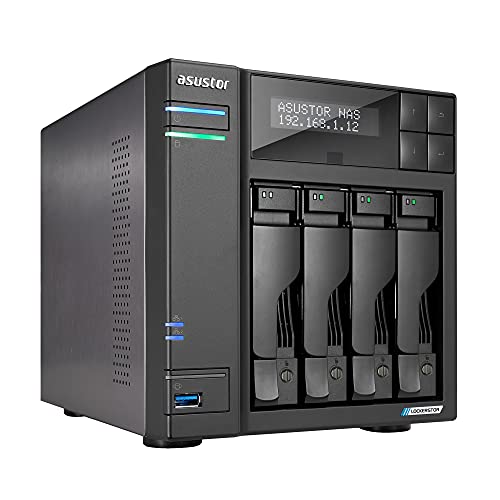
TL;DR: The Asustor AS6704T packs a quad‑core Intel Celeron, dual 2.5 GbE, four M.2 NVMe slots and four drive bays into a 7.7‑lb chassis for fast, secure home‑office and media workflows.
The standout hardware is the Intel Celeron N5105 quad‑core processor (2.0 GHz base, 2.90 GHz burst) paired with 4 GB DDR4 RAM and an 8 GB eMMC module. Dual 2.5 GbE ports deliver up to 2.5 Gbps per lane and can aggregate to 5 GbE via SMB Multichannel, while two USB 3.2 Gen 2 Type‑A ports run at 10 Gbps. Four 3.5"/2.5" SATA bays (max 88 TB raw) and four M.2 2280 NVMe slots give you massive storage flexibility.
Compared with the other seven entries, the AS6704T is heavier than the Terramaster F4‑425 Plus (6.39 lb) and the Terramaster F2‑425 Plus (4.19 lb), but it offers more drive bays than the 2‑bay QNAP TS‑216G and the 2‑bay Terramaster F2‑425. Its dual 2.5 GbE matches the Asustor AS5402T and Terramaster F4‑424 Pro, yet those models either lack the four M.2 slots or have fewer bays. While the Terramaster F4‑425 Plus provides 5 GbE ports, the AS6704T’s 2.5 GbE with aggregation still gives solid multi‑gigabit throughput without the higher power draw of a built‑in 10 GbE NIC.
Reviewers consistently praise the unit’s “speedy performance” and its ability to handle 4K transcoding, thanks to the Celeron’s burst clock and the optional NVMe cache. The front‑panel LCD and HDMI 2.0b output also make it a handy media server. On the downside, users note that installing drives needs a screwdriver and that the M.2 daughterboard occupies the PCIe slot, preventing a simple 10 GbE upgrade. The device runs at 35 W during operation and can reach 17.6 dB of noise when the disks spin, which's louder than the quieter 2‑bay QNAP model.
Pros
Cons
Best for: Value-conscious buyers seeking quality at $609.99
Avoid if: You have limited desk space or need portability
“high-performance design for intensive tasks like video editing”
“up to 590 MB/s read and 555 MB/s write speeds”
TL;DR: The Terramaster F6-424 packs six hot‑swap bays, dual 2.5 GbE ports and 283 MB/s test throughput into a 4.6‑lb chassis, ideal for power users who need fast, expandable storage.
The combination of six hot‑swap drive bays and two 2.5 GbE Ethernet ports delivers a tested data transmission speed of 283 MB/s and 4K hardware transcoding at up to 60 fps. The unit runs on an Intel N95 quad‑core processor (2.0 GHz base, 3.4 GHz burst) with 8 GB DDR5 RAM, expandable to 32 GB, and offers two M.2 2280 NVMe slots for cache or extra storage.
Compared with the other seven NAS models in this roundup, the F6-424 offers far more raw capacity—up to 144 TB with 24 TB drives—while most peers top out at far lower bay counts (e.g., the Asustor AS5402T and QNAP TS-216G each have only two bays). Its dual 2.5 GbE ports match the Terramaster F4-424 Pro and Asustor AS5402T, but exceed the single‑port setups of the Terramaster F2‑425 and QNAP TS‑216G. At 4.6 pounds, it's slightly heavier than the F4‑424 Pro (4.2 lb) and the Asustor AS5402T (4.4 lb), yet far lighter than the Asustor AS6704T (7.7 lb). The 22.0 dB(A) noise level is a bit louder than the 20.0 dB(A) reported for the Terramaster F2‑425 Plus, but it's still quiet enough for most home or office environments.
Reviewers praise the easy, tool‑free drive installation and smooth 4K Plex playback, noting the high‑speed Ethernet makes large file transfers feel swift. However, several users mention the default 8 GB of RAM can bottleneck heavy multi‑user or virtualization workloads, and the RAID configuration UI feels less polished than some competitors, leading to a steeper learning curve for newcomers.
Pros
Cons
Best for: Small‑to‑medium businesses and advanced home users who need high‑speed 2.5 GbE networking, extensive storage capacity, and 4K media transcoding.
Avoid if: You require a compact form factor, a highly polished UI, or out‑of‑the‑box heavy virtualization without upgrading RAM.
TL;DR: The QNAP TS‑216G is a compact 2‑bay NAS with 2.5 GbE, 4 GB DDR4 RAM and a 2.0 GHz quad‑core ARM CPU, delivering solid performance at a budget‑friendly $269 price.
The TS‑216G packs a 2.5 GbE port alongside a standard 1 GbE link, letting you exceed typical 1 GbE speeds when your network supports it. Under the hood sits an ARM Cortex‑A55 quad‑core processor clocked at 2.0 GHz and 4 GB DDR4 RAM that’s fixed but sufficient for QTS 5.2.8 tasks such as media streaming and file backup. Its two 3.5‑inch bays can hold up to 38.6 TB of raw capacity (44 TB with 22 TB drives), and the unit draws a typical 13.907 W while operating, with a 48 W minimum adapter rating for the power supply.
At 3.196702799 pounds, the QNAP's heavier than the Terramaster F2‑425 (2.866009406 pounds) but lighter than most of the other contenders, which range from roughly 4.2 pounds up to over 7 pounds. Its single 2.5 GbE port offers fewer connections than rivals that provide dual 2.5 GbE or 5 GbE ports, so you won’t get the same link‑aggregation bandwidth out‑of‑the‑box. On the price side, the TS‑216G lands well below many peers, making it one of the most affordable options in this eight‑product set.
Everyday owners praise the device for its quiet operation, straightforward QTS setup and reliable streaming of home media libraries. Professional reviewers call out the “excellent performance for its price tier” and note the built‑in NPU that accelerates AI‑driven tasks. The main trade‑offs users mention are the lack of an HDMI output for direct video playback, the absence of M.2 SSD slots for cache, and the non‑expandable 4 GB RAM, which can limit heavy multitasking.
Pros
Cons
Best for: Shoppers on a tight budget who want the most for their money
Avoid if: You need advanced features or professional‑grade performance
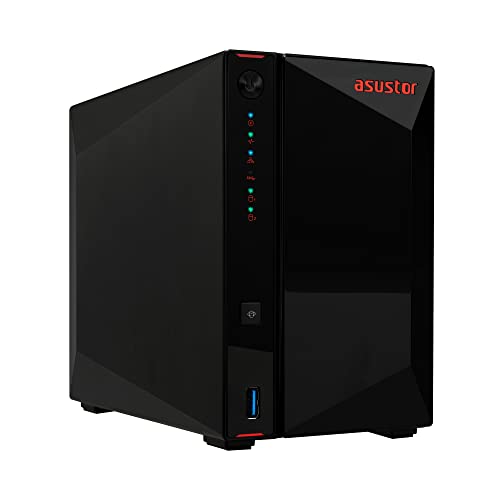
TL;DR: The Asustor AS5402T packs dual 2.5 GbE ports, four PCIe Gen3 M.2 slots, and up to 48 TB storage in a compact 70 mm, 4.4‑lb chassis, delivering fast 222 MB/s read speeds.
This two‑bay NAS stands out with 2.5 GbE networking on each of its two LAN ports and a 5 Gbps link‑aggregation ceiling, letting you hit 222 MB/s read and 245 MB/s write over the network. Its four PCIe Gen3 M.2 NVMe slots give plenty of room for SSD caching, and you can expand the pre‑installed 4 GB DDR4 RAM to 16 GB.
Compared with the Terramaster F2‑425, the AS5402T is noticeably heavier, but it runs quieter than the Terramaster F2‑425 Plus thanks to its 18.6 dB noise level versus the Plus’s 20.0 dB. Its 70 mm fan is also smaller than the Plus’s 80 mm fan, which some users note as a trade‑off for the lower acoustic footprint.
Users consistently praise the device for rapid 4K streaming, swift backup transfers, and the useful AiMaster mobile app. Professional reviewers highlight the strong performance and the HDMI 2.0b output for direct media playback. Common complaints revolve around the lack of native RAID 5/6 on a two‑bay setup, the reliance on Cat 5e cables for full 2.5 GbE performance, and the fact that the unit ships diskless.
Pros
Cons
Best for: Content creators and power users who need fast local storage and great expandability.
Avoid if: You require built‑in RAID 5/6 or an all‑in‑one unit with pre‑installed drives.
TL;DR: The Terramaster F4-425 Plus packs a quad‑core Intel N150, 16 GB DDR5 RAM and dual 5 GbE ports into a 4‑bay chassis, but its premium $649.99 price and dated UI may deter budget‑focused buyers.
What really stands out is the Intel N150 quad‑core processor (1.0 GHz base, up to 3.6 GHz burst) paired with 16 GB DDR5 4800 MT/s memory that you can expand to 32 GB. Combined with three M.2 2280 PCIe 3.0 x1 slots and four hot‑swappable SATA bays, the unit can hold up to 144 TB of total storage while still delivering up to 1020 MB/s network throughput through its dual 5 GbE ports.
At 6.393405598 pounds, the F4-425 Plus is heavier than most of its rivals – only the Asustor AS6704T tops it in weight. Its price of $649.99 also sits above the majority of the eight‑product lineup, making it a premium‑tier choice. The dual 5 GbE ports outpace the 2.5 GbE connections found in devices like the Asustor AS5402T and QNAP TS-216G, and only the Terramaster F2-425 Plus matches its Ethernet speed. With four drive bays, it offers more raw capacity than the 2‑bay models such as the Asustor AS5402T and QNAP TS‑216G.
Users consistently note the silent operation – the fan runs at 20.9 dB(A) idle and 33–43 dB(A) under load – and appreciate the solid 16 GB of RAM for Docker containers or VMs. Professional reviewers highlight the CPU’s efficiency and the fast link aggregation, while also pointing out the clunky TOS interface and the HDMI port limits you to terminal access only. Power users frequently cite the lack of a native 10 GbE or Thunderbolt connection and the single‑lane PCIe 3.0 NVMe slots as pain points.
Pros
Cons
Best for: Those prioritizing quality and willing to pay for premium performance
Avoid if: You're shopping on a tight budget — it's priced at $649.99
“Silent and cool under load”
“16GB DDR5 is a game-changer for Docker and VMs”
TL;DR: The Terramaster F2-425 Plus packs 8 GB DDR5, three M.2 NVMe slots and dual 5 GbE ports into a quiet 4.188782978‑pound chassis for fast home‑media and small‑business file sharing.
What really sets this unit apart is the trio of M.2 NVMe 2280 slots, letting you add up to three high‑speed SSDs for caching or an all‑flash configuration while still offering two hot‑swap SATA bays. Coupled with two 5 GbE RJ45 ports that can be aggregated for up to 1,020 MB/s of network throughput, the F2-425 Plus can move large files far quicker than many rivals that stop at 2.5 GbE.
Compared with the Asustor AS5402T, which only provides 2.5 GbE ports, the Terramaster’s 5 GbE links are noticeably faster. It also carries more RAM than the base Terramaster F2-425 (8 GB vs 4 GB) and the QNAP TS‑216G (4 GB). The F4‑425 Plus shares the same dual‑5 GbE setup but is heavier at 6.393405598 pounds and larger in width, while the Asustor AS6704T, though similarly equipped with two Ethernet ports, weighs 7.71617917 pounds—considerably heftier than the 4.188782978‑pound F2‑425 Plus. The F6‑424 and F4‑424 Pro both use 2.5 GbE, making the Terramaster’s 5 GbE a clear performance edge.
Users consistently praise the quiet operation—registering just 20.0 dB(A) with an 80 mm smart fan—and the straightforward setup lets you plug in drives and start sharing right away. Professional reviewers highlight the HDMI output that can decode 4K @ 60 FPS and even 8K video, turning the NAS into a media player without a PC. The downside most mention is the modest app ecosystem of 57 TOS apps, which feels limited next to the richer libraries of competing platforms.
Under the hood sits an Intel N150 quad‑core processor that bursts to 3.6 GHz, paired with 8 GB DDR5 memory that can be expanded to 32 GB via a single SODIMM slot. The unit draws power from a 48 W external adapter and measures 219 mm × 150 mm × 122 mm, making it compact enough for a home office shelf while still supporting up to 88 TB of total storage (two 30 TB HDDs plus three 8 TB NVMe SSDs).
Pros
Cons
Best for: Home media enthusiasts who need 4K/8K playback and small businesses that require fast file sharing over high‑speed Ethernet.
Avoid if: You rely heavily on a large third‑party app ecosystem or need professional‑grade performance and expansion options.
TL;DR: The Terramaster F2-425 packs a 2.9 GHz Intel Celeron, 2.5 GbE networking and 4K hardware transcoding into a 2‑bay, 2.866009406‑pound chassis for under $300.
What really stands out is the combination of a quad‑core Intel Celeron N5095 that can burst to 2.9 GHz and a dedicated 2.5 GbE Ethernet port, enabling smooth 4K (4096×2160) streaming at up to 60 FPS. The unit also supports up to 60 TB of storage across two hot‑swap bays and comes with 4 GB DDR4 RAM that you can expand to 16 GB in a single slot. An 80 mm cooling fan keeps temperatures in check while the standby noise sits between 19–21 dB(A), so it stays quiet in a home office.
At 2.866009406 pounds, the F2-425 is the lightest NAS among the eight contenders. The QNAP TS‑216G tips the scales at 3.196702799 pounds, while the Asustor AS6704T and Terramaster F4‑425 Plus weigh 7.71617917 pounds and 6.393405598 pounds respectively. However, it offers only a single 2.5 GbE port, whereas the Asustor AS5402T and several Terramaster models provide two 2.5 GbE ports for link aggregation or failover. RAM is also limited to one slot, unlike the Asustor AS5402T which has two slots and the Terramaster F2‑425 Plus that ships with 8 GB DDR5.
Users consistently praise the F2‑425 for its effortless 4K Plex or Jellyfin streaming and its tool‑free push‑lock drive trays that make swapping disks a breeze. Professional reviewers highlight the fast hardware transcoding and the ability to run Docker containers such as Pi‑hole. On the flip side, users describe the TOS interface as having a steep learning curve, and reviewers criticize the all‑plastic chassis for feeling cheap compared with metal‑framed rivals. Reviewers note the lack of an M.2 NVMe cache slot as a missed opportunity for those who want ultra‑fast tiered storage.
Pros
Cons
Best for: Entry-level buyers or those on a tight budget
Avoid if: Reliability and user satisfaction are your top concerns
Breakdown
Terramaster F4-424 Pro
Pros
Cons
Asustor AS6704T
Pros
Terramaster F6-424
Pros
Cons
QNAP TS-216G 2-bay
Pros
Based on scoring data and product specs
Personalized picks
Best Overall Pick
Terramaster F4-424 Pro
Best OverallBest for: Audiophiles and enthusiasts seeking premium sound quality and advanced features
Asustor AS6704T
Best for: Value-conscious buyers seeking quality at $609.99
$648.99-$211.00 vs winner
Skip Terramaster F2-425 if…
Reliability and user satisfaction are your top concerns
We crown the Terramaster F4‑424 Pro as the clear winner. It ships with two 2.5 GbE ports, a measured linear transfer speed of 283 MB/s, and an 8‑core Intel Core i3‑N305 processor that keeps heavy workloads smooth. Add to that a 32 GB DDR5 memory slot, four drive bays that can hold up to 88 TB, and a solid 2‑year warranty, and you get the highest‑speed Ethernet NAS in the lineup.
The Asustor AS6704T lands as the runner‑up, ideal if you need a unit with a built‑in 2.5‑inch LCD front panel and room for future upgrades. Its PCIe 3.0 expansion slot lets you add a 10 GbE NIC or NVMe SSD, while the dual 2.5 GbE ports and quad‑core Intel Celeron N5105 CPU deliver reliable performance for mixed‑media environments.
Choose the Terramaster F4‑424 Pro today and secure the fastest Ethernet‑ready storage for your cloud workflow.
The Terramaster F4-424 Pro offers four hot‑swap bays, two 2.5 GbE ports with link‑aggregation support, and a powerful Intel Core i3‑N305 processor, making it a solid choice for a small office that wants fast, reliable storage.
Please sign in to leave a review
No reviews yet. Be the first to review!
